• Film review: “Jackie” (2016)

    “Jackie” (2016)

    Drama

    3-stars

    Running Time: 99 minutes

    Directed by: Pablo Larraín

    Featuring: Natalie Portman, Peter Sarsgaard, Greta Gerwig, Billy Crudup and John Hurt

    Jacqueline Kennedy: “I’m not the First Lady anymore. I lost Jack somewhere. I was real, that was performance.”

    So much has been written and filmed about ‘Camelot’ and the Kennedys that “Jackie” (2016) isn’t the first and surely will not be the last project about the JFK and his wife, Jacqueline. This film alone has gone through a number of iterations including once being attached to Darren Arynofsky as director, although he now serves as producer, and this is how Oscar winner Natalie Portman comes to it in the title role, as Jacqueline Kennedy.

    The film follows Jackie Kennedy in her final days as First Lady in the White House and her life following the assassination of her husband, President John F. Kennedy, in 1963. It focuses on Theodore H. White’s Life magazine interview with the widow at Hyannis Port, Massachusetts.

    Pablo Larraín and his cinematographer Stéphane Fontaine film Portman and the other characters in close up, providing a challenge for all the actors as well the lighting department, who have to be ready and not let up on their performances at all. It is no coincidence that Fontaine has shot two other magnificent looking films this year, “Elle” (2016) and “Captain Fantastic” (2016), and no surprise that both films are making critics top 10 lists, they are both remarkable in their own right.

    Portman’s portrayal of the title character delivers what must be the performance of her career,behind her “Black Swan” (2010) character, Nina, which won her the Oscar that year. This one, whilst based in fact, as well as some fiction, sees her not relying on physical moments, but in her eyes, her make-up and that voice. We see her nervous before the events in Dallas unfold, as well as the immediate aftermath of the assassination, the funeral arrangements and an interview with Life Magazine much later. There is also footage of a TV Special that was a tour of the White House with Jackie, we see behind and in front of the camera – the first time Jackie has been seen in public and was presented to a huge audience – there is much reference to Lincoln, who was also assassinated after some pretty major historic events.

    This isn’t a one person show and the supporting cast of Greta Gerwig, Billy Crudup and John Hurt all give great performances but it is Peter Sarsgaard as RFK, who stands out as not a caricature of the great man, which with the accent it could have been, but in at least one part you sense the loss in his soul not only for himself and his famliy, but also the country.

    The narrative and style of the film has thrown many, which is one of the reasons it has been nominated for only three Oscar’s, Natalie Portman, composer Mica Levi and costume designer Madeline Fontaine. This is definitely a mood and character piece – illustrating the break down and restoration of not only a woman as well as being representative of an entire country that had just seen their husband/President killed in front of their eyes. There is no way to tell what effect this would have on Jackie and the entire Nation – the times they were changing.

    Larraín who has directed many films including the excellent “Tony Manero” (2008) and “No” (2012) both period pieces which reflect different political climates in times when there was much unrest. All three films also deal with celebrity as well as what it means to be popular and where the public and private personas begin and end. With “Jackie” you are witnessing the end of one story and the beginning of another – Jackie the character is finding it hard to move from one life to another something Portman shows in an all too realistic way.

    Mica Levi who also composed the music for the dramatic science fiction “Under the Skin” (2012) again has composed music that haunts the film in an ethereal way that while it does not cue feelings in an obvious way makes us think along with Jackie about what she is going through. The soundtrack is not overpowering but hangs within the film where we can hear it complimenting each scene with such an affection for the story that one must have the other – they are linked in such a loving way.

    The tragedy of the Kennedys has been written about for almost sixty years, and this film reminds us of a lot and what happened over such a short period of time. The strangeness of how the world must have felt, which becomes apparent when we see parallel scenes of Jackie talking about the day of the assassination while Oswald is being shot live on TV by Jack Ruby – it feels surreal and you could not make up what happens over the hour and half of the running time.

    This is a must see and one of the movies of the year, whilst another actress is being talked about in the Oscar race, I cannot help but think this is at least worthy of serious consideration as the best performance of the year.

  • DVD Review: “Jesse Stone – TV Movie Series” (2005-2015)

    Jesse Stone – TV Movie Series (2005-2015)

    Drama/Thriller

    images

    Created by: Robert B. Parker

    Series created by: Robert Harmon & Tom Selleck

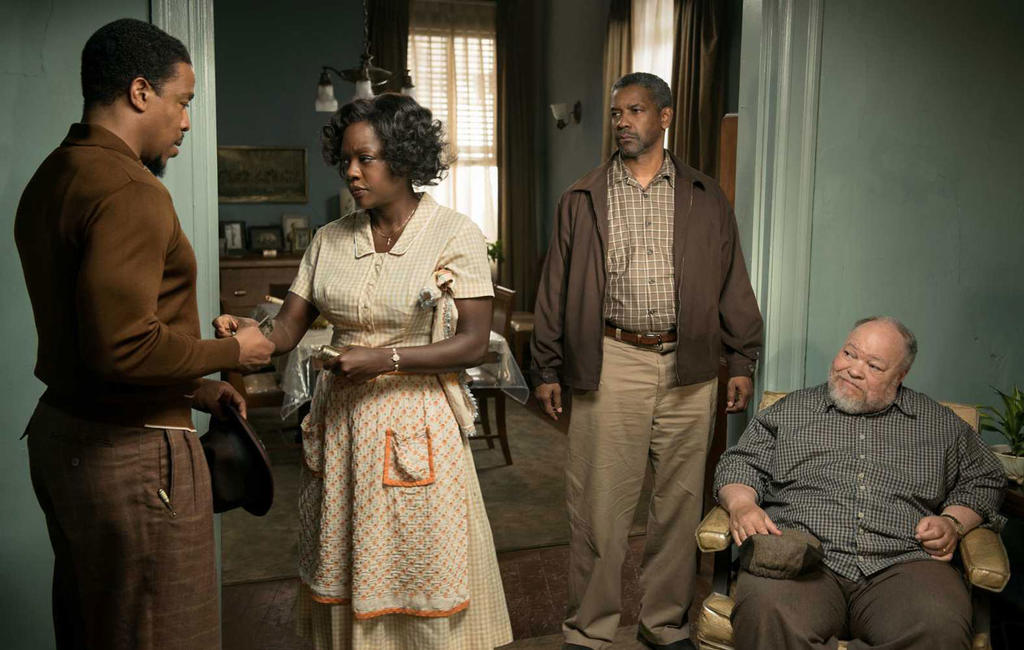
    Featuring: Tom Selleck, Kohl Sudduth, Kathy Baker, Viola Davis, Vito Rezza, Stephen McHattie, William Devane, Saul Rubinek and William Sadler

    Luther ‘Suitcase’ Simpson: “Is this official?”

    Chief Jesse Stone: “No. It’s personal.”

    Tom Selleck has had a pretty great career although you may not think that until you start looking at his filmography, he was catapulted to international stardom in the 1980s with his TV show “Magnum P.I.”(1980 – 1988), film roles followed and even now he is in the long-running “Blue Bloods” (2010 – present ). He is blessed with a great smile, a handsome face and the ability to play almost any kind of role. The ability to play deeply flawed characters was not something he was know widely for, until he started playing Jesse Stone in the TV movie adaptions of the characters created by the late author, Robert B. Parker. My personal opinion is that this is his greatest role, which very few people know about.

    This is a character piece through and through and we find Jesse Stone, at about 35 years old. He is a former minor league baseball shortstop whose career was cut short by a shoulder injury. He was asked to resign from his job as a homicide detective for the LAPD Robbery-Homicide Division because of a drinking problem that began after his divorce from his wife, Jennifer. Showing up drunk to an interview for a job as police chief for the small town of Paradise, Massachusetts, Stone is hired because the corrupt president of the town board of selectmen thinks he will be easy to control. Stone quickly notices that the town has big league crimes, struggling with the mob, white supremacists, wildly errant wives and a triple homicide, and that his job will be more difficult than he expected. But, he proves up to the task, beginning with making a corruption case against the town council president and arresting him.

    The series chronicles Stone’s cases as chief of the Paradise Police Department, as well as his struggles with alcohol and his complicated relationship with his ex-wife Jennifer. He is respected and well liked by the police officers in the town police department. He develops a good working relationship and friendship with the State Police Homicide Commander, Captain Healy.

    No man is an Island – unless your name is Jesse Stone in which case it is entirely possible. After a career spent as a cop and reaching the homicide division it is a pretty hard fall going to a small town in the middle of nowhere – where the biggest crime might be speeding or theft. This is where Stone finds himself, its no wonder he is so introspective and difficult in dealing with authority as well as having an outsized sense of justice. This sense of justice has a price and as the series moves forward you can see the toll this has on Jesse as well as those that are close to him.

    Each film is well directed but the atmosphere is helped by the fitting compositions by composer Jeff Beal, they not only haunt Jesse as the main character through whom the plot of each film flows, but they undercut each scene well – there is little manipulation added when viewing to the mise-en-scene and the outlook of the ocean, this is a soundtrack that complements the images and spoken audio well.

    The following is a breakdown of each TV film that has been produced. They have just been re-released this month and are available now from retailers. The descriptions are not full as to get the most out of the stories you really need to watch them in order and there are many spoilers that would be given away by going too deep into any synopsis. Each movie deals with Jesse Stone and his peers as well as crimes that he has to solve with assistance from those around him.

    Stone Cold (2005)

    Jesse Stone (Tom Selleck) is the police chief of Paradise, Massachusetts, a small coastal town north of Boston. A former homicide detective in Los Angeles, Jesse was fired from the LAPD because of a drinking problem that began following his divorce. He was hired for the Paradise position by the corrupt president of the town council who thought he would be easy to control. After five years, Jesse is still in contact with his ex-wife Jenn, who calls him regularly. He also has a relationship with a beautiful lawyer named Abby Taylor (Polly Shannon), who sits on the town council. Although their relationship is mainly physical, they have a genuine affection and concern for each other.

    Jesse Stone: Night Passage (2006) a prequel to Stone Cold

    This prequel follows former LAPD homicide detective Jesse Stone (Tom Selleck) driving across the country with his dog Boomer to the small coastal town of Paradise, Massachusetts, where he has been offered the position of police chief. Forced to resign from the LAPD for drinking on duty, Jesse knows that the Paradise job is his last chance.

    Meanwhile, Hastings “Hasty” Hathaway (Saul Rubinek), a wealthy banker and corrupt town council chair in Paradise, orchestrates the ‘retirement’ and a secret $50,000 payoff of the previous police chief, Lou Carson (Mike Starr), who has known about Hathaway’s money laundering operation. Carson accepts the payoff, planning to ‘throw a fishing rod in the car’ and drive off to who knows where. Hathaway offered Jesse the position thinking that he was a drunk and a loser, who could easily be manipulated.

    Jesse Stone: Death in Paradise (2006)

    Chief of police Jesse Stone (Tom Selleck) and his men investigate the death of teenage girl found floating in a lake. Officer Luther “Suitcase” Simpson (Kohl Sudduth) discovers a high school ring bearing the initials “HR”. In the coming days, Jesse is haunted by disturbing dreams about the girl’s murder. Since moving to Paradise, his private life involves drinking alone at his isolated house on the water with his dog Reggie looking on, occasionally talking on the phone with his ex-wife in California. Jesse is still in contact with his ex-wife Jenn, who calls him regularly. Concerned about his drinking, she convinces him to see psychiatrist Dr. Dix (William Devane), a former detective and recovering alcoholic himself.

    Jesse Stone: Sea Change (2007)

    Jesse (Tom Selleck) is on the phone with his ex-wife Jenn in Los Angeles, who tells him not to call her that night. She’s started seeing someone, who finds it strange that the two still talk every evening. Stone is dealing with other changes: his deputy, Luther “Suitcase” Simpson (Kohl Sudduth), is still in a coma from a head-wound he received in a supermarket robbery; his other deputy, Molly Crane, resigned from the force to have a family. Her replacement, Rose Gammon (Kathy Baker), is learning to deal with Stone, as she had once worked for his predecessor.

    Stone struggles with his drinking. A concerned neighbor, Hilda Evans (Marcia Bennett), recommends the music of Johannes Brahms as comfort during troubled times.

    Stone visits his psychiatrist, Dr. Dix (William Devane), whom he hasn’t seen in months. Stone acknowledges that he drinks more when work is slow. Dr. Dix advises him to find a way to occupy his time, and to make it important. Back at the office, Jesse has Rose pull up the unsolved homicide cases (cold cases), and chooses one to investigate: in 1992 female bank teller Rebecca Lewis was found dead and buried after having been taken hostage during a robbery.

    Jesse Stone: Thin Ice (2009)

    State Police Captain Healy is attacked but is saved by Jesse, who is able to get off a couple of shots at the unknown assailant despite also being wounded. At the hospital, Healy reveals to Jesse that he was spying on his nephew, who may be sleeping with his saxophone instructor. Jesse begins investigating the shooting despite protests from the Paradise town council. The town council member’s feel that the police department is already spread too thin, and they and Internal Affairs are concerned about six shooting incidents Jesse has been involved in.

    Jesse Stone: No Remorse (2010)

    The film begins with the shooting murder of a young man at night as he opens his car door in a parking garage. Jesse Stone who, after his suspension as chief of police, has sunk into seclusion and alcoholism. Ordered not to communicate with his former subordinates while on suspension, he has been out of touch with everyone. Eventually his colleague Rose, an officer, becomes concerned and asks Stone’s friend Captain Healy, the State Police Homicide Commander, to check in on him. Healy is recovering from gunshot wounds and supposed to be on medical leave but, as he tells Stone, he’s taking his leave at his office. Healy finds Stone disheveled, drunk, and despondent. Shortly after Healy arrives, Stone receives a phone call from his ex-wife Jenn, so Healy leaves. Jenn tells Jesse that she needs to talk because she and Elliot had a fight. Angered, Jesse tells Jenn that they shouldn’t speak anymore, and rips out the phone. Later he buys a cell phone, which Rose helps him program. He gives the number only to her and a few others. Jesse and Rose are becoming close.

    Jesse Stone: Innocents Lost (2011)

    After being replaced as the chief of police in Paradise, Massachusetts by the town council president’s son-in-law, William Butler (Jeff Geddis), Jesse Stone is still without a full-time job (though he vows to one day be reinstated). Nevertheless, he continues to find ways to pursue investigations into two separate murders: one involves a friend with whom he had lost contact, and the other has him working as a consulting investigator for the Massachusetts State Police Homicide Division on a case involving a robbery and murder suspect. Both Jesse and his friend, State Police Captain Healy (Stephen McHattie), have doubts as to the robbery/murder suspect’s guilt. His problems with his ex-wife, and drinking issues are still present.

    Jesse Stone: Benefit of the Doubt (2012)

    Jesse Stone still misses the Paradise, Massachusetts police chief position, which he lost because the current town council president, Carter Hansen (Jeremy Akerman), wanted his son-in-law, William Butler (Jeff Geddis), to have the job. A suspicious police cruiser explosion kills chief Butler and officer DeAngelo (Vito Rezza). Curiously, the former town council president, Hastings “Hasty” Hathaway (Saul Rubinek), appeared to know about the incident before the current town council president was officially notified. Jesse is reinstated as “temp chief” by Hansen and uncovers apparent (but unproved) police corruption involving Butler.

    Jesse attempts to reassemble his team, starting with his deputy Luther “Suitcase” Simpson (Kohl Sudduth) and then longtime assistant Rose Gammon (Kathy Baker), but both have moved on to other pursuits after choosing to not work with Jesse’s replacement, thus Jesse is left to solve the case himself. State Homicide Commander Healy (Stephen McHattie) also returns, along with Jesse’s psychotherapist Dr. Dix (William Devane). Thelma Gleffey (Gloria Reuben) also remains in Jesse’s life, and continues to work as a sales associate at Hasty’s luxury car dealership.

    Jesse Stone: Lost in Paradise (2015)

    Police Chief Jesse Stone (Tom Selleck) accepts a position as an unpaid consultant with the Massachusetts State Police, working for Lt. Sydney Greenstreet (Leslie Hope) who gives him case files on several murders. After reviewing the files, Stone takes special interest in one case that involves the fourth victim of a brutal serial killer who slashed and disemboweled his victims while they were still alive. The jailed killer, a man named Richard and known as the “Boston Ripper” (Luke Perry), admits to the first three murders with pride, but maintains he did not commit the fourth murder. After interviewing the killer, Stone concludes that he’s a “sick son of a bitch”, but does not believe he killed the fourth victim, Mavis Davies.

  • Film review: “Manchester by the Sea” (2017)

    “Manchester by the Sea” (2017)

    5stars_small

    Drama

    Running Time: 137 minutes

    Directed by: Kenneth Lonergan

    Featuring: Casey Affleck, Michelle Williams, Kyle Chandler, Gretchen Mol, and Lucas Hedges

    Randi Chandler: “I said a lot of terrible things to you. My heart was broken, and I know yours is broken, too.”

    The third film written and directed by Kenneth Lonergan (after “You can count on me” (2000) and “Margaret (2011)) finally arrives in New Zealand after making the festival rounds as we as a successful wide release in the US, it is well worth the wait. “Manchester by the Sea” (2017) has been nominated or won numerous awards over the past few months so has been a success in anyone’s books, this reviewer is not going against the grain. It is a wholly original work both in front and behind the camera – this is a film that tops off 2016 as a year that has ended up being pretty good, film wise anyway.

    The film sees Lee Chandler (Casey Affleck), a quiet and reserved janitor in Quincy, Massachusetts, who has his share of stress. One morning he receives a message from George (C.J. Wilson) , a family friend, that his brother Joe (Kyle Chandler) has had a heart attack. Joe dies before Lee can reach the hospital.

    Lee goes to his hometown of Manchester-by-the-Sea to break the news to Joe’s son Patrick (Lucas Hedges). Staying in Joe’s home while arranging Joe’s funeral and looking after Patrick temporarily, he is shocked to learn that Joe named him as Patrick’s guardian. To accept this role, Lee would be required to move permanently to Manchester, but he is tortured by memories of the death of his children in a fire he inadvertently caused, his subsequent suicide attempt, and his eventual divorce from his wife Randi (Michelle Williams)

    The big themes in “Manchester by the Sea” (2017) are loss and the redemptive power of love, and living your life for someone else – accepting responsibility when you don’t really want it. Casey Affleck brings these thoughts and emotions to the screen with a commitment not often seen on the screen, and not for the amount of time he must have spent in a very dark place. It is an honor to Lonergan’s script that Affleck is able to deliver a performance that many people can relate to – this is not just a white man’s film but a film that could reflect many cultures in the world today – all you need to have experienced is loss.

    Lonergan made his name in writing stage plays and that is how he and Affleck first became aware of each other – Affleck appeared onstage in one of Lonergan’s plays – and why Affleck was considered for this role – they have wanted to work together onscreen for years. This, it turns out was an excellent film for them to team up on, as it offers so much in terms of performance, themes and story.

    The film like others of its kind let us in on a family’s personal life, the problems and adversities they face in everyday life as well as once in a life time losses. The movie reveals some whoppers and Lee is at the center of all of them, even his brother’s diagnosis and ultimate death. The plot of the film is fairly simple, but the tragedy is all too cruel and unusual. The narrative on the other hand splits the film in two, as the present moves ahead so to do the flashback scenes, offering us glimpses into Lee’s life before he left Manchester-by-the-sea, it is not a unique storytelling device but the way in which it is used is, coupled with the extremely beautiful way it is shot leaves a lasting impression.

    I had heard that the film was described as dark and depressing but I can assure you that whilst the film has its dark patches there is, like life, humour to be had in a naturalistic way.

    The standout scene is when Lee is read the will of his brother, the flashback scene that is contained within that segment is one of the most heartbreaking and well-constructed scenes of the year. The aftermath is draining and senseless.

    Lonergan uses the geography and some classical music to convey the loneliness, anger and powerless Lee feels when he returns home and while he is there as the realization that he may not leave again.

    This is a beautiful film that will not easily leave you once viewed, and it should be seen in the cinema, it is a film that has been made with an artist’s eye and deserves to be seen. For me Casey Affleck’s performance is the star of not only this movie but of the year.

  • Film review: “Silence” (2017)

    “Silence” (2017)

    Historical Drama

    images

    Running Time: 161 minutes

    Directed by: Martin Scorsese

    Featuring: Andrew Garfield, Adam Driver, Liam Neeson, Tadanobu Asano and Ciarán Hinds

    Ferreira: “I do because you are just like me. You see Jesus in Gethsemane and believe your trial is the same as His. Those five in the pit are suffering too, just like Jesus, but they don’t have your pride. They would never compare themselves to Jesus. Do you have the right to make them suffer? I heard the cries of suffering in this same cell. And I acted.”

    The latest Martin Scorsese film comes at a time when historical and/or religious epics are far and few between – and maybe that’s a good thing. This film follows Scorsese’s last film, the bloated and overlong “The Wolf of Wall Street” (2012), which suffered from a variety of issues, but my main one was of someone who was making films out of a duty to, and not because that’s what he wanted to do. I have long maintained that Scorsese is not the be all and end all in film, he is definitely not the greatest living filmmaker. His work this century has been plodding, muddled and unremarkable. The films he has produced have been adaptions, remakes and historical documents that end up being compromised in some way. Now after a break comes “Silence” (2016) which is something of a return to form.

    The film concerns itself with Portuguese Jesuit priest Alessandro Valignano who receives news that Father Cristóvão Ferreira, his mentor, in Japan has renounced his faith after being tortured. Ferreira’s pupils, Father Sebastião Rodrigues and Father Francisco Garupe, disbelieving he would commit such apostasy, set off to find him.

    Closing borders, persecuted people based on religion and culture, sound familiar? It should, it is what Martin Scorsese’s “Silence” (2017) and the current state of the US have in common. Simply a sad state of affairs that proves we are doomed to repeat history time and time again. Of course the subject matter for Scorsese is extremely personal, his background would attest to that. He is of course a deep thinker, so it is easy to see why this film would be suitable subject matter for him – his films have always been full of Christian iconography and guilt. It is a testament to his power and authority in Hollywood that he was able to get this made at all, it is one of the finest protest movies I have ever seen – it is very difficult to view this without thinking about the world in general and the kinds of racist rhetoric going on at the moment.

    Although there is a lot of voice over (courtesy of Andrew Garfield and later a Dutch sailor) within this film, it cannot be considered a weakness, much like Terrence Malick’s “The Thin Red Line” (1998), which too was loaded with the same narrative technique, it speaks to the world that is inhabited by the central characters, the way in which they interact with the natural and un-natural world alike. This narration like the priests serve a larger purpose – even the language that they are unable to speak is a metaphor of understanding both culturally and religiously.

    In terms of Scorsese’s collaborators on “Silence”, there are three that need to be mentioned, the first is his long time friend and screenwriter Jay Cocks who co-wrote this with Scorsese – on all of the directors most personal projects Cocks has been an undeniable presence, for better or worse. In this case it is important to note that it is the contemplatory nature of the writing that is most important and they both excel at this. Secondly, Rodrigo Prieto, the cinematographer who previously worked with Scorsese on “The Wolf of Wall Street”, and here he has improved a lot, there are some challenging environments for him to shoot in and he succeeds mightily. Where would a Scorsese film be without his longtime partner, friend and editor Thelma Schoonmaker, who has worked on all his films since “Raging Bull” (1981) – maybe the longest lasting and most successful partnership in film history?

    There is not much to add to the discourse about the directing by Scorsese, but as usual there are not many master shots and everything is filmed either in close-up, two-shots or lots of camera movement. He has his own way of using actors, foreground and background and loves to have many reaction shots to stressful situations. He has become a master of representing emotional truths on screen – particularly men with which he seems to have dedicated his career to.

    The performances of Andrew Garfield and Adam Driver are excellent and you can see this film and the roles meant much to them – they immersed themselves in their parts and it shows onscreen. Garfield in terms of performance is on a roll at the moment, and it appears he enjoys working with directors and writers who have an idea of the goals of their films. Driver, as well who has become a megastar over the past year illustrates in his time onscreen why he has become so popular with independent and studio directors at the same time. He has a face that is so interesting to look at and it seems to change from film to film. However, this film was always going to live and die with the performances and casting of the Japanese actors, and here “Silence” exceeds expectations. Yôsuke Kubozuka as the alcoholic fisherman, Kichijiro, steals the show, it is a revelatory performance, and I am frankly surprised he ahs not been nominated for an Academy Award for it.

    After seeing the trailers for “Silence”, I was not impressed and prepared not to like or enjoy it, they were not very good at all, they did not really show or explain the film at all – you still have to het people to see it. I felt a little alienated by them, but boy was I wrong.

    This, in my mind is the best Martin Scorsese has produced in years, there is almost not a foot put wrong. Part of this comes from the strong sense of relevance it has, the fact that most of it is in Japanese as well as entering a completely foreign and mysterious world. I remember having the same sense of wonder watching “Goodfellas” (1990) for the first time – I was witnessing something original, but at the same time familiar.

    In case you are wondering you should definitely see this film and enjoy it for what it is, a masterpiece that we see to rarely produced in a Hollywood studio system. It offers truths about human nature as well as the power of belief, whether it is right or wrong. We see the frailty of human beings at their best as well their worst – seeking truths they may never find in this life.

  • Blu-ray Review: “The Queen of Katwe” (2016)

    “The Queen of Katwe” (2016)

    Drama

    images

    Running Time: 124 minutes

    Directed by: Mira Nair

    Featuring: David Oyelowo, Lupita Nyong’o, and Madina Nalwanga

    Robert Katende: [to Phiona] “Sometimes the place you are used to is not the place you belong. You belong where you believe you belong. Where is that for you?”

    Robert Katende: [to Phiona] “Sometimes the place you are used to is not the place you belong. You belong where you believe you belong. Where is that for you?”

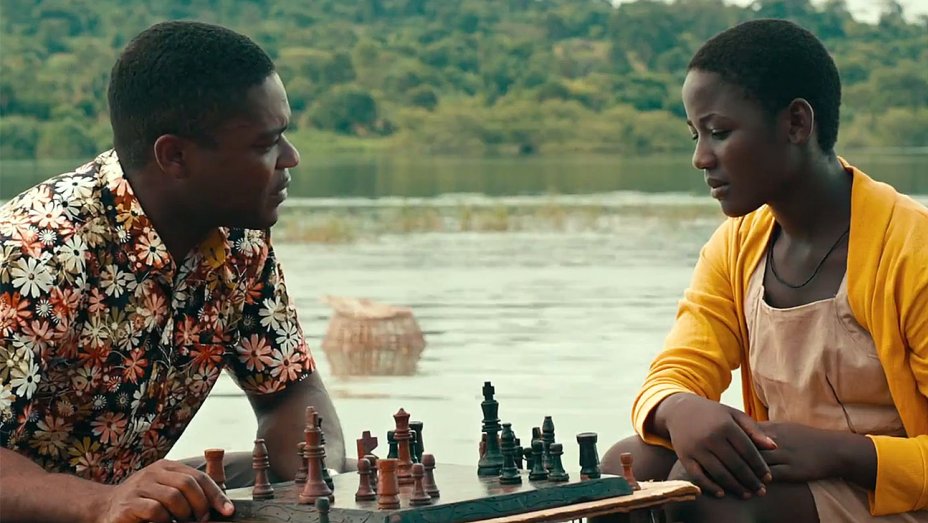
    Mira Nair, one of the most accomplished writer/directors to be working today brings the true story of Phiona a Ugandan who learns to identify herself through the art of playing chess, to the the screen in “The Queen of Katwe” (2017) an overlooked film from this years Oscar race. The Indian born and educated Mira Nair has produced and dircected some of the best films and documentaries over the past thirty years, from her stunning debut “Salaam Bombay!” (1988)

    “The Queen of Katwe” is a loving character piece about Phiona (Madina Nalwanga), a young girl living in the slum of Katwe in Kampala, Uganda with her family struggling with everyday life. Her world changes one day when she meets Robert Katende (David Oyelowo) at a missionary program. Katende coaches soccer and teaches children to play chess. Curious, Phiona approaches and learns the game. She becomes fascinated with it and soon becomes a top player under Katende’s guidance. Over several years, her success in competitions and tournaments leads to greater competitions, stress, and identity issues.

    This may sound trite but the chances and outlook one has on life should not be dictated by where you are born, but for Phiona and her family and friends this is exactly how it is. Not only that but it is heartbreaking when your own family is unable to help you succeed at anything and you must rely on the kindness of strangers. It is testament to Phiona that she was able to find her own way and make her own decisions to learn how to play competitive chess. So not only did Phiona show the requisite skill in learning and playing she became determined to be the best, which of course she is.

    Mira Nair directs “The Queen of Katwe” like she was born to do tell this story and coupled with the new star power of David Oyelowo and Lupita Nyong’o she tells a story that doesn’t rely on sorrow or pity but uses empowerment, love and kindness to show the growth of not only Phiona but her friends and family. There may have been the temptation to play on easy emotions but Nair stters us away from that and uses her actors wisely, not telegraphing the film at all.

    The cast is incredible and it may hard to believe but this is Lupita Nyong’o’s first role in a live action film since she won her Oscar two years ago – shame on Hollywood for not giving her roles to shine in – she is a real talent. This is Madina Nalwanga first film and you wouldn’t know it – she shines in every scene she is and you are unable to take your eyes off her – not an easy task considering her co-stars – she is the leader on screen and all cues are taken from her. I really hope that Madina is able to make more films, and is given that opportunity, she is a true talent.

    I, like most people am unable ti imagine what it is like to be born and raised in a country like Uganda with its history that unfortunately defines it in most peoples eyes but it is refreshing to see a story like this unfold in that country. It is easy to imagine the kind of hardships people do go through and that this would have a most adverse effect on their lives and their emotional stability may be effected by the way they live their lives. This film however lets us discover and enjoy how a real family behaves, all the ups and downs as well as the discovery of what it means to have love in your life.

    I recommend this film highly and it is one of those movies that could be re-watched at any time. On a personal level I do not understand how a film like this is not in an awards race when something as ordinary and dull like “Hacksaw Ridge” (2017) is nominated and winning awards.

    Go and buy this now! DVD and Blu-ray released on the 8th March 2017.

  • DVD review: “Operation Avalanche (2016)”

    Operation Avalanche (2016)

    Drama/Mock Documentary

    stars-2-5

    Running Time: 94 minutes

    Directed by: Matt Johnson

    Featuring: Matt Johnson, Owen Williams, Josh Boles

    I have a general weakness for found footage films, I think its that they are low budget and a throwback to the genre films that I loved since I was a child. I have found the best films are the ones that take an idea and twist it into something original – in fact the found footage aspect is just a way to tell the story in an easy low-budget way. So, the story has to be very strong for these kinds of movies to even have a chance of working. In this case I do not think that thresh hold has been reached – close but not quite.

    The movie is about two CIA agents infiltrate NASA to expose a potential mole. There, they find that NASA has kept their inability to reach the 1969 deadline for the Apollo 11 Moon landing a secret. They subsequently become involved in a plot to fake it.

    This is neither a documentary nor a mockumentary, but is not a narrative film either, as it pretends to be a found footage film – or at least something that has been edited together to feel like it was made in a cinema vérité style. What this film does is take two facts, there is a place called NASA, and, that they wanted to send people to the moon. Where it deviates and borrows (I am being kind) from other sources is the conspiracy theory (that has existed for years) that the moon landing was faked and that somehow Stanley Kubrick was involved – they have then created a chase movie around this as a narrative and plot device.

    As a recommendation I would say that this film is really not worth owning and if you see it on a streaming service and want to watch something as a distraction then this is the movie for you. I think it is decidedly average for its genre, it breaks no new ground and when boiled down there is nothing original about it. In fact a better narrative film was made in 1977, “Capricorn One” which was when conspiracy movies were everywhere, it has a great cast, even has O.J. Simpson in a good film – before he became a novelty act.

    Released 15th February 2017.

  • Blu-ray review: “The Girl on the Train” (2016)

    “The Girl on the Train” (2016)

    Thriller/Drama

    3-stars

    Running Time: 112 minutes

    Directed by: Tate Taylor

    Featuring: Emily Blunt, Rebecca Ferguson, Haley Bennett, Justin Theroux, Luke Evans, Allison Janney, Édgar Ramírez and Lisa Kudrow

    Megan: “You’re not gonna get rid of me. You’re gonna pay for this for the rest of your life.”

    This film was set up as a spiritual successor to “Gone Girl” (2014), the David Fincher adaption of the book of the same name. That film made US$370 million worldwide was nominated for an Oscar for Best Actress, Rosamund Pike, and was hailed by most critics as a success. A few years later a book is published, “The Girl on the Train” the first written by Paula Hawkins a thriller with a woman at the center – the “Gone Girl” comparisons begin. The film of the book has its weaknesses but some of them are off set by the cast led by the extremely talented Emily Blunt.

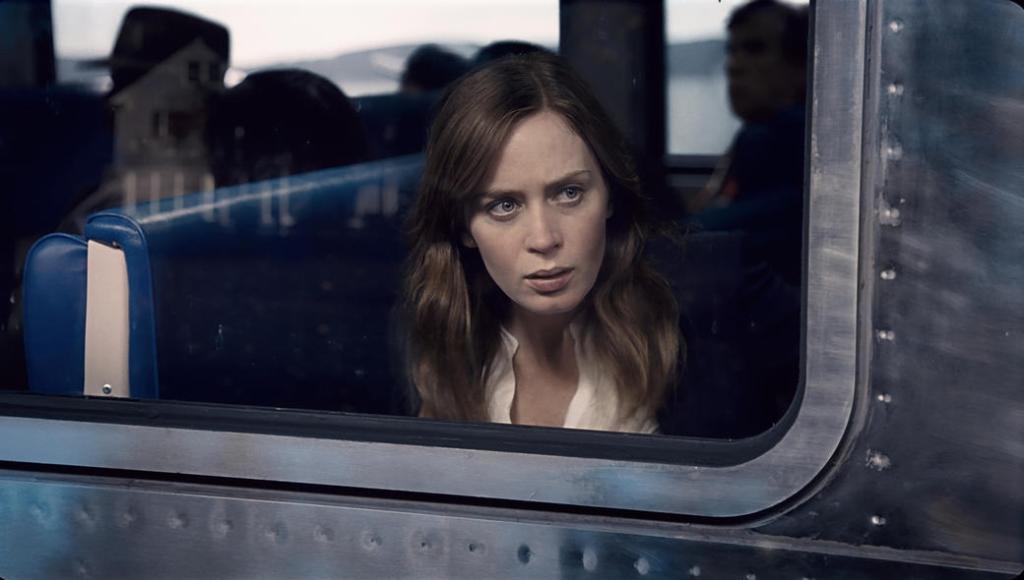
    “The Girl on the Train” is about Rachel Watson (Emily Blunt) an alcoholic, who divorced her husband, Tom Watson (Justin Theroux), after catching him cheating on her with their real estate agent, Anna Boyd (Rebecca Ferguson). During their marriage, Rachel was prone to alcohol-induced blackouts during which she engaged in self-destructive behavior that she only later learned about from Tom, and to which she attributes the ending of their marriage, in addition to her being sterile.

    Rachel spends her days commuting on a train, often stalking Tom, Anna, and their newborn daughter Evie. During her trips, Rachel grows fascinated with Tom’s neighbors, Scott (Luke Evans) and Megan Hipwell (Haley Bennett), a young couple in what Rachel believes is a perfect marriage. In reality, Scott is aggressive and controlling, while Megan is detached, prone to dishonesty and sex addiction, which we learn through her therapy sessions with her psychiatrist, Dr. Kamal Abdic (Édgar Ramírez).

    After a drinking binge, Rachel leaves the train to confront Megan, only to black out and awaken hours later at her apartment, injured. Rachel later finds out that Megan is missing and presumed dead, and is questioned by Detective Sergeant Riley (Allison Janney).

    The film is a nourish thriller that takes its cue from not one but possibly more unreliable narrators. It also at times can be very hard to follow as the plot and narrative are completely mixed up to be at some points nonsensical. It does not stay that way the entire film but that type of storytelling can be tiring as an audience member. Also it does not help that almost every character in the story is completely unlikeable – even the protagonist of the story, Rachel, who spends most of the running time in a funk as well as relieving the worst moments of her life in flashback.

    I am not going to say what twists there are, but of course it would not be a thriller if the plot was straight forward, and it isn’t – it may have served the narrative more if there was more of an even split with the plot and then by the time any reveal has happened the viewer might not be completely sick of the story itself – I found myself at some points wishing the film was over already!

    Now this may sound like a completely negative review and a complete turn off – but there is some good news in that I have watched the movie twice and I enjoyed it much more on the second watch. I put this down to the performances and knowing where the film is heading – I had much more compassion for the characters I should have compassion for in the first place, and this helped immensely.

    The director, Tate Taylor who directed both “The Help” (2011) and “Get On Up” (2014), which are pretty much straight forward dramas (no offence) struggles with this genre and that is not his fault, as it is a big step going from a formulaic plot and narrative to one that has to be coherent as well as keeping an audience on their toes.

    I would recommend this DVD/Blu-ray to anyone that enjoyed the book to see what changes were made in the adaptation as well as anyone that enjoys re-watching thrillers. The lead actress Emily Blunt is excellent as usual and garnered a BAFTA nomination for her role – that is worth seeing alone.

  • DVD Review: “A Hologram for the King” (2016)

    “A Hologram for the King” (2016)

    Drama/Comedy

    3-stars

    “A Hologram for a King” (2016)

    Running Time: 97 minutes

    Directed by: Tom Tykwer

    Featuring: Tom Hanks, Sidse Babett Knudsen, Tom Skerritt and Sarita Choudhury

    Alan Clay: “You may find yourself living in your garden shack, and you may find yourself looking for your large automobile. And you may find yourself without a beautiful house, without a beautiful wife, and you may ask yourself, “Well, how did I get here?””

    Its so refreshing seeing people work together time and again, particularly in Hollywood  where profit seems to drive most decisions made. In this case after the big budget disappointment of “Cloud Atlas” (2012) – which I really enjoyed, and is worth a watch – Tom Hanks and German Director Tom Tykwer find themselves together adapting a novel by Dave Eggers. This is quite a wonderful film. Hank’s has had an up and down year with the great “Sully” (2016) and the very disappointing “Inferno” (2016) – this movie falls in between the two, although heading in the direction of the former film.

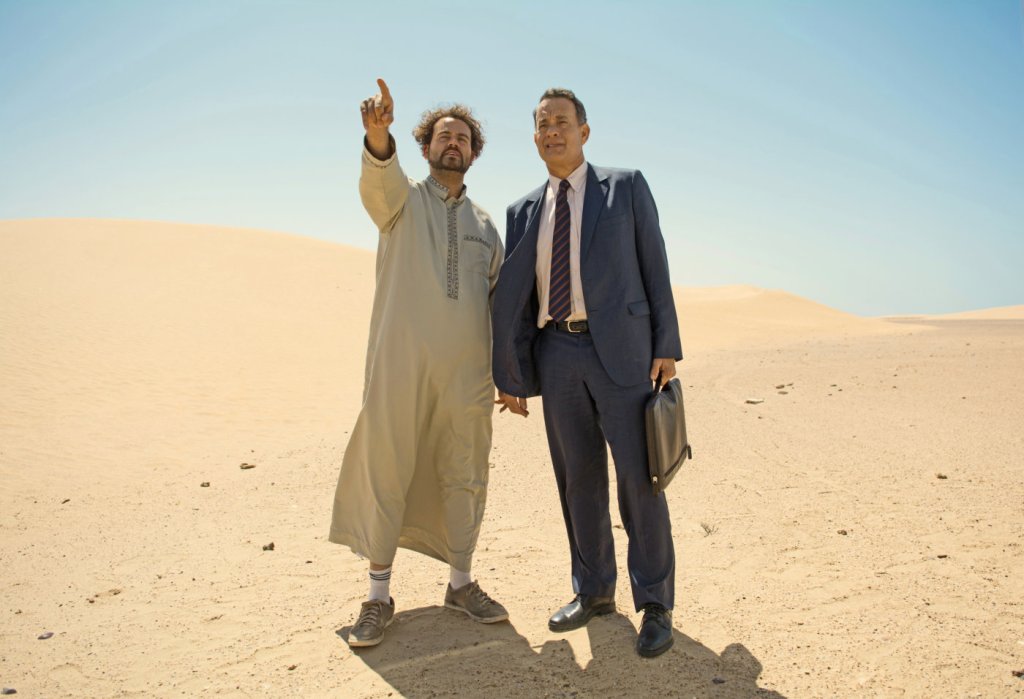
    The film tells the story of a washed-up, desperate American salesman who travels to Saudi Arabia to sell a holographic teleconferencing system to the Saudi government. Set in 2010, before the Arab Spring, American consultant Alan Clay is depressed after losing his house and being divorced by his wife during the Great Recession; he arrives in Jeddah, Saudi Arabia to make a sale in an upcoming development called the King’s Metropolis of Economy and Trade (a fictionalized version of King Abdullah Economic City).

    This movie on the surface may seem like just a fish out of water story or even a clash of cultures, but it is so much more than that. It is a reflection on the world today and illustrates the differences of thinking from one culture to another. In this case most films like this may place the protagonist in a Western Culture, but the big difference here is that Alan (Hanks) is placed in the Middle East, in Saudi Arabia, which in reality is actually a mix of East meets West.

    The character of Alan is of course a reflection of middle age angst coupled with the feeling that the middle class of the US feels helpless when confronted with decreasing power of authority in their own lives with the inability to make enough to pay for things that for them, and their parents felt like a right, and not an extra. Things such as a house, car and education are not items people are used to not having, especially on our consumerist society.

    Alan, faced with being required to see technology in a country that currently has more money than sense, suddenly, is faced with opulence and waste the likes of which he has never imagined – when the reality of paying for his daughter’s education is looming over him, as well as a messy divorce. In this country not only does he face his own mortality he finds himself being looked after and looked out for in ways he did not foresee.

    I wont go into too much detail about the plot but the narrative is pretty straightforward and directed by Tykwer who by now is a reliable director and he has a love for the subject. Hanks, yet again delivers a performance with seeming ease although he still brings such originality to all his roles.

    I really loved this film and recommend it highly – it is a drama with a dash of loving himour. I wish more people would see this and I wish more films were made like this.

    DVD out now!

  • Blu-ray Review: “Snowden” (2016)

    “Snowden” (2016)

    Drama

    images

    Running Time: 134 minutes

    Directed by: Oliver Stone

    Featuring: Joseph Gordon-Levitt, Shailene Woodley, Melissa Leo, Zachary Quinto, Tom Wilkinson, Scott Eastwood, Logan Marshall-Green, Timothy Olyphant, Ben Schnetzer, LaKeith Lee Stanfield, Rhys Ifans and Nicolas Cage

    Edward Snowden: “So, this is data collection for the month of March worldwide, emails and Skype calls. So France, 70 million. Germany, 500 million. Brazil, two billion. Inside the U.S., 3.1 billion emails and calls. That’s not including any of the telecom company data.”

    NSA Dep. Director Lowell: “Okay, so what’s the collection in Russia?”

    Edward Snowden: “Russia is 1.5 billion.”

    NSA Dep. Director Lowell: “Wait, so we’re collecting twice as much in the U.S. as we are in Russia?”

    Ed Snowden remains a hot topic in the US and rightly so, the most high profile whistle blower in history is sought by his government for charges under the Espionage Act – there is no politician around that will call him what he is – a patriot, who should be celebrated for putting his country first and successive governments second. Oliver Stones latest film is perhaps his best in years, for many reasons, this is deeply personal to him, it fits in with his politics and he seems to have been given free reign to tell a unique story about a unique man in a very unique situation.

    The film begins in 2013, when Edward Snowden arranges a clandestine meet in Hong Kong with documentarian Laura Poitras and journalist Glenn Greenwald. They discuss releasing the classified information in the former’s possession regarding illegal mass surveillance conducted by the National Security Agency (NSA).

    With the help of journalist Ewen MacAskill, the information is disseminated to the press on June 5, 2013, with additional leaks published in the following days. In the aftermath, with the help of MacAskill, Greenwald and Poitras, Snowden is smuggled out of Hong Kong on a flight bound for Latin America by way of Russia. However, the U.S. Government revokes his passport, forcing him to remain in Moscow indefinitely.

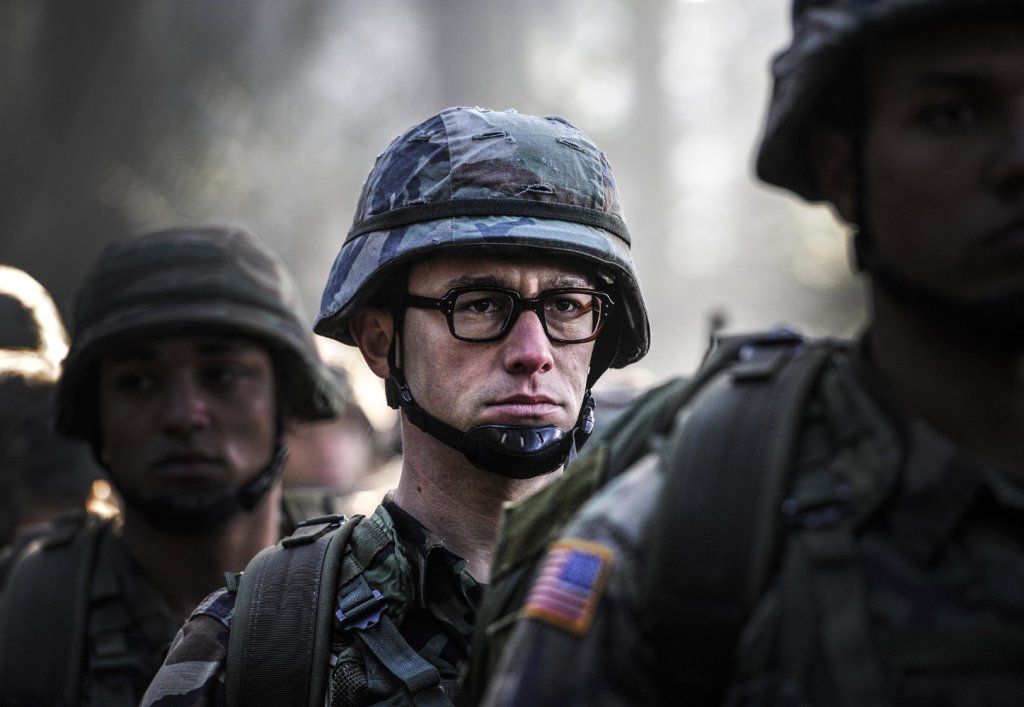
    Stone, wisely sticks his plot and narrative to a set period, that being the time Snowden was training in the military in 2005 to an interview he gave online in 2015. This is a very smart move as it shows Snowden’s love for his country and what he was willing to do to assist in the fight against terrorism in light of 9/11. It becomes apparent to him that he will need to help the fight in another way and joins the CIA – although not the done deal you would think. For a large part of the film Snowden is someone who drinks the Kool-Aid and believes in what he is being told but the longer he stays at the CIA the faster he becomes disillusioned with what his own government is doing to its people – it is a great dawning that Stone was born to show.

    The film is anchored by the performance of Joseph Gordon-Levitt as the central character who inhabits the role in every way he can, including a voice-inflected tone that is reminiscent of Snowden himself. Gordon-Levitt has shown over the past few years he is capable of appearing in blockbuster films and smaller more personal and lesser budgeted features, this film seems to be a perfect mix of a character drama as well as a grand ambitious piece that illustrates a steady resolve.

    This is a fully realized film driven by Oliver Stone and it’s his best since “Any Given Sunday” (1999), which at the time topped of a decade of great films by the director. However, since that film his output has been steady, but a little patchy. My feeling is he was making movies he thought people wanted to see from him and he paid the price with very mediocre projects. “Snowden” is what Stone does best, take something very real and offer his own opinions, while producing a story for the ages, one that is still very popular and offers surprise after surprise. The subject of the film is still quite a popular figure unlike Julian Assange the only other person that compares who seems to be more interested in creating havoc and destroying the credibility of governments.

    This is highly recommended viewing especially now around awards time when this is a film that reveals what governments can do and are doing. In this new political environment and with all the vitriol aimed at the Republicans and Trump it’s not a huge leap to think that this will continue and could be stepped up with new technology. I personally would have liked to see this film in contention at the Oscars, particularly in the place of “Hacksaw Ridge” (2016) as this is more in the moment than that film.

    Released on DVD and Blu-ray 1st February 2017.

  • DVD Review: “The Bronze” (2015)

    “The Bronze” (2015)

    images

    Comedy

    Running Time: 100 minutes

    Directed by: Bryan Buckley

    Featuring: Melissa Rauch, Gary Cole, Thomas Middleditch, Sebastian Stan, Cecily Strong, Haley Lu Richardson and Dale Raoul

    Hope: “Throughout history, those who are truly great, have stepped up. Just like all of you. You give me a smile or a wave. Or sometimes you break the celebrity boundary and come up to me, tell me about where you were on the day I made this country proud. There is a reason I call this town my home. ‘Cause you fuckers remind me of who I am. And who I can be. I am… Coach Hope.”

    Living in the past is something we all do to a point; we relive good times and bad times. Sometimes this can be a great reminder of great accomplishments, it can also be a lesson to learn from for us to move forward with our lives. “The Bronze” is a film that was released in 2015 and premiered at Sundance to great acclaim, and while on the surface this seems to be a crude and rude comedy, it is much more than that. While watching the film I wondered if it was ahead of its time by a few years, and in this post election world it may have been much more successful. With someone who not only lives in the past but lives in an imagined reality much like Trump.

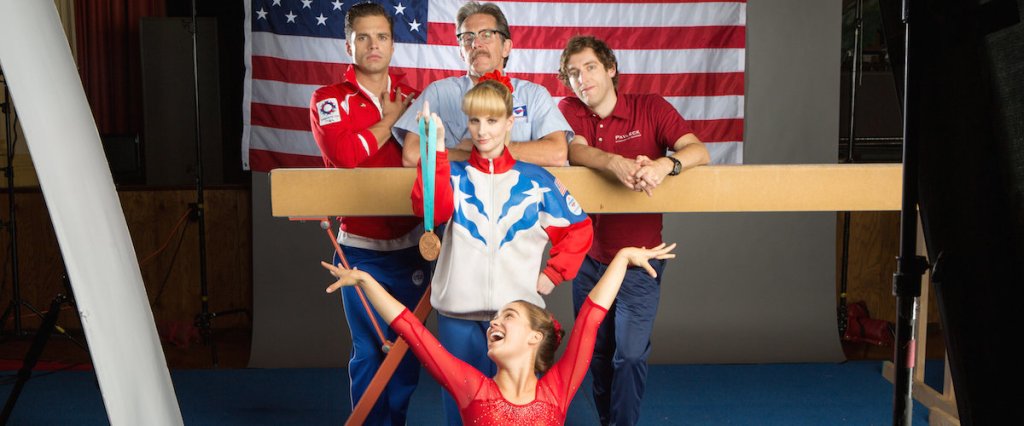
    The film revolves around former gymnastics Bronze Medalist Hope Ann Greggory (Melissa Rauch) who has been living off her celebrity status in her hometown of Amherst, Ohio, although she is reduced to going through the mail her mailman father delivers for spending money. When her former coach Pavleck (Christine Abrahamsen) suddenly commits suicide, a letter arrives addressed to Hope stating that if she can guide Pavleck’s best student, a young gymnastics star named Maggie Townsend (Haley Lu Richardson) to the Olympics in Toronto, she will receive a $500,000 inheritance. From here the film kicks it up a gear and I won’t say to much more as its best left as a surprise.

    Melissa Rauch, who starts and co-wrote the film along with her husband and director Bryan Buckley brings to life a truly original character who not only lives in the past, in this case 2004, a time when she was a winner and at the top of her game, but also seems to enjoy torturing others. She has a unique outlook on life that rubs many people in her life the wrong way, but they all seem to enable her – except for her father, kind of. Rauch is in a star making role, that many people have not seen, which is a shame because it is as good a comedy role as has been seen in years.

    The film represents the US in the worst and best possible light, as Hope representing America, lives in a past that actually was not all the great, and with others lying to her she is unable to face the past and live up to a new future. It is not until she finds a new lease on life (hope if you will) that she is able to start to become a fully realized adult – as much as Hope can be. She uses what she has and twists it to make herself a future in her hometown and let people in so she can forge new relationships.

    As well as Rauch the cast includes the great Gary Cole, as Hopes endearing father who is the one that instigates the story. From the recent Captain America films comes this movies villain, Sebastian Stan in a role that could have been more arch, but he fills it with a huge amount of personality. The film’s cast is rounded out by Thomas Middleditch (TV’s “Silicon Valley”) and Haley Lu Richardson fresh off the excellent “The Edge of Seventeen” (2016).

    What separates this from other comedies is its originality of both setting and character, the way that the changes all of that the characters go through is not too far removed from their origins. This is what makes the film so good and as good as “Bridesmaids” (2012) the film is most closely resembles in terms of characters and the impact it should have had.

    “The Bronze” is so good and watchable that it needs re-watching as the dialogue and physical humor is as good as anything you have or will see. This is a high recommend and indeed worth a purchase, it is out now on DVD.

  • Streaming Review: “Into the Inferno” (2016)

    “Into the Inferno” (2016)

    images

    Documentary

    Running Time: 104 minutes

    Directed by: Werner Herzog

    Featuring: Clive Oppenheimer and Werner Herzog

    Werner Herzog: [reciting from Iceland’s Codex Regius] “The sun dimeth / the land sinketh / Gusheth forth steam / And gutting fire / To the heaven soar / The hurtling flames / Of the mighty gods / The engulfing doom”

    Werner Herzog is possibly one of the greatest directors of fiction and non-fiction that has ever lived. He is at ease with creating a document of a given subject matter whether it’s a grizzly man, the lochness monster or even with volcanoes, which he has looked previously with his documentary “Encounters at the End of the World” (2007). The good news is at 74 years of age he shows no sign of slowing down with three movies released in 2016 alone.

    “Into the Inferno” is an exploration of active volcanoes in Indonesia, Iceland, North Korea and Ethiopia, Herzog follows volcanologist Clive Oppenheimer, who hopes to minimize the volcanoes’ destructive impact. Herzog’s quest? To gain an image of our origins and nature as a species. He finds that the volcano—mysterious, violent, and rapturously beautiful—instructs us that, “there is no single one that is not connected to a belief system.”

    Travelling to Indonesia and Vanuatu, Herzog and Oppenheimer illustrate how present-day humans have created myths that both anthropomorphize volcanoes and seek to placate their wrath.  Oppenheimer, ever respectful, interviews local chieftains who claim to have spoken with volcanoes.

    At other points in their film, Herzog and Oppenheimer journey to Iceland and North Korea, where volcanoes have had a seminal role in these nations’ identities.

    If you have seen any of Herzog’s documentaries before they are very different from anybody else’s – he has a certain meditative view on life that he loves to share not only with his subjects but also the audience as well. This mediation is integral to the subject matter of the documentary he is directing and it is vital here. Herzog seems to be saying that the volcanoes and the earth itself is ignorant of man going about his business while these under-rated behemoths hold our very lives in their ‘hands’. He has made such proclamations before, in “Grizzly Man” (2009) and “Encounters at the End of the World” (2009).

    Of course Herzog makes a link between the volcanoes and those populations that either rely on them or identify with them. Each segment of the documentary offers an insight into a story or identity of the people with a certain Herzogian slant.

    This is the latest in the long line of Werner Herzog documentaries and is a must watch for anyone that loves nature, the earth or Werner. It is streaming on Netflix now!

  • Film Review: “A Monster Calls” (2017)

    “A Monster Calls” (2017)

    Drama/Fantasy

    Running Time: 108 minutes

    Directed by: J. A. Bayona

    Featuring: Sigourney Weaver, Felicity Jones, Toby Kebbell, Lewis MacDougall, and Liam Neeson

    The Monster: “I know everything about you, Connor O’Malley. The truth you dream, the truth that you hide.”

    A Monster Calls is a 2016 dark fantasy drama film directed by J. A. Bayona and written by Patrick Ness, based on his own novel. The film deals with some pretty heavy emotions and events that we all must deal with, but this story is about how a child must learn to live with a loved one who is facing the possibility that they are going to die. Not only that but there is a complication in that the child’s father is living in another country and only has an older Grandmother to rely on.

    The film’s plot is based around young Conor O’Malley must face his mother’s terminal cancer, his strict grandmother, his estranged father, and his school bully, Harry. One night at 12:07 a.m., Conor encounters the tree-like Monster, who tells Conor it has come to relate three true stories, after which Conor will tell the Monster his own story, the truth behind his nightmare. They continue to meet at 12:07 a.m. or p.m., and Conor ultimately understands that though he does not want his mother to die, he understands it is inevitable and something he must accept, and that he wants the experience to be over. After this, Conor returns, with the Monster by his side, to comfort his mother one last time, and she dies at 12:07. He returns home with his grandmother, who becomes caring towards him and gives Conor a room of his own. In the room he finds his mother’s old art book, which depicts the characters of the stories that have been told by the Monster, and a drawing of his mother as a child with the Monster.

    This film has a budget of US$40 million but it looks like a bigger budgeted film and this is all to Bayona’s credit. It must have been difficult to green light a film about a child and a talking tree that may never find an audience. Don’t be fooled, while the main character is a child this is not necessarily a film for all children. It must walk a fine line between being too much for children and not enough for adults and in most cases in succeeds without question – it is something to behold and once again full credit must be given to Bayona for following through on what must have been some pretty tough decisions.

    It is always great to see a new child actor being able to carry an entire film and newcomer Lewis MacDougall as Conor is in every scene of the film carrying off a touch perfect performance of a boy who is going to lose his mother, the most important person in his life, and has no idea how to deal with the multitude of conflicted emotions. He (with help) imagines a mentor/bodyguard/friend in the Liam Neeson voiced tree, if you look hard enough there is a link between the tree character and the rest of the family. Neeson is of course a great actor, but with that gravely Irish tone is perfectly cast in the voice role, and brings all the gravity you would expect of someone who once played Zeus. Felicity Jones in her fourth major role since her break out performance in “The Theory of Everything” (2014) shows why in a supporting role is one of the most in demand actresses today. The supporting cast of Sigourney Weaver and underrated Toby Kebbell round out what is an absolutely perfect film.

    If you do go and watch this film with a child then you may find you have some explaining to do to them – but in my mind that is a positive, as we all face the loss of loved ones in this life. This movie handles a painful subject with humour, drama and love in what could have been a disaster. The ending is greta and od course there will be tears – but the film is hopeful especially in its final moments which bring the entire story full circle. Go and see at theatres!

    “A Monster Calls” is at the 2017 NZIFF.


  • Blu-ray Review: “The Neon Demon”(2016)

    “Neon Demon” (2016)

    3-stars

    Drama/Thriller

    Running Time: 117 minutes

    Directed by: Nicolas Winding Refn

    Featuring: Elle Fanning, Jena Malone, Bella Heathcote, Abbey Lee, Karl Glusman, Christina Hendricks and Keanu Reeves

    Roberto Sarno: “True beauty is the highest currency we have. Without it, she would be nothing.”

    Dean: “I think you’re wrong.”

    Roberto Sarno: “Excuse me?”

    Dean: I said, I think you’re wrong.

    Roberto Sarno: “So are you gonna tell me that it’s what’s inside that counts?”

    Dean: “Yeah, that’s exactly what I think.”

    Roberto Sarno: “Well I think, that if she wasn’t beautiful… you wouldn’t have even stopped to look.”

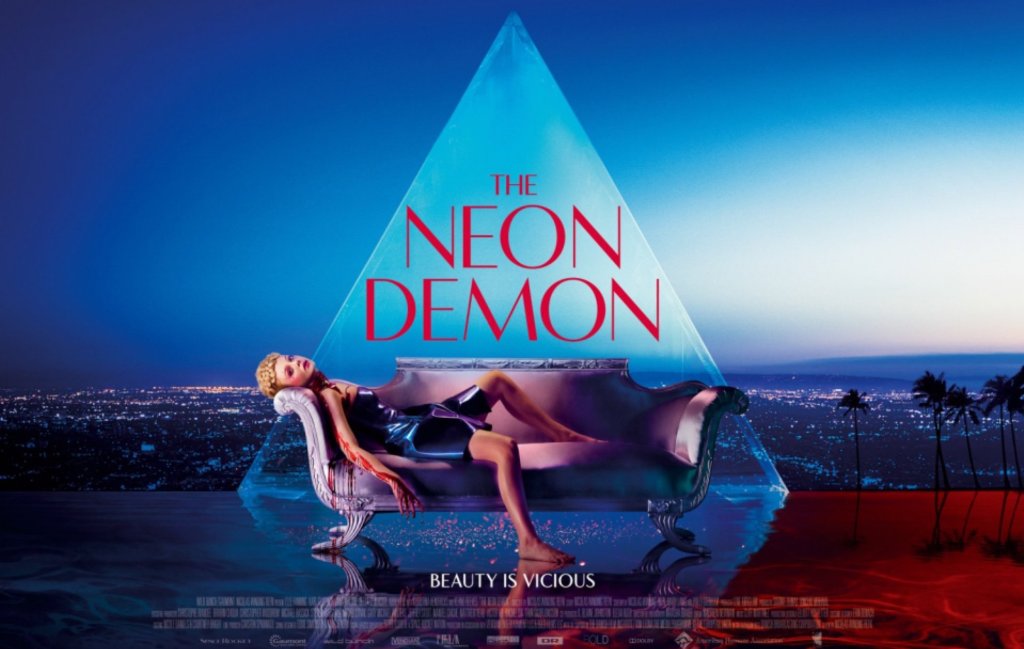
    Nicolas Winding Refn’s follow up to “Only God Forgives” (2013) seems to be his comment on Hollywood, stardom and what this does to people at all levels of society in Los Angeles. How successful he is at it in this film is up for debate, with many viewers either loving or hating it. One thing is clear and that is like all his films it at least looks fantastic and viewers are rewarded who see it on the big screen. When I watched this film I was ready to be let down from the early word from last years Cannes Film Festival – however I am a fan of horror, particularly when it attempts to comment on art and commerce. I did like this film, but if i were to recommend a film that tackles a similar subject in a more straight forward with a lot less flash I would watch “Starry Eyes” (2014).

    “The Neon Demon” is centrally about sixteen-year-old aspiring model Jesse (Elle Fanning) who has just moved from small-town Georgia to Los Angeles. At her first photoshoot she meets makeup artist Ruby (Jena Malone), who introduces fellow older models Sarah (Abbey Lee) and Gigi (Bella Heathcote). The three women are intrigued by Jesse’s natural beauty, as well as curious about her sexual prowess which she lies about.

    Jesse gets signed by Roberta Hoffman (Christina Hendricks), the owner of a modelling agency, who tells her to pretend she is nineteen and refers her to a test shoot with a notable photographer, Jack McCarther (Desmond Harrington).

    Jesse goes to a casting call for fashion designer Robert Sarno (Alessandro Nivola), where Sarah is also present. He pays no attention to Sarah but is entranced by Jesse. A distraught Sarah flees into a bathroom and shatters the mirror with anger and when Jesse enters, Sarah asks her how it feels to be the one who everyone admires. Jesse admits, “It’s everything.” From this point the narrative which has been more of a drama turns into something completely different, which you can find out for yourself.

    As is the case with all of Refn’s films it looks amazing, I cannot help but think that Refn enjoys making movies more than the actual end product – for him it seems that the journey is most of the fun. As his films have progressed over the year the plot and narrative of his oevre seems to be less important than the feel and look of the film itself – he is becoming a true post-post modern filmmaker. For him the medium is much more important than the message – which I think may be a legitimate comment given the kind of films Hollywood has become known for, he is not even trying for a coherent plot.

    I cannot help but feel that as Refn’s career has made him become more avant-garde he is  trying to out do himself with each subsequent movie – to my mind his best and more plot and narrative friendly is the Ryan Gosling “Drive” (2011) which should have received more attention than it did. And maybe the answer for Refn has been that last two films. I have to admit it would be a shock for Refn to actually make a more traditional film – however I would really enjoy that, and I cannot help but think it would also rejuvenate his career somewhat.

    Refn is know for being collaborative with his actors and that explains why he always has top talent in his movies, here he has Elle Fanning, in her first real adult role, but to me while she is playing an ingénue here it rings a little hollow for this particular actress. The stand out for me is the always-undervalued Jena Malone in a femme fatale role that shows a real range. Malone has been around for years and makes anything she is in the better for it, particularly when there are weaknesses in the films she appears in.

    As for the movie itself I really believe that this is for fans of this type of almost surreal work. I think it does get mired in self importance and Refn seem to be showing off a little but viewers may enjoy this. There is a huge element of horror and grand guignol but by now this should be expected form a film about a woman being seduced then swallowed up (literally)!

    Special Features:

    • audio commentary with Director Nicolas Winding Refn and Elle Fanning
  • DVD Review: “I, Daniel Blake” (2016)

    “I, Daniel Blake” (2016)

    5stars_small

    Drama

    Running Time: 100 minutes

    Directed by: Ken Loach

    Featuring: Dave Johns, Hayley Squires, Dylan McKiernan, and Briana Shann

    Daniel: “Well I’m pencil by default.”

    “I, Daniel Blake” (2016) was one of the crowning achievements in cinema last year and must stand as the best film to come out of the UK at the very least for quite some time, at least since the last great Ken Loach film. At 80 years of age and having had such success with film it is incredible to think that he could create something so refreshing, relevant and scary as “I, Daniel Blake”. This has to stand as Loachs best film behind my personal favorite and winner of the Palme d’Or, “The Wind That Shakes the Barley” (2006).

    Daniel Blake (of the title) is a 59-year-old joiner living in Newcastle, England. Daniel has had a heart attack at work. His recovery is incomplete and his cardiologist is concerned that Daniel’s heart might begin to beat abnormally, putting him at risk of developing a life-threatening arrhythmia. She tells him that he is not ready to go back to work.

    Daniel applies for the sickness benefit called ‘Employment and Support Allowance’ which he receives at first, but when an eligibility test is carried out, he is deemed to be able to work. The supervisor at the job centre says Daniel’s only option is to claim Jobseekers Allowance. As a condition of receiving Jobseekers Allowance, he must actively look for work. Daniel launches a legal appeal against being found fit for work but he finds it difficult because he is not computer literate.

    Daniel gets to know single mother Katie and her two children, Dylan and Daisy, who have left a homeless persons’ hostel in London and, with no other affordable accommodation being available in the capital, have moved to Daniel’s home town, a place unfamiliar to Katie and her children. On her first visit to the Job Centre Katie was “sanctioned” — her benefits were stopped because she briefly got lost on the way there — and she can no longer feed all her family nor heat their flat.

    Yes this is a drama but it moves along at such a brisk pace and with such unrelenting events that to me it plays out like a taught thriller and the wonder of what is going to happen next keeps you glued to the screen – it is hard to look away. You feel such closeness to all the characters even with their flaws, you are on board from the start.

    It would be easy to say to say that the issues concerning Daniel and Kate are limited to one town, in one city in one country in one hemisphere of the world, but that is not the world we live in. It has become routine for families to struggle to make rent, make mortgage payments, feed their family or even on a basic level find somewhere to live. While “I Daniel Blake” gives us a first hand experience of what it is like to have to navigate ones way through the social welfare system with all the inherent bureaucracy and dogmatic approach that government departments make ‘normal’ people deal with, this film does not have Daniel as a hero but as a real person and makes us witness his outcome whether we are ready for it or not.

    There is a tendency to simplify a film like this and to say that this is a depressing and gloomy view of the world, and of course it is, but it is also a deep comment on what has been happening for years to the dispossessed and marginalised people in society, that is the non-white, handicapped and any other segment of society without a voice to be heard. Now in “I, Daniel Blake” it is the white and what would have been the middle class – except now they too have been robbed of their voice and stake in society – a group that is growing thanks to many legislative and corporate decisions made unilaterally around the world. It’s no wonder we have Trump and Brexit.

    Aside from being a drama there is a real sense of dread that exists within the narrative that almost gives a thriller bent to the film and that is the sword of Damocles that hangs over Daniel – his heart condition that is exacerbated by the dogmatic approach to him by the institutionalised welfare system that means he must find work to survive – this causes its own unique stresses.

    If you missed this film at the theatres this is definitely one to add to any home collection and like many of Loach’s films gets better on a re-watch. In fact the film is so well constructed and edited there is no reason that this should not be considered an immediate classic. Many of the filmmakers coming out of this new millennium could learn a lesson from a film so well constructed around one central conceit.

  • Film Review: “Patriots Day” (2017)

    “Patriots Day” (2017)

    images

    Drama

    Running Time: 133 minutes

    Directed by: Peter Berg

    Featuring: Mark Wahlberg, J. K. Simmons, John Goodman, Kevin Bacon, and Michelle Monaghan

    Sgt. Tommy Saunders: “What I saw today, good versus evil, love versus hate. There’s only one weapon you have to fight back with, it’s love. You wrap your arms around each other, I don’t think there’s a way they could ever win.”

    The second film within six months from Peter Berg and Mark Wahlberg after the excellent “Deepwater Horizon” (2016), this is another true story, centered on the immediate aftermath of the 2013 Boston Marathon Bombing.

    On April 15, 2013, two bombs explode during the Boston Marathon. In the aftermath of the attack, police Sgt. Tommy Saunders (Mark Wahlberg), FBI Special Agent Richard DesLauriers (Kevin Bacon) and Commissioner Ed Davis (John Goodman) join courageous survivors, first responders and other investigators in a race against the clock to hunt down the suspects and bring them to justice.

    If something is worth doing its worth doing right – this is something that goes through my mind when I watch Peter Bergs films, he has an inate sense of how to portray real life scenes of tragedy and heroism in a way that makes you feel a part of the action or event as well as following the characters journey. It must also be said that his now frequent collaborator, Mark Wahlberg, is fast becoming a reliable character actor, so much so that he is able to hold his own onscreen with many of the top actors working today. It must be only a matter of time before he is rewarded for that, and I for one hope it happens in a Peter Berg directed film.

    Berg not only uses a cinéma vérité approach to this film, he also uses something the authorities would also use, the footage from smart phones, CCTV footage and television footage to show not only the hours before the event but also during, when the carnage was at its worse –  then after when the speedy and extremely stressful investigation gets underway. This is extremely effective as it of course seems to let us in on the main focus of the film, that is the characters, but does not tell us what role they will play. In the second half of the film as we move in on the bombers and the investigation is in its later stages Berg takes a more traditional approach, we see conventional setups take shape right up to the final moments. It is an effective approach and is a film of two halves – we are thrown off in the first and then we regroup and start to take stock and move into more traditional movie making.

    For a film with such a basic storyline the depth comes from the characters, much like his earlier work, “The Kingdom” (2009), where, while it covered similar territory it was the relationships that served as the meaning behind the film. This too does something similar, with Saunders (Mark Wahlberg) who interacts most frequently with, DesLauriers (Kevin Bacon) and Commissioner Davis (John Goodman) – there are some self-reflective moments between Saunders and Superintendent William Evans (James Colby). These are all welcome as they put real emotion into the police and what some of the investigators went through over the five days of the event.

    Berg is at his best (it seems from recent evidence) at presenting the minutiae of any part of a given story that involves a process that needs to be carried out where the objective is to discover some truth. He has done this in many films but none so clinical as “Patriots Day” where the discovery is not only important to one person or one city but to an entire country. As we have witnessed over the past sixteen years there is nothing so scary as a random (seemingly) act of violence and in this case terrorism. It has to be said it is not only surprising how quick the terrorists were brought to justice but how it happened through seemingly unrelated coincidences and acts of real bravery by everyday people.

    The humanity of the victims and survivors is in show with a number of the cast and they are given quite a bit of screen time. The only character we do not see enough of is the wife of Saunders played by Michelle Monaghan who as usual shines in all of her brief appearance – this could have been beefed up to illustrate the toll on the family of the authorities investigating the bombing.

    This film sits nicely alongside other Wahlberg/Berg joints such as “Lone Survivor” (20011) and “Deepwater Horizon” (2016) as well the Berg directed “The Kingdom” (2009) and “Friday Night Lights” (2005). I recommend this movie highly and it looks great on the big screen.

  • Film Review: “Christine” (2016)

    “Christine” (2017)

    5stars_small

    Drama

    Running Time: 119 minutes

    Directed by: Antonio Campos

    Featuring: Rebecca Hall, Michael C. Hall, Tracy Letts

    Michael: “If it bleeds it leads.”

    I had never heard of Christine Chubbuck before I had learnt of this film, but one thing is for sure, I will never forget her name, her story and her way of doing with her life. This film is led an astonishing performance from Rebecca Hall in what has to be a career best from this British actress. Haunting is the word I would use to describe this movie , it shows the horrendous effects of depression and mental illness at its worse and is pailful to  the extreme ways in which it can alter a persons perceptions of the world around them.

    “Christine” (2017) is the very true story of 29-year-old news reporter Christine Chubbuck who in 1974 who took her life, live on air by shooting herself in the head, a premeditated act by someone who was sick and had no idea that help was not far away. This film is not for the faint of heart but it is an exploration into someone that took drastic action to a problem nobody talked about in the wake of the Vietnam war where returning soldiers were facing similar issues – this is something we as a society still do not deal with very well, so over thirty years later these same mistakes in dealing with mental health are still occurring.

    The film takes place over a relatively short amount of time leading up to the on air suicide. We see Christine struggling at home, at work and with her health. Her mother alludes to possible mental problems in her past and we see separate instances of Christine breaking down on the surface for little or no reason. Christine really has no one she trusts to talk to and she also lacks the skills in recognising when her issues are in full effect. Like most people with personality disorders she doesn’t really know how to let people in and can be dismissive of people she does not trust or she feels lacks the intelligence in how to deal with her.

    The film within its narrative begins to address a few things, that is the coming technology revolution with film starting to be replaced by videotape – of course now videotape has gone and been replaced by digital technology. The fact that film was used meant that not all of the live TV shows were recorded, and Christine’s was no different – in fact she asked for the episode to be filmed when she killed herself. The other aspect of change was within the news industry, the type of story that was being covered was changing from character pieces to more sensationalised stories – we witness a story from a rival station where someone is shot on air. This change in story seems anathema to Christine who in the film tries to fight it, but becomes unpopular with the station manger, she starts to see she must go along to get along.

    This is Campos third directing gig and the difficulty in producing what is now considered a period piece is not noticeable here. The film plunges you into the world of the early 1970s in a very specific location and it has to be applauded that nothing looks out of place and the environs look excellent. Particularly the old way of shooting and editing on film as well as the costumes feels authentic.

    This is a story about how someone can come undone and take drastic actions to solve their issues that they feel are not able to be overcome with time and perspective. Like most suicides this one involves many people and aspects of life that some take for granted. The closing scenes are inevitable and are difficult to watch – there is raw emotion from all Christine’s friends and her mother, which at the time must have been difficult to come to terms with what happened.It still must be very hard for all involved and really why she did it will always be a mystery.

    This is an incredibly moving film and I think anyone that has friends or family that suffer from depression should see this as not only a way to try and get inside their minds but to also see what can happen when emotions and thoughts are not dealt with.

    This film opens in New Zealand this year.

  • Film Review: “Hidden Figures” (2017)

    “Hidden Figures” (2017)

    Drama

    images

    Running Time: 127 minutes

    Directed by: Theodore Melfi

    Featuring: Taraji P. Henson, Octavia Spencer, Janelle Monáe, Kevin Costner, Kirsten Dunst, Mahershala Ali, Jim Parsons

    Mary Jackson: “Every time we get a chance to get ahead they move the finish line. Every time.”

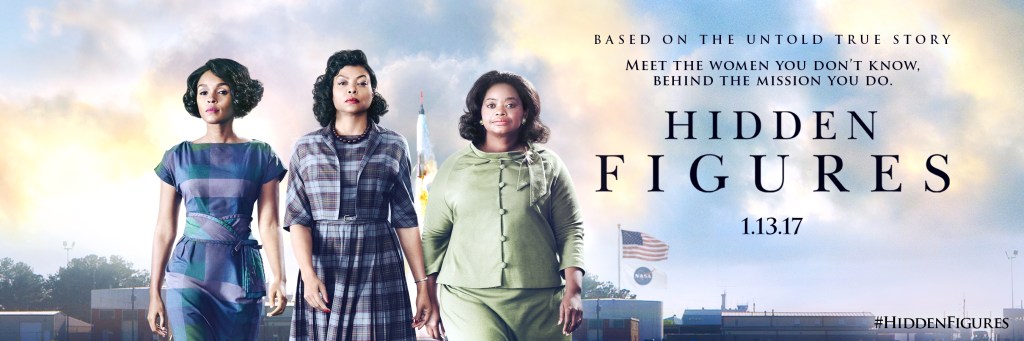
    Whilst some could argue this has been a good year for minorities in films I would argue that the fact that it is highlighted shows film makers still have a long way to go and in regards to women in film there is even a longer way to go. However, it is with glad tidings that I report that “Hidden Figures” (2016) directed and co-written by Theodore Melfi gives hope with a rousing story about three African-American women working for NASA in the 1960s, holding their own against absolutely everything and everyone of that era.

    The film recounts the story of three African-American women who worked in professional positions at NASA and helped the United States advance during the Space Race. Mathematician Katherine Johnson and her two colleagues, Dorothy Vaughan and Mary Jackson, worked in the segregated West Area Computers division of Langley Research Center in Hampton, Virginia. Using these calculations, NASA supported John Glenn in becoming the first American astronaut to make a complete orbit of Earth.

    This is a fundamentally a great film and everyone involved has done an exceptional job in all aspects of production. In particular the writing, directing and acting (the big three) are top notch and it is incredible to think that is has taken this long for this story to be told, particularly when we live in a world where “Driving Miss Daisy” (1989) exists.

    The film’s narrative is told mostly from the point of view of Katherine Johnson (Taraji P. Henson), Dorothy Vaughan (Octavia Spencer) and Mary Jackson (Janelle Monáe) with their stories told in of importance with the relevant amount of screen time allocated to them. While the films plot is based mainly around Johnson, it is important to note that both Vaughan and Jackson have their own very personal and separate arcs within the narrative, each fighting for their own way through the system that they have been marginalized within.

    To say this film is about race and what that meant to African Americans living in Virginia in the 1960s would be an understatement. The film does shy away from any real racial violence of the time, and instead focussus on what it was like to try and get along while taking small steps towards a better life. Each of the principal characters are close friends and encourage each other in a very real way – not making grand statements, but asking questions and making themselves think about how they can become more than the promise of what Has gone before. Like the astronauts themselves these women were as much pioneers as those explorers. They had courage in the face of the unknown and know at any time the wrong step could be their last – they also are aware that they are standing on the shoulders of ancestors and relatives that have led their lives to this point.

    This is a drama but there are many moments of levity which is a valid way of dealing with stress and the director and co-writer Theodore Melfi, who fresh off his under-rated debut “St. Vincent” (2014), knows how to balance the two very nicely without becoming too reliant on laughs or sentiment. That brings me to the music, which is another highlight of this fantastic film.

    Pharrell Williams is an integral part of this movie, it is his presence that really pushes this film above many others – he acts as Producer, Composer and a soul to the film. When making a period piece that involves African Americans it would be easy to play the sentiment card and have music of the period playing, having the characters singing along – this film goes a different route. Williams has composed and performed (it must be said along with star Janelle Monáe) music for the film that is original but harks back to the time and it is excellent – I highly recommend buying the soundtrack – I am listening to it as I write this.

    Like all great films, this one, as a drama, is built around great, believable and passionate performances, led by the incredible and talented (and Oscar winner) Octavia Spencer, she has proved over her career that she is an actress with talent and is to be reckoned with on the screen. She acts as the member of the trio that holds them together and never lets on her own issues, instead she figures out not only how to keep her job, but the jobs of her friends, by learning a new computer language and making herself indispensible to NASA and to the people who actually designed the computer in the first place. Janelle Monáe plays the firebrand of the piece and is showing how talented she is, by not only being a musical artist but an actress to watch for in upcoming films. Finally, the glorious Taraji P. Henson who has been lighting up the screen for years as a character actress, now finds herself in the lead role in what is going to be a major success and she grabs the reins and doesn’t let up, not even when the final reel has run.

    The supporting cast, led by Kevin Costner, and including Kisten Dunst, Jim Parsons and Mahershala Ali also come to the movie firing on all cylinders – they are all playing real (mostly) people that either hinder or help the three woman attain their goals – each is unapologetic in what they witness over the course of the piece and this makes them at once sympathetic and real to themselves.

    Its hard to make a perfect film and the only quibble I have is that the relationship between some of the secondary charters is not explored fully and in some cases there feels like a lot was left on the cutting room floor. This is very minor as I can see it meant there was more that the filmmakers wanted to focus on – the three women of course!

    This is a film that only comes along once in a while and without reservation you should seek this out at theatres and enjoy it as much as the audience I saw it with – and if you feel the need to clap then do so – this is something that is worth celebrating!

  • Film Review: “Toni Erdmann” (2016)

    “Toni Erdmann” (2016)

    Comedy/Drama/Foreign

    images

    Running Time: 162 minutes

    Written & Directed by: Maren Ade

    Featuring: Sandra Hüller, Peter Simonischek, Michael Wittenborn

    Germany and comedy may not be two words that are synonymous with each other but after “Toni Erdmann” (2016) this might change – for the better. The viewer should be prepared for the almost three hour running time – but fear not the film moves along at a good pace, there never feels like any short changing much like any good drama. The film is at once epic but at the same time deeply personal in a way rarely seen in today’s movie world.

    The film revolves around Winfried Conradi, a divorced music teacher, an old-age hippie of sorts, with a passion for bizarre pranks involving several fake personas. Over the bereavement of his dog, he decides to reconnect with his daughter Ines, who is pursuing a career in business consulting and is currently posted in Bucharest, Romania, where she works on an outsourcing project in the oil industry.

    The story is pretty crazy and I wont spoil it but it this film has to be seen to be believed – it is a great tale that will have you chuckling well after the movie is over. It is not to say there are no dramatic moments – any film dealing with estrangement is inherently going to be dramatic but the levity is a welcome diversion.

    There is tragic realism within the film as well from not only both characters but their surroundings as well especially in the final third of the film. The director, Maren Ade,  frames the actors in honest and satisfying ways – we are invited into this new world, both emotionally and physically.

    With most successful comedies there are elements of drama and at the core of all the fun is the relationship that exists or doesn’t exist between Winfried and his daughter, Ines. This is a great way to build a film using the tension of Toni’s odd mannerisms and sense of humor. This film did remind me in a way of the James L. Brooks film “As good as it gets” (1997), which put the main characters OCD as a way for him to explore a possibly difficult new relationship. No surprise then that Jack Nicholson has expressed interest in remaking this film featuring himself in the main role.

    This film operates on both a micro and a macro level – it has something to say about the awkward ways in which we lead our lives, the masks that we put on to deal with happiness, success, failure and defeats. This is what makes the film so great – yes its German but it uncovers universal truths that all the best films do so well. There is also a comment to be found about the state of Europe and in doing so comments on our Global situation where borders are both being erected in parts and removed in others. This is a challenging film but for all the good reasons.

    This is the frontrunner for this years Foreign Film Academy Award and to be honest it probably will win and deservedly so. It is a unique film that focuses on humor and not conflict to solve problems – something we could all learn from in this very divisive time.Highly recommended.

  • Film Review: “Fences” (2016)

    “Fences” (2016)

    images

    Drama

    Running Time: 138 minutes

    Directed by: Denzel Washington

    Featuring: Denzel Washington, Viola Davis, Stephen Henderson, Jovan Adepo, Russell Hornsby, Mykelti Williamson and Saniyya Sidney

    Bono: “Some people build fences to keep people out, and other people build fences to keep people in.”

    Denzel Washington as actor, producer and director brings August Wilson’s Pulitzer Prize winning play to the screen from a screenplay Wilson wrote before his death in 2005. This film is not only a tour de force for Washington who won a Tony on Broadway for the same role, but also showcases Viola Davis in the role for which she too won a Tony. The film is about African-American characters, their emotional ties to each other and the world around them. It also brings to the screen characters that have only been hinted at in the past as well as highlighting Wilson’s amazing prose.

    “Fences” is set In 1950s Pittsburgh, Troy Maxson (Denzel Washington) lives with his wife Rose (Viola Davis) and their son Cory (Jovan Adepo), and works as a waste collector alongside his best friend, Jim Bono (Stephen McKinley Henderson). Troy’s older brother, Gabe Maxson (Mykelti Williamson), sustained a head injury in World War II that left him mentally impaired, for which he received a $3000 government payout which Troy used to purchase a home for his family. Gabe has since moved out, but still lives in the neighborhood, where he is often tormented by the local children.

    In his adolescence, Troy left home and became a robber to sustain himself. After killing a man during a robbery led him to prison, he met Bono and revealed himself to be a talented baseball player. He then played in the professional Negro league baseball, but failed to achieve a career in Major League Baseball. Although it is likely that he was rejected due to his advanced age, Troy firmly believes he was passed over due to the color of his skin. Having survived a near-fatal bout of pneumonia in his youth, Troy claims to have done so by defeating the Grim Reaper in a fistfight, upon which the Reaper vowed to return for a rematch.

    The performances from all cast members is excellent and this is very much a character piece,  each actor is thrust into the center of the story at some point – but don’t be fooled this is very much Denzel Washington’s film, here he proves why he is the pre-eminent actor of his generation, both on stage and in the movies. Washington plays Troy with added weight, a small stoop and a lot of attitude that he has never let go of because of his childhood and the racism he has faced over the years. Troy also is hard on both his sons who are trying to get along and make the best of their new world – Troy through a misplaced idea of protection comes off as a selfish bully who wants to keep his family as victims of his perverted world view. This is possibly the most negative character Washington has ever played and he offers no hint of salvation, right to the bitter end.

    Viola Davis as Rose, feels like she was born to play this part as the wife who has put up with her husband, Troy, for years, all of his bluster, bravado and bullshit – she knows how to bring him back to earth and seems to ride a fine line as the matriarch and the grounding that holds not only the family but the home together as well. Rose at the end of the movie is very different to the character at that we are introduced to – after Troy’s betrayal Rose decides to make her own life a priority and focuses on her family – protecting those with the fence.

    This film whilst focusing on both racial and family issues is centered in one geographic location and watching this film is very much like watching the play – there are very little wide shots and most of the film is shot in two shots and close ups – in fact when the camera moves it is actually quite jarring and out of place, which is a little odd, but this was a rushed production and I think this shows onscreen. The film while true to the play is not cinematic in the least, and that is a shame and has to be squarely placed at the feet of Washington and producer Scott Rudin. It is great to see this story finally on the big screen but it would have been fantastic to see some sweeping shots or some external forces placed on the family. As an adaptation and a character study that relates to racism in America and the familial damage that this causes this is first rate, however as a film in the medium it could do with some work.

    This is not to say that I do not recommend, in fact I do – this is an important film and should be embraced as a work of art and can show how the written word is so powerful and why it has been such a hit on Broadway. There is also a reason that top actors are drawn to this play and that is because August Wilson was one of the great American playwrights and it is a duty to see his work whenever possible.

  • DVD Review: “CSI Finale” (2016)

    “CSI Finale” (2016)

    3-stars

    TV Show/TV Movie/Finale

    Running Time: 90 minutes

    Created by: Anthony E. Zuiker

    Featuring: Ted Danson, Jorja Fox, Eric Szmanda, Robert David Hall, Wallace Langham, David Berman, Elisabeth Harnois, Jon Wellner, William Petersen, Marg Helgenberger, Paul Guilfoyle, Melinda Clarke

    Catherine Willows: “Listen, I need a favor. The new girl, she’s having a bit of a rough one. She thinks she let you down. I was hoping you might be able to help her process the suitcase, give her a little of that Grissom TLC? She could really use it.”

    Gil Grissom: “I’d rather not. I’m quite content here. Where did that girl come from, anyway?”

    Catherine Willows: “My vagina! You don’t recognize her? Grissom, that’s Lindsey, my daughter.”

    CSI: Crime Scene Investigation, began on October 6, 2000, and ran for fifteen full seasons. Starring William Petersen, Ted Danson, Marg Helgenberger, Elisabeth Shue, and Laurence Fishburne, the series concluded its run with a two-hour finale entitled Immortality on September 27, 2015.

    CSI’s first spin-off and the second series within the franchise is CSI: Miami, which ran for ten seasons between 2002 and 2012 and was canceled on May 13, 2012. Miami stars David Caruso, Kim Delaney, and Emily Procter, with its lead character, Horatio Caine, based upon LAPD bomb squad technician Detective John Haynes.

    In 2004, CSI: Miami spun off CSI: NY, the third series in the franchise and the only indirect spin-off of CSI. It was canceled after nine seasons on May 10, 2013. The series starred Gary Sinise, Melina Kanakaredes, and Sela Ward. In 2014, CSI spun off CSI: Cyber, its second direct spin-off and the fourth series in the franchise. Cyber premiered in 2015, and starred Patricia Arquette and franchise alum Ted Danson – the only actor to appear as a series regular in more than one CSI series. The lead character, Avery Ryan, was inspired by cyber-psychologist Mary Aiken who is attached to the series as a producer. The final active series, CSI: Cyber, was canceled on May 12, 2016.

    So after all that the series comes down to a television finale where a suicide bomber detonates his vest on the floor of the Catherine Willows-owned Eclipse casino, the FBI Special Agent returns from Los Angeles in order to join the investigation. Gil Grissom, meanwhile, working to preserve sharks in international waters, is arrested for trespassing at the Port of San Diego, and D.B. Russell offers Sara Sidle the chance to supervise the local investigation into the bombing. Sidle, who is vying for the position of Director of the Las Vegas Crime Lab, is initially irked when Sheriff Conrad Ecklie inquires as to Grissom’s location when “Lady” Heather Kessler is linked to the crime. Ecklie ensures Grissom is released from custody, and he and Willows, alongside Eclipse security officer Jim Brass, assist in locating the suspect.

    As the team works to restore safety to the streets of Las Vegas, D.B. decides it is time for him to “head East” and pursue new challenges, while he places a plaque, dedicated to the memory of Julie Finlay, alongside his personal possessions. Catherine expresses an interest in leaving the FBI and working alongside her daughter Lindsey in the Las Vegas Crime Lab, noting that, should Sara reject the promotion she is going to be offered, Catherine will accept it in lieu of her former colleague. The series ends with the newly promoted Sara, upon hearing a recording of Grissom confessing his love for her, sailing from the Port of San Diego with Grissom.

    To be honest this finale feels like a longer episode and does not really even feel very inclusive with George Eads being conspicuously absent as he left in the final regular episode – as a long time viewer I thought it was sad Nick Stokes did not make one final appearance.

    That being said I think it was time for CSI to end and to make way for younger fresher shows – it did start the procedural TV show, which now goes on in other forms. Farewell CSI!