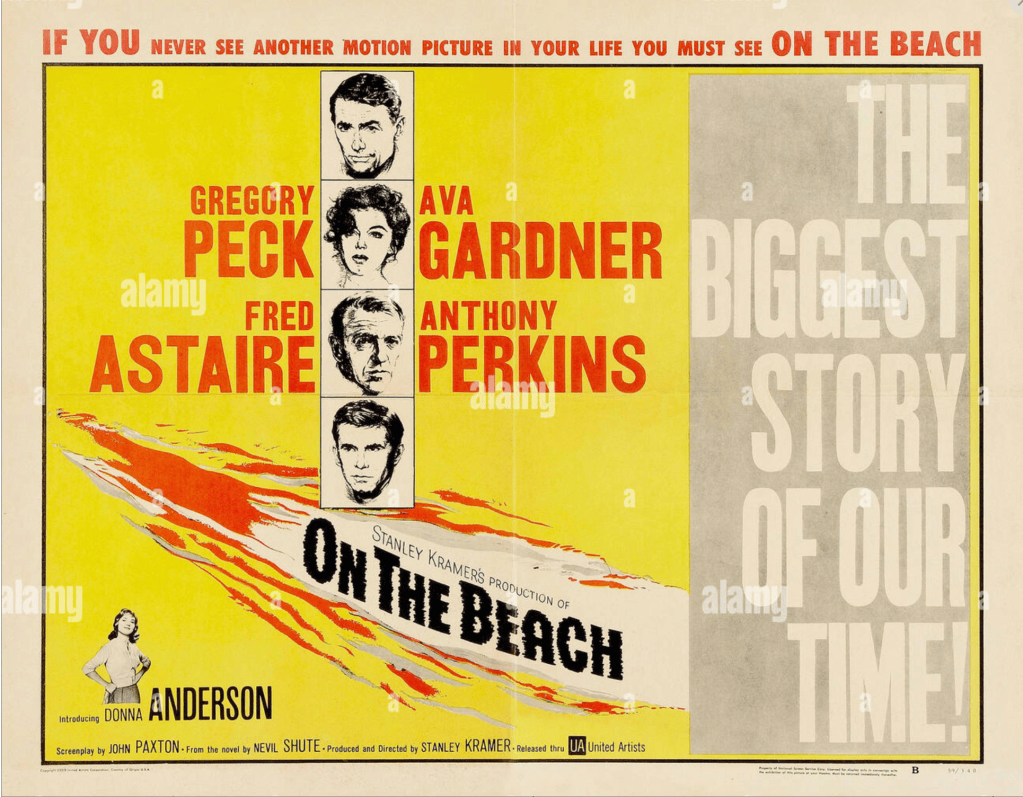
Written by: John Paxton based on the novel by Nevil Shute
Directed by: Stanley Kramer
Featuring: Gregory Peck, Ava Gardner, Anthony Perkins, Fred Astaire and Donna Anderson
Peter:“Now, this is a special kind of; – sleeping pill. I had a devil of a time getting ’em. But, I wanted you to have them on hand and to make sure you knew how to use ’em.; – What happens with the radiation is that you get; you get ill; and you start feeling sick and then you are sick and you go on being sick. You can’t keep anything down. You may feel better for awhile; but, but it always comes back. You get weaker.”
Mary:“And this cures it.”
Peter:“Darling, you know nothing cures it. This ends it.”
Released recently on Blu-ray, and one might say at an opportune time is the Nuclear Holocaust drama “On the Beach” (1959) based on the novel by Nevil Shute who is one of the most celebrated authors of the first half of the 20th century who was based in Australia after World War II. Whilst not the first kind of its genre or even the most realistic in terms of portraying what might happen in the aftermath of a Nuclear conflict it did open the door for what would follow especially in the 1980s when the Cold War was at its height and the threat of some conflict was very much in the air, much like the threat that faces Europe today.
Growing up I remember loving this film not only because the subject matter was serious and realistic (to my young mind) about something that was talked about a lot but also because it was set in Australia with bonafide Hollywood stars. The film has Gregory Peck (Dwight Towers) and Ava Gardner (Moira Davidson) in the lead roles as well as Fred Astaire(Julian Osborn) whom I adored because I had seen him in many musicals, as well as Anthony Perkins (Peter Holmes) who I was fascinated with, like most because of his role in “Psycho” (1960), which he starred in after this film.
There is no doubt that the subject matter of “On the Beach” is challenging more so than most films produced around the time, even the ones that feature similar themes, that is because it takes its subject matter very seriously, especially when viewed through the eyes of the characters that are on show. There are very real archetypical characters on display that inform the audience of what this situation would be like, this is the strength of the film, even when at times it seems overly dramatic or sinks into melodrama.
The screenplay written by John Paxton has to grapple with two opposing forces that is the narrative that deals with the end of the world, very serious as well as engaging, all the while trying to bring in some human drama which is reflected in the love story between Peck and Gardener which seems forced in a way, it is something recognisable for the audience I assume. This love story for want of a better description is something that is absent in many other Nuclear Holocaust dramas, and it is easy to see why especially when the obvious outcome of a nuclear exchange would be, absolute devastation as seen the two landmark films of this genre, these being “Threads” (1984) and “The Day After” (1984). In fact the film that most closely resembles “On the Beach” is the film “Testament” (1983) directed by Lynne Littman that attempts to show a creeping death through a small town who have survived the explosions but slowly are enveloped by radiation. Like “On the Beach” it is a maudlin affair that seeks to show a small cadre of families dealing with their emotions in different ways.
“On the Beach” was directed by Stanley Kramer who at this point in his career was about hit his stride with some great dramas that not only reflected society but have become classics such as this film as well as “The Defiant Ones” (1958), “Inherit the Wind” (1960), “Judgment at Nuremberg”(1961) and a host of others. There is no doubt that Kramer had a talent for turning social commentary into truly entertaining art that informed viewers without preaching to them. Even in his most broad films Kramer is able to hone in on the aspects that are the most important or relevant. We see aspects of the loss that Hightower has suffered while on his submarine as well the loss that is to come in the relationship between Peter and Mary.
“On the Beach” features some excellent performances by Gregory Peck, Ava Gardner, Anthony Perkins, Fred Astaire and Donna Anderson who are all American imports that have to do a lot of the heavy lifting emotionally and all take their lead from Gregory Peck who was already a hugely successful star, who shines in having to portray someone who has lost everything but has to deal with the world that has been left behind. The strength of these lead performances really come into their own as the film progresses especially as it dawns on the characters as well as the audience that reality is on its way, there is no happy ending on its way. This may be a movie with huge Hollywood stars but there is no Hollywood ending in sight.
Whilst “On the Beach” attempts to base itself in reality it in fact rides a line between that and a fantasy that simply does not exist. Some of the hope in the film comes from the US submarine that arrives in Australia and then heads back to America to investigate the idea that the Nuclear fallout may be disbursing. This section of the film sees San Francisco fully intact but bereft of people, we see scenes of vacant streets, shops and homes, this will marry up with the final scenes of the film which makes a poignant point about humanity as well as its fragility. Of course to say that the aftermath would be like this is utterly ridiculous but maybe shocking the audience or the expense may have been too much. However in saying that the absence of any physical reality is more than made up for by the human story.
I recommend “On the Beach” wholeheartedly as both a time capsule of what was and perhaps a prescient message to us from the past about out present. It is an excellent edition with plenty of extras for those that wish to dig deep. I believe this is a film that you can see onscreen how important it was to all involved giving us something special, like so many Stanley Kramer films.
Special Features
Disc One: On the Beach
1080p High-definition presentation on Blu-Ray by MGM
Audio Commentary by film scholar Adrian Martin (2021)
Audio commentary written by On the Beach expert Dr. Philip Davey, read by actor Douglas Hansell (2015)
Archival audio interview with actor Gregory Peck by Lawrence Johnston (1997)
Discovered Outtakes, Location Footage and Costume Test
Big Stars Arrive In Melbourne – Newsreel (1958)
Making On the Beach – 8mm amateur footage capturing location footage (1959)
Kim Newman on apocalypse cinema (2022)
No Safety Nets: Human Horror and On the Beach – video essay by Kat Ellinger (2022)
Clothes to Die For: On the Beach Costumes of Ava Gardner – video essay from costume historian Elissa Rose (2022)
Theatrical Trailer and Original Radio Spots
Photo Galleries featuring Stanley Kramer’s photo album (with optional descriptive text), Ava Gardner wardrobe tests, original film posters, lobby cards, stills and behind-the-scenes
Original Aspect Ratio 1.66:1
Audio English DTS-HD 5.1 Surround + LPCM 2.0 Stereo
Optional English HOH subtitles
Disc Two: Fallout
1080p High-definition presentation on Blu-Ray
Fallout– Lawrence Johnston’s 2013 feature documentary on the novel and Hollywood movie of On the Beach
After the Fallout – interview with director Lawrence Johnston (2022)
Featuring: Kelly Marie Tran, Awkwafina, Izaac Wang, Gemma Chan, Daniel Dae Kim, Benedict Wong, Sandra Oh,Thalia Tran, Lucille Soong and Alan Tudyk
Sisu:“I’m going to be real with you, alright? I’m not like the best dragon, you know?”
Raya:“But you saved the world.”
Sisu:“I did do that. That’s true. But have you ever done like a group project, but there’s like that one kid who didn’t pitch in as much, but still ended up with the same grade? Yeah, I wasn’t the one who actually made the gem. I just turned it in.”
Released on Blu-ray and DVD is the latest Pixar feature “Raya and the Last Dragon” (2021) that features at its heart a fictional creation of Asian mythology that makes this movie not only unique but actually makes it stand out in the now crowded animated environment that exists in the marketplace today. Not only is this movie one of the highlights of this new pandemic environment but it also feels like it was not given the attention it so richly deserves. To ensure its cultural authenticity, the filmmakers formed a story trust of Southeast Asian cultural experts, including choreographers, musicians, linguists, architects, cultural experts, martial artists, and anthropologists. In the early days of making the film, a group of filmmakers and artists traveled to Laos, Indonesia, Thailand, Vietnam, Cambodia, Malaysia, and Singapore to gain inspiration. The key creative team itself consisted of people with Southeast Asian cultural backgrounds, and they shared their life backgrounds and added details they felt were important.
The movie is set in the prosperous land of Kumandra is ravaged by the Druun, threatening evil spirits that petrify people and dragons. Sisu, the last dragon, concentrates her magic into a gem and banishes the Druun, reviving Kumandra’s people but not the dragons. A power struggle for the gem divides Kumandra’s people into five tribes, based on their placement along with a giant, dragon-shaped river: Fang, Heart, Spine, Talon, and Tail. Five hundred years later, Chief Benja of the Heart tribe trains his daughter Raya to protect the gem. Firmly believing that the tribes can be united once again, Benja decides to hold a feast for the leadership of all five tribes. During the feast, Raya befriends Namaari, the daughter of Chief Virana of the Fang tribe, who gives Raya a dragon pendant as a gift. Trusting her, Raya shows Namaari the location of the gem, but she betrays Raya as part of a plot to help Fang steal it. Alerted to the attack, Benja and the other tribes arrive at the scene and start fighting over the gem, which gets broken in the scuffle. As each tribe steals a piece of the gem, the Druun reawaken and overtake Heart and its people before spreading throughout the rest of Kumandra. Benja saves Raya by throwing her off the bridge into the water below and she watches him get swallowed and petrified by the Druun. The actual plot of the movie is not new not only in terms of other animated movies but in other genres as well, however what makes it great are all the details that have been interwoven to make “Raya and the Last Dragon” actually unique and something that Disney should be very proud of.
Disney’s “Raya and the Last Dragon,” available this week in limited theatrical release and on Disney+ for an extra fee, is a wonderful adventure. Blending imagery and mythology from several Southeast Asian cultures into its own vision, it’s an ambitious family film that will work for all ages, and one that never talks down to its audience while presenting them with an entertaining, thought-provoking story. It also contains some of the most striking imagery Disney has ever produced, dropping its characters in a world that feels both classic and new at the same time.
Directed by Don Hall and Carlos López Estrada who both have a large amount of experience both in animated and live action features which pays off well here especially since the movie feels very real especially in the design and the real world feel that is throughout it. Written by Qui Nguyen and Adele Lim who even though they are creating an animated feature do not get lost in it and they have created three dimensional characters with what feels like real emotion as well as stakes for audiences to get involved in.
The voice work in “Raya and the Last Dragon” is excellent with Kelly Marie Tran showing some real talent with a much better character than her ‘Star Wars’ efforts. There is just the right amount of vulnerability and strength in her Raya. The entire ensemble brings their A-game: Kim grounds a father/daughter dynamic with just a few scenes, Wong is so fun that he could anchor a spin-off about his character, and Chan sells the complex arc of a young woman forced by her mother to act against her own beliefs.
“Raya and the Last Dragon” could have been yet another traditional Disney princess story, a story about a young woman chosen by legacy or magic to save her people. It’s a story about fallibility and uncertainty that is framed by a great narrative that pays homage to mythology that has come before while creating its own past, present, and future.
Featuring: James Caan, Paul Sorvino, Lauren Hutton, Morris Carnovsky and Burt Young
Axel Freed:“I’m not going to lose it. I’m going to gamble it.”
Released recently for the first time on Blu-ray is the 1970s drama “The Gambler” (1974) featuring James Caan in the central role of a flawed academic who owes large debts to the wrong people. This film is a character piece that not only reflects the time in which it was made but also part of the new wave of movies coming out of the US at this time right up to the early 1980s. “The Gambler” has an odd mix of talent in director Karel Reisz who was a veteran at this point, screenwriter James Toback who was a novice and rising superstar, actor James Caan who had risen to stardom with “The Godfather” (1972). What they produced was a film that dipped its toes into many themes regarding manhood, professionalism and to some extent the meaning of life mixing many worlds as well as infusing it with nourish undertones.
“The Gambler” revolves around Axel Freed an English professor in New York with a gambling addiction that begins to spiral out of control. In the classroom, Freed inspires his college students with his interpretations of Fyodor Dostoevsky’s work. In his personal life, Axel has the affection of the beautiful Billie and the admiration of his family, including his mother, Naomi, who is a doctor, and his grandfather, a wealthy businessman. Axel’s gambling has left him with a huge debt. His bookie, Hips, likes the professor personally but threatens grave consequences if he does not pay it soon. When Billie, having been informed by Axel that he owes $44,000, questions the wisdom of her associating with him, Axel confidently tells her she loves his life’s dangers, including “the possibility of blood”. The plot moves along at a brisk pace and we move from one world to another with solutions that become apparent but the main character seems unable to bring himself to actually save himself or accept any assistance.
Directed by Karel Reisz who helped spearhead the English kitchen sink dramas of the 1960s with his classic “Saturday Night and Sunday Morning” (1960) which featured not only some of the realism that would feature in his later works but also announced the debut of actors Albert Finney and Rachel Roberts who would go on to become two of the finest actors of the next twenty years. “The Gambler” has much of the directors style as well as its deep themes on existence and coupled with the screenplay by James Toback is one of Reisz ‘s better films of his mid career. This was James Toback’s first produced screenplay and like his other films he writes original characters with motivations that reflect the times they live in. If Toback has a signature it is creating movies about outsiders and their own self destructive nature, this follows through to his documentaries as well. There may be no better example of this than his Oscar nominated screenplay for “Bugsy” (1991) directed by Warren Beatty that maybe the ultimate example of someone who self sabotages and believes himself above almost everyone much like the main character in “The Gambler”.
Driven by the central performance of James Caan who really has never been better in a leading role and who is not the first choice one might think of as an English Professor but who you would think of as a gambler, here he balances both aspects of his character to really hone in on his performance, he has never really been better. “The Gambler” also has some incredible actors in supporting roles in the form of Paul Sorvino, Lauren Hutton and Burt Young who were all staples of 1970s US cinema and here all play their own parts extremely well in very different aspects of the films storyline.
The existential nature of “The Gambler” still holds fascination today as some of the themes still exist today especially the idea that the main character has to find his own dangers to test himself against when he finds nothing in his own life which to him is meaningless. Of course the tension for the audience is seeing Axel watching games in different situations where he is losing and there is a sword of Damocles that hovers over him getting lower and lower as the film proceeds through its plot. Of course throughout the narrative the main character is also revealed to have different motivations in different aspects of his life which are all exposed expertly by Toback and Reisz.
“The Gambler” is an excellent film from the 1970s that deserves to be seen and would make a welcome addition to any collection, it shows people at their best as well as their very worst which jibes with some of the texts that are talked about in Axels classroom, do yourself a favour and get this now.
Special Features
1080p presentation of the film on Blu-ray
NEW Audio commentary from cinema author & critic Matthew Asprey Gear (2021)
NEW “After the Game” Video essay by Chris O’Neill (2021)
NEW “On The Morning After: Composing The Gambler” – A new interview about Jerry Fielding’s legendary score with author/film music historian Jon Burlingame.
In On The Cut – Interview with assistant editor Sue Kingsley
1991 archival audio interview with Karel Reisz about his life & career from the British Entertainment History Project
Featuring: Gemma Arterton, Gugu Mbatha-Raw, Lucas Bond, Dixie Egerickx, Siân Phillips, Penelope Wilton and Tom Courtenay
Mr. Sullivan:“Bad news is bad news no matter how you tell it. There’s nothing makes it easier.”
Released recently on DVD is, “Summerland” (2020), the latest film featuring Gemma Arterton in a World War II era story after the excellent “Their Finest” (2017) which not only had a fun and inventive plot but also held deeper meaning about loss, sacrifice and love which carry on even through a war which is not being fought on the fronts but at home in very different ways. The idea of the war film is set in stone and is a very real, recognisable and constant genre that is easily transplantable from conflict to conflict and nation to nation. However there is a sub genre which is easily as fascinating as a film filled with action and that is what happens at home and these films have been more regular in the past ten years especially those produced and about the UK, they offer new twists as well as untold true stories told by people with new points of view, “Summerland” is one of those films.
“Summerland” brings together a very good high profile cast, gives them all room to breathe with their own stories that link up to the main narrative. It’s remarkable the seeming ease that the British Film Industry is able to produce great independent drama, comedies and horror movies each and every year. Not only that, but the talent on show always seems to be original as well as first class. What many of these English films have in common is that they are based around something unique or have some kind of gimmick, this new movie “Summerland” has both of those. This movie has much in common with many of the British movies produced over the past twenty years, it has some well known actors that could all carry their own movies, it has a concentration of on location production, is based on a very English story and most often has relatively inexperienced writers and directors. What is healthy to see with “Summerland” is that it is a feminist narrative that has been directed and co-written by women who are not newcomers with some experience in large productions.
“Summerland” is set in 1945 and is based around Alice Lamb, who is working on her typewriter, lives in a cottage by the seaside in Kent. She has lived in the village since before the start of WWII, during which time she tolerated the harassment by local children who thought she was a witch because she was a loner. As part of the war effort, the brusque and reclusive writer is entrusted with the care of a young boy, Frank, who has been evacuated from London where it is unsafe. Alice had not volunteered to be a host and does not want to care for him as she fears it will interfere with her work researching mythology and folklore, but reluctantly agrees to let him stay believing that he has nowhere else to go and she will be able to be rid of him in a week. Of course you can almost guess what happens from this point onward but it is executed in such a way that makes this a movie more than the sum of its parts.
Written and directed by newcomer Jessica Swale who while having little experience in cinema has extensive and impressive theatre credits so brings that aspect to bear with her cinematographer Laurie Rose, who lends a glowing look to the rural environment.
The film is led by Gemma Arteton who has played these characters for years sometimes playing against her looks which she could use but uses her talent to provide audiences with a look into a bygone era as well as bygone people. The other main role goes to Gugu Mbatha-Raw who is great as the face that haunts Alice’s dreams, reminding her how much she has lost. The rest of the film is cast with terrific character actors in the form of Tom Courtenay as the avuncular and schoolmaster, as well as Bond and Dixie Egerickx, who plays Edie, who is bucking the system she has been born into.
This is yet another UK based movie in a long line that illustrates what an expert industry the English have as well as the talent that is available seemingly at will. “Summerland” is a very good film and one that will bring a smile to anyone that watches it and will remind people how life used to be and the reason why people used to make the decisions they would make. It also offers hope in that it perfectly illustrates that people are able to change their minds and point of view which is something that could be learnt in todays polarising world.
Featuring: Jacob Junior Nayinggul, Simon Baker, Callan Mulvey, Aaron Pedersen, Ryan Corr, Caren Pistorius, Sean Mununggurr, Witiyana Marika, Esmerelda Marimowa, Maximillian Johnson and Jack Thompson
Moran: “They are calling them the wild mob, brought together by baywara.”
Released recently on Blu-ray and DVD is the Australian film “High Ground” (2020) that delves into the Colonial past offering viewers a micro look at a location and event that shows just how what the English thought of the indigenous peoples as well as what justice looked like for in terms of horrific crimes that are still around the world today, there are many themes to this film but one I took away was that in parts of the world we have not come very far at all.
“High Ground” is the latest in what Australians call Meat Pie Western, also known as Australian Western or Kangaroo Western, is a broad genre of Western-style films or TV series set in the Australian outback or ‘the bush’. This sub-genre of film has been around for decades but in the past decade or so they have become much more common especially in terms of addressing Colonialism as well the effects this has had on Aboriginals and the ongoing effects, this film is definitely set in the past but its repercussions, even based on a fictional incident can be seen today in very real historical incidents. In fact there there were many massacres of Aboriginal and Torres Strait Islander people by settlers following the colonisation of Australia by the British Empire, in 1788, most were perpetrated as summary and indiscriminate punishment for the killing of settlers or the theft and destruction of livestock.
The film is set around a sniper, Travis, after fighting in World War I he is now a policeman in northern Australia, he loses control of an operation that results in the massacre of an Aboriginal Australian tribe in 1919. After his superiors insist on burying the truth, Travis leaves in disgust, only to be forced back twelve years later to hunt down Baywara, an Aboriginal warrior whose attacks on new settlers are causing havoc. When Travis recruits mission-raised Gutjuk, the only known massacre survivor, as his tracker, the truth of the past is revealed and Travis becomes the hunted. From here the film expands into what is the ‘present’ for the characters and becomes something of a revenge story albeit with devastating outcomes for all those involved.
The film has been directed by Stephen Johnson who is relatively experienced and has proven a very good choice for a film that is not only part of a genre with plenty of examples to show but has also been made on a small budget with limited locales. However in saying this Johnson uses his locations very well with some having grand vistas but others feeling claustrophobic juxtaposing the two in any given situation which is a great narrative tool to use. For a country that is massive it is surprising how closed in it feels. possibly because so much seems to be arid and lifeless which of course it is not. We see from the outset that the indigenous peoples have a Universal way of looking at life and death whereas the Colonials are rigid and believe in very artificial people to worship, if anything the Aboriginals have a far reaching outlook that belies the way they live.
Led by the performances of Jacob Junior Nayinggul and Simon Baker, who both inhabit their roles no matter who these people really are. Both are misunderstood taking part in lives they have no real joy for which of course leads them to decisions neither want to make but are forced into because of circumstance and the idea of what life means as well as revenge and justice. Baker who has been a mainstay on television seems to want to make movies in Australia trying to tell Australian stories and for the most part has succeeded. In contrast this is Nayinggul’s first role and judging by the results he has a future in the medium. One other highlight are the always great Aaron Pedersen and Jack Thomson who play relatively small but integral parts, both show why they are two of the best character actors in Australia at the current time.
Whilst “High Ground” is a work of fiction there are chilling similarities to real life which can be found by doing some pretty basic research, I am not going to compare them here that would lessen the value of real life. What this film does is to show some very basic truths that are evident today. They are that there are very real negative effects of Colonialism, the idea of the savage to be modernised, the idea of people being removed from their own. authorities, what revenge means and what justice looks like to very different groups of others, these are the most obvious ones and they should inspire debate about what should be done in today’s world to offer justice to those that have suffered.
I recommend this film highly it is a must watch from its direction through to the narrative, story and performances, it has a great ending which is both justified and moving, do yourself a favour get it now.
Featuring: Jack Smethurst, Rudolph Walker, Nina Baden-Semper, and Kate Williams
Joan Booth: “Nobody dances at work socials. It’s mainly drinking to music.”
Released on DVD is the early 1970s long running comedy “Love thy neighbour” (1972-1976) which sought to analyse in its own way race relations in England or at least part of that county in a way that would expose racist leanings and maybe even enlighten the public to their own leanings in terms of race and gender. Of course what may have been forward thinking or liberal in the 1970s may seem like outright racism in the 2020s and so I am actually not sure how to treat this series. It is a conundrum indeed, one that bears thinking about, there are situations within the long running series that ring true, but there are others that seem ill thought out and quiet out of date.
The series was created and largely written by Vince Powell and Harry Driver; it was based around a white working class couple (Eddie and Joan Booth) living in Twickenham, in the outer London suburbs, and a black couple (Bill and Barbie Reynolds) as their next-door neighbours. Of course what happens over the long run of the series are increasingly inventive and ludicrous ways for the neighbours to come together and knock heads all in a racial way of course. This of course is part of the problem looking back at this series, the idea that nothing ever really changes which means of course that it always seems that the black characters have to fit into their life with their white counterparts.
Created by Vince Powell and Harry Driver who were both experienced writers it seems odd that they would not have the self awareness to know what they were creating but I assume it must have felt like they were breaking down walls with this show. Unfortunately this series has been created and written from a white mans point of view which of course explains why the show has aged so badly as well as feeling right out of place in todays environment whether you think it is woke or not.
At the time of production there was also a similar series in the form of “Till Death Us Do Part” (1965-1975) which suffered from the same issues, both were attempting to highlight the politics and racism of their time but ultimately became what they were racing against. Of course the white characters are working and middle class but I find it egregious that they are all so racist because that seems out of place and insulting. The idea of the racist insults at the drop of a coin seem a little too put on, they are everywhere and in all sorts of forms which would not happen these days on television not without some consultation.
I don’t think anyone involved in Love They Neighbour ever deliberately set out to offend, but time has certainly not been kind to how they handled the issue of race. It wouldn’t be so bad if everything else away from the prejudices was in any funny, but this barely raises a smile throughout its 80 minute duration.
Episodes
Series One
Pilot: When a black couple move in next to him, Eddie decides he and his wife have to move. He changes his mind when he sees the woman though, but trouble is still afoot.
New Neighbours: The house next door to Eddie and Joan has been sold and the couple that moves in comes as a massive shock to Eddie.
Limbo Dancing: Joan tries some of Barbie’s exotic food on Eddie. After joining the works social club, Bill challenges Eddie to see who’s best at Limbo dancing.
The Petition: Bill gets angry at Eddie when he keeps ogling Barbie when she’s sunbathing in the garden. Eddie thinks Bill is stirring things up so he decides to move. Bill though doesn’t want any black people moving in.
Factory Dispute: After an argument over a new machine at work gets out of hand, Bill and Eddie both withdraw their labour and go on strike. As a result, Barbie and Joan both also go on strike until the guys go back to work.
The Seven Year Itch: Eddie has a union meeting at the pub with Jacko and Arthur. Barbie and Joan think that their husbands have a roving eye, so phone two girlfriends to try and tempt them into cheating.
Refused a Drink: Eddie gets all excited about meeting Harold Wilson but the arguments start when Bill puts up a poster of Edward Health in his window. To prove a bet that blacks can get served anywhere, Eddie dresses up in an Afro wig and blacks himself up.
Sex Appeal: Barbie suggests to Joan that she doesn’t wear a bra like her, to try and keep Eddie interested. Eddie though, doesn’t even notice. When he later thinks he sees Joan and Bill embracing, Eddie gets really drunk and tries to start a fight.
Series Two
The Housewarming Party: Eddie refuses to go to Bill and Barbie’s house warming party thinking he isn’t wanted. When the music gets too loud for him, he calls the police to break it up.
Voodoo: Getting annoyed after Bill gets a football ticket and he doesn’t, Bill and Eddie get into an argument about voodoo. When Eddie makes a voodoo doll of Bill, Bill scares Eddie when he pretends it’s worked.
Clarky Leaves: After Eddie has a drunken night at the foreman’s leaving party, he refuses to go for the job as it’s against his principles. When his boss offers it to him with extra money and the key to the executive toilet, he soon changes his mind.
The Bedroom Suite: Joan convinces Eddie to buy a new bedroom suite in the sale. Unfortunately Bill wants the same suite, so they both decide to camp outside the shop overnight.
The T.U.C. Conference ’72: Eddie thinks his trip to the T.U.C. Conference will get him away from everything, only he gets a shock when Bill says that he’s going as well and Barbie has arranged that he shares his room.
Religious Fervour: After being disturbed by the local Revivalist Band and having a big argument with the boys about Religion, Eddie gets converted and joins the band. Joan hatches a plan though to revert him to normal.
Series Three
The G.P.O.: Bill and Barbie get a new phone. They share a party line but get a shock when they find out that they are sharing with Eddie and Joan. So Bill decides to wind Eddie up knowing he’s listening in.
The Car: Bill buys a brand new car. Joan tries to convince Eddie that they need one, but after Bill’s constant bragging Eddie finally buys one. Eddie though, can only afford a bit of a scrap heap.
Eddie Returns from Holiday: When Eddie gets home from holiday, he finds the place over run. Bill is sitting in his pub chair, the new vicar is black, his corner shop is now owned by a Pakistani, and Bill is inviting all his black friends to the pub.
The Lion and the Lamb: The White and Black Vicars and Joan and Barbie try to stop the mass punch up between Eddie and his mates, and Bill and his mates, planned for 12 O’clock. The two gangs meanwhile, are down at the gym.
The Lift: After Joan invites Bill and Barbie over, Bill and Eddie hatch a plan to escape to the club.The gang go home with Arthur as he’s forgotten his wedding anniversary, though they get stuck in his block of flats lift.
Barbie Becomes Pregnant: Barbie announces that she’s pregnant. Due to Bill’s bragging, Eddie, believing that anything Bill can do, he can do better, tries to convince Joan to start a family as well.
Series Four
Hines’ Sight: Eddie tries to vet those who are interested in buying the empty house next door, they have to be white, northern and Manchester United supporters. There is a new barman at the social club.
Friendly: Eddie and Bill enter a raffle, the prize, a trip for two to Paris. They decide to take each other should they win, leaving their pregnant wives at home but their wives have other plans.
Working on New Year’s Eve: The boys are asked to work on new years eve, and decide to throw a party.
Eddie’s Mother-in-Law: Joan’s mother comes to visit and Eddie puts his foot down and kicks her out. Joan leaves with her.
The Antenatal Clinic: Bill bets Eddie that he can’t go 24 hours without saying a racial slur. The men have to join the ladies at the antenatal clinic.
Two Weeks to Babies: Bill overhears Joan talking about another mother and misunderstands what she is saying. He then starts a rumour that the father of Joan’s baby is the window cleaner Speckie. Then the rumour switches to Barbie. Both men go after Speckie.
To the Hospital: Part 1. After a few false starts, Bill and Eddie get the girls to the hospital. When they are told it may not be until morning when the babies come, the boys go drinking.
The Big Day: Part 2. Eddie is still waiting for the phone call from the hospital, but can’t help getting drunk again. His friends sober him up and get him to the hospital in time for the birth. Bill’s child is born first.
Series Five
The Mediterranean: At the club meeting, the men decide to take a trip to Majorca. The women threaten to withhold all their services if they do not take them. So off they all go. Through a misunderstanding, Eddie spends the duration of the trip in jail.
Teething Problems: Bill gives Barbie tickets to go to Trinidad. Eddie uses the envelope to write a note, then throws it in the bin. He spends his morning going through the tip trying to find it. Meanwhile, the garbage man found them earlier, returned them, and Barbie has already gone. When Joan thinks Bill will wander, she makes him stay with them.
Eddie’s Birthday: It’s Eddie’s birthday and the boys at the club band together to send him sexy birthday cards as a joke, which doesn’t impress Joan. Bill also sends a joke one from Harold Wilson that leads to Eddie being arrested.
Cat’s Away: Eddie is jealous of the attention Bill is getting from Joan, and turns his eyes to Sandra from the barber shop. She just flirts with him to get him to do the stock taking. Bill shows up, and then the wives, ending the fling before it starts.
Ghosts: The discussion in the club turns to ghosts. When Nobby says that there is a ghost haunting the club, Eddie and Bill end up having a bet that Eddie can’t stay in the club all night.
Bananas: Eddie takes a crate of bananas that belong to Bill. While he is eating a banana, a giant tarantula comes out of the crate. It is a clockwork spider, but Eddie tells everyone he is dying from a bite. They all know better.
Series Six
Reggie: Eddie seems to be taking Joan for granted and she tries everything to get him to pay attention to her. She starts thinking about Reginald Truelove, her first boyfriend. One night when Eddie goes to the club, she calls Reggie to come over, but she has a change of heart by the time he gets there. Reggie answers the phone for her and he tells her it’s “Bloody Nora”. She gets spooked and goes to the club to explain. Eddie is not there, she missed him. Next thing she knows is Eddie is in the hospital for confronting Reggie.
Jacko’s Wedding: Jacko comes back from holiday with news that he is getting married to a bingo caller he met while he was away. When she shows up everybody thinks she is after his money. Joan knows this girl to be a gold digger and already married. She sends the girl packing and the wedding is off. Albert thinks Jacko is going to jump in the canal and they all race to save him. It seems his hat blew into the water and Eddie jumps in to save him.
Duel at Dawn: Bill tells Eddie he is having relatives stay at his house. They get into a dispute and decide to settle it with a duel. Nobby lends them his antique guns and off they go. Jacko loads the guns with blanks, and when Nobby sees this, he switches them for the real thing. When one gun goes off, Jacko goes down and Eddie thinks he killed him. Jacko only fainted.
The Darts Final: Joan forces Eddie to babysit so she can go to the movies with Barbie. The vicar comes around and Eddie cons him into babysitting so he can go to the club. The wives come home early and the vicar goes to the club to tell Eddie. Joan is so mad at him, she locks his clothes in the wardrobe so he can’t go to the dart’s match. Eddie wears Joan’s clothes and gets in all kinds of trouble.
Royal Blood: Eddie is researching his family tree and as a joke, Bill fakes an old portrait and says it is Eddie’s ancestor. Eddie thinking he has royal blood and is lauding it over everyone until Joan discovers the documents were written in ball point pen. Mr. Pettigrew from Somerset House comes to the club and tells Eddie his ancestor was on the ship “The Bounty” and was indeed married to royalty. A black princess on Pitcairn Island.
Club Concert: The annual concert is looking dismal without a celebrity. Eddie phones the Duke of Edinburgh and Bill pretends he knows Charlie Williams. Charlie’s agent tells him that he is booked in for the concert. The boys think he is an impersonator and coach him on how Charlie acts and speaks. When Eddie insults him, he walks out. The night of the concert there is no Charlie. Will he show up? Arthur tells Eddie that he turned away a drunk calling himself the Duke of Edinburgh.
The Nannies: The girls get a part time job on Saturdays, so they hire 2 nannies for the day sight unseen. After they go to work, two sexy ladies show up to look after the children. These nannies get Bill and Eddie to do all the work and just lounge around all day. Barbie and Joan come home and catch them eating a meal together. The men are barred from all football and Joan and Barbie go to the match in their place.
Series Seven
Famous Crimes: Barbie invites Joan and Eddie for dinner and sends Bill down to the club to get him. When Bill gets there Jacko is showing off the handcuffs that were worn by Dr. Crippen the famous murderer. He puts them on Bill and Eddie and they are stuck without a key. While Jacko goes to find keys, Eddie and Bill go home to dinner. They break into the factory to find something to cut them off when Jacko arrives.
The Lady and the Tramp: The club is having a Lady and the Tramp theme night. The men will be tramps, and the ladies will be the ladies. Not so simple for Jacko who comes as the lady and his mother is the tramp. Unfortunately, the police crash it because their liquor license has expired. It seems that Eddie forgot to renew it.
The Protection of the Law: Bill decides to leave the social club and go to the Caribbean Club. When Jacko, Eddie and Arthur hear there is a stripper over there, they go over too. When Bill sees them, he refuses to sign Eddie in. Eddie calls the race relation board and Bill is investigated and given a warning. When Eddie goes back to the club, Bill throws Eddie’s pint of beer on the floor and they are both barred.
The Opinion Poll: Eddie wants to take an opinion poll at the club. “Are you for more blacks coming into this country”? The problem is there are only ten people and it is a tie. The next one to walk in the door will decide, but he happens to be a vicar and won’t vote. He suggests they have it out in a boxing ring to decide who will win.
Manchester United: Bill and Eddie are looking forward to going to the FA Cup Replay between West Ham and Manchester United so much that they both pretend to be injured so that they can take a day off work to go to the match. However their wives have other ideas!
The TUC Conference: Eddie is so sure he will get voted as president of the club for ten years running. Then Bill throws his hat in the ring. No one told Bill that the annual trip to the conference would mean Doris would be there. A rather frisky lady who usually chases Bill all over the place. The night of the elections and a surprise candidate wins the election and a trip to the TUC conference with Doris.
Series Eight
The Local By-Election: Eddie campaigns for the Labour Party until he finds out his candidate is black. Bill invites everyone around for the election results and when Eddie sees that the candidate is white he is stunned. Until Charlie walks in. Apparently Bill sent him to Eddie’s house to impersonate the Labour candidate.
Eddie Becomes a Father Again: Joan joins a shopping club and Barbie tells Bill Joan is “in the club” (pregnant). Joan has ordered a pram and some baby supplies. Bill tells Eddie he is going to be a father, and confusion ensues.
Christmas Spirit: Eddie, Jacko and Arthur have a meeting to vote for the dart’s captain for the upcoming Christmas tournament. Bill comes in and puts his name forward so they decide on a drinking contest. Afterward Eddie goes home and has to sleep on the couch. He dreams they are all on a desert isle and he is the dinner, and Bill is the king. They win the darts match and Eddie gives the trophy to Bill.
The Coach Outing to Bournemouth: Joan accepts a coach trip to Bournemouth for her and Eddie, not mentioning that is a Tory event. Eddie is Labour so when he finds out, he loads up on crates of beer. He proceeds to get drunk on the coach, and makes the bus stop so many times, they finally abandon him.
For Sale: Eddie wants to sell his house for £15,000.00 so they can move to Manchester. Mr. and Mrs. Brittain look it over and decide to buy it, until they see the neighbours; after which, being racists, they don’t want it. Eddie had given Bill tickets to a game to get him and Barbie out of the house so prospective buyers wouldn’t see them. To get even with Eddie, Bill puts an ad in the paper and lists Eddie’s house for £1,500.00. He and Joan are swamped with buyers.
Power Cut: The Electricity Board cuts off the power to Bill and Barbies’ for non payment. They know they paid it, but can’t prove it. Joan lets them move in and Eddie offers to go down with Bill to the office and sort it out. Unfortunately, the man is black and Eddie can’t hold his tongue, making things worse. They find out that Bill gave the cheque to Barbie to mail. She gave it to Joan, and she gave it to Eddie. It is still in his pocket.
The Lodger: There is a homeless man, Albert, doing odd jobs around the pub. Bill bets Eddie £5 that he won’t take him home. Eddie does it and Joan takes a shine to him. She feeds him and gives him Eddie’s new suit and he looks a million dollars. Eddie wins the bet, but the man’s son comes to get him and gives Eddie £10 for his trouble. Apparently, he leaves home and takes up with strangers regularly.
Featuring: James Mason, Robert Redford, Vera Miles, Peter Falk, Jayne Mansfield, Angie Dickinson, Tony Randall, John Forsythe, Peter Graves, Gene Barry, William Conrad, Bob Crane, Dean Stockwell, Diana Dors, Dabney Coleman, Gig Young, Christopher Lee, Martin Landau, Ray Milland, Bob Newhart, Leslie Nielsen, Anne Baxter, Robert Culp, Gloria Swanson, Darren McGavin, Roddy McDowall, George Segal, Bruce Dern, John Cassavetes, Dick York, Lillian Gish, Robert Loggia, Peter Fonda, David Carradine, Efrem Zimbalist, Jr, Vera Miles, Angie Dickinson, Anne Francis, Roddy McDowall, George Kennedy, Peter Lawford, Lola Albright, Lee Majors, June Lockhart, Ann Sothern, Bruce Dern, John Cassavetes, James Cann, Sally Kellerman, Jack Cassidy, Walter Koenig
Alfred Hitchcock:“Fear isn’t so difficult to understand. After all, weren’t we all frightened as children? Nothing has changed since Little Red Riding Hood faced the big bad wolf. What frightens us today is exactly the same sort of thing that frightened us yesterday. It’s just a different wolf. This fright complex is rooted in every individual.”
Alfred Hitchcock is one of the greatest directors to ever create films, his legacy is complete and his films are timeless. His masterpiece is arguably “Vertigo” (1958), although of course he made many other amazing films – check them out!
While his films had made Hitchcock’s name strongly associated with suspense, the TV series made Hitchcock a celebrity himself. His irony-tinged voice and signature droll delivery, gallows humor, iconic image and mannerisms became instantly recognizable and were often the subject of parody.
The Alfred Hitchcock Hour, which was a continuation of the program “Alfred Hitchcock Presents” (1955–60). The Alfred Hitchcock Hour, like its predecessor, is an anthology series in the thriller genre. NBC renamed the program when they extended its running time from about 25 minutes to about 50 minutes and Hitchcock hosted both shows.
The Alfred Hitchcock Hour premiered on 20 September 1962, three months after the conclusion of the seventh and final season of Alfred Hitchcock Presents. In its new incarnation with a 50-minute running time, the show lasted for three seasons. All three of these seasons are included in the DVD Box set.
The three seasons still look very good in terms of today’s standards and the stories are still excellent even if a little dated in terms of content – but the overall themes remain relevant.
Naturally, the language and violence are nothing that audiences are used to today, but they are sophisticated enough to want sharp and compelling storytelling, great acting and something that could look perfectly at home on the big screen. That’s what you get with The Alfred Hitchcock Hour. The picture is razor sharp and of outstanding visual quality, whilst the mono audio soundtrack is as clear as a bell. The episodes range from being deadly dark to humorously macabre, and just watching Hitchcock slyly put down the shows sponsors, as well as his opening and closing skits, is worth the price of admission.
Featuring: Wendy Craig, Robin Davies, David Parfitt, Valerie Lush, George Selway, Richard Coleman, Julie Dawn Cole, Miriam Mann and Richard Thorp
Sally: “And I’m coming to the end… of my tether! That television set is on day and night. No homework ever gets done. You come home from school, you plonk yourselves down in front of it, and on Saturdays it’s on from twenty to Thunderbirds to quarter past The Epilogue.”
Released recently on DVD is the family comedy series from the early 1970s, “…And Mother Makes Three” (1971-1973), which featured at its heart once of the biggest English television actors of that time in Wendy Craig who played mothers in many different series and after viewing any number of her performances you can see why, not because she was a woman although that helps but because she had in all her performances many layers, she could be funny, serious, consoling, self aware, smart and sexy. I know I used to get great comfort from her, probably best known from the excellent series “Butterflies” (1978-1983) in which she played a mother and wife who longed for more and found it, this series “…And Mother Makes Three” predated that but introduced many to her and would pave the way for her entire career.
The series revolves around newly widowed mother Sally Harrison who is trying to hold down a job as an assistant to Mr Campbell, a veterinarian. Her children are Simon and Peter, and her aunt Flo lives with them and tries to help. In Series 3 Mr Campbell moves to Scotland and the vet premises is taken over by divorcee David Redway, an antique bookseller who has a daughter, Jane. David and Sally fall in love. The series moved through their experiences over four series initially and then changed to “And Mother Makes Five” (1974-1976).
The series is from our point of view a rather routine and rather clumsy, it obviously does not take into account how families and society in general has altered, make no mistake this is not a show that should be looked upon fondly, it is very white, very straight and is actually very make, or it attempts to be. Of course with series like this in particular based around a woman it is relatively groundbreaking offering a point of view that would be seen in later years although not common until the 1980s.
“…And Mother Makes Three” is, as I have said, anchored by Wendy Craig but the supporting cast is very good as well with Valerie Lush as Auntie, she plays her as the seen-it-all wise woman with a nice line in silk blouses, wry smiles and an always-there shoulder to cry on. Of the children Robin Davies had already appeared in a television series in “Catweazle” (1970-1971) so was experienced and had a likeable screen presence. The younger boy David Parfitt was much more inexperienced and it shows.
Interestingly “…And Mother Makes Three” actually changed through its initial run unlike many television shows of its time and later when every week characters would not really alter no matter the story they went through, they were essentially in a bubble that never changed. With this show there was major change especially from the first two series to the later ones where the main character was married and the entire dynamic changed, which it had to so audiences had to change as well. This is the main reason to enjoy the entire series and I did for that reason, I actually recommend this to people who want to see what it was like in the early 1970s and how women coped.
Episodes
Series One
Simon’s Holiday: Sally packs Simon’s bag for a camping trip to stop him making more lists, a test run in the garden leads to a sleepless night filled with fussing, and the children from next door pop round when he ends up catching a chill.
Birthday Bike: Simon reveals that he’s been trying to save enough money to buy a bike, Sally takes on some extra hours so she can surprise him on his birthday, and hiding it proves to be as difficult as getting it home in the first place.
A Bird in the Hand: Sally offers to look after a mynah bird for a lady who needs an operation, finding his cage empty leaves her desperately looking for a replacement, and a pet shop owner is confused by a list of very peculiar requirements.
Get Mobile: Peter turns to Pythagoras when the family try their best to Spot the Ball, Sally asks Mr. Campbell to lend her a car so she can have driving lessons, and Auntie’s unimpressed when she picks up an old banger from a vicar.
School for Love: Sally falls for Simon’s teacher when she confronts him about his report, being invited to an art happening allows her to show her natural talent, and a date at a cocktail bar sees her get far too familiar with Tom Collins.
Pound of Flesh: Sally’s utterly horrified when Peter tells her that she’s got a wobbly bum, the boys bet her that she won’t be able to lose as much weight as Auntie, and things quickly get tough when hunger starts to get the better of her.
Mr. Mum: Sally panics when she wakes to the sound of strange voices in the house, Simon and Peter are told to find hobbies when television is banned, and Auntie gets a nasty shock when she tries to spy on a very secret project.
Series Two
A Hard Day Out: Sally struggles with exhaustion during the long school summer holidays, Auntie’s not happy about being tied up and put in the broom cupboard, and Mr. Campbell’s suggestion to wear them out leads to fun at the fair.
The Matchmakers: Simon and Peter come up with the idea of finding their mum a husband, Sally’s not too happy when a randy admirer manages to track her down, and Mr. Campbell agrees to help her by playing the part of a rival suitor.
Growing Pains: Sally protests when Simon talks about leaving school and getting a job, a note suggests that he’s run away from home to start a life as a soldier, and a recruitment officer points her in the direction of the intake camp.
But How Can I Tell Them?: The family accept an invitation to stay at Mr. Campbell’s sister’s cottage, Sally has problems when she tries to find what she needs to iron a skirt, and her attempts to put everything right only make the situation worse.
Once a Year Day: Sally tells Auntie that the boys don’t need reminding about her birthday, a promise from Simon leaves her looking forward to an Italian meal, and talk about going to the cinema leads to a number of rather blatant hints.
All Play and No Work: Mr. Campbell is forced to sack Sally because of the standard of her work, Auntie helps by pointing her in the direction of a job at the boys’ school, and a disagreement about staff dinners sees her try her luck elsewhere.
Series Three
Gather Ye Mushrooms While Ye May: Sally complains to her new neighbour about rocks landing in her garden, news that Mr. Campbell is moving away sees her go into agriculture, and applying for a job with a book expert means competing with dolly birds.
Father Figure: Sally denies that her great mood is because of her handsome new boss, a dinner invitation reveals the truth about a shapely female friend, and Simon and Peter decide to show him that their mum’s a bit of a swinger.
Girl Talk: Sally worries when she finds dirty magazines hidden in Peter’s bedroom, Auntie suggests being open about the issue after reading an article, and David asks about introducing the boys to his daughter during half-term.
Thank Heaven for Little Girls?: Sally worries that the boys will be horrible to David’s peculiar daughter, Simon hits it off with her when she turns out to have a filthy mind, and Auntie can see no harm in spending a night at a hotel with a bit of a lad.
A Family Affair: Questions are asked when Sally’s parents decide to visit out of the blue, news that David’s mother has a title comes as something of a shock, and Auntie insists that a meeting of the two families needn’t be humiliating.
Two Hearts That Beat as Two: Sally’s not happy when her mother tries to take over her wedding plans, a jewellers turns into a war zone when a young couple start arguing, and David’s reluctance to get married in church leads to very serious doubts.
Series Four
Wedding Talk: Auntie worries Sally when she talks about how her engagement ended, finding an available Saturday for the wedding proves to be difficult, and David causes panic when he says that he needs to talk about something.
Homes, Sweet Homes: Sally discovers that marriage might mean giving up her beloved house, David’s not too pleased when he finds an estate agent in his home, and the boys shock their mother by favouring a move over the garden fence.
A Home and a Job: Simon tries to find Auntie a man so that she won’t have to live by herself, David’s not keen on the idea of there being three adults in his marriage, and Sally’s horrified when she finds that she’s been replaced at the shop.
The Eve of the Day: The boys borrow a wedding present when they can’t afford to buy one, David insists that his friends won’t turn his stag night into an orgy, and Sally causes amusement when she pretends to have a party of her own.
And Father Makes Five: Sally’s mother asks whether she’s certain that she wants to get married, David finds that the food and drink have been taken to the wrong house, and things get worse when the chauffeur manages to get the bride lost.
Starting Trouble: David and Sally realise that they’ve set off for the airport much too early, an eventual late arrival forces them to take separate planes to Paris, and a mechanical failure threatens to keep them apart on their honeymoon.
The Honeymoon’s Over: Sally’s first ever Redway family breakfast quickly turns into an argument, trying to get rid of a rather large cobweb puts paid to a relaxing day, and doing a piece for the local newspaper leads to a double dose of jealousy.
Featuring: Eve Myles, Hannah Daniel, Matthew Gravelle, Bradley Freegard, Mark Lewis Jones, Mali Harries and Aneirin Hughes
Megan:“People just don’t go missing, even I know that.”
Released recently on DVD is the second season of the Welsh drama “Keeping Faith” that features Eve Myles in the lead role playing a complex character in a very complex television show.
Faith, a small-town Welsh lawyer, is forced to cut short her extended maternity leave when her husband and business partner, Evan, disappears whilst she is on maternity leave following the birth of their third child. As the truth of his actions surface, Faith must fight to protect her family and her sanity.
The second season picks up 18 months after the cliffhanger of the first season, we find Faith reassembling her life after Evan’s unexpected return — and outrunning the demons he brought with him — while plunging into a new mystery.
While the first series was united by a central mystery, the second series without this felt messy and chaotic, with great performances unable to save the show from feeling more like a mess of stuff rather than a series with momentum and an engaging throughline.While this may not be the case, season one felt like a complete story that season two sometimes struggles to follow up.
There is no doubt that while this is a finely crafted show by people who definitely know what they are doing and hopefully where they are going this show rest on the performance of Eve Myles who has been many places in her career, finding herself at the centre of a bonafide hit both in terms of the number of viewers and it becoming a critical darling.
Episodes
Faith and Evan’s divorce and custody battle goes from bad to worse. Faith juggles being a mother and a lawyer, and an unwanted visitor returns.
Unsettled by Rose’s reappearance in her life, Faith struggles to keep everything together and focus on Osian’s case. Evan decides to keep a closer eye on Faith’s every move.
As Faith’s mind is on helping Mike get justice for Osian and keeping Rose away from her family, she loses sight of the effect the divorce is having on her children.
Faith and Cerys fight for Osian at the Court of Appeal. Faith meets up with a friend from the past to get information on Rose. Evan continues to keep a watchful eye on Faith.
As Faith ignores her attempts to make amends Rose puts the second stage of her plan into action, putting Steve and Evan’s futures in jeopardy. Time’s running out for Osian.
Rose’s revenge steps up a gear and sees Faith having to fight for all that’s dear to her. Does Rose have more guts than Faith gives her credit for?
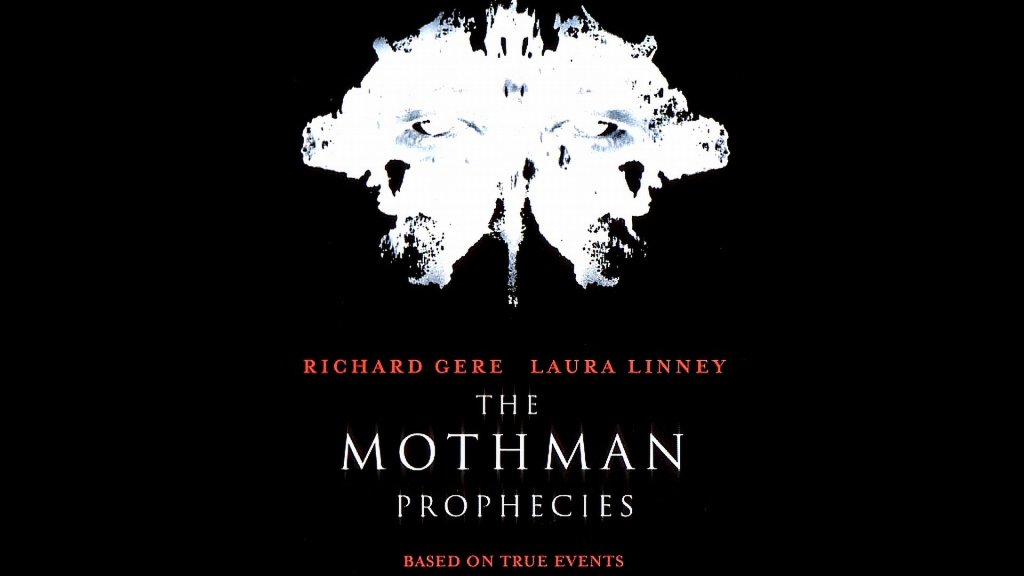
Written by: Richard Hatem based on The Mothman Prophecies by John Keel
Directed by: Mark Pellington
Featuring: Richard Gere, Laura Linney, Will Patton, Debra Messing, Lucinda Jenney and Alan Bates
John Klein:“I think we can assume that these entities are more advanced than us. Why don’t they just come right out and tell us what’s on their minds?”
Alexander Leek:“You’re more advanced than a cockroach, have you ever tried explaining yourself to one of them?”
The latest in the Imprint line has been released in the form of the Australasian Blu-ray debut of the horror/drama “The Mothman Prophecies” (2002) loosely based on the nook by the now deceased John Keel that saw some major talent in the form of leads Richard Gere and Laura Linney as well the, at the time, up and coming director Mark Pellington who bring to the screen something wholly original that does not feel like an extended “X-Files” (1991-2019) but something that is entirely encapsulated in the narrative and plot played out onscreen between a few characters that turns out to be more about loss and grief than the titular supernatural being ever present in the minds of protagonists.
Like all good genre movies the more important aspects are almost always the human stories at the heart of the plot, in this case the ability to deal with life, what it hands you, the seeming randomness of life and the idea of sudden loss is what is at the heart of “The Mothman Prophecies”. Sure there is a mystery about the idea of being for-warned about cataclysmic events and disasters which is what the main character thinks he is in need of especially after the loss of his wife to a brain tumour which ends up killing her. The main characters grief drives him to say and do things he never would have before his wife’s death, he lets his own life go for the sake of some light in his own darkness. Amongst all the mystery is a man trying to hold on to something that is already gone, it is not until he is faced with the possibility of sinking further into his own loss or turning a corner to hold onto someone who is present that he realises not only what he has lost but I way to move on.
“The Mothman Prophecies” is based around Washington Post columnist John Klein and his wife Mary who are involved in an accident when Mary swerves to avoid a black, flying figure. John survives the crash unscathed, but Mary is hospitalized. After Mary dies of an unrelated brain tumor, John discovers mysterious drawings of the creature that she had created in the hospital. Two years later, John becomes lost in West Virginia and inexplicably finds himself in Point Pleasant, hundreds of miles off his route. Driving in the middle of the night, his car breaks down, and he walks to a nearby house to get help. The owner, Gordon Smallwood, reacts violently to John’s appearance and holds him at gunpoint. Local police officer Connie Mills defuses the situation while Gordon explains that this is the third consecutive night John has knocked on his door at 2:30 AM asking to use a phone, much to John’s disbelief. John stays at a local motel and ponders how he ended up so far from his original destination. The movie then moves into a familiar genre plot that involves talking to others about similar experiences until the whispers that we hear become solid for John to solve which is where he reconciles his wife’s death.
Directed by Mark Pellington who up to this point had been known for his huge oeuvre in directing music videos for some of the biggest acts in the 1990s (he still directs music videos to this day), he had also directed the excellent conspiracy thriller “Arlington Road” (1999) to great success and so followed that up with this paranormal tale that was adapted by Richard Hatem. When viewing Pellington’s work it is not difficult to understand why he was so successful in his movies and music videos, he is a visual director and that does fail him with “The Mothman Prophecies”. Throughout the almost liner narrative there are visual clues throughout that obviously represent a Moth, there are twin visuals everywhere much like the wings of a moth or even its body or eyes, they are haunting and jarring at the very same time. Although written by a novice in Richard Hatem who has gone on to have a very good career in televisions the plot itself is rather pedestrian in that it feels like an extended genre television episode but because of the direction of Pellington it is elevated to something more personal and a highlight within the year it was produced.
This is a movie anchored by three performances, the obvious one being that of Richard Gere who had a stellar year when this was released, he also appeared in the hit “Unfaithful” (2002) and the monster hit “Chicago” (2002) so “The Mothman Prophecies” was a nice diversion and offered him a different kind of acting challenge. Gere has been known as an actor in drama, thriller and quiet epics, so a paranormal movie may have seemed a little out of left field but he was up for it and knew exactly how to play the part especially with a director who had only a small amount of feature experience. Then there are the performances of Laura Linney and Debra Messing who are excellent in their roles, Messing only appears for a short time but has to make an impact so that we believe that Gere would miss her and she does. Linney is the logical foil to Gere’s possible beliefs and her part comes into sharp focus towards the conclusion of the movie offering the grieving husband a choice in a most believable way.
I have always been a big fan of not only Mark Pellington but this movie as well so I was extremely happy to see its local release on Blu-ray and it does not disappoint I recommend this movie highly, it is a pleasure to see A list actors in a paranormal movie that is much more than first meets the eye.
Special Features and Technical Specs:
1080p high definition presentation
Audio Commentary by Director Mark Pellington
“NINETY-NINE WILL DIE: DIRECTING THE MOTHMAN PROPHECIES” – A new interview with director Mark Pellington
“NOCTURNAL BUTTERFLY: EDITING THE MOTHMAN PROPHECIES” – A new interview with editor Brian Berdan (2020)
“DON’T BE AFRAID: COMPOSING THE MOTHMAN PROPHECIES” – A new interview with composers Tomandandy (2020)
“WHAT DO YOU SEE?: DESIGNING THE MOTHMAN PROPHECIES” – A new interview with production designer Richard Hoover (2020)
Making Of featurette
Half Light music video by Low
Search for the Mothman Documentary
Day By Day – A Director’s Journey Pt 1: The Road In documentary
Day By Day – A Director’s Journey Pt 2: The Road Home documentary
Featuring: Lee Sung-jae, Bae Doona, Song Kang-ho, Kim Sang-kyung, Kim Roi-ha, Park Hae-il, Byun Hee-bong, Kim Hye-ja, Won Bin, Lee Sun-kyun, Cho Yeo-jeong, Choi Woo-shik, Park So-dam, Lee Jung-eun and Jang Hye-jin
Detective Park Doo-Man:“Did you see his face?”
[Girl Nods]
Detective Park Doo-Man:“What did he look like?”
Schoolgirl:“Well… kind of plain.”
Detective Park Doo-Man:“In what way?”
Schoolgirl:“Just… ordinary.” – “Memories of Murder”
A few months ago a collection of films were released in a box set ‘Bong Joon Ho Collection’ which contained many of the directors work including “Barking Dogs Never Bite” (2000), “Memories of Murder” (2003), The Host (2006), “Mother” (2009) and “Parasite” (2019). Now they have all been released individually with “Parasite” being given the 4K treatment and it has never looked better.
Bong Joon-ho is a South Korean film director, producer and screenwriter. His films are characterised by emphasis on social themes, genre-mixing, black humor, and sudden tone shifts. He first became known to audiences and achieved a cult following with his directorial debut film, the black comedy “Barking Dogs Never Bite” (2000), before achieving both critical and commercial success with his subsequent films: the crime thriller “Memories of Murder” (2003), the monster film “The Host” (2006), the science fiction action film “Snowpiercer” (2013), and the Academy Award-winning black comedy social thriller “Parasite” (2019), all of which are among the highest-grossing films in South Korea, with “Parasite” also being the highest-grossing South Korean film in history.
All of Bong’s films have been South Korean productions, although both “Snowpiercer” and “Okja” (2017) are mostly in the English language. Two of his films have screened in competition at the Cannes Film Festival— “Okja” in 2017 and “Parasite” in 2019; the latter earned the Palme d’Or, which was a first for a South Korean film. “Parasite” also became the first South Korean film to receive Academy Award nominations, with Bong winning Best Picture, Best Director, and Best Original Screenplay, making Parasite the first film not in English to win Best Picture.
“Barking Dogs Never Bite” (2000)
Ko Yun-ju, an unemployed academic, lives in a large apartment complex with his pregnant wife Eun-sil. He is struggling to become a university professor and grappling with his strained relationship with Eun-sil. Searching for the loudly barking dog of one of his neighbors, which is driving him crazy, he finds an unattended Shih Tzu. He tries to drop the dog from the roof, but hesitates and is stopped when an old woman comes to dry radishes there. He takes the dog into the basement instead and, after being unable to hang it, locks it inside a cabinet.
Park Hyun-nam, the lazy bookkeeper and custodian of the apartment complex, longs to be famous like a bank teller she and her friend Yoon Jang-mi saw on TV who was rewarded for stopping a robbery. A little girl comes to Hyun-nam with flyers she wants to hang up in order to find her missing dog, the Shih Tzu. Yun-ju continues to hear barking, and sees the old woman from the roof with her Min Pin, the actual source of the noise. He reads on the flyer for the missing dog that it was unable to bark because of a throat operation. Realizing his mistake, he goes to the basement at night to free the dog from the cabinet, but hides when a janitor comes in. Yun-ju watches in horror as the janitor pulls out the dead Shih Tzu and prepares to eat it.
“Memories of Murder” (2003)
In October 1986, two women are found raped and murdered on the outskirts of a small town. Local detective Park Doo-man, not having dealt with such a serious case before, is overwhelmed—evidence is improperly collected, the police’s investigative methods are suspect, and their forensic technology is near non-existent. Park claims he has a way of determining suspects by eye contact. He decides to first question a scarred mentally handicapped boy, Baek Kwang-ho, because he used to follow one of the victims around town. Park uses his eye contact method, thinking Baek is responsible, and has his partner Cho beat confessions out of Baek.
Seo Tae-yoon, a detective from Seoul, volunteers to assist them. However he and Park’s methods clash. Seo deems Baek’s hands too weak and scarred to be able to commit such an elaborate crime, clearing his name. After more murders are committed, they realize that the killer waits until a rainy night and only kills women wearing red.
“Mother” (2009)
An unnamed widow lives alone with her only son, selling medicinal herbs in a small town in southern South Korea while conducting unlicensed acupuncture treatments for the town’s women on the side. Her son, Yoon Do-joon, is shy, but prone to attacking anyone who mocks his intellectual disability. She dotes on him and scolds him for hanging out with Jin-tae, a local thug. When Do-joon is nearly hit by a car, he and Jin-tae vandalize the car and attack the driver and passengers as revenge. Jin-tae blames Do-joon for the damage done to the car, and Do-joon is sued. His mother struggles with the burden of the debt.
“Parasite” (2019)
The Kim family—father Ki-taek, mother Chung-sook, daughter Ki-jung, and son Ki-woo—live in a small semi-basement apartment, have low-paying temporary jobs as pizza box folders, and struggle to make ends meet. University student Min-hyuk, a friend of Ki-woo’s, gives the family a scholar’s rock meant to promise wealth. Leaving to study abroad and knowing his friend needs the income, he suggests that Ki-woo pose as a university student to take over his job as an English tutor for the daughter of the wealthy Park family, Da-hye. Ki-woo, presenting himself as a Yonsei University student, is subsequently hired by the Parks.
The Kim family schemes to get each member of the family a job by posing as unrelated and highly qualified workers to become servants of the Parks. Ki-jung poses as “Jessica” and, using Ki-Woo as a reference, becomes an art therapist to the Parks’ young son, Da-song. Ki-jung frames Yoon, Mr Park’s chauffeur, for having sex in the car, then recommends Ki-taek to replace him. Finally, Chung-sook takes over as the Parks’ housekeeper after the Kims exploit the peach allergy of the long-time housekeeper, Moon-gwang, to convince Mrs Park that she has tuberculosis. Ki-woo begins a secret romantic relationship with Da-hye.
Kiyoko:“The future is not a straight line. It is filled with many crossroads. There must be a future that we can choose for ourselves.”
Critical Commentary
Released recently on 4K Blu-ray is the manga “Akira” (1988) that was the first movie to really expose mass Western audiences to what manga could be as well as becoming a global phenomenon that has only grown stronger over the intervening thirty years.
“Akira” is regarded by many critics as a landmark anime film, one that influenced much of the art in the anime world that followed its release with many illustrators in the manga industry citing the film as an important influence. Manga author Masashi Kishimoto, for example, recalls becoming fascinated with the way the poster was made and wished to imitate the series’ creator Katsuhiro Otomo’s style. The film had a significant impact on popular culture worldwide. The film led the way for the growth in popularity of anime outside Japan as well as Japanese popular culture in the Western world. Akira is considered a forerunner of the second wave of anime fandom that began in the early 1990s and has gained a massive cult following since then. It is credited with setting the scene for anime franchises such as Pokémon, Dragon Ball and Naruto to become global cultural phenomena. According to The Guardian, the “cult 1988 anime taught western film-makers new ideas in storytelling, and helped cartoons grow up”.
In Japanese anime, realism and style have a strange interplay that remains its defining visual motif. With its roots in manga, the anime artist commands both elements and takes complete control. In the case of Akira, Otomo’s realism presents itself in the form of painterly images depicting the incredible iridescent cityscape of Neo-Tokyo, the images only slightly less fantastic than the futuristic vision of Ridley Scott for his Tokyo-inspired Los Angeles in Blade Runner (1982). On the other hand, Otomo employs a more comic-book stylization elsewhere, particularly in the less weighty and more actionized or comic relief scenes involving Kaneda. Anime often has these juxtapositions of style and tone, but few blend as well as Otomo’s approach in Akira.
His massive scope celebrates the glorious Neo-Tokyo, but his entertaining and thrillingly composed action sequences don’t betray, except in pitch, the other more grandiose visuals. With anime, sometimes the need for multiple artists working on a single film results in an inconsistency of style. Still, Otomo’s production spared no expense to bring uniformity to the screen. The result is awe-inspiring at times and completely immersive. At the same time, Otomo’s reach, given his unquestionably cinematic approach, becomes evident everywhere from countless other Japanese anime films such as Ghost in the Shell (1995) to live-action works like The Matrix (1999) and The Fifth Element(1997). But the film is much more than attractive visuals, sci-fi concepts, and rousing motorbike action.
Set in a dystopian 2019, Akira tells the story of Shōtarō Kaneda, a leader of a biker gang whose childhood friend, Tetsuo Shima, acquires incredible telekinetic abilities after a motorcycle accident, eventually threatening an entire military complex amid chaos and rebellion in the sprawling futuristic metropolis of Neo-Tokyo.
After twenty-five years, Katsuhiro Otomo’s Akira still inspires awe. As a seminal work of anime, cyberpunk or otherwise, it still has yet to be matched in its epic stature. Hollywood has tried for more than a decade to produce a live-action adaptation, resulting only in false starts. But no amount of expensive computer-animated special FX, star power (names involved have included Leonardo DiCaprio, Keanu Reeves, and Garrett Hedlund), or blockbuster production value could ever match the singular vision Otomo achieved in 1988. His limitless spectacle of a nuked world reborn into a frightening dystopian city—teeming with the subgenre’s usual range of cyberpunks, telekinetics, and authoritarian bad guys—may overshadow the emotional depth of his characters and their often overly expositional dialogue. But Otomo’s audience is so rapt by the proceedings that these criticisms hardly seem important. Akira remains so densely steeped in spectacle, out-there sci-fi ideas, and an overload of visual information that its social and cultural commentaries may go overlooked. Despite this unbalance, such an extraordinary achievement demands to be seen and seen again for re-evaluation into its deeper relevance—and to be appreciated as a landmark not just of anime but of international cinema.
Technical Commentary
Video
If you thought the 25th Anniversary Edition of Akira on Blu-ray (in SteelBook packaging) released in 2017 looked good, you’ll be even more impressed with this 4k Blu-ray upgrade. The video is presented in 2160p at 16:9 widescreen aspect ratio with HDR10 High Dynamic Range. The colors are vibrant, contrast is striking, and sharpness about as good as a 30 year old film can get. It’s amazing how rich the black levels can be in some scenes given the fact this is hand-drawn and not computer-generated animation.
Some of the artefacts that were more evident in older Blu-ray and DVD editions were hard to come by in this edition, but it’s also worth noting that not all mistakes were removed. The amount of detail is really what’s striking on 4k Blu-ray. Much of the graffiti in the background images, elements like broken glass, texture in the brick walls, sidewalks and streets, are all more visible in 2160p.
Audio
Japanese audio is the way to listen to Akira, with a 24-bit Dolby TrueHD 5.1 soundtrack that Sound Director Susumu Aketagawa says was remixed to take advantage of the higher quality format. English audio comes close with a 16-bit TrueHD 5.1 track (mixed in 2001), but is not as dynamic as the new TrueHD track. Listening to Akira in Japanese also just seems so much more authentic than with English dubs. If you don’t speak Japanese we suggest viewing subtitles to follow the film (at least to get a taste of the higher-definition Japanese mix).
Extras
This 3-disc edition of Akira packages a separate BD-50 with bonus material (some previously released) that includes AKIRA Sound Making 2019, AKIRA Sound Clip by Geinoh Yamashirogumi, End Credits (From The Original 1988 Theatrical Release), Theatrical Preview — Trailer Collection (with English Subtitles), and Storyboard Collection.
Written by: Robert Lorenz, Chris Charles and Danny Kravitz
Directed by: Robert Lorenz
Featuring: Liam Neeson, Katheryn Winnick, Juan Pablo Raba and Teresa Ruiz
Jim:“I don’t scare easy.”
Released on Blu-ray and DVD is the latest in a long line of Liam Neeson starring action movies in the form of “The Marksman” (2021) a bit of a throwback to the 1990s where a movie would not only feature action but would also make a comment on some kind of issue, in this case there is a cursory nod towards immigration and the crime that goes with that. Now don’t expect some kind of dissertation by the main character because this is still an action movie, albeit not a very good one as the plot and narrative seem as tired as Neeson looks in this movie. “The Marksman” definitely thinks it is one thing, an earnest Clint Eastwood style movie but is devoid of any nuance or the subtilise that Eastwood, who is a master filmmaker brings to even his worst movies. This is mainly due to the script as well as the direction both of which are in a word, bland.
At almost seventy years old Liam Neeson is now known as an action movie star which is certainly saying something about the age we are living in. Of course we all know how since starring in “Taken” (2008) almost fifteen years ago Neeson has consistently made action movies of varying quality, in saying that they have almost all made money in one form or another, the reason is obvious, Neeson has the kind of charisma that the aforementioned Eastwood has, it is unfortunate then that he seems to lack the material to really show it. In fact since taken Neeson has appeared in eighteen action movies in fourteen years so it is a genre he knows intimately. There is also no doubt that the best of those movies have been helmed by Pierre Morel and Jaume Collet-Serra.
“The Marksman” is based around former United States Marine Corps Scout Sniper and Vietnam War veteran Jim Hanson who lives along the Arizona-Mexico border, reporting attempted illegal crossings. One day, while on patrol, he encounters Rosa and her son Miguel, Mexican citizens on the run from the cartel. Hanson calls border patrol on them before he sees the cartel coming up. He ends the call and gets involved in a shootout with the cartel led by Mauricio. Hanson shoots and kills Mauricio’s brother; Rosa is fatally wounded by one of the cartel members. Before she passes, she gives Hanson a note that lists her family’s address in Chicago. Hanson reluctantly agrees to take Miguel to her family in Chicago.
This movie is written and directed by Robert Lorenz whose previous outing was the Clint Eastwood starrer “Trouble with the Curve” (2012) which seemed to waste all those involved with a relatively route script as well as some basic direction. Lorenz had previously worked on Eastwoods films and again while many of those films had the laconic and seemingly effortless signature of Eastwoods films none of that was present in “Trouble with the Curve” or “The Marksman”. What is unfortunate is that Lorenz has chosen to represent the villains in this movie in such a reductive way matching any stereotype that any viewer could think of. This matched with the morale character of Jim Hanson mean that we are seeing the Alamo played out again with a very different outcome which is an odd thing to happen in this type of movie, especially one that has been played out time and time again, most recently in “Logan” (2017) with much better results.
Of course the movie is supposed to be anchored by Liam Neeson and he does what he can with the material given playing someone beaten by the system and a widower to boot. He is a man who has been set up as someone living out of time with no real allies and nothing to lose which is an archetype seen in older movies, the question I have is who is this movie appealing to? There is a supporting cast with the biggest name being legitimate action star Katheryn Winnick, who here is almost given nothing to do but play the shrill, a woman who constantly whines and moans until she finally just leaves to let the man do his thing, be a man. Winnick deserves so much more than this, especially from someone who played the shield maiden Lagertha so well in “Vikings” (2013-2021).
This movie is so paint by numbers that I find it insulting there are three credited writers on this almost racist diatribe if white people versus Mexicans, not only that but it doubles as a white people will also save the Mexicans. I get why Neeson would star in this movie and it comes down to money which I assume the producers were willing to fork over to get a legitimate action star. However I cannot really recommend this movie at all, it has little redeeming value at all.
Written by various based on the All Souls Trilogy by Deborah Harkness
Featuring: Teresa Palmer, Matthew Goode, Edward Bluemel, Louise Brealey, Malin Buska, Aiysha Hart, Owen Teale,Alex Kingston, Valarie Pettiford, Trevor Eve and Lindsay Duncan
Matthew Clairmont:“Once the world was full of wonders, but it belongs to the humans now. We, creatures, have all but disappeared. Daemons… vampires… witches… hiding in plain sight. Ill at ease even with each other. But, as my father used to say, in every ending, there is a new beginning.”
Released recently on DVD is the second season of the Deborah Harkness adaptation “A Discovery of Witches – Season Two” (2021) which sees all of the first season characters back for more witch, vampire and demon action that feels more like a supernatural version of “Outlander” (2014-present) with less history and much more brooding although there does seem to be more a plot after the initial season that for me was a little plodding narratively except for the scenes in which the great Lindsay Duncan would make an appearance all arch and mysterious.
The past thirty years or so has seen the proliferation of tween supernatural sagas in book form which on one hand means that people are still reading which is a feat in this age of screens and social media, on the other hand since the global box office success of certain fantasy properties, both old and new, means that even below average books now seem to be able to make it the big screen or in this case small screen. Upon a cursory glance “A Discovery of Witches” may seem like a Twilight ripoff there is a little more going on, and of course it gains credibility by being set in Europe. In fact this series owes more to the aforementioned “Outlander” especially this season with its time travel aspects as well as the meeting of historical characters which I enjoyed immensely.
In case you missed it “A Discovery of Witches” concerns Diana Bishop, a historian and reluctant witch, who unexpectedly discovers a bewitched manuscript in Oxford’s Bodleian Library. This discovery forces her back into the world of magic in order to unravel the secrets it holds about magical beings. She is offered help by a mysterious geneticist and vampire Matthew Clairmont. Despite a long-held mistrust between witches and vampires, they form an alliance and set out to protect the book and solve the mysteries hidden within while dodging threats from the creature world.
One of the issues with a multipart television series is that there are normally different writers and directors working any number of episodes, that is the case here although there are a limited number of these so the style is mostly carried through episode to episode which means there is a nice look and feel to series two. For the most part the narrative holds together nicely with the strength of this new season being the trip to the past and the discoveries made there.
In the leads Teresa Palmer and Matthew Goode both seem to be able inhabit their own characters and I believe since both have been involved in genre film before they know exactly how to play these parts. My only concern is that they play these parts a little too stiffly and sometimes it feels like Bella and Edward redux. As I have mentioned my favourite character is Ysabeau De Clermont played by Lindsay Duncan who like her costars has been in genre television before so knows what she is doing. This series we also get to meet Philippe De Clermont played by James Purefoy who was a welcome addition, I hope there is an excuse to bring him back for the final series.
In contrast, A Discovery of Witches is, considering the subject matter, painfully genteel. Despite featuring vampires on the loose it rarely lets much blood flow, and the boffing between these two inhuman superbeings, whose ardour is meant to fuse two immortal, elemental forces, is strictly vanilla. The big consummation in season one was over in seconds and somehow involved both participants keeping their trousers on, while the central relationship doesn’t work as an elegant, demure will-they-won’t-they romance either. Diana and Matthew committed themselves to each other fully about three episodes in, and have been comfy companions ever since. Teresa Palmer and Matthew Goode are competent leads, but they look as if they want to sack off this netherworld palaver, climb into a Range Rover and hit David Lloyd’s for a jolly game of doubles and a nice Aperol spritz.
For a series about vampires, witches and demons there seems to be a conscious effort to steer away from too much blood, gore and violence, something that many tween stories have to do or risk turning away audiences. Even with this I do enjoy watching the show although the need for cliffhangers does seem forced but knowing there is only one more season means I will be back as I suspect readers of the books will be as well.
Episodes
In Madison, Satu, Knox and Gerbert arrive at the Bishop house to find that Matthew and Diana have disappeared. The couple arrives in 1590’s London and are confronted by a face from Matthew’s past.
As Diana continues her search for a mentor she meets a wealthy alchemist Mary Sidney. London’s vampire ruler demands fealty from Matthew.
In the present, Domenico makes a disturbing discovery in Oxford. Back in 1590, Matthew must beg for forgiveness from Father Hubbard.
Another vicious vampire murder rocks present-day Oxford. Marcus makes a breakthrough.
Matthew and Diana arrive in France on their journey to face Philippe. Elsewhere, Louisa and Kit cut a swathe through London.
Philippe makes a troubling discovery, provoking a conflict with Matthew. Ysabeau, Em and Sarah start to look for a message.
Matthew and Diana go to Bohemia to search for Edward Kelley and the Book of Life. There, they encounter the strange Emperor Rudolf II.
In 1590, Diana is transfixed as she tries to work out what the Book is telling her. Matthew worries over the Book’s power.
As Diana and Matthew return to London, Diana learns news that could change everything. The Queen holds Matthew to account.
Realising that she must return to the present, Diana aims to complete her training.
Featuring: Steven Yeun, Han Ye-ri, Alan Kim, Noel Kate Cho, Youn Yuh-jung and Will Patton
Soonja:“Minari is truly the best. It grows anywhere, like weeds. So anyone can pick and eat it. Rich or poor, anyone can enjoy it and be healthy. Minari can be put in kimchi, put in stew, put in soup. It can be medicine if you are sick. Minari is wonderful, wonderful!”
Released on Blu-ray and DVD is one of the better reviewed movies of the past twelve months in the form of “Minari” (2020) a foreign language film set in rural US. “Minari” was nominated for six Academy Awards eventually winning one for Youn Yuh-jung in the category of Best Supporting Actress, although it could have easily won more having shone in many other awards shows. The movie itself deals with something many people can identify with, arriving in a new country where the main aim is to carve out a new life for your family all the while maintaining an identity that you can reconcile with a new culture that is different from what has been experienced in the past.
The film is sent in 1983, the Korean immigrant Yi family moves from California to their new plot of land in rural Arkansas, where father Jacob hopes to grow Korean produce to sell to vendors in Dallas. One of his first decisions is to decline the services of a water diviner and he digs a well in a spot he finds on his own. He enlists the help of Paul, an eccentric local man and Korean War veteran. While Jacob is optimistic about the life ahead, his wife Monica is disappointed and worries about their son David’s heart condition; he is frequently told not to run due to this. Jacob and Monica work sexing chicks at the nearby hatchery and argue constantly while David and his sister Anne eavesdrop. To help watch the children during the day, they arrange for Monica’s mother Soon-ja to travel from South Korea. David, who is forced to share a room with her, avoids her because she does not conform to his idea of how a grandmother should be. Still, Soon-ja attempts to adjust to life in the States and bond with the children. The story from here gets more complex and I am not going to explain any more what happens to avoid spoilers, but it is an intense story that reflects real experiences and possibilities for an entire family over three generations.
“Minari” is partly the story of Jacob’s struggle to get his new business up and running in a very naturalistic way, but of course with all the peace comes volatility from his family and from those around him in the wider area. Minari is a leafy green vegetable (sometimes called water celery or water dropwort) popular in Korean cooking. In this movie, it flourishes in an Arkansas creek bed, supplying a title, a precise bit of detail. This story is a type of frontier exploration in a place that has been abandoned but is now a home for a new type of family. Like farmers before the family is isolated from each other and from the world around them, life is tough for the time it is set and this comes through with the sparse filing created by the writer/director who knows exactly the storey he is telling, I must say expertly. Interestingly the genre is a movable feast that brings comedy into the fold with the arrival of Oscar winner Yuh-Jung Youn, a Sonja the suffering Mother.
Written and Directed by Lee Isaac Chung “Minari” is that rare film that embraces its predictability while offering audiences twists and turns along the way to its ending. The immigrant family is now a genre unto itself that does breed familiarity but everyones story is its own thing and that is true here. It’s not just that Chung, a Korean-American filmmaker in his early 40s who grew up on a farm in Arkansas, is drawing on what he knows. Like any good or even great relatively independent or low budget film “Minari” is not only deeply personal but original in its setting and execution, can you think of another foreign language US movie set in rural America with not only truly unique immigrants but also those US citizens around them, it demands repeat viewings and deserves them.
“Minari” is undoubtedly led by the central performance of Steven Yeun who shines in this movie much like he has for the past little while especially since the critical hit “Burning” (2018) directed by Chang-dong Lee. However this movie is also bolstered by the entire cast and it has to be said by Youn Yuh-jung who almost steals the entire film with her fantastic Oscar winning turn as the somewhat matriarch of the newly arrived family. It is also great seeing Will Patton as a character only he can play, very strange yet very authentic.
This is a film that not demands to be seen but is also an outlier in one sense but a narrative that we will be seeing more of in the years to come when there is now a demand for new, interesting stories about people we have never seen before but told from their own point of view and not told by outsiders. “Minari” is also a film that engages and invites points of view of different ages from the very young to the seniors which again reflects our society now although the idea of the aged offering wisdom is an idea that could grow, especially after the recent US election.
I recommend this movie highly and it should be a part of any collection, it is an easy rewatch.
Featuring: Olly Alexander, Omari Douglas, Callum Scott Howells, Lydia West and Nathaniel Curtis
“It’s a, it’s a, it’s a, it’s a sin It’s a sin Everything I’ve ever done Everything I ever do Every place I’ve ever been Everywhere I’m going to I It’s a sin” – Pet Shop Boys – It’s a Sin
Released recently on DVD is the miniseries “It’s a Sin” (2021) written by Russell T Davies that is based around the AIDS epidemic from the early 1980s to the early 1990s based in London and is taken from some of the writers own experiences which is one of the most important aspects of this limited series. It may seem that in this enlightened era it would not be an effort for someone who rebooted the sci-fi series “Doctor Who” (1963-present) not only into something viable but into a global juggernaut as well as creating the groundbreaking “Queer as Folk”(1995-2005) but as it turned out this was a series that had to be fought for, not only that it was originally planned as eight episodes but it could only be greenlit at five episodes. Davies it has to be said is a very good writer especially at getting themes, issues and straight forward narratives across to mass audiences while instilling originality into subjects that have been seen before, he is truly talented and this comes across in “It’s a Sin”, his most personal story in a few decades.
The themes and narrative of “It’s a Sin” are not new at all, in fact there have been many AIDS era dramas written, not only that but they have been around since the epidemic themselves, some of these are “And the Band Played On” (1993), “Jeffrey” (1995), “It’s My Party” (1996), “Angels in America” (2003) and “The Normal Heart” (2014) just to name a few. What is interesting and more than unique is that this new series is set in London and is written from a certain point of view. The series also does not get mired in too much melodrama and science, in fact there is a lot of humour and the life that some of the main characters have.
The series itself follows a group of gay men who move to London in 1981. They form a friendship group but the fast developing HIV/AIDS crisis in the United Kingdom impacts their lives. Over five episodes the group are shown living through an entire decade until 1991, as they become determined to live fiercely despite the threat HIV poses to them.
As already mentioned “It’s a Sin” has been written by Russell T Davies from a very personal point of view, so what does that mean in terms of what we see on-screen? Well while the entire cast is not white the main point of view and illness related aspects are very white which for me is completely understandable because guess what, Davies is a gay white man and that is what he knows which ends up on the screen, that is the main criticism but it should not put anyone off from watching what is a very good miniseries. The other aspect of “It’s a Sin” is the director and in this case the producers were able to recruit Peter Hoar who is a very experienced director who has been operating for years and has a great eye, here he brings that eye to bear with a colourful palette as well as many different viewpoints which suits the writing down to the ground.
“It’s a Sin” has been cast extremely well with the lead being Olly Alexander who is fantastic throughout, he embraces the role and it is not difficult to imagine him in the 1980s behaving exactly like he does in the series. There are great supporting actors in the form of Omari Douglas, Callum Scott Howells, Lydia West and Nathaniel Curtis who all are fresh and young and bring this to their performances which give the series a huge amount of depth.
This is a series that is very well done and is a snapshot of how it must have been for some people in the 1980s who were dealing with the AIDS epidemic on the front lines and offers a microcosm look at a group of people that are all fascinating in one form or another. “It’s a Sin” is not perfect but the mere fact that creator Russell T Davies was able to construct a narrative from his own personal story says something not only about him but that experience of living through this time, something that must have been terrifying. This is a show like many of its genre that is able to be watched again and again and you owe it to yourself to do just that.
Episodes
Episode 1: September 1981. The lives of five friends converge in a flat together in London. Roscoe runs away from home when he learns his father intends to take him back to Nigeria. Ritchie Tozer, who has not come out to his parents, pursues his dreams of being an actor with his friend Jill. Colin begins a sales apprenticeship at a Savile Row tailor, where he is befriended by Henry Coltrane. Coltrane and his partner mysteriously fall ill and die of rare cancers.
Episode 2: December 1983. Despite education outreach by AIDS activists, Ritchie remains in denial and spreads conspiracy theories and AIDS denialism. An old friend, Gregory (known as Gloria), hides after falling ill and asks Jill to secretly buy his groceries. Jill struggles as she worries the illness is infectious and starts to over clean and sanitise. Gloria’s illness gets worse and his hostile family brings him back to Glasgow, where he soon dies. Colin is sexually harassed by his boss on a trip to New York and is subsequently fired after his boss sees publications on AIDS that Jill had requested and fears he could have the disease. Jill tries but fails to get the men to realise the risks of casual sex.
Episode 3: March 1986. Colin finds work in a print shop and volunteers as an AIDS activist along with Jill. Ritchie begins a relationship with another actor but is forced to confront the reality of AIDS. Colin is diagnosed with AIDS and is detained in a hospital under the Public Health Act, 1984. His mother and friends watch in horror as he suffers rare neurological symptoms caused by progressive multifocal leukoencephalopathy. A one-night stand leads Roscoe to a profitable relationship with a closeted Conservative MP. With the help of a lawyer, Colin is released from the Welsh hospital and brought to London to be cared for on a unit where many other men are suffering from AIDS. Ritchie, Jill, Ash and Roscoe visit Colin, but his condition worsens and he dies. Everyone is heartbroken by the loss and it prompts those who were close to Colin to take the HIV test.
Episode 4: March 1988. Ritchie is diagnosed with AIDS and goes home to the Isle of Wight where he struggles to confide in his family. He speaks with an old friend and decides to return to London, vowing to fight the disease. Ash is ordered to censor the school library to comply with new rules forbidding public institutions from informing children about homosexuality under Section 28. Roscoe takes a personal stand against Prime Minister Margaret Thatcher as protests begin against pharmaceutical companies who are profiting off the disease.
Episode 5: November 1991. Ritchie’s condition worsens and other friends continue to die. Ritchie dreams of returning to the stage and insists on chemotherapy when he is diagnosed with lymphoma. Ash and Ritchie confess their feelings for each other, and Ritchie’s parents finally discover the truth and take him home to the Isle of Wight. Jill and Roscoe follow, but are denied the opportunity to say goodbye to Ritchie before he dies. Jill confronts Ritchie’s mother for making him live in shame. After heading back to London, Roscoe goes home to see his parents and Jill visits the hospital to support a lonely man dying from AIDS. The ending shows a flashback to Ritchie and his friends enjoying their time together, before the AIDS pandemic hit.
Featuring: David Schwimmer, Nick Mohammed, Jane Stanness, Sylvestra Le Touzel, Gana Bayarsaikhan, Eliot Salt and Oliver Birch
Joseph:“I have written a program that should be able to narrow down whether the person responsible for this cyber attach is male or female.”
Recently released on DVD is the British comedy “Intelligence – Season One” (2020) which is based around a cyber crimes unit with a fish out of water narrative that hits more than it misses with a spot on performance by US actor David Schwimmer, and a bumbling performance by writer/creator Nick Mohammed who both have undeniable chemistry and at times are probably far better than the material.
The show is based around NSA agent Jerry(David Schwimmer) who is assigned to act as liaison to the cyber crimes unit in the UK’s Government Communications Headquarters, quickly antagonising the unit’s chief with his brash style and tendency to try to take over.
“Intelligence” may sound familiar with a narrative that involves an unknown quantity in a US operative arriving in the UK to be part of an all English team that at times bristle at his arrival and who is controlled by an older woman who has her own ambitions. You might be fooled into thinking that this is a somewhat haphazard description of critical darling and Apple TV stalwart “Ted Lasso” (2020-present). That series also features Nick Mohammed in a central role as a bumbling but intelligent sidekick so it is not difficult to see where he may have derived the idea from. The only minus in “Intelligence” is that is uneven in execution which could be put down to Mohammad or the direction of Matt Lipsey although it is possibly the former rather than the latter.
This series written by Nick Mohammed and directed by Matt Lipsey is as mentioned a fish out of water story with the added complication that the fish in this case an American is convinced he is a big fish so all manner of clashes occur which narratively wise is fairly easy to write. The strength in the series is definitely the performances of Mohammed and Schwimmer who seem to be having a good time with the material. The other element that has to be mentioned is the direction by super experienced director Matt Lipsey who really only has a few sets to deal with which could be a challenge in anyone else’s hands but he is able to bring originality to almost every set up which has to be commended especially with such small spaces.
The central performances by both Nick Mohammed and David Schwimmer are as broad and manic as they should be with both really going for it which can lead to some uncomfortableness especially from Schwimmer who is embracing all the negative elements you would expect from an American in a position he thinks he is control of. The supporting cast are all excellent who have been written to be as different from each other as possible so as to hit as many differences as possible and they all do to their credit. This can lead to some exhaustion as well as them all not being either as fully complete as possible as well as their own narratives not being as polished as they could be.
There have been some negative comments about this show but I found it funny and delightful but that might be because I have really liked Mohammedin almost anything I have seen him in as well as Schwimmer whom I have not always liked but I think he does a fine job here.
Episodes
When NSA agent Jerry joins a team at GCHQ tackling cyber crime, junior analyst Joseph is particularly excited. But Director of Cyber Security Christine is less keen with the shakeup and wants to know the real reason Jerry is over here.
The whole team are forced to redo their aptitude tests after Joseph accidentally deletes the departmental personnel files. Afraid of having to take a polygraph, Jerry manoeuvres to take over and run the test procedure himself.
When the NHS servers are hacked the whole team are forced to work through the night. Jerry finds the work tedious and coerces the rest of the team into tracking down the culprit behind the attack his own way.
Jerry suggests the person behind the cyber attack on GCHQ should join the team. But Joseph becomes jealous of Jerry’s cool new friend and looks to change his image and win back Jerry’s affection.
When Jerry admits that he has slept with Tuva, Joseph is devastated. But when he learns that Jerry is married he begins to question their whole friendship. Having failed her appraisal, Christine attempts to soften her style.
When Jerry learns that his best friend Clint, an FBI Agent, has been sleeping with his wife he accidentally shoots him. When Clint shows up at GCHQ with an extradition order for Jerry, the staff stage a wedding to protect him.
“The Man from Snowy River – Series 1 – 4” (1994-1996)
Television/Drama
Sixty-five Episodes
Based on Banjo Paterson’s poem “The Man from Snowy River”
Featuring: Andrew Clarke, Wendy Hughes, Brett Climo, Hugh Jackman, Guy Pearce, Joelene Crnogorac, Sheryl Munks, Kristie Raymond, Josh Lucas, Amanda Douge and James Sherry
Jessica Harrison:“If I’d wanted your help, mate, I would’ve asked for it.”
Released this month on DVD is the early nineties Australian television series “The Man from Snowy River – Series 1 – 4” (1994-1996) which was created after the two movies that were successes in the 1980s. As much as this seems like an attractive proposition this is a series of its time with a nod to previous US dramas such as “The Waltons” (1972-1981) as well as a host off other televisions shows spun off from movies such as “The Magnificent Seven” (1998-2000). Of course because of the time it was produced there is a very standard narrative that accompanies each episode making it an easy watch from week to week and year to year, however if watching many episodes close together the weakness in storytelling becomes apparent. These kind of weaknesses are not present in the best series made today, of course it is still present in many network shows, in particular those known as procedurals.
“The Man from Snowy River” was an Australian drama television series based on Banjo Paterson’s poem The Man from Snowy River. The series follows the adventures of Matt McGregor (Andrew Clarke), a successful squatter, and his family. Matt is the hero immortalized in Paterson’s poem, the series is set 25 years after his famous ride. The first season was very much a soap opera with several story arcs, but the primary one concerns the arrival of Matt’s American nephew, who’s bent on revenge, certain Matt cheated his father out of the station Matt now owns. In subsequent seasons, there were shorter story-arcs, often featuring guest stars over a few episodes, and some episodes stood entirely on their own. This television series has no relationship to the original Australian movie “The Man from Snowy River” (1982) or the sequel The Man from Snowy River II (1988).
One of the issues that make the series confusing as well as a little muddled is that there were a myriad amount of producers all pulling the show in different directions, something that was a common element of many series that were ultimate unsuccessful. If there is one thing that has been proven time and again especially in the modern era is that truly successful and memorable shows have a single voice at the helm with support from experienced writers and creatives, unfortunately this is not the case here.
One of the benefits of filing in Australia was the prevalence of cameos and guest stars that included Andrew Clarke, Guy Pearce, Josh Lucas, Victoria Tennant, Olivia Newton John, Tracy Nelson, Lee Horsley, Dean Stockwell, Chad Lowe, Jane Badler, Wendy Hughes, Hugh Jackman, and Frances O’Connor. This is something that “The Man from Snowy River” has in common with many Australia television productions of the time, including the long running “Blue Heelers” (1994-2006) which included many of the same up and coming actors but had a small amount of creatives running it and must be held up as an example of what success looks like in adult drama.
To say all of that “The Man from Snowy River” is still a good watch and something that can still be enjoyed especially if one was a fan of the original movies and wanted something to sate an appetite that attempts to show an imagined past of Australia where some of the more distasteful elements of life are ignored. That is not to say that these events should not be ignored as they can be found in other movies and television shows. I do recommend this as it not only is good value but shows how far narrative television has come in the intervening thirty years.
Episodes
Series One
The Race: The famous Matt McGregor finds himself drawn to a beautiful young widow who has returned to Australia, while at the same time a mysterious and dangerous young American lad challenges him.
Pascoe’s Principles: When the sadistic new school teacher savagely punishes his daughter Danni, Matt is forced to take action. His son and nephew, Rob and Luke play dangerous games to win the affections of the beautiful Victoria Blackwood.
Kathleen’s Choice: A competitor arrives to challenge Matt for the affections of Kathleen O’Neil until Matt and Kathleen have a romantic encounter while snowbound.
Partnerships: Their romantic affair takes a comedic turn when Rob rescues Victoria after she is stranded in the outback.
Where There’s Smoke: Seeking revenge against Matt for supposedly abandoning her, his old flame returns home to Paterson’s Ridge. Luke strikes gold and becomes a serious threat to Matt.
Tracks of Gold: Kathleen feels rejected by Matt and decides to end the relationship while Danni and Michael are lost in the mountains.
Plans of Poison: Matt stands by Kathleen when the rest of the town turns against her.
Stepping Out: Luke accuses Matt of stealing Langara from his father, but also finds himself falling in love with Anita.
The Bushranger: As Matt goes to save Kathleen who he finds is being held hostage, a tragic accident occurs involving Anita and her brother.
The Rustlers: Danni experiences the heartbreak of first love as Colin and Emily get married.
The Loneliness of Luke McGregor: Luke asks for Victoria’s hand in marriage with shocking results.
Love Finds a Way: Luke’s entire world collapses around him when he loses Victoria and his gold.
The Stampede: Matt stands to lose everything he owns, including Langara.
Series Two
The Hostage: Colin speaks out against alcohol after a teenager is found drunk. The bootleggers in turn set light to the church. At the same time, Grady Hocking and his two sons, George and Greg, have come to town.
The Savage Land: Matt and Oliver become lost in the desert while returning to Paterson’s Ridge from buying stock. Matt accepts the help of an Aboriginal and his wife, but Oliver refuses.
The Railroad: Poor railroad workers live in deplorable conditions, and Kathleen sets out to help them and their families.
Fathers and Sons: Victoria returns from England with her fiancé, Baron Hugh Trevalyan, in tow. However, friction is caused in the Blackwood house when it emerges that Hugh is not as gallant as he seems. Meanwhile, Rob takes on a contract to supply the British army.
The Manly Art: The arrival of a travelling boxing troupe in Paterson’s Ridge, led by “Dandy” Jim O’Rourke, has the community, including the McGregors, ready to try their hand. A visiting pianist is suspected of being a con man.
The Dry Argument: A drought causes a flood of hostility between the McGregors and the Blackwoods over a shared boundary creek when Frank changes the course of the stream.
Servant of the People: Matt and Kathleen fight a land-grabbing politician’s scheme to drive the farmers from the high-country after news breaks that their high-country grazing leases are about to expire.
The Search: A trapper wanders into town with news about Joanna’s father.
The Lost Child: Joanna Walker is determined to find her half-brother and Kathleen O’Neil agrees to accompany her in the search.
The Foundling: While going to fish one day, Colin and Rob discover the stagecoach, which tumbled down a cliff. The only survivors are a woman and a baby. The woman, Ruth Whitney, claims that the baby is not hers, but nobody in Paterson’s Ridge believes her.
The Long Arm of the Law: Edward Dengate is the new constable in Paterson’s Ridge, which he hates because he would rather be a farmer. Matt convinces Edward’s father that he cannot choose his son’s life for him, and Edward leaves to fulfill his dream.
The Recruit: The British army comes to town and attempts to recruit the locals using some dubious methods. Much to Matt’s dismay, Rob is tempted to enlist. However, Rob finds himself conflicted about leaving because of his growing feelings for Ruth.
The Reilly Gang: The notorious Reilly gang turns up in Paterson’s Ridge in an attempt to evade being captured by the state troopers. While Matt and Rob are away mustering, the Reillys arrive at Langara and take Colin, Emily and Danni captive.
The Choice: Ruth is forced to make a difficult decision after she is offered a position with the Associated Press in America. Ruth’s article on the founding father of Paterson’s Ridge threatens to unearth a Blackwood family secret.
Man and Boy: A young aboriginal boy must choose between his heritage and an education when his father arrives in Paterson’s Ridge.
Flight of Fancy: The residents of Paterson’s Ridge are given a look into the future when a hot-air balloon crashes. The pilot charms the townspeople – especially Michael, who is inspired to build a glider.
Code of Ethics: Kathleen’s exposure of a government scandal surrounding a new railway line threatens Matt’s position as the town’s parliamentary representative and puts their relationship to the test.
The Cutting Edge: Matt and Kathleen intervene and devise a plan to save the town’s sawmill from bankruptcy.
House of Worship: The arrival of a family of Russian refugees in Paterson’s Ridge creates friction with the locals, just as the completion of Colin’s new church is uniting the community.
Series Three
A Sea of Troubles: Matt is held responsible by an angry landowner when the government decides to take his land to dam the valley.
Rough Passage: Rob and Michael have an accident while taking the old printing machine to get the new one – resulting in Rob’s leg becoming pinned under the cart. Meanwhile, Matt and Colin tackle a stubborn tree stump.
The Grand Wedding: Matt and Kathleen’s wedding day is marked, and could be marred, by a woman who appears at the church and wants to buy a horse from Matt. Matt finds a riderless horse and goes off to investigate, without telling anyone.
Montana Territory: Montana’s new horse is stolen by rustler Seb Holgate after she bests him in a shooting competition. Montana sets out after him and is joined by Kathleen.
High Country Justice: McGregor takes a stand between an aboriginal man who is accused of the murder of a teenager, and the victim’s father and two brothers who want revenge.
The Question of Danni: Danni and her father Matt argue after he tells her he wants her to go to a ladies finishing school. Objecting, Danni runs away to the cabin and spends the night, only telling Michael where she was going.
The Prodigal Father: Part 1: Kathleen’s husband, who was thought to have perished eight years ago, returns to make amends with Kathleen and Michael for his deceit.
The Prodigal Father: Part 2: Emily is still ill from drinking water from the river and it turns out someone has built a dam. Matt makes the decision to get rid of the dam by using dynamite, but one person is killed in the explosion.
Fire Boy: Josh is found in the woods but refuses to talk to anyone. Two graves are found, of his parents, so Emily and Colin take him in. But then people come to take Josh away – will he talk and tell the truth in time to stay?
Blind Faith: Matt is blinded in a mining explosion and is aided by Kathleen and the family as he struggles to regain his sight. Meanwhile, Colin reveals a dark secret from his childhood.
Shoshoni Dreaming: A man who claims to have been wounded by outlaws recuperates in Paterson’s Ridge – at the same time that Montana’s ranch comes under a succession of attacks.
The Trial of Hetti Lewis: Montana is charged with the murder of Sam Taylor’s father and scheduled to be extradited to America. But Matt and Kathleen get her a hearing in Paterson’s Ridge with Matt as her defender.
Toy Soldiers: When Matt allows visiting soldiers to camp on his land, Michael and Josh get swept up in the romanticism of the military – and Josh sets his sights on carrying a gun.
A Mid-Winter Nights Dream: Danni falls in love with a stranger who arrives in Paterson’s Ridge. His presence seems to have an encouraging effect on all the romances in town but his gift to make others happy masks his own unhappiness.
In Duty Bound: When Matt and his family visit Melbourne, they become embroiled in a political plot between English and Russian royalty.
The Lion and the Lamb: During Paterson Ridge’s charity sale, a book belonging to Mr. Elliott is accidentally sold. Kathleen finds – and publishes – a love poem that falls from the book but who is the lady of Herbert’s dreams?
Broken Hearts: A fair is held in aid of church funds and members of Patterson Ridge all make donations. When a hand-written love poem is found in a second hand book, gossip around town is rife as everyone tries to work out who wrote the poem.
Deliverance: Mr Gleeson and Kathleen travel to Mansfield to collect an old friend who has travelled from England to visit him. When their carriage skids down an embankment, they find themselves stranded and injured in the bush.
A New Life: Part 1: A friend of Emily’s arrives in Paterson’s Ridge with her newborn child in search of a fresh start but her abusive husband soon follows to take her with him.
A New Life: Part 2: Macalister tries to persuade his wife to return by destroying the economy of Paterson’s Ridge, but Matt finds a weak spot in his plans.
Series Four
Comeback: Duncan Jones, an old friend of Rob’s turns up while Rob is away. Danni is suspicious of him though as he seems nervous. The Race is being re-run and none of the McGregor’s are going to be competing.
The Grand Opening: Miss Hannah Kirov opens a Russian tea room at the back of the general store to generate more income. The hotel owner though isn’t happy with the business he is losing, so he cuts his prices in half.
Black Sheep: Jessie McClusky turns up in Paterson’s Ridge to run the Railway Hotel. While much of the town doesn’t like Jessie, it is Emily’s reaction which has Colin worried. It takes a real heart-to-heart for Emily to reveal her secret.
Prince of Hearts: Spanish gypsies pass through Paterson’s Ridge, and Danni falls in love with Carlos, while Hannah loves Carlos’ older brother. Then the town turns against the gypsies after several robberies take place.
The Grand Duke: Nell Frampton sells Matt a bull called ‘The Grand Duke’, but soon after the bull vanishes and another bull turns up dead. Meanwhile, Emily and Colin move into their home.
New Business: Duncan leaves town just before Rob returns. In town, the stables are going up for auction and Rob wants to buy them, but can’t afford it on his own. He must try and convince Colin that they are a good buy.
Foundation Day: Foundation Day has arrived and with it brings Henry Wagner to town. Henry is in Patterson Ridge to catch a rabid dog. Danni agrees to meet up with him to help him hunt the dog.
The Lovers: Two teenagers go missing in the scrub so Matt and Colin set off to find them. In town, a man has arrived to see Jessie one last time before he dies.
The Claimant: Dave Turner arrives at Emily and Colin’s to claim Josh and take him back to his family. Emily is upset and Josh believes that now Emily is pregnant, she and Colin won’t want him around.
The Loaded Deck: After a long absence, Victoria Blackwood returns to Patterson’s Ridge, only to find that the land is gone and she has been left with nothing.
Difficult Times: The stables are proving to be hard to financially manage as Rob and Colin get behind in the bank re-payments. Victoria turns down another proposal.
A Son for a Son: Part 1: The Morrell clan turn up to settle an old score with Matt. As luck would have it Matt has left town leaving either Rob or Colin to fight in the duel – if they don’t, the Morrell’s will burn the town down.
A Son for a Son: Part 2: Emily goes into labour while in the cabin shortly after Matt finds her with Nancy. Colin gets ready to fight in the duel, writing a farewell letter to Emily
Created by: Michael Winterbottom, Steve Coogan and Rob Brydon
Directed by: Michael Winterbottom
Featuring: Steve Coogan and Rob Brydon
Steve Coogan: “Originality is overrated.”
Released on DVD recently are the movie versions of all four series of the hit comedy “The Trip” featuring at its core actors Steve Coogan and Rob Brydon and Director Michael Winterbottom who take a road trips around different parts of Europe which are coupled with a theme fir each one that become more pronounced as the series developed over the past ten years. All the while doing the same old schtick of telling jokes, giving a history of the are they are in, insulting each other and offering impressions. What is immediately apparent throughout the four movies is the growing tiredness that at times permeates the air of our two protagonists, whilst Rob seems as usual brimming with enthusiasm his partner Steve seems not only tired of the same routine but challenges Rob in almost every episode whether it be about guessing the bill, Rob over talking Steve at points, the idea of what Alan Partridge means and their general disagreeable about a variety of topics, Steve’s perceived success of himself at the cost of Rob or that Rob does not seem to care about that aspect of his life.
The original series of the “The Trip” (no coincidence that the Odyssey was ten years and this travel series has been about the same time) was broadly based around Steve, in an effort to impress his gourmet girlfriend, Mischa (Margo Stilley), accepts a commission from The Observer to go on a restaurant tour of the north of England. When Mischa insists they take a break from their relationship, Steve invites colleague and friend-of-sorts Rob Brydon. On the trip, Coogan has a number of one-night stands, but is miserable professionally and personally, despite being the bigger star; Brydon, with his young family, is more content and laid-back. In the second series, Rob and Steve are commissioned to do another restaurant tour, this time in Italy from Piedmont to Capri, following in the footsteps of the great Romantic poets in the early 19th century on the Grand Tour. While on the tour, Rob wins a part in an American Michael Mann film, which Steve bristles with the idea of. In the third series, Rob and Steve are commissioned to do another restaurant tour, this time in Spain.
With the latest and the last, both actors feel more apart than ever, almost like they are not only over each other but would both rather be somewhere else. In the first series it seemed like a diversion, especially for Steve, as each subsequent series has evolved the idea who the trips were for has altered, now we see that maybe both Steve and Rob may rather be in others company.
It is always important to remember that both Steve and Rob are not themselves but are heightened versions of themselves with fictitious elements brought into the series which also means that their points of view and other personal elements must be taken as a fiction also. This means of course that they can be someone other than they actually are which is a freedom few get to experience and make art out of which is fantastic. Some of the best aspects of the series are when we think we are seeing some truth but it probably is the opposite. My favourite segments of the show have moved away from the meals when the two stars would riff on mimicking other actors, the most famous now being Al Pacino and Michael Caine which still appear here, the importance of which has diminished as time has moved forward. When we see Steve in a stolen moment actually being entertained by Rob is something truly special, the smiles and actual joy are something to see from someone who thinks they might be a better actor and bigger star than they actually are, who seems to dismiss public acknowledgement but loves being recognised by anyone, especially at his partners expense. However we see less and less of the ‘real’ Rob, there are few moments when I think I might actually be seeing some real part of him, for me his performance is either all real or all artifice.
There are so many moments in this series that are so good that by the time we witness them we are already on to the next scene or segment which is a strength and a weakness, we never delve too long on one topic or in one place, the narrative style created by director Michael Winterbottom has increased over the ten years with the latest one possibly the busiest. Winterbottom has proved himself to be one of the greatest living English directors to have emerged in the past five decades, his work is eclectic in a good way with this travelogue not only defying its genre but introducing a new one where celebrities tour but with a knowing eye on themselves and their audience.
There is much to discuss in terms of this series but the idea of mortality and what that means hangs over the show especially with Steve’s father being sick and on death’s door and Rob with his family not seeming to notice he has even gone on a trip. Add that with the fallen Empire they are travelling through and them constantly talking about the legacies some of the greatest thinkers have left behind it is not difficult to see what the underlying theme is.
This is a movie series that is not only original, but insightful, self reverential as well as being completely entertaining that needs to be seen, I would also recommend watching the television versions as well.
The Trip (2010) – Coogan and Brydon’s roles as fictionalised versions of themselves are a continuation of their improvised performances in the film “A Cock and Bull Story” (2005), also directed by Michael Winterbottom. In an interview with The Guardian, Coogan said he and Brydon exaggerated “the aspects of ourselves that help the comedy … I like playing with the fact that it might be me, to give it a bit more edge. So some of the conversations with Rob are funny, but some of them are very uncomfortable. They’re sort of genuine arguments. It’s a sort of an exaggeration of real life.”
The Trip to Italy (2014) – Rob has been commissioned by a newspaper to go on a road trip through Italy from Piedmont to Capri, partly following in the footsteps of the great Romantic poets. Steve joins him, and as they journey through the beautiful Italian countryside, they contemplate life, love and their careers.
The Trip to Spain (2017) – Steve convinces Rob to go on a road trip through Cantabria, the Basque region, Aragon, La Rioja, Castile, La Manchaand Andalucia, retracing the journey Steve took as a young man. On their journey the pair discuss history, fame, and fatherhood.
The Trip to Greece (2020) – The fourth series is set in Greece where Rob and Steve conduct a restaurant tour that follows the path of the Odyssey.
Captain Phil Harries:“Now you know why lions eat their young!”
Released recently on DVD are the first ten seasons of the reality television series “Deadliest Catch: Season 1 – 10” (2005-2013), which follows the lives of crab fishermen aboard fishing vessels in the Bering Sea during the Alaskan king crab and snow crab fishing seasons. The Aleutian Islands port of Dutch Harbor, Alaska is the base of operations for the fishing fleet, a cold hard place to live and work which the show explores sometimes with repetitiveness. If you have heard of this series it is probably because of a few reasons those including the longevity of the series and its ability to survive in a very crowded marketplace as well as the fact that if you watch television then you have at least heard of this show, much like “Dancing with the stars”, “Survivor” or even American Idol”. Of course that does not mean it is good although that term is very loaded.
In terms of a reality television show this is action produced extremely well and it is obvious from the outset that there are some life threatening situations going on in many of the scenes, of course this does not make a good show on its own, as after a while viewers will recognise that even life threatening situations cannot sustain a season of a show let alone an episode. So what the producers have done is frame the seasons around workers and families which works well for a time but ultimately this is a series of repetition and so operates on a formula that works as the eighteen seasons attest to.
Everything that happens at sea is compounded by the claustrophobia of the men’s situations. These are small boats, 100 feet or so (most of which is tanks for the catch), with a small crew – the skipper, five deckhands, an engineer. If one person isn’t getting on with another, there is no escape. Relationships become poisonous, and priorities become twisted. Those who don’t pull their weight – including virtually all the first-timers, or greenhorns – are first teased, then bullied mercilessly. The contempt of the crabbers for those who aren’t fit to pull a pot is painful, but there is no escape from it – once you’re on the boat, you’re there till it returns to port, no matter how agonising it might be for you.
Episodes
Series One
Greenhorns: Fifteen hundred fishermen have converged on Dutch Harbor, Alaska, for the beginning of the Alaskan King Crab season. Each man is here to stake his claim on the 14,267,000 pounds of crab and the chance to earn a year’s wages in just one week.
Long Sleepless Nights: After a long night of baiting and setting crab pots, the fishermen anxiously await the captain’s call to begin fishing. The first pot pulled of the season sets the mood. The early losers agonize over strategy hoping to make up for a lost catch.
Lady Luck: It’s hour 42 of the season and every captain feels the pressure. The Alaskan Department of Fish and Game announces an early closure to the season. Each boat has 24 hours to pull the pots they have in the water out – and every one of the final pots count.
Beat the Clock: With half a day left in the Alaskan king crab season, the crews race against the clock to get as much crab as possible. As the race to unload begins, minutes can mean the difference between unloading immediately or waiting in the harbor for days.
Dead of Winter: It is the dead of winter in Dutch Harbor, Alaska, where the days are a mere 6 hours long. The forecast for crab fishing is cold and dangerous. But opelio crab season is just about to begin and 171 boats begin the long journey to find them.
Man Overboard: The 2005 Opelio crab season didn’t start but stumbled! The Big Valley sunk and its crew are still missing. “Good Samaritan” boats help search for survivors in the frigid Bering Sea. Soon though, it’s 170 boats left fishing, and then tragedy strikes again.
High Hopes: It’s been a little over 12 hours since the Opelio crab season opened and the Bering Sea has already claimed 6 lives. Despite these losses, the rest of the fleet begins to pull the pots and hopes are high. For the first time this season, the seas are calm.
Good Fishing: It’s crab season on the Bering Sea. Unseasonably warm weather and calm seas have contributed to record catches for the fleet. Capt. Sig Hansen and crew landed on the crab early and cranked through their gear filling two of the boat’s three holds.
The Clock’s Ticking: The Opelio crab season is open and the hunt for crab is intensifying. Rumors of a possible closure prompt the men to push even harder. After many blank pots, Capt. Jim Stone of the Retriever decides to give up on the Northern fishing grounds.
The Final Run: With the deaths of the Big Valley crew, this Opelio crab season has been a rough one. As the last hours of the season tick down, a new race begins- the race back to port. Captains strategize and compete for the best spot in line to off-load.
Series Two
Heading Out to Sea: October in Dutch Harbor means only one thing: king crab season. Bering Sea weather reports warn of some of the roughest seas the fleet has seen in years. A massive storm system is moving in. The captains must decide whether to shove off or batten down.
Batten Down the Hatches: In the pre-dawn hours of October 17, the king crab fishing fleet are enjoying rare, calm weather on the Bering Sea. Though the weather is cooperating momentarily, there is word of an impending storm and the decision must be made to run or to fish.
On the Crab: One of the worst storms in years is raging on the crab grounds, but the crab fishing fleet must continue its hunt for the deadliest catch: Alaskan King Crab. In spite of a torrential downpour and a blinding snowstorm, the crews push on.
The Finish Line: After a profitable offload on Akutan Island, Captain Sig Hansen and the Northwestern crew are back on the trail of the Alaskan King Crab. Meanwhile, the crew of the Maverick witness a change in command as their Captain stands down.
Friends and Rivals: The Aleutian Ballad is knocked on its side by a vicious wave, stripping the ship of power and leaving the crew scrambling in the dark. Meanwhile, the exhausted crews of the Time Bandit, the Maverick, and the Rollo endure rough weather.
A New Hunt Begins: January in Dutch Harbor, Alaska finds the fishermen returning to their boats for the Opilio Crab fishing season. As crews return, they’ll prep their boats, the bait, and the supplies and hope that this season will be even more productive than the last.
Smoke on the Water: The arctic storm continues as the Time Bandit pushes on with a limited amount of bait and the Rollo and the Maverick drop their pots quickly to avoid rolling. With the frustrated Cornelia Marie stuck in port, the Northwestern sticks with successful Cod.
Man vs. Ice: Bad crab and long days fray nerves and cause fights on the Maverick and Rollo. The trailblazing Time Bandit presses north into the arctic onslaught and Sig Hansen wakes from a short nap to find the Northwestern lost after Edgar sits on wheel watch.
On the Edge: The Time Bandit finds their ice pack as the Rollo fishes through gnarly weather. The crew of the Maverick must work through a shipwide flu epidemic while the Cornelia Marie has trouble finding their Opilio crab. Sig moves on from the Cod to Opilio Crab.
Pribilof Stare: Freezing weather and severe icing claim its first victim on the Cornelia Marie when deckhand Dave Gilbert takes a spill. Also, as the Time Bandit navigates the northern ice pack, the crews on the Maverick attempt to jury-rig a shattered stiff arm.
Race Against the Ice: Rollo and Maverick race back to the crab grounds after a heavy offload on St. Paul Island. The Rollo’s Captain Eric is cross with his crew after miscalculation results in forty thousand more pounds of crab than scheduled.
Cashing In: Facing the end of the season, the fleet is scrambling to the deep and pushing the fishing into overdrive. But when the job is over, a new challenge awaits-getting back to port in one piece.
Series Three
A Tragic Beginning: Welcome back to Dutch Harbor, Alaska. The largest fishing port in the United States is buzzing with life as 81 fishing vessels, including the Northwestern, the Cornelia Marie, and the Time Bandit, return to start the 2006 Red King Crab season.
The Unforgiving Sea: After a fishing boat sinks, the fleet works with the Coast Guard to find survivors. Equipment failures plague the Northwestern & Cornelia Marie, and the Time Bandit & Maverick start fishing only to have one boat come up empty while the other fills pots.
Pain and Paybacks: After a deadly start, the Bering Sea is still claiming victims. Working in high seas, Deckhand Lenny Lakanoff of the Wizard suffers a crippling injury, leaving Captain Keith scrambling to shore. On the Northwestern, Deckhand Matt fears possible jail time.
Cheating Death: Halfway through the season the grind is on. On all the boats the men are working 40 hours without sleep. Equipment failures, fatigue and bad weather are making fishing even more dangerous, and the men of the high seas must deal with repairs and rescues.
Bering Sea Salvation: The end of the king crab season is drawing near. Captain Johnathan and crew start dropping gear. The Time Bandit is back in contention, Captain Sig hauls in huge pots of keepers and onboard the Wizard, the crew is struggling to make their final offload.
The Last Lap: The grinding 2006 Red King Crab fishing marathon comes to a close — Sig Hansen and the Northwestern crew finish a 30-hour grind and steam for port while Phil Harris of the Cornelia Mariem aka “the comeback kid” returns to Dutch injury free.
New Beginnings: January 2007 on the Bering Sea, Opilio Crab season starts.
Caught in the Storm: Only days into the Opilio season, a major storm system has arrived on the fishing grounds. High seas cause Captain Andy of the Time Bandit to call his men off deck, moments before a rogue wave hits the starboard side.
Crossing the Line: Busted buoys, broken pots, and a blown engine have put the Northwestern more than a week behind schedule. Captain Sig hopes Lady Luck will smile upon him as he drops all of his gear far north of the rest of the fleet.
Trials of the Greenhorns: Greenhorns are put to the test as the Bering Sea’s harsh winter weather deteriorates. Guy, the Wizard horn has only worked three days and is already faltering; but the Northwestern and Cornelia Marie greenhorns step up to prove their worth.
Ice and Open Water: The promise of a great catch outweighs the dangerous risks faced by the Opilio Crab fishing vessels.
A Frozen Finish: Finale for the greenhorns — some have succeeded in their quests to become Bering Sea crab fishermen, others won’t be coming back. The 2007 Opilio crab tally’s in and a winner is declared.
Series Four
Get ‘Em Back Safe!: The Red King Crab 2007 season begins on the Bering Sea.
Striking Out: The crews are off to stake their claims on coveted grounds, but the sea is not going to give up its bounty without a fight. The Time Bandit pulls a prank. After only 48 hours, one Wizard greenhorn is already starting to fall apart.
A Numbers Game: A mechanical breakdown presses Northwestern’s Edgar to make a dangerous repair. Meanwhile questionable counting makes Sig lose his temper. Hard work separates the greenhorns on Wizard. On Cornelia Marie, Phil’s health is failing and impacts the crew.
Unsafe and Unsound: Greenhorns, skippers, and family fishing dynasties begin to crack. On Northwestern, Sig and Edgar have a “last man standing” contest to see who can fish the longest without sleep. Time Bandit’s Captn Johnathan has a brush with death.
No Mercy: Tempers flare onboard Wizard and Northwestern. Time Bandit has a dangerous electrical short. On Cornelia Marie, Phil’s health deteriorates. Early Dawn runs headlong into high seas when its greenhorn falls asleep at the wheel.
Racing the Clock: With a few weeks left in king crab season, the fate of every deckhand’s paycheck sits squarely on his captain’s shoulders. Time Bandit’s Capt Johnathan has had good fishing but a string of bad luck for crew and boat. The North American returns to duty.
Seeking the Catch: As the King Crab season ticks down, mass amounts of stinging jellyfish in unfilled pots add insult to injury. The Cornelia Marie faces losing their captain for good. Crew mistakes onboard Northwestern could be costly.
No Season for Old Men: As the king crab season comes to an end, a totally exhausted crew fills the Northwestern’s crab tanks to the brim. Cornelia Marie has a blackout. North American does a “Hail Mary”. Wizard and Time Bandit race for the “String of the Week” prize.
Storm Season: January 2008 on the Bering Sea, Opilio Crab season starts.
Blow Up: A routine Coast Guard rescue becomes a battle against nature. Cornelia Marie heads to land for repairs. Fatigue is causing mistakes on Northwestern. On the Wizard, Greenhorn Moi locks horns with Capt. Keith. Time Bandit heads for better grounds.
Big Weather, Big Trouble: On Time Bandit, Capt. Johnathan joins the deck crew and promptly has an accident while showing off his skills. The Northwestern crew is irritating Capt. Sig. Lenny from Wizard barely escapes a huge wave. The North American greenhorn is hazed.
Mortal Men: The captains and crews share their take on family, traditions, and a passion for fishing. They admit to rivalries and jealousies between blood brothers and to the love and respect that keeps them working side by side.
Fresh Blood: Capt. Phil heads for the hospital, so Murray struggles to take over the helm of the Cornelia Marie. The Northwestern strains its crane to the breaking point and destabilizes the ship. Wizard springs a serious leak. Greenhorn Moi gets the ax.
Changing Tides: Greenhorn and veteran deckhands share their first crabbing experience, crewing under crazy captains, and their best pranks from the King Crab and Opilio Crab seasons.
Catch as Catch Can: Arctic ice pack descends as the fleet makes its final push. Northwestern’s Capt. Sig and Wizard’s Capt. Keith battle freezing spray. Cornelia Marie’s crew suffers from “Bering Sea dementia” while Time Bandit’s crew is at its breaking point.
The Final Hour: The captain’s race to catch the last of their remaining quotas, battling ice and equipment issues. Time Bandit’s Scottie makes a near fatal mistake working the hydraulic system. An ominous message comes across the radio as the men head for home ports.
Legends: Revisit the legendary moments from season four of Deadliest Catch and hear some new tales from the captains, their Gloucester comrades, author Spike Walker, and one of Catch’s legendary cameramen.
Emergency: The captains and crew recall some incredibly close calls and examine some of the missteps and mishaps that can lead to a life-threatening emergency. A Catch cameraman stationed with the Coast Guard shares his amazing rescue footage.
Series Five
Everything on the Line: The King Crab 2008 season begins on the Bering Sea.
Red Skies in the Morning: It’s week 2 of the season, and boats are hunting down the elusive King crab. A vicious storm kicks up and a Mayday goes out. The Skippers are glued to their radios — waiting to hear the fate of 11 brother fishermen in distress…
Stay Focused or Die: The fleet is still dialling into the crab, and already a typhoon has taken its toll. A boat has sunk – and bone-chilling accounts of the fate of its men relay around the fleet.
Put Up or Shut Up: It’s week four of King Crab Season. Seven souls have perished, but the fishermen soldier on, in the hunt for crab. Grueling hours and vicious hazing test the Greenhorns — and some start to crack.
Long Haul, Short Fuses: Crab pots still come up empty and the skippers are out of ideas. Low bait and long grinds take our crews to dark places — the smallest infractions from a Greenhorn or fellow Deckhand cause tempers and even violence to flare.
Deadline: A new deadline is set: an upcoming drop in the price of king crab has the skippers rushing to finish their season. But crew battles and a fierce arctic storm block the way.
Down to the Wire: The King Crab Season is down to the wire and skippers are desperate to top off their quotas. It’s looking bleak as crews pick through bone-yards of fished out grounds. Some boats dig deep for an end of season sprint, –other boats just scrape by.
Payback Time: It’s the start of the 2009 Opilio Crab Season. Anything the Bering Sea held back during King Season is now being paid out in spades. The skippers have their eye on the oncoming ice pack — but it’s a lethal, 40-foot rogue wave that’s on the hunt. And the Opilio season opens yet another judgment day for Skipper Phil Harris…will doctors allow him to reunite with his boat and his sons? On the Time Bandit the men target the Greenhorn of the Northwestern for some sweet revenge. And on the Wizard, it’s the boat itself that becomes a target — of an angry Bering Sea.
No Second Chances: The fleet arrives on the Opi Grounds and boats struggle with ice, big seas, and bad information to hunt down the crab. A skipper regrets sending his men out in savage weather to save the boat — but there are no second chances on the Bering Sea.
Sea of Misery: It’s week three of the Opilio Crab Season. Long hours and miserable conditions already have the crabbers turning on each other. Boat-crushing ice stands between one skipper and the safety of harbor.
Lockout: After weeks battling freezing spray, forty foot waves, and sub-zero temperatures, skippers have begun plugging their boats with Opilio crab. As they lrace to St. Paul harbor for offload, the 250,000 square mile arctic ice pack stands in their way.
A Slap in the Face or Kick in the Butt: Halfway through the season, each skipper faces his own personal form of hell. Frozen crab, frozen gear, and a frozen harbor chill the hearts of the most callous of fishermen. On the Northwestern, Sig battles a fierce cigarette addiction-and a fierce storm.
Ends of the Earth: When the fleet gets word of great fishing by the ice pack, the chase is on to the ends of the earth! Hellacious hours and missing pots-a journey to the far north will push these men over the edge.
Bitter Tears: Weeks into the Opilio Season, the fleet is bone tired and desperate for home. As delirium sets in, deadly, rib-crunching mistakes are made. But for one fisherman, a tragedy on land spells gut-wrenching, heartbreak at sea.
Day of Reckoning: For two decades the Alaskan crab fleet has been haunted by the legendary “Black Sunday” storm. Now history repeats itself when multiple maydays go out during a massive arctic storm. Most Coast Guard assets are deployed to save a boat from going ashore.
Shipwrecked: It’s the final 24 hours of the 2009 Opilio crab season. A savage arctic storm causes multiple vessels to send out maydays. The Coast Guard is in a race against the clock to save four men before their boat is pounded into splinters against jagged rocks.
Series Six
Slow Burn: As the fleet prepares for king crab season conflicts surface in a meeting between the ship captains. Two of the captains hatch a creative scheme to help their kids grow up. The fleet heads to sea and sets their traps in eerily calm seas. Then, the Guardian comes to the rescue of a sinking cod boat.
Breaking ‘Em In: The fleet pulls up their first king crab string of the season and after some suspense most of the boats show good numbers. But the greenhorns are already feeling the strain and there be storms a-brewing; not just in the weather but in the families.
Sea Tested: The storms roll in but the fisherman take them in stride except when it comes to mundane things like cooking. A bigger problem is bait shortages making tempers rise. After three weeks at sea the captains trade their kids back.
Bering Sea Swim Club: The captain’s boys spend some harrowing minutes alone in the wide open ocean transferring back to their home boats. Then its back to work to close out the king crab season but there are troubles. One boat takes on water. One has dead crab and too many crewmen. Another has a crewman with a bad attitude and a nagging skeleton in the closet.
Arctic Quest: The boats unload and head back out to top off their quotas but the fishing is poor. Captain Sig takes the Northwestern on a risky excursion to the northwest for blue king crab. The high seas are fighting everyone.
False Pass: Two storms converge in the the last week of king crab season. Time bandit, heading home, struggles to navigate a narrow channel, False Pass, in heavy seas. The Northwestern continues its pursuit of blue king crab while the Wizard switches to the lucrative baridi crab.
When Hell Freezes Over: Getting set for opilio crab season the Time Bandit’s crew has some fun with their new greenhorn. The Wizard is a little tougher on theirs. The Cornelia Marie starts the season in dry dock. The rest face ice.
We’re Not n Kansas Anymore…: The ice storm prevented the fleet from reaching their planned fishing grounds so thy have no idea what to expect as they pull in their first sting of opilio crab pots. What they find is ice, heavy seas, seasickness, injury and the wrong kind of crab.
Glory Days: After a poor start to the opilio crab season the captains head to their favorite fishing grounds. As crew members can’t or won’t pull their weight the rest of the crew gets down on them. Then the Coast Guard comes to the rescue of a crewman with heart trouble.
The Darkened Seas: After last night’s failed rescue a second Coast Guard team arrives to rescue the fisherman who suffered a heart attack. The fleet finds crab. Loaded, the Northwestern attempts a dangerous and tense night passage into St. Paul to unload. Serious family matters come to the surface on the Cornelia Marie.
Blown Off Course: On the Cornelia Marie Captain Phil comes to grip with his son Jakes’s drug addiction. Phil and a couple other skippers contemplate retirement and who can take charge of their legacy. Captain Sig has to deliver some hard news to a deck hand. The fleet returns to unload and is reminded that bad things happen in port too.
Empty Throne: Captain Phil is sent to Anchorage for medical treatment leaving no one certified to run the boat. The Hilstrands pick a new captain. A greenhorn gets called on his attitude. News of Captain Phil’s condition circulates to the boats at sea.
Cain and Abel: Captain Phil’s boys go to Anchorage and are briefed on his condition. But they turn against each other as they struggle to deal with the situation. Jake, deckhand on the North-western, is feeling the tension of his missing father. Three others are injured and Edger is thinking he needs some time off but Captain Sig is irritated he hasn’t trained a replacement. The Wizard navigates an ice flow. The Kodiak finally finds a happy hunting ground but looses loads of crab to poorly set traps. The time Bandit battles hyper-cold.
Redemption Day: In eerily calms seas Captain Andy juggles crew assignments with adverse results and the crew boarders on insubordinate. The Northwestern continues to grind it out with mediocre numbers. Edgar, who’s just about had enough of crabbing, starts training his replacements. Captain Phil begins recovering faster than expected. After off-loading Captain Bill cleans out troublesome crew members. Then the fleet is battered by heavy seas in a massive storm.
Valhalla: Battling 30-foot seas Captain Sig calls a halt and heads for port. The Kodiak tests two new deckhands in sub-zero temperatures. The Wizard finds great fishing grounds but the captain is worried about ice and a sluggish crew. The Cornelia Marie remains in port mourning the lost of her skipper.
Captain Phil Harris Remembered: One hour celebrating the life of the great captain Phil Harris. Everyone from the Harris boys to the captains and crews of all the boats in the Bering sea tell there stories they had with Captain Harris.
Endless: Tension runs high on the North-western. Edgar Hansen is fed up with the 22 year marathon of pain, and confronts older brother Sig. Josh Harris returns to the Cornelia Marie and the Opilio Season ends with a harrowing mayday.
Season Seven
New Blood: The 2010 King crab season begins with an infusion of fresh blood into the crab fleet. Challenging the veteran skippers are 36-year-old Scott Campbell Jr. who helms the Seabrooke, and 28-year-old first-time captain, Elliot Neese, on the Ramblin’ Rose.
Proving Grounds: Across the Bering Sea crab fleet, bad fishing causes high tensions and low morale as empty pots whittle away profits and nerves among the men.
Old Age and Treachery: Jake Harris gets a sink-or-swim lesson on driving the Cornelia Marie as danger strikes the Wizard when a crewmember gets caught in the line.
Breaking Point: A serious injury forces a crewmember to his bunk after the crane breaks on the Kodiak, while the Seabrooke’s greenhorn has a mental breakdown. The crew of the Cornelia Marie must put aside their differences to seek cover from a massive Bering Sea storm.
A Wing and a Prayer: Two crewmembers nearly come to blows on the Northwestern while a deckhand on the Wizard falls asleep at the wheel and sends the boat steaming blindly toward a fleet of nearby vessels.
Exit Wounds: In the midst of a rough King Crab season, a mutiny transpires on the Cornelia Marie while mental and physical breakdowns plague the crew of the Kodiak. A rogue wave threatens the Time Bandit and a Wizard deckhand summons the wrath of captain Keith.
Thick as Thieves: The police are called in after a confrontation on the Cornelia Marie while a debilitating injury to a Kodiak deckhand ends his career for good. An injury onboard the Ramblin’ Rose causes the rookie skipper to have a change of heart.
Graduation Day: The King Crab Season closes with a fierce arctic storm, a spectacular prank on the Northwestern by the crew of the Time Bandit and the departure of one of the fleet’s most revered fishermen.
Sea Change: Massive change strikes every returning boat as Opilio Season begins. Edgar finally says goodbye to the Northwestern, a new captain boards the Cornelia Marie and the entire fleet is shut down by one of the largest arctic storms in history.
Frontier Medicine: As the fleet battles an epic arctic hurricane, focus shifts from strategy to survival. Ice and injuries have the captains considering desperate measures. With the fishing in question, only one thing remains certain: there will be blood.
Birds, Bones and Blood: As another winter storm rips through the crab grounds, the Ramblin’ Rose makes an all-or-nothing gamble, the Time Bandit courts danger at the dock and a crewman on the Northwestern suffers a bloody, nose-breaking blow.
It’s Not All Mai Tais and Yahtzee: A loose pot turns into a half-ton wrecking ball on the Kodiak, while a crewman on the Seabrooke is nearly crushed by ice. On the Cornelia Marie, the new skipper courts mutiny with a move to untested fishing grounds.
Pirate School: A captain and deckhand clash on the Cornelia Marie over a crippling lack of bait, while skipper Elliott Neese attempts to fix a possible season-ending breakdown and the Time Bandit’s soft-spoken greenhorn goes to the Hillstrands’ Â’Pirate School.’
The Island: The treacherous waters off St. Paul Island make offloading crab in this barren outpost a terrifying necessity for several boats. A harbor surge snaps lines on the Wizard while another greenhorn walks off the Seabrooke in a cloud of shame.
I Smell a Nightmare: As Opilio season winds down, two exhausted crewmen on the Time Bandit nearly come to blows. The skippers of the Seabrooke and Cornelia Marie both suffer debilitating injuries and the captain of the Wizard erupts and physically assaults an unlikely victim.
Mohawks & Madness, Goodness & Gladness: The Bering Sea fleet finishes the season with big pots and big paydays. The Seabrooke captain fights an agonizing illness and the Northwestern takes revenge on the Time Bandit. The Cornelia Marie comes home from what could be its final season of fishing.
Series Eight
The Gamble: Early October 2011 and the Blue & Red King Crab season starts on the Bering Sea.
Turf War: With the fleet split, a tale of two fisheries emerges. On the Blue grounds, a captains’ bet has the boats jockeying for position. On the Red grounds, a returning veteran quickly proves his worth, while another boat copes with a fallen deckhand.
Weak Links: As the fleet grinds through injuries and mental mistakes, the Bering Sea exposes soft spots and weak links in each crew. While the skippers wonder which deckhands have the right stuff, the Time Bandit says goodbye to a crewmate who never made it back.
The Hook: Across the Bering Sea crab fleet, bad fishing causes high tensions and low morale as empty pots whittle away profits and nerves among the men.
Alien Abduction: Past the halfway point of the King Crab season, man and machine alike show signs of wear under the brutal hand of the Bering Sea. While repairs can be made to the equipment, the fishermen must dig deep to soldier on in a place where nature rules.
Vital Signs: As king crab season nears the finish line, the crew of The Wizard faces a life or death situation as a deckhand collapses and struggles to hold on. Catching crab suddenly becomes secondary to a fight for survival on the harsh Bering Sea.
I Don’t Wanna Die: Midway through the winter crab season and the Bering sea is taking its toll on the boats and the men. The northern most boats are in a race to save their gear as the polar icepack descends onto the fishing grounds.
The Aftermath: In the aftermath of an arctic hurricane, the fleet struggles to reach the finish line of a brutal king crab season. Poor fishing and quarreling crews make this final push a painful one for every man on the Bering Sea.
Nowhere to Go But Down: It’s winter in Dutch Harbor and the fleet prepares to hunt Opilio crab. The season looks promising with the quota up and the price high, but tensions rise before the lines are thrown as one deckhand quits, two brothers fight and one goes overboard.
Rise and Fall: With unrelenting northerly winds bearing down on the fleet, every skipper steels himself for battle with the descending polar ice pack. And as temperatures drop on the grounds, tempers on deck flare up.
No Exit: Across the fleet, captains battle the descending polar ice pack to save their pots, and it’s a losing war. The Northwestern and Wizard struggle to escape St. Paul harbor, while the rest of the fleet scrambles to keep their opilio season alive.
Collision Course: The Captains explore their own legacies as they swap stories of the legends of the Bering Sea. Elliot squares off with his boat’s owner. Jake and Josh Harris compare what they learned as deckhands on the Time Bandit and the Northwestern.
Landlocked: Life at home is more complicated than life at sea. This explosive episode deals with Jake Anderson’s murdered father, Jake Harris’ addiction, and Elliot’s disintegrating home life.
Fearless Leaders: The captains discuss their strategies for dealing with the red crab quota and the brutal ice. Elliot and Junior settle their wager. Keith comes face to face with his most disgruntled Greenhorn yet.
Release the Beast: There is an unwritten code of ethics in the Bering Sea. Junior and Elliot settle the score about their long-simmering feud. Josh Harris looks back at far he’s come in a year.
The Bitter, Bloody End: In this special two-hour close to a merciless opilio season, a veteran deckhand pays for a mistake in flesh. Then in the final hours some men rise and some men fall, but not everyone will make it home.
Series Nine
Mutiny on the Bering Sea: It’s October in Dutch Harbor Alaska, and after a devastating 2011 opilio season, every ship in the fleet is looking to make a comeback in the 2012 king crab season.
Dagger in the Back: It’s cloak and dagger time on the Bering Sea as Keith and Junior form a covert alliance. The Northwestern crew knocks out their rocky string but then faces a surprise challenge. Elliot finally debuts his new boat on the dangerous blue crab grounds.
Blood in the Morning: On the blue crab grounds, brutal competition leads to more deceit amongst the captains. Serious injuries plague the fleet, and Junior’s betrayal of his alliance with Keith comes back to haunt him with potentially lethal consequences.
The Crooke & the Tangler: On the crowded blue crab grounds, a high seas showdown between the Saga and Seabrooke takes an unexpected turn. On the Northwestern, Captain Sig must make a tough decision about his brother’s future, while the Time Bandit has a close call in False Pass.
Judgement Day: Five weeks into the king crab season change is in the air and on the Bering Sea. Big moves are made on some boats while it’s the same old story on others. Still, the hunt for the elusive blue crab is on everyone’s radar.
A Fist to the Face: On the Northwestern, Jake’s dark secret sets off a fistfight that throws Edgar’s new captaincy into jeopardy.Tempers flare on the Saga and Seabrooke when Elliott grows wise to Junior’s devious ways.
Goodbye Jake: As King Crab season comes to an end life-changing decisions must be made. The captains of the fleet pull up their last pots while young Jake Anderson struggles with his decision to leave the Northwestern and Josh Harris plots to buy his father’s old boat.
Kicking Off with a Bang: Chaos kicks off the 2013 Opilio Season when an accident on the Time Bandit has them racing for the shore. Jake Anderson gets a not-so-warm-welcome on his new boat, the Kiska Sea. As these gladiators of the Bering Sea lace up for their biggest money season.
The Storm of the Season: A Category 4 storm has landed on the fleet two weeks into the Oplio Crab Season. As the first pots come aboard some captains are dialed into the crab, while others are off their scent, but they’re all struggling to stay afloat.
Sleeping with the Enemy: Survival is the name of the game as the fleet battles their way through a ferocious arctic storm. Junior takes a huge risk in order to get back in the game; two greenhorns struggle to fit in with their crews; and Elliott’s problems on land continue.
We’re Not Gonna Take It: The fleet’s weathered the storm, but the crab are still off the bite. Desperate to make their offload dates, captains mercilessly grind their crews, but some deckhands sick of being bullied when they’re not making any cash aren’t gonna take it.
Listing Lovers: The crews and battered boats are feeling the brunt of one of the hardest Opilio seasons on record. While some crewmembers battle potentially catastrophic breakdowns to stay out on the grounds and keep fishing, others throw in the towel and call it quits.
So You Wanna Be a Boat Owner…: Midway through the crab season and the northernmost boats are in a race to save their gear as the polar ice pack descends onto the fishing grounds.
Ship of Iron, Men of Steel: With only three weeks left in the Opilio Season, the fleet prepares to make the final push to wrap up their seasons. Captains battle weather, equipment, and their own men in a sprint to the finish, but nothing comes easy.
Man Overboard: After enduring months of mechanical breakdowns, sleepless grinds, and infighting, the fleet is starting to crack. When deckhands on the Wizard are unable to lasso a floating walrus carcass, Freddy Maugatai takes matters into his own hands.
The Final Battle: The younger generation is put to the test as the fleet races to finish a gruelling opilio season. As defiance on the Wizard turns brother against brother, an accident brings one crabber’s career to a gruesome end.
Series Ten
Careful What You Wish For: A government shutdown shortens the season and starts off a chain reaction that forces the fleet to fish harder and faster to make the market deadline. One boat goes up in flames and many are left to wonder if this is really the life they wished for.
Family Affair: Two weeks into the King Crab season the fleet is already behind after a government shut down and now a massive arctic storm. A harrowing Coast Guard airlift must abort with 100-knot winds whipping over the grounds.
Darwin’s Law: A storm shut down the fleet, now an even more severe weather system hits them again. While captains do their best to stay their course, greenhorn problems, mechanical malfunctions and bad fishing conspire to shake their resolve.
Against the Law: The King fleet grows desperate as it hurtles towards the finish line and the Wizard’s fishing strategy lands them on the wrong side of the law.
On the Rocks: As crews prepare to head to the Bairdi grounds, a mayday call from a sinking ship prompts a dramatic at-sea rescue. On the Cape Caution, Bill’s greenhorn is looking for a way out, while Edgar on the Northwestern takes a big risk at his first time as captain.
Falling Down: With one captain in the hospital and another on a bender, fishing has come to a halt on two boats. Out at sea an alleged felon is trapped, a boat goes dark, and on the Time Bandit…well Captain Johnathan Hillstrand just wants to be young again.
Lost at Sea: One captain faces what might spell the end of a storied career while another struggles to check into rehab. Problems on land pale in comparison to those on the Bering Sea where the brave men and women of the United States Coast Guard lose one of their own.
Cornelia Marie Blue: Opilio season kicks off with the return of the fabled Cornelia Marie. After a 3-year struggle Josh Harris bought back the boat that helped make his old man a legend. 18-year-old Mandy Hansen arrives to convince her father Sig to take her fishing.
Skipper Harris in Training: Blood is spilled on the Cape Caution, when a brutal storm rips across the Bering Sea. Rookie boat owner Josh Harris swallows his pride. Captain Sig fights to keep the Northwestern from going up in flames and Captain Keith battles boat-sinking ice.
Fisherman’s Daughter: In Dutch, Sig welcomes their newest greenhorn: his daughter. After four generations of Hansen fishermen, the next in line is a woman. In high seas, a major hydraulic leak on the Time Bandit primes the engine room to blow.
Blonde Ambition: While the rest of the fleet have their doubts about a woman’s place on a crab boat, the Northwestern crew must train their new recruit; Sig’s 18-year-old daughter, Mandy Hansen.
Women Drivers: As the wintery Opilio season roars on, Sig puts Mandy at the helm in boat-crushing seas. Josh Harris struggles quash a rebellion. Elliott’s new girlfriend arrives (much to his crew’s chagrin). Zack Larson feels Wild Bill’s wrath.
Greatest Game Ever Fished: It’s Super Bowl Sunday on the Bering Sea. The Cornelia Marie battles 20-foot breakers in St. Paul, a blown prop on the Time Bandit causes a rift that pull the Hillstrands apart and Wild Bill takes his deck boss to task.
Breaking Mandy: As Sig orders a classic Northwestern grind, Mandy learns what it’s really like to be a greenhorn. With major repairs on the Time Bandit, Captain Andy is faced with a tough decision.
Sabotage: With the end in sight, crews struggle to keep it together. A saboteur seeks an early end for the Cape Caution. Cornelia Marie Captains Josh Harris and Casey McManus fight to control their crew. On the Time Bandit a long lost Hillstrand returns.
You’ll Know My Name Is the Lord…: An arctic hurricane strikes the fleet. The Cornelia Marie faces sinking. Blood is shed on the Time Bandit. The North-western needs repair in 30 foot seas. The Wizard has a near perfect season.