
“Hell’s Island” (1955)
Film Noir

Running Time: 84 minutes
Written by: Maxwell Shane
Directed by: Phil Karlson
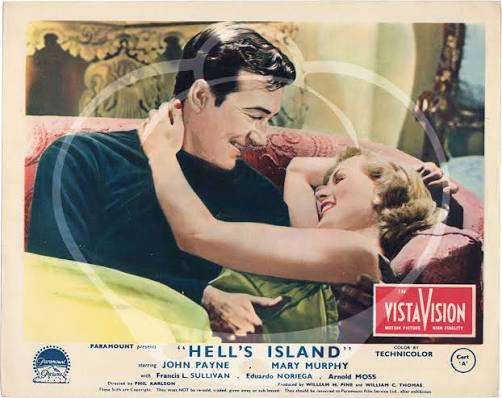
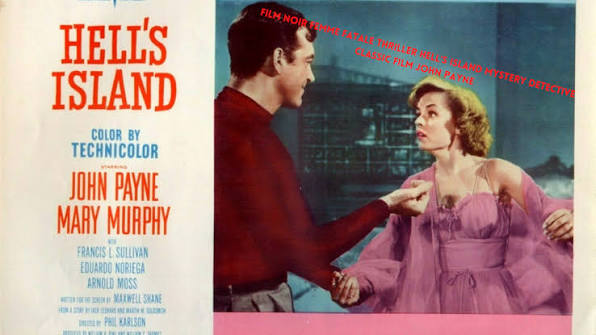
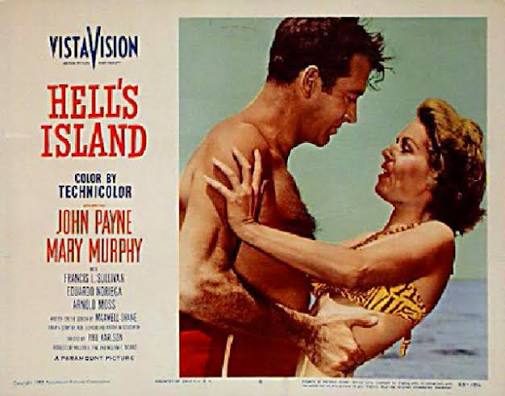
Featuring: John Payne and Mary Murphy
Mike Cormack: “I’ve been beaten, badgered, hit over the head, and mixed up in three killings, and believe me, I’m going to find out why.”
There is something wonderfully peculiar about Hell’s Island. On paper, it sounds like a fairly conventional mid-1950s film noir: a disgraced man, a mysterious employer, a missing fortune, a beautiful former lover, a tropical island, murder, betrayal and a priceless ruby. Yet the film is anything but a routine urban noir. Directed by Phil Karlson, one of the most reliable craftsmen of hard-edged American crime cinema, Hell’s Island takes the familiar ingredients of the genre and relocates them to an exotic Caribbean setting, where bright sunlight, tropical scenery and Technicolor replace the traditional rain-soaked streets and shadowy alleys.
The result is a fascinating hybrid — part film noir, part adventure mystery, part romantic melodrama and part exotic thriller. It is also one of those pictures that has been waiting far too long for serious attention on home video. Imprint’s release, as part of its Essential Film Noir: Collection 6, finally gives this unusual 1955 production the opportunity to be seen in a presentation that does justice to its distinctive visual character. It is also a particularly welcome release because this is the worldwide Blu-ray debut of the film.
Running approximately 84 minutes, Hell’s Island stars John Payne as Mike Cormack, Mary Murphy as Janet Martin and Francis L. Sullivan as the sinister Barzland. Payne is an especially appropriate leading man for the material. He had already demonstrated his ability to move between musicals, westerns and crime pictures, and by this point in his career he was increasingly associated with tougher, more cynical roles.
The film was directed by Phil Karlson, whose career is particularly important to an appreciation of Hell’s Island. Karlson understood the mechanics of crime pictures. His later work would include such celebrated examples of hard-boiled cinema as Kansas City Confidential, and the same interest in compromised men, criminal conspiracies and violent reversals can be detected here.
What makes Hell’s Island particularly interesting is the tension between the conventional noir story and the unusually bright environment in which it unfolds.
A Noir Story Under the Tropical Sun
Mike Cormack is introduced as a man whose life has already gone badly wrong. Once an attorney, he has descended into alcoholism and now works as a Las Vegas bouncer. His circumstances are not merely unfortunate; they have given him precisely the sort of damaged personality that film noir loves.
He is approached by the mysterious Barzland, who offers him a seemingly straightforward proposition. Mike is to travel to the Caribbean island of Santo Rosario and locate a valuable ruby that disappeared following a plane crash. The job is well paid, but there is another attraction: the woman who may have the jewel is Janet, Mike’s former fiancée.
That last detail changes everything.
Mike isn’t simply being sent after a precious stone. He is being sent into his own past.
The emotional dimension of the story is therefore established almost immediately. Janet is not simply the standard mysterious woman in a crime picture. She represents the life Mike lost, and his feelings toward her are a mixture of resentment, attraction, suspicion and unresolved affection.
The ruby provides the conventional noir MacGuffin, but the emotional history between Mike and Janet gives the story its real motivation.
The film’s plot deliberately keeps shifting the viewer’s assumptions. Who has the ruby? Who can be trusted? Why was Mike selected for the assignment? What exactly happened to Janet? What is Barzland’s real interest in the jewel? And how many people on Santo Rosario are concealing something?
The answers are gradually revealed through a series of confrontations, discoveries and reversals.
It is not the most original noir plot ever devised, and the film occasionally relies heavily on familiar genre conventions. But Hell’s Island compensates with atmosphere and personality.
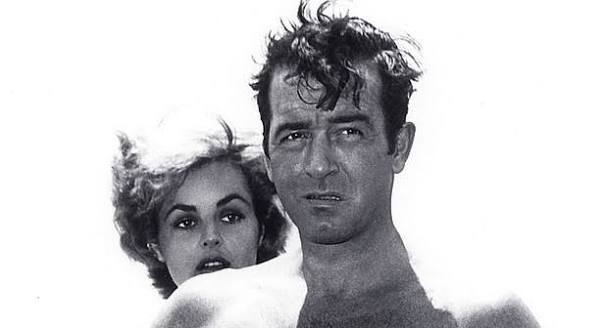
John Payne’s Mike Cormack
John Payne is the film’s centre of gravity.
Mike Cormack could easily have become an unsympathetic character. He is an alcoholic, a failed lawyer and a man carrying considerable bitterness. Yet Payne gives him enough vulnerability to prevent him from becoming merely another hard-boiled protagonist.
There is a wounded quality to his performance.
Mike has clearly been damaged by the collapse of his relationship with Janet, but he has also damaged himself. That distinction matters. He cannot simply blame other people for what has happened to him. The film’s noir sensibility is therefore embedded in his character rather than simply in the plot.
Payne’s voice-over narration is another important element. The story is presented partly as a flashback, with Mike narrating events, and this allows the film to adopt the subjective quality associated with classic noir. The narration gives the impression that Mike is looking back upon a chain of events that he has only gradually come to understand. The AFI catalog confirms the intermittent voice-over narration by Payne as Cormack.
The narration also provides some of the film’s harder-edged dialogue. Mike sounds like a man who has learned not to trust appearances.
Payne was particularly good at playing characters who could appear confident while concealing exhaustion or disappointment. That quality serves Hell’s Island extremely well.
Mary Murphy’s Janet
Mary Murphy has the considerably more difficult task of playing Janet.
The character is introduced through Mike’s memories and suspicions, which means that the audience initially sees her largely through his emotional perspective. Is she innocent? Is she guilty? Has she betrayed him again? Can he trust her?
Murphy wisely avoids making Janet simply a conventional femme fatale.
There is ambiguity to the character, but the ambiguity comes from the circumstances surrounding her rather than from exaggerated villainy. Janet exists within the same web of deception as Mike, and the film gradually complicates our understanding of her.
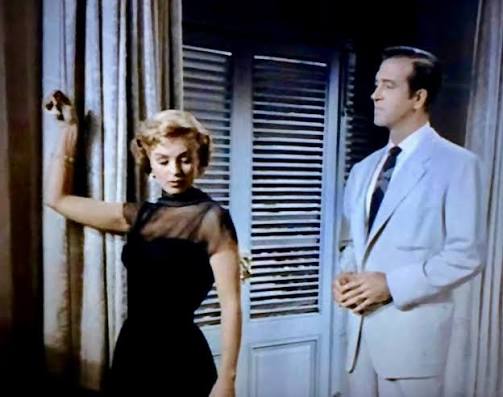
The relationship between Mike and Janet is one of the more interesting elements of the picture because their history gives the mystery a personal dimension. If Janet were simply another stranger connected to the ruby, the plot would be considerably less involving.
Instead, Mike is effectively investigating both a crime and his own memories.
Francis L. Sullivan’s Final Performance
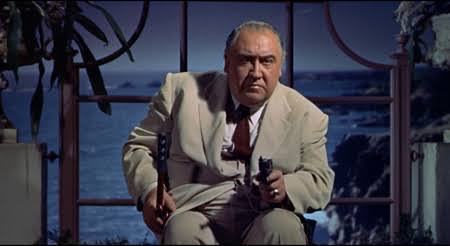
One of the major attractions of Hell’s Island is the presence of Francis L. Sullivan as Barzland.
Sullivan was a superb character actor, remembered particularly for roles in films such as Oliver Twist and Night and the City. Hell’s Island was his final film appearance.
He brings an unmistakable theatrical presence to Barzland.
There is something immediately suspicious about the character, but Sullivan does not need to overplay the menace. His physical presence and voice do much of the work. Barzland is the sort of man who appears to have calculated several moves ahead of everybody else.
Sullivan’s casting also adds a welcome touch of British character-acting tradition to an otherwise distinctly American crime picture.
Knowing that this was Sullivan’s final performance gives his scenes an additional poignancy, although the film itself obviously could not have anticipated the significance.
Phil Karlson’s Direction
Phil Karlson was not a director who needed enormous budgets to create effective crime cinema.
That is important when considering Hell’s Island, because the picture has an intriguing contradiction at its heart. It was photographed in VistaVision, one of Hollywood’s prestigious widescreen processes, yet it came from Pine-Thomas Productions, a company better known for economical productions. Contemporary and retrospective sources identify it as a VistaVision production, with Technicolor photography and cinematography by Lionel Lindon.
This creates an unusual visual character.
The film is technically designed to look expansive, but its production circumstances mean that it cannot always deliver the gigantic scale one might expect from VistaVision.
Much of the picture was made using studio resources, and that becomes noticeable in places. Yet Karlson understands how to make locations and sets function dramatically. He does not constantly attempt to disguise the modest scale of the production.
Instead, he concentrates on movement, framing and suspense.
The island becomes a maze of potential threats. The tropical environment is beautiful, but beauty is constantly juxtaposed with danger.
That contrast is one of the film’s most effective ideas.
Paradise as a Noir Environment
Traditional noir often associates danger with darkness.
Hell’s Island demonstrates that darkness is not necessary.
The Caribbean setting is bright and colourful, but people are still lying, stealing and killing.
In some ways, the sunshine makes the story more unsettling.
The characters cannot disappear into shadows quite as easily. Instead, deception takes place in plain sight. The beautiful scenery becomes almost ironic because Mike is surrounded by apparent paradise while discovering that almost everybody has something to hide.
This makes Hell’s Island an interesting companion to other exotic thrillers of the period. The film anticipates the type of colourful international crime adventure that would become increasingly common in later decades.
There is also a faint Bond-like quality to the basic ingredients: mysterious criminal figures, an exotic location, a valuable object, dangerous women and shifting loyalties. Of course, James Bond’s cinematic world was still several years away, and Hell’s Island is much more firmly rooted in 1950s American noir. Nevertheless, it is easy to see why modern viewers might respond to its tropical espionage-adventure atmosphere.
The Technicolor Advantage
The colour photography is crucial.
Film noir is so closely associated with black and white that it is easy to forget how many interesting noir-related productions experimented with colour.
Hell’s Island makes excellent use of the contradiction.
Instead of shadows dominating the frame, colour becomes part of the film’s psychological vocabulary. Tropical greens, bright skies, warm interiors and colourful clothing create a world that initially appears inviting.
But beneath those colours is the same suspicion that drives conventional noir.
The film’s use of VistaVision also contributes to its appeal. The widescreen composition allows the island environment to become an important component of the story rather than merely a backdrop.
There is something especially enjoyable about seeing a relatively modest crime picture given such a large-format visual presentation.
The Story’s Weaknesses
Hell’s Island is far from perfect.
Its biggest weakness is that the plot is more familiar than the presentation.
The missing jewel, the mysterious employer, the dangerous ex-lover and the succession of betrayals all belong to well-established crime-film territory. The screenplay, credited to Maxwell Shane with story material from Martin Goldsmith and Jack Leonard, occasionally feels as though it is assembling familiar pieces rather than discovering new ones.
Some supporting characters are also more functional than fully developed.
The film is primarily interested in Mike’s investigation, and this means that certain characters exist principally to provide information, create obstacles or advance the plot.
The pace can also be somewhat uneven. The picture is not slow by any means, but its middle section occasionally feels like a conventional mystery being stretched across an exotic location.
Yet these weaknesses are partly compensated for by the film’s brevity.
At around 84 minutes, Hell’s Island never becomes an exhausting experience. Just as one begins to notice the mechanics of the screenplay, the story moves on to another confrontation or revelation.
That compactness is one of its virtues.
The Imprint Blu-ray
For collectors, the most important fact about this release is that Hell’s Island had never previously received a Blu-ray release. Imprint’s edition represents its worldwide Blu-ray debut.
The film is presented in 1080p high definition with its original 1.85:1 aspect ratio, English LPCM 2.0 mono audio and optional English hearing-impaired subtitles. It is included as part of Essential Film Noir: Collection 6, a four-film limited-edition package containing Naked Alibi, Ring of Fear, Hell’s Island and Flame of the Islands.
The presentation is particularly valuable because the film’s colour photography is one of its principal attractions.
Contemporary reports about the disc have been positive regarding the transfer. The Digital Bits describes the Hell’s Islandimage as supremely sharp, with excellent colour and no obvious damage, while also praising the LPCM mono soundtrack.
That is excellent news for a film like this.
A poor transfer could easily reduce Hell’s Island to a faded curiosity. A strong high-definition presentation instead allows its Technicolor photography and VistaVision compositions to become part of the viewing experience.
The picture is not supposed to look like a modern digital production. Film grain and the characteristics of 1950s photography remain important. The goal is preservation and clarity rather than artificial perfection.
The mono soundtrack is similarly appropriate. There is no reason to expect a modern surround presentation from a film of this kind. The LPCM presentation retains the original character of the audio while giving dialogue, effects and Miklós Rózsa’s musical contribution a clean presentation.
The New Gary Gerani Commentary
One of the most attractive extras is a new audio commentary by film historian Gary Gerani.
This is precisely the sort of film that benefits from contextual commentary.
Hell’s Island may not immediately announce itself as a major piece of Hollywood history, but there is considerably more going on behind the production than its modest B-picture status might suggest.
Gerani has discussed the research behind the commentary, including studio material and earlier screenplay drafts. In particular, he has noted that the earlier versions of the screenplay differed significantly from the final film.
That makes the commentary potentially valuable not merely as a conventional scene-by-scene track, but as an exploration of how the film evolved from script to screen.
For enthusiasts of 1950s Hollywood, this sort of production history can sometimes be as fascinating as the film itself.
The United States vs. Hell’s Island
The other major extra is The United States vs. Hell’s Island, described by Imprint as a recreation of a 1955 United States Senate hearing concerning the film’s lurid advertising.
This is a particularly intriguing inclusion.
It reminds us that exploitation and publicity were already important aspects of Hollywood’s marketing machinery during the 1950s. A film could be sold not merely on its story or stars but on its sensational qualities.
The title Hell’s Island itself practically writes the advertising campaign.
The Senate material also places the film within a broader cultural context. Hollywood was increasingly under scrutiny for the content and marketing of motion pictures, and sensational advertising could attract as much attention as the movies themselves.
Consequently, the extra adds something that the film alone cannot provide: historical context about the way Hell’s Islandwas presented to its original audience.
A Film Rediscovered
Perhaps the most appealing thing about Imprint’s release is that it encourages us to look beyond the most famous examples of film noir.
Everyone knows the major titles.
But there is an enormous second tier of American crime cinema containing films that experimented with colour, widescreen formats, exotic settings and unusual combinations of genres.
Hell’s Island belongs firmly in that category.
It is not a masterpiece in the conventional sense. It does not reinvent film noir. It does not possess the psychological depth of the greatest examples of the genre.
What it does possess is character.
It is a colourful, compact, occasionally strange and consistently entertaining example of 1950s American genre filmmaking.
Its strongest qualities are its atmosphere, John Payne’s central performance, the presence of Francis L. Sullivan, Karlson’s efficient direction and the sheer novelty of seeing noir conventions transplanted into a tropical environment.
The result feels like a missing link between traditional film noir and the international adventure thrillers that would become increasingly popular in subsequent decades.
Final Thoughts
Imprint’s Hell’s Island Blu-ray is an important release primarily because the film deserves to be seen.
The movie itself is a fascinating little piece of 1950s Hollywood: a crime story disguised as a tropical adventure, a noir photographed in vivid colour, a modest Pine-Thomas production presented in VistaVision, and the final screen appearance of Francis L. Sullivan.
It is also an excellent example of why boutique labels are valuable to film history. Without releases such as this, films that once played in cinemas and then gradually disappeared from circulation can become little more than names in filmographies.
Here, Hell’s Island has been given another life.
John Payne makes an appealingly bruised and cynical protagonist, Mary Murphy brings ambiguity to Janet, and Sullivan gives the picture considerable character as Barzland. Phil Karlson keeps the machinery moving while the unusual tropical setting gives the film its distinctive personality.
The Imprint transfer is the real revelation for collectors. The 1080p presentation, strong colour reproduction, clean LPCM mono soundtrack and optional subtitles make this an especially worthwhile opportunity to experience the film in high definition. The Gary Gerani commentary and Senate-hearing recreation add genuine historical interest rather than merely padding out the disc.
For viewers expecting a definitive noir masterpiece, Hell’s Island may prove too conventional.
For anyone fascinated by the forgotten corners of 1950s Hollywood, however, it is considerably more rewarding.
It is a film of contradictions: dark subject matter in brilliant colour, a B-picture photographed in VistaVision, a conventional mystery given an exotic setting, and a noir story in which the sunshine is almost as deceptive as the characters.
And that is ultimately what makes Hell’s Island so enjoyable.
It may not be one of the best-known films of the 1950s, but Imprint’s Blu-ray demonstrates exactly why it should not remain one of the forgotten ones.


Leave a Reply