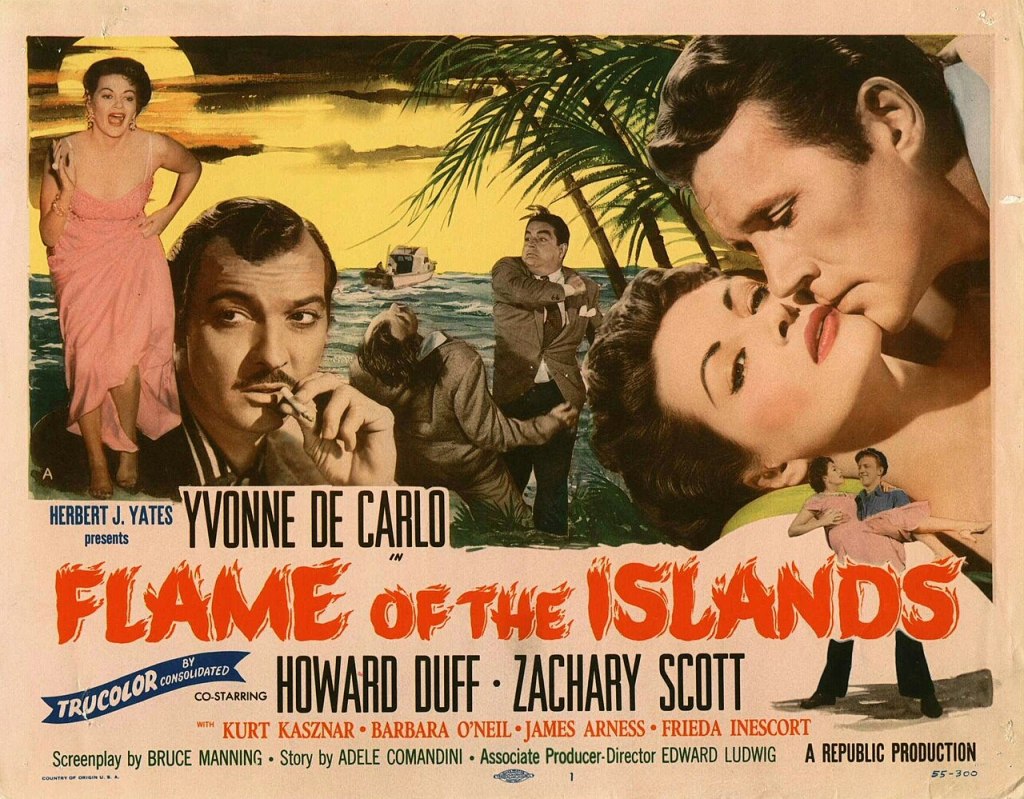
“Flame of the Islands” (1956)
Film Noir

Running Time: 90 minutes
Written by: Bruce Manning
Directed by: Edward Ludwig
Featuring: Yvonne De Carlo, Howard Duff and Zachary Scott
Evelyn Hammond: “Had I died, he would’ve married you I’m sure. But I didn’t die. Please, take this.”
Rosalind Dee: “There is no need for that.”
Evelyn Hammond: “Allow me to be the judge. Mr Hammond left his entire fortune to me. I’m glad he spent some hours of happiness with you. Now you try and find some. Money sometimes helps.”
Flame of the Islands is one of those wonderfully strange examples of early-1950s Hollywood filmmaking in which melodrama, romance, crime, glamour and exotic fantasy are thrown together with such enthusiasm that the result becomes considerably more entertaining than its reputation might suggest. Released in 1955 and directed by Edward Ludwig, the film stars Yvonne De Carlo in one of the most overtly glamorous roles of her career, supported by Howard Duff, Zachary Scott, and a cast of familiar character actors. It is a film about reinvention, ambition, desire and survival, wrapped in the kind of lavish Technicolor melodrama that Hollywood was particularly good at producing during this period.
The arrival of Flame of the Islands on Blu-ray from Imprint is therefore a welcome opportunity to rediscover a film that has generally lived in the shadow of better-known pictures from its stars and director. It is not a masterpiece, nor does it pretend to be one. But it is an enormously characteristic product of its period, and its mixture of melodramatic excess, glamorous locations, colourful personalities and slightly disreputable behaviour makes it a particularly enjoyable piece of 1950s cinema.
What makes the film especially interesting today is the degree to which it belongs to a Hollywood that was already changing. The studio system was still capable of manufacturing these polished star vehicles, but the old certainties were beginning to disappear. Flame of the Islands has one foot firmly planted in traditional Hollywood romance and another in the more cynical, adult entertainment that would increasingly define American cinema during the following decade.
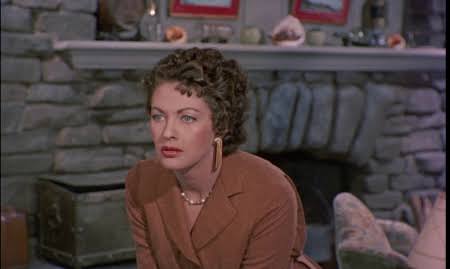
At the centre of everything is Yvonne De Carlo.
And what a presence she is.
Yvonne De Carlo at the centre
De Carlo was an enormously versatile performer. She could play glamorous romantic leads, tough women, historical figures, western heroines and comic characters, and later became permanently associated with Lily Munster in The Munsters. But before that television role transformed her public identity, she had spent years establishing herself as a major Hollywood star.
Flame of the Islands provides a particularly good showcase for her screen persona.
Her character is the sort of woman Hollywood melodrama loved: intelligent, attractive, ambitious and unwilling to accept the limitations that society has imposed upon her. She is neither an entirely conventional heroine nor a straightforward femme fatale. Instead, the film places her in a morally ambiguous world in which survival depends upon understanding people and knowing how to manipulate circumstances.
De Carlo plays these contradictions beautifully.
She understands that appearance is a form of power, but she also understands that appearance alone is insufficient. Her character is constantly assessing the people around her, calculating what they want and determining how she can use that knowledge. The performance therefore has a shrewdness beneath its glamour.
This is important because the film could easily have reduced its central character to an attractive woman moving through a succession of handsome men. De Carlo gives the role considerably more substance than that.
Her performance is also one of the major reasons the film remains watchable.
She has an effortless screen presence. Even when the dialogue becomes excessively melodramatic, De Carlo generally manages to sell it. She understands the heightened style of the material and does not try to underplay the film into something it is not.
There is a pleasure in simply watching her inhabit the picture.
A very 1950s kind of story
The story is constructed around transformation.
The central character wants more from life than her circumstances appear to offer, and she is prepared to take risks to achieve it. The film consequently becomes a fantasy about social mobility as much as it is a romance or melodrama.
This was a particularly appropriate theme for post-war Hollywood.
The 1950s were filled with films about people attempting to reinvent themselves. Sometimes those characters were ambitious businessmen. Sometimes they were entertainers. Sometimes they were criminals. Sometimes they were women attempting to escape conventional expectations.
Flame of the Islands belongs to that tradition.
The heroine understands that identity can be constructed. She can alter the way other people perceive her, and in doing so she can potentially change her position in the world.
The film is consequently fascinated by appearances.
Clothes matter.
Money matters.
Social connections matter.
Location matters.
Reputation matters.
And, perhaps most importantly, desire matters.
The characters are continually pursuing something they do not currently possess. That gives the film its slightly feverish quality. Everybody seems to want something from somebody else.
There is a deliciously cynical quality to this.
People fall in love, but they also calculate. People offer friendship, but there are often ulterior motives. Wealth brings opportunities but also creates obligations. Beauty provides access to certain circles but can also become a trap.
The film does not explore these ideas with the sophistication of a major Douglas Sirk melodrama, but it understands their entertainment value.
The Howard Duff factor
Howard Duff makes an excellent counterbalance to De Carlo.
Duff had the kind of screen presence that suited films about morally complicated men. He could play toughness without becoming completely unsympathetic, and he had a natural ability to suggest that there was more happening beneath the surface than the dialogue revealed.
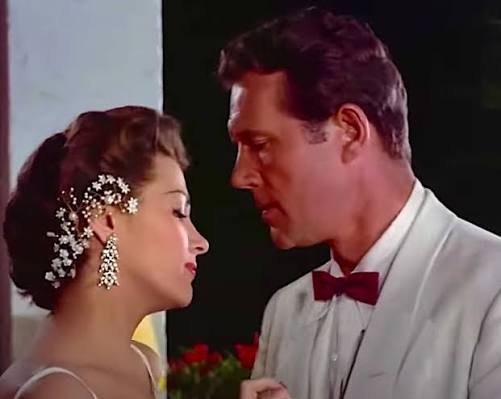
His relationship with De Carlo is one of the film’s strongest elements.
There is genuine tension between the characters because they are both trying to understand the other person. Neither is entirely innocent, and neither is entirely straightforward.
That gives their scenes an interesting friction.
Rather than simply presenting a conventional romance, the film makes attraction part of a larger struggle involving trust, ambition and manipulation.
Duff’s performance also helps prevent the film from becoming completely dominated by De Carlo’s glamour. His character provides an element of grounded masculinity that contrasts nicely with the more extravagant aspects of the picture.
Zachary Scott and the world of melodrama
Zachary Scott is another important presence.
Scott was one of those actors who seemed particularly comfortable in stories involving wealth, deception and questionable motives. He had made an enormous impression in films such as Mildred Pierce, and there was something inherently interesting about putting him into a film like this.
He brings an appropriate sense of danger and sophistication.
One of the pleasures of Flame of the Islands is watching these performers interact. The film has a strong ensemble quality despite being constructed primarily as a vehicle for De Carlo.
The supporting players also help establish the social world through which the heroine moves.
This is not an ordinary environment.
Everybody seems slightly theatrical.
Everybody seems to understand the importance of money and status.
Everybody is performing to some extent.
That makes the film’s heightened style feel appropriate.
Edward Ludwig’s direction
Edward Ludwig was an experienced director whose career encompassed an unusually wide variety of genres. He had worked in adventure films, westerns, thrillers and dramas, and that background serves him well here.
He understands that Flame of the Islands needs to move.
This is not a film built around long stretches of introspection. It is designed as popular entertainment, and Ludwig keeps the narrative moving through changes of location, relationships and circumstances.
There is a certain efficiency to the filmmaking.
Scenes do not linger forever.
Characters are introduced quickly.
Conflicts are established without excessive explanation.
And the film constantly gives the audience something new to look at.
At times this efficiency works against the film because certain emotional developments could benefit from greater depth. But it also means that Flame of the Islands rarely becomes dull.
There is always another complication waiting around the corner.
The visual appeal
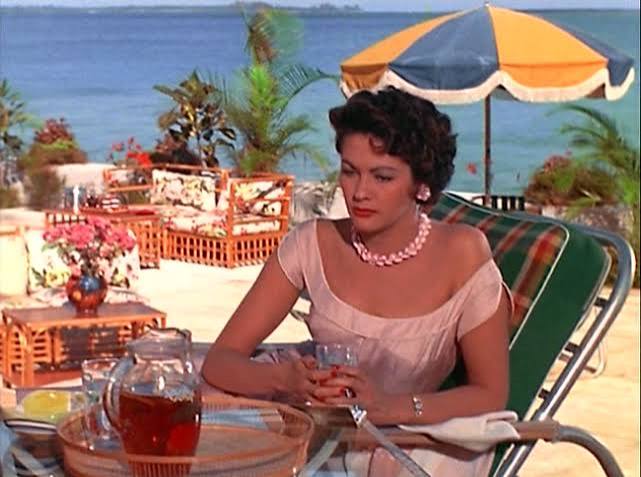
One of the great attractions of the film is its visual presentation.
The picture was designed as a glamorous colour production, and it makes extensive use of the visual vocabulary of 1950s Hollywood.
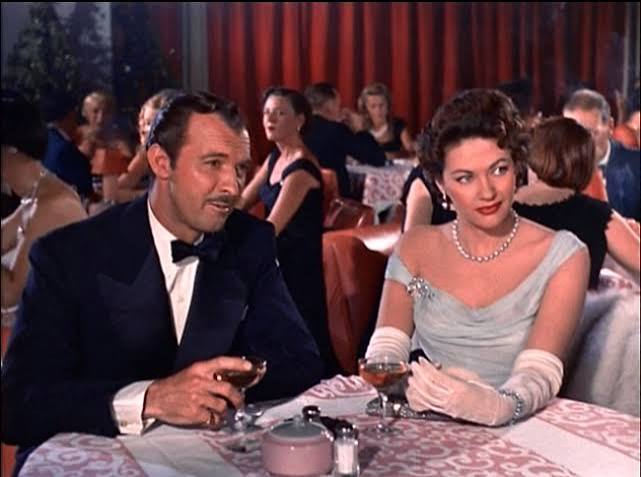
Costumes are important.
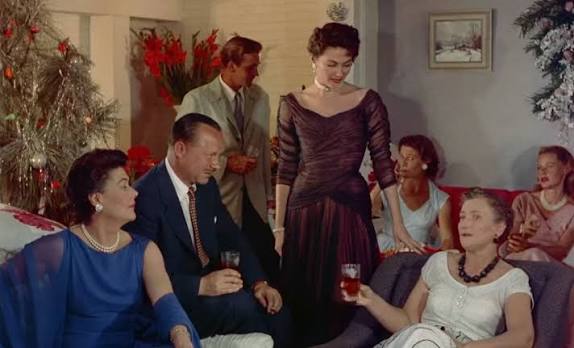
Interiors are carefully arranged.
The characters occupy attractive environments.
And De Carlo is photographed in a manner that emphasises her status as a major star.
This is precisely the kind of movie that benefits enormously from being seen in a good-quality home-video presentation.
The visual richness of the period becomes much more apparent when the image is given room to breathe.
The film’s colour photography is also an important part of its identity. It is not merely a technical feature; colour is part of the fantasy. The world of Flame of the Islands is deliberately more glamorous than everyday life.
That is fundamental to its appeal.
The audience is not simply being asked to watch a story.
We are being invited into a fantasy.
A film about performance
Perhaps the most interesting way of looking at Flame of the Islands today is as a film about performance.
Its characters are constantly presenting versions of themselves.
The heroine reinvents herself.
Other characters respond to the image she presents.
Romantic relationships become negotiations.
Social situations become stages.
The film therefore has a surprisingly modern theme beneath its old-fashioned surface.
It understands that identity is not always fixed.
People can reinvent themselves.
They can deceive others.
They can deceive themselves.
They can become trapped by the image they have created.
The film does not analyse these ideas in a particularly philosophical way, but they are embedded in its narrative.
And this gives the picture more substance than its reputation as a routine 1950s melodrama might suggest.
The romance
The romantic material is inevitably central, but Flame of the Islands is more interesting when the romance is viewed as part of the heroine’s larger journey.
The relationships are not simply about love.
They are also about security, ambition, trust and social position.
This makes the romantic encounters somewhat unpredictable.
The audience is continually encouraged to wonder which characters genuinely care about each other and which are motivated by self-interest.
That ambiguity works well.
It also suits the performances.
De Carlo does not play her character as somebody waiting passively for a man to rescue her. She is actively attempting to control her own destiny.
That makes her more compelling.
Melodrama without apology
There is no question that Flame of the Islands is melodramatic.
Very melodramatic.
But that is part of its charm.
Modern viewers sometimes approach older films with the expectation that everything should conform to contemporary ideas of realism. Flame of the Islands is better appreciated on its own terms.
It is heightened.
It is colourful.
It is romantic.
It is occasionally outrageous.
It is interested in glamour and spectacle.
And it wants the audience to enjoy the ride.
The dialogue can occasionally be wonderfully excessive. Some situations are pushed to extremes. Characters can behave in ways that seem more appropriate to a Hollywood screenplay than ordinary life.
But that is precisely why the movie is fun.
The picture belongs to an era when studio filmmakers were not afraid of giving audiences entertainment with a capital E.
The Imprint Blu-ray
For collectors of classic Hollywood cinema, the Imprint Blu-ray is particularly appealing because Flame of the Islands is not the sort of title that receives constant attention.
Major films from the 1940s and 1950s have been restored and reissued repeatedly. Lesser-known studio pictures often have to wait considerably longer.
That makes releases like this valuable.
The opportunity to revisit a film such as Flame of the Islands in a quality home-video edition allows viewers to reassess it rather than relying upon reputation or memory.
The presentation is especially important because the film’s appeal is substantially visual.
The colour photography, costumes, sets and star presentation are all integral to the experience.
A strong transfer therefore does more than improve sharpness. It allows the film to function as the lavish studio production it was intended to be.
The Blu-ray format also brings out the texture of the period filmmaking. Faces are clearer, costume details are easier to appreciate and the production design becomes considerably more enjoyable to study.
For classic-film enthusiasts, this is precisely the kind of title that benefits from being treated as something more than disposable entertainment.
Sound and atmosphere
The audio presentation is equally important in recreating the period atmosphere.
The dialogue is central, but so is the musical accompaniment. The score helps reinforce the emotional manipulation of the story, moving between romance, tension and melodrama.
The sound design is naturally less elaborate than what contemporary audiences are accustomed to, but that is part of the charm.
This is studio-era filmmaking.
The soundtrack serves the performers and the story rather than attempting to overwhelm them.
The result is an old-fashioned cinematic atmosphere that is increasingly enjoyable on physical media.
Why the film deserves rediscovery
There is a tendency to divide classic Hollywood into two categories: the acknowledged masterpieces and everything else.
That can lead to films like Flame of the Islands being overlooked.
But the history of cinema is not made exclusively from masterpieces.
A huge part of Hollywood’s cultural significance comes from the hundreds of films produced to entertain audiences week after week. These pictures reveal what studios believed audiences wanted to see, what stars were capable of carrying, how genres evolved and how social attitudes were reflected in popular entertainment.
Flame of the Islands is valuable in precisely that respect.
It captures a particular moment.
It gives us Yvonne De Carlo at the centre of a glossy star vehicle.
It demonstrates the continuing strength of the melodrama.
It reflects Hollywood’s fascination with wealth, beauty and reinvention.
And it provides another example of the extraordinary range of films being produced during the studio era.
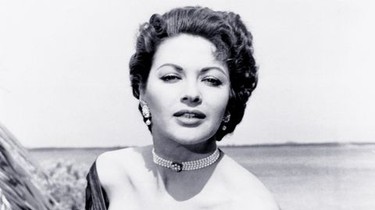
Yvonne De Carlo’s star persona
The film is ultimately impossible to separate from De Carlo.
She carries it.
There are scenes in which the plot becomes somewhat improbable, but she remains fascinating to watch.
Her screen persona combines glamour and toughness in a way that few actresses could reproduce.
She could look completely at home in a luxurious environment while simultaneously suggesting that she was capable of fighting her way out of trouble.
That quality is crucial here.
The character has to be believable as somebody who can survive in a world where everybody is trying to get something from everybody else.
De Carlo makes that possible.
There is also a refreshing lack of passivity in her performance.
Even when the story places her in romantic situations, she remains an active participant in her own destiny.
That makes the film considerably more interesting than a conventional romance.
The pleasures of 1950s Hollywood
There is something wonderfully reassuring about the craftsmanship of this kind of film.
Everything is designed.
Everything has been lit.
Everything is photographed.
Everything has been costumed.
The actors understand how to project themselves toward the camera.
The sets create an idealised version of reality.
And the narrative is constructed to keep the audience entertained.
Modern cinema can be far more naturalistic, but there is a particular pleasure in returning to this artificiality.
Flame of the Islands does not want to convince us that its world is exactly like ours.
It wants to make that world glamorous.
And that is one reason the film remains enjoyable.
Final thoughts
Flame of the Islands may not rank among the essential classics of 1950s American cinema, but that does not make it unworthy of attention. Quite the opposite: its relative obscurity makes the Imprint Blu-ray a particularly welcome release for collectors interested in exploring beyond the familiar titles.
The film is a fascinating mixture of romance, melodrama, crime, glamour and social ambition. It is entertaining without pretending to be profound, and its heightened style is perfectly suited to the story it tells.
Most importantly, it gives Yvonne De Carlo a substantial showcase.
She dominates the picture with a combination of beauty, intelligence, determination and sheer movie-star presence. Howard Duff provides a strong romantic and dramatic counterpoint, while Zachary Scott and the supporting cast help create the slightly dangerous, highly theatrical world in which the story unfolds.
The film’s greatest strength may ultimately be its atmosphere.
It belongs to a Hollywood in which glamour was still an essential part of the cinematic experience. The characters may be scheming, the romances may be complicated and the situations may occasionally become wonderfully improbable, but the whole thing has been constructed to entertain.
And on Blu-ray, that quality becomes easier to appreciate.
For classic-Hollywood collectors, Yvonne De Carlo fans and anyone interested in the lesser-known corners of 1950s studio cinema, the Imprint release of Flame of the Islands offers an enjoyable opportunity to revisit a colourful and thoroughly characteristic piece of mid-century Hollywood melodrama.
It is not a film that needs to be defended as a lost masterpiece.
It is better than that.
It is a fascinating time capsule, a glamorous star vehicle and an entertaining example of the kind of film Hollywood once produced with remarkable regularity. Its pleasures are found in its performances, its visual style, its heightened storytelling and above all in the magnetic presence of Yvonne De Carlo.
For those willing to embrace the conventions of 1950s melodrama, Flame of the Islands proves to be an unexpectedly enjoyable rediscovery—and the Imprint Blu-ray gives this neglected title an opportunity to shine again.


Leave a Reply