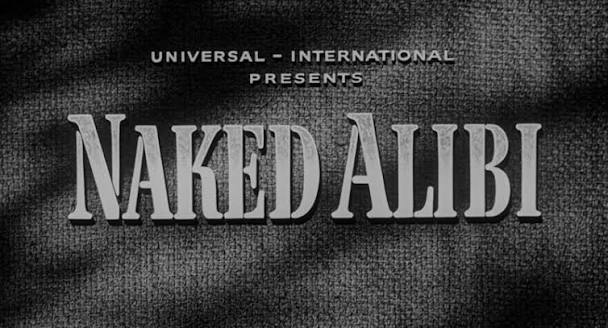
“Naked Alibi” (1954)
Film Noir

Running Time: 86 minutes
Written by: Lawrence Roman
Directed by: Jerry Hopper
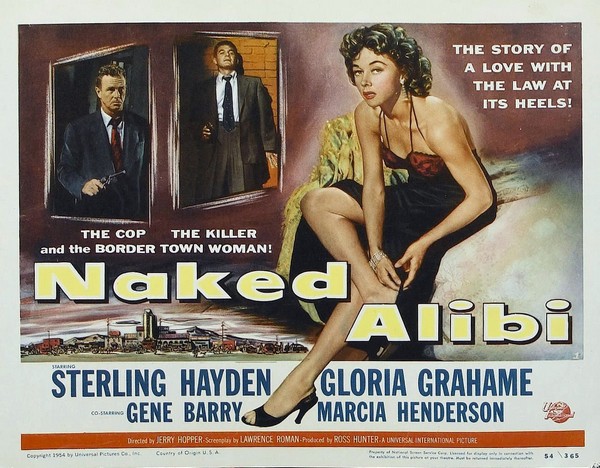
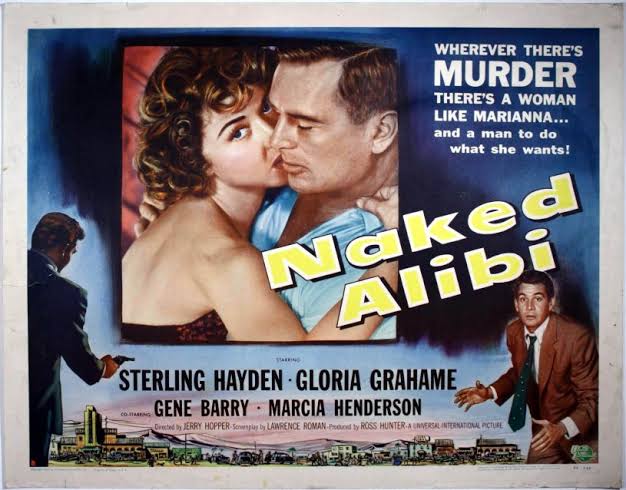
Featuring: Sterling Hayden, Gloria Grahame and Gene Barry
Marianna: [to Joe] Funny… “I don’t understand you and you don’t understand me. You know, we got a lot in common.”
There is something wonderfully disreputable about Naked Alibi. Released in 1954, this compact piece of film noir is the kind of movie that seems to exist in a permanently overheated atmosphere. The streets are dirty, the characters are nervous, the police are frustrated, the criminal is volatile, and almost everyone appears to be hiding something. It is a film built from suspicion, aggression and sexual tension, yet beneath its hard-boiled surface it is also an unusually atmospheric character thriller.
The film stars Sterling Hayden as Sergeant Joe Conroy, Gloria Grahame as Marianna, and Gene Barry as Al Willis, with Hayden’s intimidating physical presence providing much of the film’s dramatic force. Directed by Jerry Hopper, Naked Alibi is not generally placed among the very highest-profile American noirs, but it is precisely the sort of rediscovery that makes boutique Blu-ray labels so valuable. It is a lean, atmospheric, sometimes surprisingly brutal film that rewards a viewing far more than its relatively obscure reputation might suggest.
Imprint’s Blu-ray gives the film an opportunity to be appreciated again, and for admirers of classic noir, 1950s crime pictures and the work of actors such as Hayden and Grahame, it is a release with considerable appeal.
A classic noir premise
Naked Alibi begins with a murder and a suspect who appears to be guilty.
Sergeant Joe Conroy is convinced that Al Willis is responsible for the killing. Willis is a violent, unpleasant and evasive man, and Hayden’s performance makes Conroy’s hostility toward him immediately understandable. But the film is not interested in simply presenting a conventional police procedural in which the detective gathers evidence and eventually brings the villain to justice.
Instead, Naked Alibi is concerned with the uneasy space between suspicion and proof.
Conroy believes Willis is guilty, but belief is not enough. He needs evidence. That gives the film its central tension. Willis knows the police are watching him, while Conroy knows that his own determination can become a liability if he allows personal conviction to replace proper investigation.
It is a familiar noir theme: the detective who knows who the criminal is but cannot prove it.
The difference here is that Naked Alibi gives the situation a particularly aggressive physical quality. This is not a world of detached detectives quietly smoking cigarettes while examining clues. People shout. Fists fly. Cars race through streets. Men threaten one another. Characters drink heavily. There is a constant sense that violence is only seconds away.
The result is a film that feels more dangerous than its modest running time might suggest.
Sterling Hayden’s performance
Sterling Hayden is perfectly suited to the role of Joe Conroy.
Hayden had one of the great faces for film noir: large, angular, weather-beaten and capable of suggesting both authority and exhaustion. He could look like a man who had spent his entire life fighting his way through difficult circumstances, and Naked Alibi uses that quality extremely well.
Conroy is not a particularly charming detective. He is stubborn, confrontational and willing to push people hard. Hayden does not attempt to soften those qualities. Instead, he allows Conroy’s determination to dominate the performance.
This is important because the film could easily have turned Conroy into a conventional heroic policeman. Hayden makes him more complicated. He is convinced he is doing the right thing, but there are moments when his certainty threatens to become obsession.
That gives the character a genuine noir quality.
Hayden’s physical presence also creates an interesting contrast with Gene Barry. Where Hayden seems built out of granite, Barry’s Al Willis has a more slippery, unpredictable quality. The confrontation between the two men therefore becomes one of the film’s principal attractions.
They are not simply hero and villain. They are two men who seem to regard one another with instinctive hostility.
Gloria Grahame
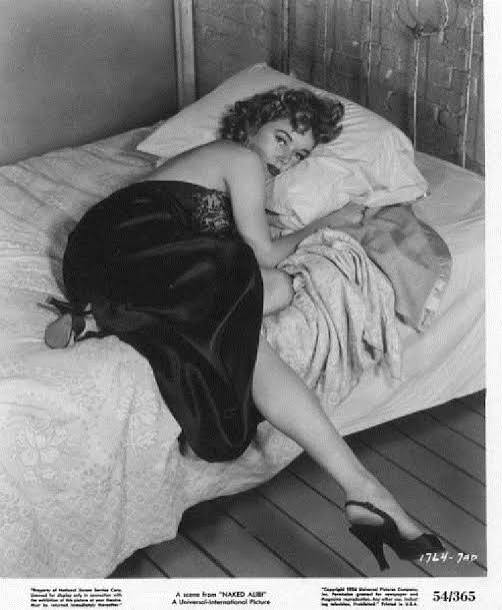
Gloria Grahame is one of the great figures of American film noir, and her presence immediately raises the film’s interest.
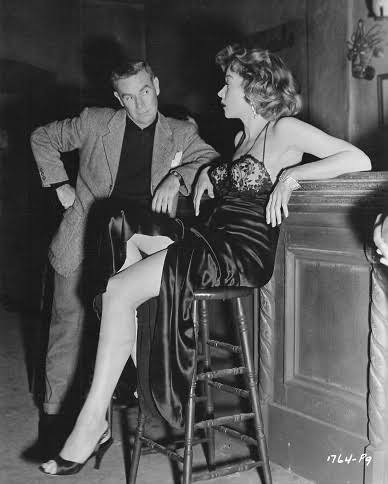
As Marianna, she brings an entirely different energy to the picture. Grahame had a remarkable ability to suggest vulnerability and toughness simultaneously. Her characters could appear emotionally exposed while still retaining an inner independence, and Naked Alibi makes good use of that ambiguity.
Marianna is not merely there to provide romantic interest for the male characters. She becomes part of the film’s emotional and moral uncertainty.
Grahame’s performance is understated compared with some of her more famous noir roles, but that works to the film’s advantage. She does not overplay the material. Instead, she gives Marianna a sense of someone trying to survive in an environment dominated by aggressive men and dangerous circumstances.
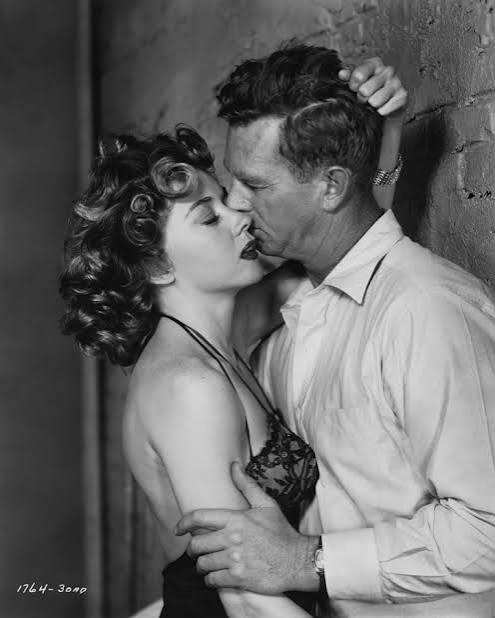
Her scenes with Hayden are particularly effective because the two actors have a different kind of screen energy. Hayden is imposing and physically forceful, while Grahame communicates through smaller gestures and expressions.
The contrast gives their relationship a welcome degree of tension.
Gene Barry as the villain
Gene Barry is perhaps the biggest surprise.
Barry is frequently associated with more polished and sophisticated roles, but as Al Willis he is nasty, arrogant and dangerous. The performance gives the character a disturbing unpredictability.
Willis is not an especially complicated villain psychologically, but Barry understands that he does not need to be. His menace comes from the feeling that he could lose control at any moment.
There is a particularly effective contrast between Barry’s relatively controlled appearance and the violence underneath it. He does not need to constantly scream or threaten people. Sometimes a look is enough.
The film’s treatment of Willis also fits neatly into the tradition of noir villains who are less frightening because of elaborate criminal schemes than because they appear capable of doing almost anything.
The atmosphere
Perhaps the greatest strength of Naked Alibi is its atmosphere.
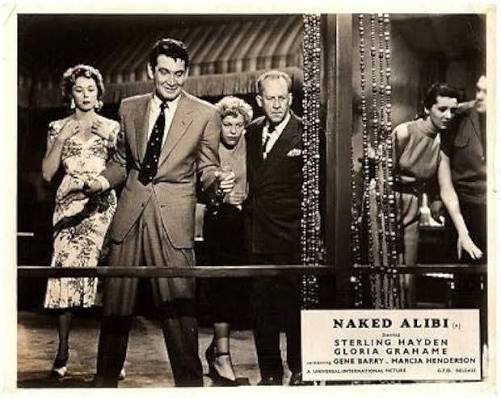
The film is steeped in the visual language of early-1950s noir. Streets become threatening spaces. Bars and nightclubs feel like places where information is traded and trouble begins. Cars are not simply transportation; they become extensions of the characters’ movement through a hostile urban landscape.
The film’s locations give it a convincing sense of place.
There is an appealing mixture of city streets, smaller communities and open spaces, allowing the picture to move between claustrophobia and relative freedom. Yet even when the characters appear to escape into more open surroundings, the tension remains.
That is an important characteristic of noir.
Geography rarely provides genuine safety.
The cinematography takes advantage of this by emphasizing shadows, nighttime settings and strong contrasts. There is a persistent feeling that the characters are being watched, followed or trapped.
A lean running time
One of the most enjoyable things about Naked Alibi is how efficiently it tells its story.
The film does not spend excessive time establishing elaborate backstories. It gets to the murder, the investigation and the central conflict relatively quickly.
This economy suits the material.
Crime films can sometimes become overloaded with subplots, but Naked Alibi remains focused. Its principal concern is the conflict between Conroy and Willis, with Marianna providing an important emotional dimension.
The result is a film that moves.
There is a pleasing lack of self-importance about it. It does not attempt to announce itself as a major statement about crime or society. It is simply an efficiently constructed noir thriller made by filmmakers who understood the value of atmosphere, character and momentum.
That modesty is part of its charm.
Violence and brutality
For a film from 1954, Naked Alibi can be surprisingly hard-edged.
The violence is not presented with the graphic explicitness that would become possible decades later, but the physicality of the confrontations is striking.
Men hit one another with real anger. Threats carry weight. Criminal behaviour feels dangerous rather than glamorous.
This helps distinguish Naked Alibi from some of the more romanticized crime pictures of the period.
There is little sense that the criminal world is exciting or glamorous. It is unpleasant, unstable and frequently frightening.
The film’s violence therefore serves the atmosphere rather than merely providing action.
The noir morality
At its heart, Naked Alibi is interested in the problem of certainty.
Conroy believes Willis is guilty. The audience is encouraged to share that suspicion. But the story repeatedly reminds us that suspicion and proof are not the same thing.
This is one of the classic dilemmas of the detective genre.
How far can a policeman go when he believes he knows the truth?
The question becomes especially interesting because Conroy is not an entirely neutral observer. His personal feelings toward Willis threaten to affect his judgment.
That ambiguity gives the film more substance than its straightforward crime-story premise initially suggests.
The police are not presented as completely detached machines of justice, and the criminals are not transformed into glamorous antiheroes. Everyone exists somewhere within a morally compromised environment.
That is classic noir territory.
The Imprint Blu-ray
For collectors, the attraction of Imprint’s release is straightforward: Naked Alibi is exactly the kind of film that benefits from being rescued from obscurity and given a place on a serious physical-media shelf.
The picture’s age is obviously apparent, but that is part of the pleasure of viewing classic Hollywood films on Blu-ray. A good restoration or presentation allows the textures of the original photography to come through without attempting to make a 1950s film look artificially modern.
The monochrome photography is particularly important here.
Noir lives and dies by contrast, shadow and texture, and the film’s visual style is central to its identity. Dark interiors, night scenes and sharply illuminated faces all benefit from a presentation that preserves the photographic character of the original.
The Blu-ray also gives the film the kind of permanence that streaming cannot provide. Boutique labels such as Imprint have become increasingly important for viewers who want to build collections around films that might otherwise remain difficult to access.
For a title such as Naked Alibi, that matters.
This is not a film that everybody will automatically encounter through mainstream home entertainment.
Picture quality
The presentation should be approached with the expectations appropriate to a film of its vintage.
The important question is not whether Naked Alibi suddenly looks like a modern digital production. It shouldn’t. The important question is whether the transfer preserves the film’s photographic qualities while providing a cleaner and more stable viewing experience than many older television or budget-video presentations.
The black-and-white photography is particularly well suited to Blu-ray.
The film contains plenty of deep shadows and nighttime imagery, and those sequences are where a good transfer can make a substantial difference. Facial detail, clothing textures, streets and interior environments all contribute to the atmosphere.
Rather than overwhelming the viewer with visual spectacle, the presentation allows the photography to do its work.
For collectors of classic noir, that is exactly what is wanted.
Sound
The soundtrack is inevitably limited by the original production technology, but again, that is not really a criticism.
Dialogue is the most important element, and the film’s exchanges between Conroy, Willis and the other characters are presented with the clarity necessary to follow the story.
There is none of the expansive sonic design associated with contemporary cinema, but Naked Alibi does not require it.
The soundtrack is there to support the dialogue, atmosphere and occasional bursts of violence, and it suits the film’s period character.
Why the film deserves rediscovery
The most interesting thing about Naked Alibi today is how well it sits between different strands of 1950s American cinema.
It is a police procedural, but it is also a noir.
It is a crime thriller, but it is also a character piece.
It has elements of the chase movie, the romantic thriller and the urban melodrama.
Yet it never becomes excessively complicated.
That mixture makes it representative of an era when Hollywood genre films could be produced quickly while still possessing considerable craftsmanship.
The cast is another reason for its continued appeal.
Hayden brings authority and physical presence, Grahame provides emotional complexity, and Barry makes an unexpectedly effective villain. Together they elevate material that might otherwise have been little more than routine crime programming.
Final thoughts
Naked Alibi may not have the household reputation of The Big Sleep, Double Indemnity, Out of the Past or The Killers, but it belongs to the same broad tradition of American film noir and deserves to be viewed on its own terms.
It is tough, atmospheric, fast-moving and frequently tense.
Sterling Hayden is excellent as the determined detective whose certainty threatens to become obsession. Gloria Grahame adds emotional depth and ambiguity, while Gene Barry is memorable as the dangerous and volatile Al Willis. Jerry Hopper’s direction keeps the film moving while giving it enough atmosphere to transcend its relatively simple plot.
Most importantly, the film feels like a genuine product of its time. Its shadows, streets, bars, cars and morally compromised characters create a world in which nobody seems completely safe.
The Imprint Blu-ray provides an ideal opportunity to revisit this neglected little noir. It is precisely the sort of release that demonstrates the value of boutique physical media: a film that might otherwise remain peripheral to the classic-Hollywood canon is given renewed attention and a presentation suitable for collectors.
For anyone with an interest in Sterling Hayden, Gloria Grahame, 1950s crime cinema or film noir generally, Naked Alibiis well worth rediscovering. It may not reinvent the genre, but it understands the fundamentals of noir extremely well: suspicion, violence, desire, betrayal, shadows and the uneasy knowledge that discovering the truth does not necessarily make life any safer.
In that respect, Naked Alibi remains a highly enjoyable piece of mid-century crime cinema—and the Imprint Blu-ray is a welcome chance to give this overlooked film another look.


Leave a Reply