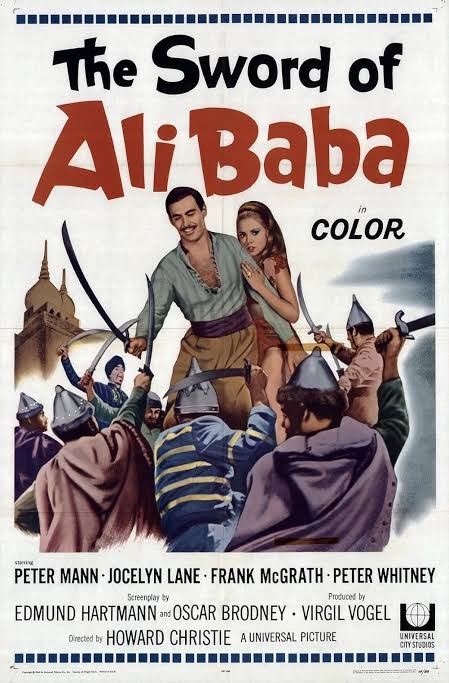
“The Sword of Ali Baba” (1965)
Fantasy

Running Time: 81 minutes
Written by: Edmund Hartmann and Oscar Brodney
Directed by: Virgil W. Vogel
Featuring: Peter Mann, Jocelyn Lane, Frank McGrath and Peter Whitney
There is something wonderfully old-fashioned about sitting down to watch a 1960s Universal adventure film. Even when the film itself is relatively modest, there is usually a sense that you are entering a cinematic world where stories could still be built around exotic locations, secret caves, sinister rulers, beautiful princesses, heroic swordsmen and villains who could be defeated by a well-timed sword fight.
The Sword of Ali Baba is very much one of those films.
Directed by Virgil W. Vogel and released by Universal Pictures in 1965, the film stars Peter Mann as Ali Baba, Jocelyn Lane as Princess Amara, Frank McGrath as Pindar, Gavin MacLeod as Hulagu Khan, Frank Puglia as Cassim and Peter Whitney as Abou. It runs approximately 81 minutes and was produced by Howard Christie, with a screenplay by Edmund Hartmann and Oscar Brodney.
At first glance, The Sword of Ali Baba looks like a straightforward Arabian Nights adventure. It has the familiar ingredients: Baghdad, a cruel invading force, a beautiful princess, an evil traitor, a band of thieves, romance, disguises, swordplay and the famous concept of Ali Baba and his forty thieves.
But there is considerably more going on here than meets the eye.
The most immediately fascinating aspect of the film is that it is not simply another adaptation of the familiar Ali Baba story. It is, to a very substantial degree, a reconstruction and reworking of the 1944 Universal film Ali Baba and the Forty Thieves. The American Film Institute catalogue specifically notes that stock footage from the earlier film is incorporated into the 1965 production.
That fact gives The Sword of Ali Baba a peculiar identity. It is simultaneously a new film, a remake, a recycling exercise and a time capsule of the way Hollywood sometimes attempted to make new entertainment out of existing material.
And that makes the Imprint release particularly interesting.
The story
The film begins with the young Ali caught up in the violent upheaval surrounding the invasion of Baghdad by the Mongols. Hulagu Khan has seized power, aided by the treachery of Prince Cassim. Ali escapes and eventually finds refuge with the forty thieves.
Rather than becoming simply another outlaw, Ali grows into a heroic figure. The thieves become his family, and their activities acquire a Robin Hood-like quality as they resist the occupying forces and redistribute wealth among the oppressed.
Meanwhile, Ali’s childhood sweetheart, Princess Amara, has become caught up in the political machinations surrounding the conquerors. She is destined to marry Hulagu Khan, creating the central romantic and political conflict of the story.
The structure is therefore extremely familiar. The hero has been separated from his rightful destiny, the princess is threatened by an unwanted marriage, the villain has political power, and the hero must gather his allies and strike back.
It is not a complicated narrative, but complexity was never really the point.
The attraction lies in the atmosphere and the succession of adventures.
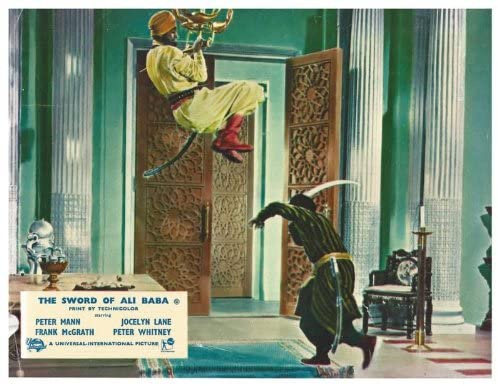
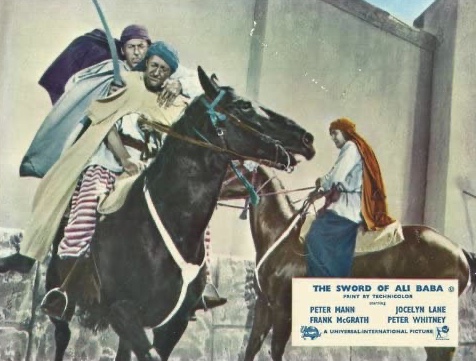
There are escapes, confrontations, sword fights, romantic encounters, villainous plotting and the inevitable return to the legendary cave of the forty thieves. The film moves briskly, never becoming particularly heavy or philosophical.
At approximately 81 minutes, it knows when to move on.
That is one of its greatest virtues.
A curious remake
The relationship between The Sword of Ali Baba and the 1944 Ali Baba and the Forty Thieves is arguably the most fascinating thing about the production.
The earlier film starred Jon Hall and Maria Montez and was one of the more colourful examples of Universal’s wartime Arabian Nights cycle. Twenty-one years later, Universal returned to essentially the same material, but rather than constructing the entire production from scratch, substantial amounts of the earlier film were incorporated into the new movie.
Some sources have suggested that an extraordinarily large proportion of the 1965 film consists of recycled footage. Contemporary film enthusiasts have even estimated figures as high as 70 percent, although such percentages should be treated cautiously rather than as definitive production statistics. What is indisputable is that footage from the 1944 film is present, and Frank Puglia actually appears as Cassim in both productions.
This produces some fascinating visual contrasts.
The newly filmed material belongs unmistakably to the mid-1960s. The costumes, photography and performances have a different character from those of the earlier production. Then suddenly the film cuts to footage from 1944.
The effect can be slightly jarring.
It can also be strangely charming.
Instead of trying to hide the seams completely, the movie becomes an accidental conversation between two different eras of Universal filmmaking.
The 1944 footage has the larger-than-life quality of studio-era fantasy filmmaking. The 1965 material feels more economical and television-oriented. The contrast is sometimes obvious, but that contrast is precisely what makes the film historically interesting.
Peter Mann as Ali Baba
Peter Mann is not the sort of larger-than-life swashbuckling star who immediately dominates the screen.
That is perhaps both the film’s limitation and part of its charm.
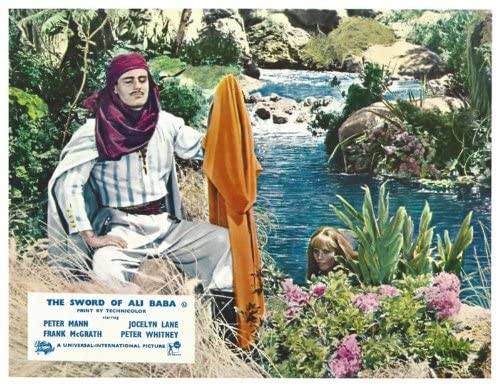
Mann plays Ali as a straightforward heroic figure. There is little of the flamboyant theatricality associated with some earlier Arabian adventure heroes. His performance is earnest and uncomplicated, and the character is fundamentally decent, courageous and determined.
Ali is less an antihero than a traditional adventure hero.
He has a clear moral purpose. He fights oppression, protects Amara and attempts to restore justice. The character therefore functions very much as the audience’s guide through the story.
Mann’s relative lack of flamboyance means that some viewers may find him less charismatic than the stars of the earlier Universal adventures. Yet he fits the film’s economical style.
The film isn’t trying to turn Ali into a complicated psychological character.
He is the hero.
He has a sword.
He has a cause.
He has a princess to rescue.
And he has a gang of thieves ready to help him.
Sometimes that is enough.
Jocelyn Lane
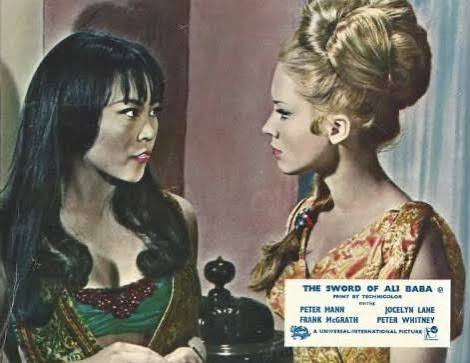
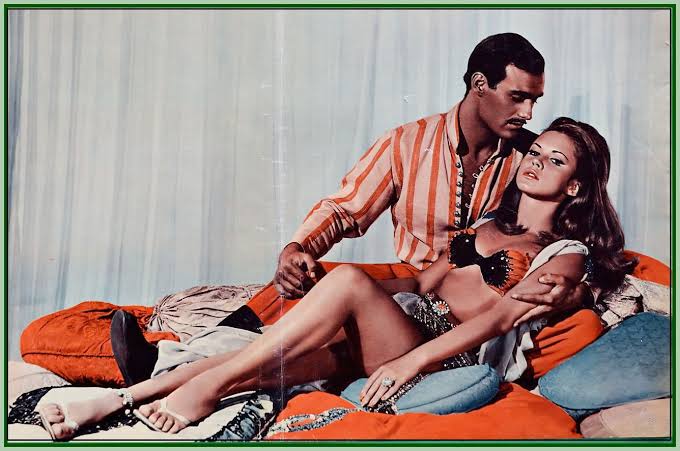
If the film has a particularly strong visual presence, it comes from Jocelyn Lane as Princess Amara.
Lane brings glamour and energy to the role, and the film clearly understands the importance of presenting Amara as more than simply a prize for the hero. She is caught inside the political machinations of the story and provides the romantic centre around which the action revolves.
Lane had an appearance perfectly suited to the colourful adventure genre.
She belongs to that wonderful tradition of 1960s fantasy heroines whose presence could transform a relatively inexpensive production into something much more visually appealing.
Her chemistry with Mann is pleasant rather than electrifying, but that is not necessarily a criticism. The romance is presented in broad adventure-film terms rather than as a deeply developed love story.
The important thing is that we understand the history between Ali and Amara.
They were connected before the events of the main story, and that gives their eventual reunion a sense of inevitability.
Gavin MacLeod as Hulagu Khan
One of the film’s most interesting casting choices is Gavin MacLeod as Hulagu Khan.
MacLeod is perhaps better remembered today for television roles such as The Mary Tyler Moore Show and The Love Boat, making it particularly enjoyable to see him in this earlier villainous role.
Hulagu is the sort of villain that adventure films of this period understood perfectly.
He is powerful, arrogant and ruthless, but he is not presented as an especially complicated human being. He represents the oppressive force that Ali must overcome.
MacLeod plays him with appropriate theatricality.
There is something inherently enjoyable about watching an actor later associated with comedy and television playing an outright adventure villain.
The film becomes a small snapshot of an actor at an earlier stage in his career.
The supporting cast
The supporting cast is one of the film’s real pleasures.
Frank McGrath plays Pindar, while Peter Whitney is Abou. Frank Puglia returns as Cassim, and other recognizable faces include Greg Morris, Frank DeKova and Irene Tsu.
For viewers familiar with American television, the film becomes something of a spot-the-face exercise.
Greg Morris, for example, would become widely known for Mission: Impossible, while Gavin MacLeod would later become associated with major American sitcom and comedy roles.
These performers help give the film an unexpectedly strong supporting ensemble.
Peter Whitney in particular contributes the sort of broad comic energy that was common in adventure films of the period.
There is no great attempt at subtle realism here.
The characters exist within a heightened fantasy world.
That is appropriate.
The forty thieves
The forty thieves themselves are perhaps the most entertaining element of the story.
They provide the film with its sense of camaraderie.
Ali is not operating alone. He has a group of colourful companions who can provide assistance, humour and muscle when required.
This is important because it prevents the movie from becoming simply a series of confrontations between Ali and the villains.
The thieves create a small community.
They also reinforce the Robin Hood quality of the narrative. These are technically criminals, but the film is interested in the distinction between legal authority and moral authority.
The rulers may possess official power, but Ali and his companions possess the audience’s sympathy.
It is a very traditional adventure-film idea, but it works.
The visual style
Virgil W. Vogel was an experienced director whose career included considerable television work, and there is a clear economy to the filmmaking.
The movie is not attempting to recreate the monumental scale of a David Lean epic.
Nor is it trying to compete with the enormous colour extravaganzas that Hollywood had produced during the peak years of the historical-adventure cycle.
Instead, it operates on a smaller scale.
That gives the film an almost television-adventure quality.
This isn’t necessarily a negative.
Indeed, there is something very appealing about the straightforwardness of the presentation.
The action is there to advance the story rather than to become an elaborate spectacle in itself.
The photography by William Margulies provides the film with the visual foundation it needs, while the production design by Alexander Golitzen and William D. DeCinces creates the necessary fantasy environment.
The film is never ashamed of its artificiality.
And that is exactly right.
The recycled footage
The reused footage deserves further consideration because it is what makes The Sword of Ali Baba such an unusual viewing experience.
At times, the older material fits remarkably well.
At other moments, the difference between the 1944 footage and the new material becomes unmistakable.
The age difference between the productions becomes part of the visual texture.
The older material possesses the atmosphere of classic studio fantasy, while the newer footage carries the more economical character of mid-1960s filmmaking.
Instead of seeing this solely as a production shortcut, it is more rewarding to regard the movie as a fascinating piece of cinematic archaeology.
Here is Universal effectively rebuilding one of its earlier adventure films for a new generation.
The film becomes evidence of how studios reused their own libraries.
The practice is nothing new, of course, but rarely is it quite so visible.
The adventure elements
Despite all of its peculiarities, The Sword of Ali Baba remains fundamentally entertaining.
The film understands what its audience wants.
There must be danger.
There must be romance.
There must be villains.
There must be swordplay.
There must be a secret cave.
And there must be a final confrontation.
The screenplay by Edmund Hartmann and Oscar Brodney keeps the story moving without getting bogged down in unnecessary complications. The plot may be familiar, but familiarity is not necessarily a problem in this genre.
Indeed, one of the pleasures of these films is their predictability.
You know Ali will fight back.
You know Amara and Ali will be reunited.
You know the villains will eventually receive their punishment.
The fun is watching how the film gets there.
The Universal connection
One of the pleasures of watching this release is recognising that The Sword of Ali Baba belongs to a much larger tradition within Universal’s history.
Universal had been making Arabian Nights and historical adventure pictures for decades.
By 1965, however, the Hollywood landscape had changed dramatically.
The old studio system was weakening, television was becoming increasingly important and audiences were being offered different kinds of spectacle.
The Sword of Ali Baba therefore feels like a late survivor.
It looks backwards.
Its story belongs to an earlier cinematic tradition, even though it was produced in the middle of the 1960s.
That makes it more interesting than its reputation might suggest.
It is a film caught between eras.
The Imprint Blu-ray
For collectors, the most exciting aspect of this release is simple:
this is the worldwide first Blu-ray release of The Sword of Ali Baba.
That alone makes it significant for fans of obscure Universal genre films. Imprint has once again gone into an area of the studio library that might easily have remained unavailable in high-definition and given it a proper physical-media presentation.
The film is presented in 1080p high definition, with an aspect ratio of 1.37:1. The audio is English LPCM 2.0 dual mono, and optional English hearing-impaired subtitles are included.
The 1.37:1 presentation is particularly welcome because it respects the film’s original television-era/studio-era framing rather than attempting to impose a modern widescreen presentation.
For a film like this, framing matters.
The compositions were designed around the Academy ratio, and the narrower image gives the picture a suitably classic appearance.
Picture quality
The high-definition presentation is one of the most important reasons to welcome the release.
This is not a modern production with pristine digital photography, and expectations should therefore be realistic.
The film contains older photographic material as well as the newly shot 1965 footage, meaning that differences in image quality are inevitable.
That is particularly important when the recycled footage appears.
The older sections naturally look different from the 1965 material.
But rather than regarding this as a failure of the Blu-ray, it is an intrinsic part of the film’s production history.
A high-definition presentation allows the viewer to appreciate the detail and texture of the surviving material more clearly than lower-resolution presentations could.
Costumes, sets, facial expressions and production design become easier to appreciate.
The film also benefits from being viewed in its correct original framing.
For collectors who have previously encountered The Sword of Ali Baba in inferior copies, the Blu-ray represents a considerable upgrade simply because the film can now be properly examined.
Audio
The English LPCM 2.0 dual-mono soundtrack is appropriate to the period.
This isn’t a movie that needs a modern surround remix.
The mono soundtrack is part of the film’s historical character.
Dialogue remains the primary consideration, while the music and effects provide the necessary adventure atmosphere.
The presentation is straightforward and authentic.
The optional English hearing-impaired subtitles are also a welcome inclusion, particularly for viewers watching older films where dialogue recordings can sometimes be less distinct than those of contemporary productions.
Gary Gerani commentary
Perhaps the most valuable extra is the new audio commentary by screenwriter and film historian Gary Gerani.
This is precisely the kind of film that benefits from contextual commentary.
Without some background knowledge, a viewer might simply wonder why a 1965 movie suddenly appears to contain footage that looks considerably older.
Gerani’s participation makes the release more valuable as a piece of film history rather than simply another catalogue title.
A commentary from a screenwriter and film historian is especially appropriate for a film whose production history is arguably more fascinating than its conventional reputation suggests.
The commentary helps place the movie within the tradition of fantasy and adventure filmmaking and provides an additional reason for collectors to revisit the film even after they have already seen it.
For a boutique release, this is exactly the kind of extra that makes sense.
Rather than loading the disc with generic promotional material, Imprint has chosen a feature that actually adds context.
Why this film matters
It would be easy to dismiss The Sword of Ali Baba as a minor Universal adventure picture.
And, in terms of its place within the history of major Hollywood productions, it certainly is minor.
But minor films can be extremely interesting.
Sometimes they reveal more about the practical workings of a studio than the prestige productions do.
The Sword of Ali Baba tells us something about how Universal could exploit existing material, revive an established property and construct an adventure film economically.
It also demonstrates the longevity of certain genre formulas.
The Arabian Nights adventure was still commercially useful in 1965.
The audience might have changed, the actors might have changed and the production methods might have changed, but the basic ingredients remained.
Heroes, villains, romance and adventure were still enough to sustain an 81-minute feature.
The film as a time capsule
Perhaps the best way to approach The Sword of Ali Baba is as a time capsule.
It belongs to 1965, but part of it belongs to 1944.
It contains actors who would later become much more familiar through television.
It features a filmmaking style that was already beginning to look old-fashioned.
It uses older material to create new entertainment.
And it tells a story that had already been adapted many times.
All of those elements make it an unusually fascinating little movie.
It is almost as though two generations of Hollywood adventure cinema have been placed inside the same 81-minute feature.
That makes the film considerably more interesting for the collector than its reputation might imply.
Final thoughts
The Sword of Ali Baba is not a masterpiece.
It isn’t trying to be.
It is a modest, colourful, briskly paced adventure film whose greatest virtues are its sincerity, its old-fashioned entertainment value and its wonderfully strange production history.
The recycled footage from the 1944 Ali Baba and the Forty Thieves is both its greatest curiosity and its greatest limitation. The seams between the two productions can sometimes be obvious, but they also give the movie its unique character.
Peter Mann provides a straightforward hero, Jocelyn Lane supplies glamour and romantic interest, Gavin MacLeod has fun as the villainous Hulagu Khan, and the supporting cast is packed with familiar faces.
The result is a film that feels like a surviving fragment of a Hollywood tradition that was already disappearing.
And that makes the Imprint Blu-ray particularly welcome.
As the worldwide first Blu-ray release, it rescues the movie from obscurity and presents it in a much more appropriate form for modern collectors. The 1080p presentation, original 1.37:1 aspect ratio, LPCM 2.0 mono soundtrack and English HOH subtitles provide the essential technical foundation, while Gary Gerani’s new commentary adds substantial historical value.
The release also fits beautifully into Imprint’s continuing interest in films that larger labels might overlook.
For anyone interested in Universal’s genre history, 1960s adventure films, Arabian Nights cinema, recycled studio footage or simply obscure Hollywood productions, this is a fascinating addition to the collection.
The Sword of Ali Baba may never be mistaken for one of Universal’s great adventure classics.
But perhaps that is beside the point.
Its pleasures are smaller and stranger.
It is a colourful adventure film.
It is an unusual remake.
It is a piece of studio archaeology.
It is a fascinating example of how old Hollywood footage could be given a new life.
And, thanks to Imprint, it is finally available on Blu-ray in a presentation that allows collectors to appreciate all of those things.
For fans of obscure 1950s and 1960s adventure cinema, that makes this release considerably more valuable than the film’s relatively modest reputation might suggest.