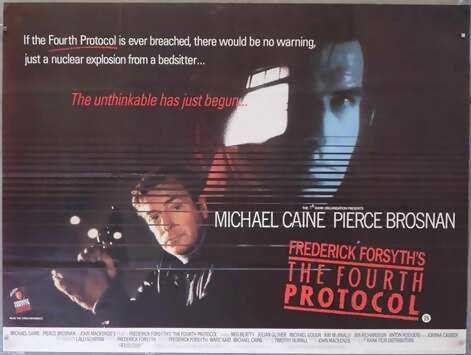
“The Fourth Protocol” (1987)
Drama / Thriller

Running Time: 119 minutes
Written by: Frederick Forsyth
Directed by: John Mackenzie
Featuring: Michael Caine, Pierce Brosnan, Ned Beatty, Ian Richardson and Joanna Cassidy
Tom McWhirter: “Don’t tell me you reached your limit, Jimmy boy.”
Valeri Petrofsky: “I usually try to keep my limit to a gallon or so.”
During the height of the Cold War, few writers captured the atmosphere of international espionage quite like Frederick Forsyth. His novels combined painstaking research with believable geopolitical intrigue, creating thrillers that felt less like fiction and more like classified intelligence reports. The Fourth Protocol, published in 1984, was one of his biggest successes, and its 1987 film adaptation remains one of the most intelligent and understated spy thrillers of its era. Directed by John Mackenzie, fresh from the success of The Long Good Friday, and starring Michael Caine and Pierce Brosnan in one of his final major roles before becoming James Bond, the film delivers suspense through intelligence rather than spectacle.
Imprint Films has now given The Fourth Protocol a welcome Blu-ray release, allowing audiences to rediscover a tense, mature espionage thriller that has perhaps been overshadowed by more glamorous entries in the genre. Featuring a strong high-definition presentation and an excellent collection of archival extras, this release reminds viewers just how effective thoughtful Cold War cinema can be. The disc includes a 1080p high-definition transfer, audio commentary by Frederick Forsyth, archival interviews, featurettes on the production and Forsyth’s career, and both DTS-HD 5.1 and LPCM 2.0 audio options.
Unlike the James Bond adventures that Pierce Brosnan would later become famous for, The Fourth Protocol is almost entirely devoid of glamorous gadgets, exotic locations or outrageous villains. Instead, it presents espionage as meticulous, patient work where victory often depends upon observation, persistence and psychological endurance.
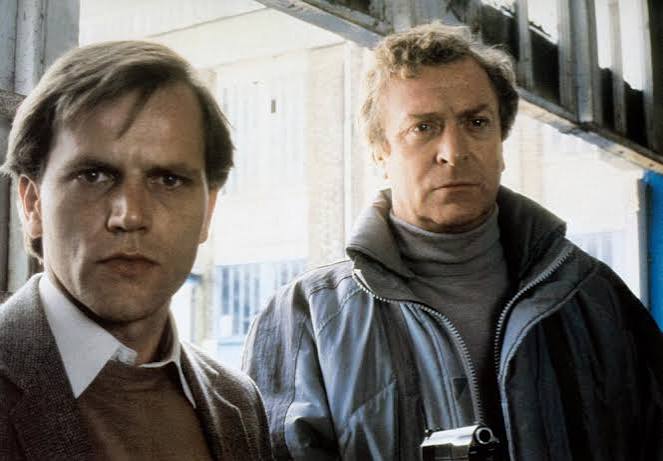
The story centres on British intelligence officer John Preston (Michael Caine), an experienced but unconventional MI5 investigator whose disregard for bureaucracy frequently places him at odds with his superiors. When fragments of intelligence suggest that the Soviet Union may be planning something unprecedented inside Britain, Preston slowly uncovers a terrifying conspiracy involving the illegal transport and assembly of a nuclear device on British soil.
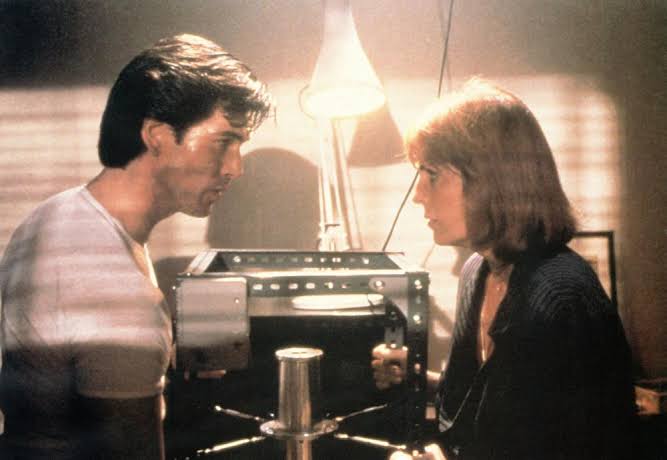
Opposing him is Soviet agent Valeri Petrofsky, played with icy restraint by Pierce Brosnan. Operating under a carefully constructed identity, Petrofsky infiltrates an ordinary English community while secretly assembling components for a devastating nuclear weapon designed to influence British politics and undermine NATO.
Rather than racing from one action sequence to another, the film patiently builds tension through investigation. Every discovery feels earned, and every mistake carries genuine consequences.
Michael Caine has always excelled at portraying professionals. Whether playing soldiers, detectives or intelligence officers, he has a remarkable ability to suggest decades of experience through subtle gestures rather than lengthy speeches.
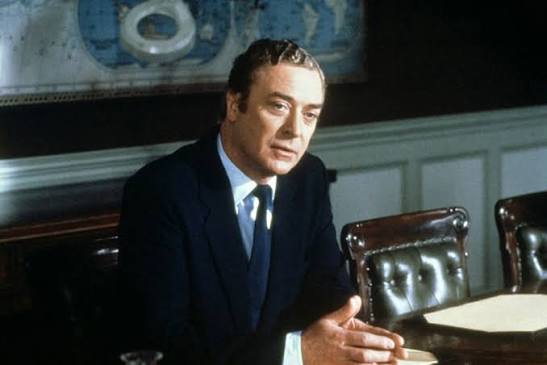
His John Preston is wonderfully understated. He’s stubborn, occasionally abrasive and politically inconvenient, but always committed to uncovering the truth. Caine wisely avoids turning Preston into an action hero. Instead, he relies upon intelligence, instinct and persistence.
There’s a quiet confidence in the performance that anchors the entire film. Even during scenes consisting largely of conversations between intelligence officials, Caine keeps the audience invested through his understated charisma.
Watching Pierce Brosnan today offers a fascinating glimpse of what made him an ideal choice for James Bond only a few years later.
His Petrofsky possesses all the elegance, sophistication and physical confidence audiences would later associate with 007—but those qualities are employed for far darker purposes.
Rather than portraying a theatrical villain, Brosnan creates an intelligent, disciplined operative whose professionalism mirrors Preston’s own. Petrofsky rarely loses control emotionally, making him all the more intimidating.
The duel between Caine and Brosnan isn’t based on physical confrontation but intellectual competition. Both men constantly attempt to stay several moves ahead of the other, giving the film the feel of an elaborate chess match.
Director John Mackenzie understands exactly what kind of film he’s making.
Having demonstrated his ability to generate enormous tension in The Long Good Friday, Mackenzie again proves remarkably adept at maintaining suspense without relying on constant violence.
The pacing is deliberate but never sluggish. Every scene contributes another piece to the larger puzzle, gradually tightening the narrative until the inevitable confrontation.
Mackenzie also captures Britain during the late Cold War with impressive authenticity. Government offices, suburban streets and anonymous industrial locations all become plausible battlegrounds in a conflict fought largely in secret.
Unlike many modern thrillers, The Fourth Protocol allows silence and observation to generate suspense.
One reason the adaptation works so well is Frederick Forsyth’s own involvement with the screenplay.
The film retains much of the procedural realism that made the novel so successful. Intelligence work is presented as detailed analysis rather than cinematic fantasy.
The central conspiracy itself feels frighteningly plausible. Rather than world domination, the Soviet objective is carefully calculated political destabilisation.
That sense of realism remains one of the film’s greatest strengths nearly forty years later.
The supporting cast is filled with distinguished British performers.
Ian Richardson brings quiet authority to Whitehall politics.
Michael Gough contributes his usual elegance.
Julian Glover lends gravitas whenever he appears.
Joanna Cassidy provides an emotional dimension that helps prevent the story from becoming entirely procedural.
Ray McAnally is, as always, memorable despite limited screen time.
Collectively they create a believable intelligence community populated by professionals rather than movie stereotypes.
Imprint’s presentation is impressive.
The 1080p transfer reproduces the film’s restrained visual style very effectively. This isn’t a colourful or flashy production. Cinematographer Phil Meheux deliberately embraces muted blues, greys and earth tones that reinforce the atmosphere of Cold War paranoia.
Detail is consistently strong throughout the image. Facial textures, clothing and production design all benefit from the increased resolution, while film grain remains natural and stable.
Black levels are particularly effective during numerous night-time sequences, maintaining shadow detail without crushing darker areas.
Colours remain intentionally subdued, accurately reflecting the original photography.
The presentation avoids excessive digital manipulation, preserving the cinematic texture audiences expect from a catalogue release.
The DTS-HD Master Audio 5.1 track offers subtle improvements without fundamentally altering the film’s original sound design, while the LPCM stereo option preserves the original listening experience. Dialogue remains consistently clear, which is essential given the film’s reliance on conversations and investigative exchanges. Jerry Goldsmith’s restrained score enjoys pleasing fidelity, supporting the tension without overwhelming the quieter moments.
Imprint has assembled an excellent selection of archival supplements.
The highlight is Frederick Forsyth’s feature-length audio commentary. As both novelist and screenwriter, his insights into adapting the book, developing the screenplay and balancing authenticity with cinematic storytelling are consistently engaging.
The featurettes The Forsyth Protocol: The Career of Frederick Forsyth and The Fourth Protocol: Filming the Novelprovide worthwhile historical context, examining both the author’s influence on the espionage genre and the production of the film itself.
The archival interviews with Michael Caine, John Mackenzie and Frederick Forsyth are particularly enjoyable, offering reflections from the key creative figures involved.
An on-location featurette and stills gallery round out a package that complements the film without feeling padded.
The Fourth Protocol deserves far more recognition than it often receives. While it lacks the flashy action of many modern spy thrillers, it compensates through intelligence, atmosphere and outstanding performances from Michael Caine and Pierce Brosnan.
John Mackenzie crafts a remarkably controlled thriller that trusts its audience to follow complex political intrigue without excessive exposition. Frederick Forsyth’s intricate plotting remains compelling, and the film’s realistic depiction of espionage has aged exceptionally well.
Imprint’s Blu-ray gives this underrated Cold War classic the presentation it has long deserved. The high-definition transfer is faithful to the source, the audio is strong, and the archival supplements—particularly Frederick Forsyth’s commentary—provide valuable insight into the adaptation.
For fans of mature espionage cinema, Cold War thrillers, or simply intelligent filmmaking driven by character rather than spectacle, this release is highly recommended. It stands as another fine addition to Imprint’s growing catalogue of classic British and international cinema and is an essential purchase for collectors who appreciate sophisticated thrillers that reward careful attention.



Leave a Reply