• Film review: “I, Tonya” (2017)

    “I, Tonya” (2017)

    Drama/Comedy

    3-stars

    Written by: Steven Rogers

    Directed by: Craig Gillespie

    Featuring:  Margot Robbie, Sebastian Stan, Julianne Nicholson, Bobby Cannavale, Allison Janney

    Tonya Harding: “I mean, come on! What kind of friggin’ person bashes in their friend’s knee? Who would do that to a friend?”

    Towards the end of every year there are multiple films released that are aimed at garnering some awards success as well as, of course, making some impact at the box office, thereby becoming ‘must see’ films. Many of these films are based on real events or use real people as subjects, thereby having something to hook people in with. So we have the new Margot Robbie film “I, Tonya” (2017), that is not only about a real person but is framed by a real event – although as you watch the movie the motivations for that event as well as who was actually involved is called into question. That event was the assault on rival ice skater Nancy Kerrigan. “I, Tonya” might call into question what you know about the subject, Tonya Harding, as well as that incident. Or, it might not, which in the end is the inherent strength and weakness of this film, which leads directly into its motivation as well as actual quality.

    Directed by Australian Craig Gillespie probably best known for the Ryan Gosling starring quirky independent “Lars and the Real Girl” (2007) this new film sees him moving into more serious territory along with star Margot Robbie, who you can see wants to be taken more seriously. This is done by taking a well-known tabloid star (in this case Tonya Harding and her brood), the story she is known for, then giving the narrative a twist and throwing in some other camera tricks, such as the famous ice-skating moves the subject is known for. Gillespie has made a technically good film with a narrative that matches the story, however where it gets lost is that it is knowingly does not take itself seriously while it deals with some pretty real as well as serious issues.

    The film starts in the mid 1970s with a four year-old Tonya whose mother forces her into figure skating by aggressively pursuing a local trainer and using cruelty and negligence to make her daughter skate. As Tonya grows up, she rapidly becomes one of the best figure skaters in the United States after her mother takes her out of school to focus exclusively on her athletic career. I will not go any further into the plot as much of the enjoyment of the film is not knowing portions of what occurs, particularly in the last half of I, Tonya.

    The narrative (as well as the performances) are the unique parts of this film which can be seen in the trailers, so there are no surprises going into it, although it can be quite jarring. “I, Tonya” plays almost everything for laughs which in my mind is a huge error. The narrative plays out with faux interviews featuring all of the principal characters talking directly to the camera as they explain portions of the story, then we see that portion acted out. All of the characters tell their own versions of what is occurring, which means there might be confusion as well as conflicting views of the same events. This is a device used to ratchet up the importance of what is happening as well as reducing the negative elements much like Scorsese did in his often-lambasted movie “The Wolf of Wall Street” (2013). That particular device was a mistake then, and it is a mistake here. It literally lets all of the characters off the hook; this is egregious as they are all not the most positive or honest people around. When elements that are being dealt with are parental physical abuse, partner physical abuse, possible rape as well as physical harm to a third person, this is not something that should be made light of. In saying that, I do believe that there is room for humor in all films, but when you treat some crimes like they are treated here it is not fair to let audiences decide what is played for humor and what is played in reality.

    There is no doubt that there is a real buzz about seeing some of these actors playing outsized roles, led by Margot Robbie as the titular character Tonya, here she goes from adolescence through to her adult life, all the while being interviewed as the character. Robbie is very good; you can see she has done her homework, but to be honest this does not seem a million miles from her characterization of Harley Quinn from the recent “Suicide Squad” (2016). The revelation (although not if you have followed her career) is Allison Janney as Harding’s mother, who for most of the film is in a breathing apparatus as she dishes on the kind of mother she was (horrible), as well as seeing her in re-enacted scenes being nothing short a ‘Mommy Dearest’. There has been early talk of awards consideration but I think that the performance is possibly too good for this film. The rest of the cast is formidable led by Sebastian Stan as Harding’s husband who here really gets to shine in ways not seen in his stint in the Marvel Cinematic Universe. Then there is, Julianne Nicholson as Harding’s long suffering coach, in an understated role, she is just as excellent as Janney but not as flashy. Overall all the actors’ carry out their jobs very well, it is just a shame about that the creative choices made by the director, for me these are insurmountable.

    One of the highlights of the movie is the way in which the difference in the economic situation of Harding and her family are in direct opposition to how the skating world wanted their skaters to appear. This is not only a tragedy for Harding, but speaks to something more in the psyche of sports not only in the US but throughout the world. There are many signs as to why the skating establishment did not only shun Harding but plainly thwarted her efforts to be a star. Harding wore low-rent costumes, did not have a hair and make-up person, skated to popular music as well as heavy metal and her routines were highly charged. In many ways she was a rule breaker in that she could see that appealing to a wider audience meant she would be more successful than other established skaters. If there had have been more of a concentration on that portion of the story then this might have been a better film and explained her actions in the last third of the movie more clearly.

    There are times when a film should be great, it has so much going for it that it should not only live up to expectations but also surpass them. In this case it unfortunately does not, there are very definite bright spots in the film, the performances are all very good as well as the skating work being outstanding which is a main part of the film. In fact the CGI work is not bad considering what is being asked of the special effects team. I do wish the film had moved away from the sensationalist aspect of the narrative so that it did treat all the physical violence a bit more seriously, but regardless of that this is still an entertaining movie on its surface but it will not stay with you much longer after the credits role. This is such a missed opportunity as it could have been an interesting analysis of the media as well as sports and the Olympics. If you want to have some fun with laughs and little depth then this will be for you.

    “I, Tonya” is released on the 25th January 2018.


    .


  • DVD review: “The Lost City of Z” (2017)

    “The Lost City of Z” (2017)

    Drama

    images

    Running Time: 141 minutes

    Written and Directed by: James Gray

    Featuring: Charlie Hunnam, Robert Pattinson, Sienna Miller, Tom Holland, Angus Macfadyen, Ian McDiarmid, Franco Nero

    Nina Fawcett: “To dream to seek the unknown. To look for what is beautiful is its own reward. A man’s reach should exceed his grasp, or what’s a heaven for?”

    James Gray’s latest film could be considered a throw back of sorts to the David Lean style of film making, or even the Francis Ford Coppola style, circa 1978 for a little jungle film called “Apocalypse Now” (1979) – where there was no CGI just practical film making. “The Lost City of Z” (2017) is a real step forward for director Gray as his career in film up to a few years ago could be seen as a study of inner city life over the past thirty years, with such films as “Little Odessa” (1994), “The Yards” (2000) and “We Own the Night” (2007), however it was not until recently when he directed the greatly under rated as well as under seen “The Immigrant” (2013) that he stepped up his scope of story, narrative and plot that made it possible for him to even think about adapting a film like “The Lost City of Z”.

    This film is based on the book ‘The Lost City of Z: A Tale of Deadly Obsession in the Amazon’ (2009) written by David Grann. It recounts the explorations of British explorer Captain Percy Fawcett who, in 1925, disappeared with his son in the Amazon while looking for an ancient lost city.

    The film begins in Ireland, 1905, Percy Fawcett is a young British officer participating in an elk hunt on an Irish baronial estate for the benefit of the visiting Archduke Franz Ferdinand of Austria. A skilled horseman and marksman, he brings down the elk swiftly but is snubbed at the after-hunt party. A year later, Fawcett is sent to London to meet with officials of the Royal Geographical Society. The governments of Bolivia and Brazil are nearly at war over the location of their mutual boundary, and have asked the British government to survey it. Fawcett agrees to lead the survey party to restore his family’s good name. On the ship to Brazil, Fawcett meets Corporal Henry Costin, who has knowledge of the Amazon rainforest. At a large rubber plantation in the jungle owned by the Portuguese nobleman Baron de Gondoriz, the two meet Corporal Arthur Manley, who tells them that the British government advises against further exploration. Fawcett, with several guides and the Amazonian scout Tadjui, complete the mission. Tadjui tells Fawcett stories about a city in the jungle covered in gold and full of people. Fawcett dismisses such stories as insane ravings, but discovers highly advanced broken pottery and some small stone statues in the jungle that convince him Tadjui’s story was true.

    Fawcett is praised after his return to England, where his wife, Nina, has given birth to their second son. In the Trinity College Library, Nina discovers a conquistador text which tells of a city deep in the Amazon jungle. Fawcett meets the renowned biologist James Murray, who agrees to back Fawcett’s expedition to the Amazon to find what Fawcett calls “the Lost City of Z”.

    I think it is interesting to note that Gray was probably not the first or most obvious choice to make this movie, his first outside of his home town of New York. It appears to be his decision to actually go into the jungle to make this movie as well as shooting on a large format, with an intricate plot that involved many moving parts – but I have to say that the decision for him to be offered the project and for him to accept was inspired – this is one hell of a movie that you just do not see be able to be produced anymore. This is mainly because of the money, the time spent in production as well as the editing process that to becomes elongated.

    When making a film of this scale it is vital certain elements are carried out well, the first is assembling a cast that is at once believable, as well as being able to become their characters, especially when talking about a subject that is for all purposes a period piece that involves some exceptionally physical moments. I was not initially convinced by the casting of Charlie Hunnam as the lead, Percy Fawcett, but I am happy to report that he has left his “Sons of Anarchy” (2008 – 2014) persona in the rear view mirror, and has brought this current character to life fully formed in three dimensions. It is impossible not to talk about the remarkable Robert Pattinson as Henry Costin, an actor who really is shining in everything he is appearing in. Since the end of the “Twilight” franchise – he seems to be choosing his roles carefully as can be seen in a batch of films, such as “The Childhood of a Leader” (2015), “The Rover” (2014), “Maps to the Stars” (2014) and “Cosmopolis” (2012). Also look out for flavor of the month Tom Holland, the new Spider-Man, who appears as Percy Fawcett’s eldest son, he makes an impact from the moment he appears, his fate of course is sealed almost from the outset, essestially by being his father’s son.

    The narrative of “The Lost City of Z” is as you would expect being based on a book, linear in nature with a distinct three act structure, simply put it follows a progression that is logical. This is extremely important as the themes that are contained within the plot could be seen as complex as well as relevant in the world we are living in. The idealism of one man, who has taken on a mantle he did not seek out is one that is seen almost at every turn in today’s society. Of course what we see in the modern world are people whose identity needs to be linked to a cause or some movement. With Percy is never seems to be about ego, it is all about discovery as well as leaving some mark for his wife and children that will make his and their sacrifice’s worth it. Does he succeed? This is not an easy answer to get from this film as we will never know his true fate, but this film attempts to answer the impossible.

    James Gray has executed a special film that at once feels epic but on a very personal level. What happens when you have a story that is set at the turn of last century, while attempting to make this story with technology that was used during the middle of that same century? You get an exciting piece of cinema filmed in actual jungles without the reliance on CGI, just great scenery as well as stellar performances from not only the leads but also the people that have been cast as natives in the foreign land. This has been filmed on film, not digitally processed, whilst I am not an expert the colors pop on screen, in particular the closing thirty minutes are truly astounding, shifting from an idyllic seaside landscape to the depths of the darkest jungles, it is a wonder to behold that anyone could make a film this breathtaking as well as sorrowful and heartbreaking. Once again I am not sure what the thinking was behind Gray’s hiring to helm this film but whatever it was, it was astute and a wise choice. The fact that he was able to bring together a disparate cast of actors that all have extremely different journeys to this project as well as marshaling his crew in different countries shows he is becoming a special filmmaker indeed. I am looking forward to his next few projects, and hope they will be as compelling as this one is.

    If you are looking for all the elements of a true story mixed with a boys own adventure that has some exceptionally real aspects to it this is for you. It has some of the aspects of classic Hollywood film-making with a twenty first century twist you may not see coming if you are unaware of this story.

    “The Lost City of Z” is out now on DVD.

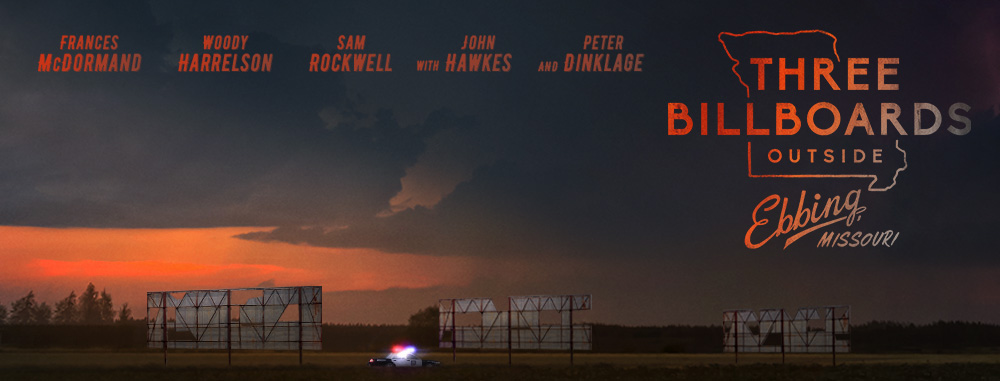
  • Film review: “Three Billboards Outside Ebbing, Missouri” (2017)

    “Three Billboards Outside Ebbing, Missouri” (2017)

    Drama

    3-stars

    Written & Directed by: Martin McDonagh

    Featuring: Frances McDormand, Woody Harrelson, Sam Rockwell, John Hawkes and Peter Dinklage

    Willoughby: “I’d do anything to catch the guy who did it, Mrs. Hayes, but when the DNA don’t match no one who’s ever been arrested, and when the DNA don’t match any other crime nationwide, and there wasn’t a single eyewitness from the time she left your house to the time we found her, well… right now there ain’t too much more we could do.” 

    Mildred Hayes: “You could pull blood from every man and boy in this town over the age of 8.” 

    Willoughby: “There’s civil rights laws prevents that, Mrs. Hayes, and what if he was just passing through town?” 

    Mildred Hayes: “Pull blood from every man in the country.” 

    Willoughby: “And what if he was just passing through the country?” 

    Mildred Hayes: “If it was me, I’d start up a database, every male baby was born, stick ’em on it, and as soon as he done something wrong, cross reference it, make 100% certain it was a correct match, then kill him.” 

    Willoughby: “Yeah well, there’s definitely civil rights laws that prevents that.”

    If you do not know who Martin McDonagh is then you are missing out on a rare talent, he made his name as an Irish playwright, then pivoted to become a film writer/director that concentrated his work on unique as well as individual characters that follow their own arcs, not necessarily following the classic Hollywood plots or emotional beats audiences may be used to. With his first feature, the multi Oscar nominated “In Bruges” (2012) McDonagh gave a glimpse into what kind of film he wants to make, to be fair he has stuck to this through to this new film “Three Billboards Outside Ebbing, Missouri” (2017). This is an original story that has deep emotions running through it as well as its characters, they are real and many of these people have to face demons, they either beat them or succumb to them. The relative merits of each decision is left up to the audience which may or may not satisfy them.

    There is no doubt that talented (and well known) actors grab the chance to work with McDonagh as well as espousing his dialogue. In this new film alone there are huge names such as Frances McDormand, Woody Harrelson, Sam Rockwell, John Hawkes and Peter Dinklage who could all be leads in their own projects, but come here to play very different characters than what they have been used to, except maybe Rockwell. As opposed to his other two efforts this new film deals with some weighty issues, as well as having a genuinely unlikeable protagonist at its heart in the character played by lead Frances McDormand.

    The film is built around Mildred Hayes (Frances McDormand) who is a divorced mother still grieving the violent rape and murder of her teenaged daughter Angela, seven months prior. Angry over the lack of progress in the investigation, she rents three abandoned billboards near her home, which in sequence read: “Raped while dying”, “And still no arrests?”, and “How come, Chief Willoughby?”

    The townspeople are upset over the billboards’ content, including Sheriff Bill Willoughby (Woody Harrelson) and officer Jason Dixon (Sam Rockwell). The open secret that Willoughby suffers from terminal pancreatic cancer adds to their disapproval. Mildred and her depressed son Robbie (Lucas Hedges) are harassed and threatened, but she stays firm, to Robbie’s chagrin.

    There are some very real and definite highlights in this film that almost transcend its possible shortcomings. The first factor are the performances by Sam Rockwell, Frances McDormand and Woody Harrelson who all are incredible, as you would expect. The only character that really has any kind of arc that is recognizable is Dixon played by Rockwell who once again proves that he is one of the great character actors of his generation, at times he reminds me of Walter Houston in this mannerisms as well as the ability to fit within almost any film he is cast, as well as his innate ability to steal every scene he appears in. Rockwell gets to play drama, comedy, as well as action and of course show off his singing and dance moves, which now seems like a prerequisite once you cast him. It is a shame that he will not receive awards recognition as there are two other people that will overshadow his own efforts.

    The two from this movie that will be in the awards hunt are lead actress Frances McDormand as well as writer/director Martin McDonagh who both are on top form in what they wanted to accomplish, but therein lies the problems with this film, as well as its subject matter which does not feel new or ground breaking – which is unlike what either of them probable wanted. The film revolves around the rape and murder of a girl as well as the repercussions that occur, in particular to her mother and brother. The issues I had with this movie was that there was just one way for her to deal with this devastation, that was to be a horrible person to everyone, even her own surviving child – she blames everyone else but takes no responsibility for her part, even at the end she transfers blame to a third party. The story is never resolved, in fact nothing is resolved, which means all the characters are stuck, while this is a reflection of real life it is not a completely accurate one, as in real life some people will have a resolution of sorts – the closest thing to resolution is the Woody Harrelson character, but that resolution is definitely not a happy one, just a deeply depressing one.

    The central premise of the film I did enjoy, that is the attempted shaming of a Sheriff into a perceived action that will bring closure to Mildred, thereby pushing her life forward – she figures if she can have someone tangible to blame she will be alright – of course she is wrong as she was a broken person before the incident, she just did not know it, unlike the rest of her family who gave up on her years ago. The same can be said for other characters within the film with the exception of Dixon who finds some sort of recovery at the hands of someone who actually enjoyed his warped perspective but offers advice on how he can be a better person. In her selfish way though Mildred will ruin that for Dixon as she has an effect on him that will push him away from any salvation.

    This is a very good film, made all the better by the dialogue as well as the actors delivering those lines, the threads that run through the plot are interesting but it never really rises above a diversion, that although on the surface seems to be heading somewhere just runs out of story with little regard for the ultimate fate of the family involved, which seems to be a shame as they all deserved much better from McDonagh. I have seen enough films with resolutions that are left up to the audience or are present to make a point, but here my feeling was that it was a little lazy on McDonagh’s part, something that may have worked in an editing suite for me does not work on the big screen. With all that said it is definitely worth seeing, and has to be one of the films of the year.

    “Three Billboards Outside Ebbing, Missouri” is in cinemas right now.

  • Film review: “All the money in the World” (2017)

    “All the Money in the World” (2017)

    Drama

    images

    Written by: David Scarpa

    Directed by: Ridley Scott

    Featuring: Michelle Williams, Christopher Plummer, Mark Wahlberg, Romain Duris, Andrew Buchan, and Timothy Hutton

    John Paul Getty III: [voice over] “To be a Getty is an extraordinary thing. My grandfather wasn’t just the richest man in the world, he was the richest man in the history of the world. We look like you, but we’re not like you. It’s like we’re from another planet where the force of gravity is so strong it bends the light. It bends people too.”

    This is the second film to be released this year directed by Ridley Scott who for some time now has upped his output to the point where he can direct a huge studio movie like “Alien: Covenant” (2017), then produce a more personal thriller like “All the Money in the World” (2017) where the measure of success is not only measured at the box office but also in execution, as well as critical acclaim, with awards thrown in for good measure. This is a story that Scott has wanted to tell for some time, as it seems to hint at what it means to be human as well as the foibles that are unavoidable when making a life as well as decisions that collide with other peoples lives. In terms of that we through John Getty are witness to a man with  one goal in life that is subservient to nothing, not even his own family – Scott has succeeded in bringing to life a true villain that today would be worshipped as a head of industry or even a President.

    Of course one of the scandalous aspects of this movie was the fact that Kevin Spacey had been cast and filmed as J. Paul Getty one of two key characters in the film. With the sexual misconduct allegations made against him in the press director Ridley Scott made the unprecedented decision with four weeks until release to refilm Spacey’s part with a new actor, in this case Oscar winner Christopher Plummer. It would be incorrect to say that the new parts are flawless but they do fit in well, if you aren’t looking for the patched parts you will be fine, but they do exist. What is incontrovertible is that Scott has created a new movie that is a grade A thriller based on true events.

    “All the money in the World” concerns a young John Paul Getty III (Charlie Plummer) who is kidnapped by an organized crime ring, his mother, Gail (Michelle Williams), desperately attempts to convince his wealthy grandfather, oil tycoon J. Paul Getty (Christopher Plummer) to pay the ransom. When he refuses, Gail allies herself with Getty’s business manager and former CIA operative Fletcher Chase (Mark Wahlberg) to set her son free, or convince Getty to change his mind before it’s too late.

    This is a movie made for great performances by very different actors that need to sell you on the conceit of the movie, which by and large is fairly simple from the outset. The story of people kidnapping others is not new, there have been many fiction as well as non-fiction stories told across many mediums with outcomes that are all similar, that is where this story is different as the person who could pay the ransom refused to, on some grounds that are understandable (those public ones) as well some grounds that are not (his private motivations).

    The cast that has been assembled is great starting with the now infamous recasting of Christopher Plummer as the elder Getty who one can at moments sympathize with, but ultimately the reasons for his refusal is maddening as well as completely insane. Of course an actor of Plummer’s stature plays him without an element of archness so as to make him a human being, with faults and all. Getty was a human being so Plummer plays him as such with motivations that may be foreign to many of us, but he has the talent to make him relatable at least to many of his own brood. Rounding out the cast of main characters are Michelle Williams as Gail Harris, Mark Wahlberg as Fletcher Chase and Charlie Plummer as John Paul Getty III. Before all the notoriety the star of this film was the talented Michelle Williams who has been nominated multiple times for Oscars without winning, this film is her best chance in ages, with a starring role that has already garnered other award nominations. Williams here, plays a mother who has one overriding aim, to get her son back, so she is stuck between kidnappers who are desperate to receive a ransom, and an old man who is desperate not to pay it. The way in which Williams does not play to a type is revelatory in its simplicity. Then there is Mark Wahlberg as a kind of negotiator who runs a relationship between Getty Senior, the kidnappers and Williams’s character all to varying degrees of success. There is no doubt that Wahlberg is trying to take on challenging roles that test his ability as well as hopefully improving it. Here he does a passable job of creating some kind of character, but when his scene partners are Williams and Plummer he comes off second best, as well as under whelming. Finally there is relative newcomer Charlie Plummer as the kidnapped Getty who spends most of the time with his abductors, as well as in relative silence, he also has to do a tremendous amount of physical acting that he carries off extremely well – he is possibly the most underrated performer in this film, but comes through with flying colors.

    For directors Ridley Scott who is possibly the biggest star of this endeavor, it serves as his most under stated as well as muted movie since possibly “A Good Year” (2006) which in contrast was a drama so could rely on subtle performances by then newly minted Oscar winner Russell Crowe and future Oscar winner Marion Cotillard. With “All the Money in the World” Scott has to maintain a balance between a true story, embellishments that have been made, the three main characters as well as the genre elements, those being a taut thriller. To his credit this is all done extremely well, it is also the most muted looking movie Scott has ever made, for a change he is short on the visual and long on the plot. I think this is a very good movie for what it is, however there are some issues more based around the general plot than the actual narrative, after a while I just felt like I was watching super rich peoples problems which in and of itself is actually pretty boring. For me the attraction are the performances as well as the kind of person Wahlberg’s character of Chase is and becomes, with a stellar scene with Plummer towards the end of the movie, it would have been nice maybe to have had a better actor of characters than the movie star Wahlberg is – at some point making less big budget movies is something he may like to try for a few years, especially with how they are turning out, that is dreadful.

    For a true story that has been all but forgotten “All the Money in the World” has turned out extremely well, it also plays better having a legend like Christopher Plummer playing someone close to his own age with all the fears as well as fallibilities that come with that – I can see him bing recognized at some point for this performance. This is a movie that is always going to have the odor of Kevin Spacey around its neck, which is a shame to say the least. This is a very good film that tells an interesting story; technically it is very good with it probably being Scott’s best and most even movie since American Gangster (2007), coincidentally another true story. The same things I loved about that movie are true with this new one. There are few technically proficient directors working today, with this film Scott confirms it. This is a movie worth checking out at cinemas; it is a smart, mid-level budgeted adult thriller, something rare these days.

    “All the money in the World” is out on the 4th January 2018.

  • Film review: “The Florida Project” (2017)

    “The Florida Project” (2017)

    Drama

    images

    Written by: Sean Baker and Chris Bergoch

    Directed by:  Sean Baker

    Featuring: Willem Dafoe, Brooklynn Prince, Bria Vinaite, Valeria Cotto, Christopher Rivera, and Caleb Landry Jones

    Moonee: [to tourist at ice-cream stand] Excuse me. Could you give us some change, please? The doctor said we have asthma and we have to eat ice-cream right away.

    A few times a year there are low budget films that break through becoming must see events normally through their exposure on the festival circuits, then becoming award favorites through critics groups as well as industry organizations. This new film from Sean Baker, “The Florida Project” (2017), is one of those. Whilst this movie is not as adlibbed or fly on the wall as it may come across, it follows in a long tradition of such films a Larry Clarks “Kids” (1995), although nowhere near as hard hitting or eye opening, mainly due to its subject matter as well as its point of view, that being very young  children that drive the narrative.

    Writer/director Sean Baker follows up his award winning shot on an iPhone “Tangerine” (2015) with this movie that follows young children who are living in a motel, their adventures are documented here, much like an updated film version of Twain’s ‘Tom Sawyer’, mixed with a new generation that the author could not have imagined. This tale illustrates that no matter the age we live in, ‘kids will kids’ is an adage without a time period. The other timeless conceit is that mothers always can see through their children no matter what they have done, that is truth will out. Baker has created a real plot with twists that might shock some, showing how families are living in a post crisis, ante Trump world where survival of the fittest is not restricted to the wild.

    “The Florida Project” is set during the summer, six-year-old Moonee lives with her young mother Halley in the Magic Castle, a motel in Kissimmee, Florida. She spends most of her day unsupervised with her motel-resident friends Scooty and Dicky, engaging in mischief at other motels, mooching from tourists at nearby businesses, and other misbehavior. They invite Jancey, a new child living at the Futureland motel next-door, to hang out with them. Following an incident, Dicky’s father restricts him from hanging out with them, and the family eventually relocates to New Orleans, which upsets the group.

    Halley is unemployable and engages in various petty schemes to make ends meet, such as hawking perfume to tourists in the parking lots of hotels, and asking Scooty’s mother Ashley to steal food for them from the diner where she works; a local church also brings foodstuffs for the many impoverished motel residents. Motel manager Bobby reluctantly but chronically plays the role of parent to both Halley and Moonee, and other residents, as part of his responsibility to manage the facility.

    Apart from the characters and their own struggles that are portrayed in the film, the location of the movie is of utmost importance, as it directly shows the massive gap between the haves and the have not’s. It also illustrates the dichotomy between a place that is so full of wealth as well as joy that the difference in the location of this movie could not be further apart. The fact the location of the Magic Castle is so close to Disneyworld is no mistake or accident as it underlines the difficulty that Halley has as a young single mother attempting to just survive with her daughter, paying for the basics such as shelter and food. One has to wonder what the point of living in the self-proclaimed greatest democracy on Earth, or the best country in the world is if you have people living like they are in this movie. The mere fact that some government agencies get involved with fat cops that are clueless to what is actually going on just underlines the importance of a movie like this in this decade.

    Baker has seemingly effortlessly (which of course is not true) created one of the best social commentaries of recent times along with Andrea Arnold’s “American Honey” (2016), which had similar themes as well as using very similar aspects of film-making. They are both using either non-professional main actors as well as a cinéma vérité approach to their method of filmmaking and real locations making use of external locales which only add to the authenticity of what both movies are trying to get across to their audiences. This is a snapshot of life in parts of the US that are devoid of a social safety net that actually look after children as well as parents when their lives are genuinely off the rails – even if they do not realize it, which is what we are witnessing with Halley and Moonee who do not have a realization as to what kind of trouble they are in. No matter how bad it looks for them they do not have a concept that they have not yet hit bottom, they are not even close.

    This film would not have even been possible without the performances of newcomers (and one has to say discoveries) Brooklynn Prince as Moonee and Bria Vinaite as her mother, Halley. Both share the screen together and apart for a majority of the movie with nary a false note onscreen which considering their experience is incredible. They both inhabit their roles like any other experienced actor might, again what is amazing about his is their inexperience in this situation. They are ably supported by a variety of performers, none more so than the beacon that is the great Willem Dafoe who here shows why he is not only a great character actor but someone who can create a subtle performance that in no way steals from the story or from his leading ladies. Dafoe though acts as a sort of father as well as grandfather figure in the girls life, he is of course inhabiting traits we recognize as fatherly such as being strong, protective, being a disciplinarian as well as offering advice that is good as well as ignored by his wayward ‘daughters’. Through all of this as well as right to the end Dafoe paints a picture of caring but of also knowing he has no actual responsibility to the girls and true to his character he does not rescue them as much as we might want him to.

    Films like “The Florida Project” are a rare thing indeed and should be cherished by all, it is immediately entertaining which is something that should not be underestimated as to how important this is in the kind of themes that are involved in terms of what the writer and director are illustrating to an audience. Not only that but the performances are all excellent with praise for the two leads undeniable. The direction is excellent, there are structured as well as adlibbed scenes that fit in perfectly, my favorite is an obvious on the spot creation where the camera is in font of Moonee’s face where she is eating breakfast, giving a running commentary where she slips in and out of focus, a long segment where she has to be on for the entire scene, showing what kind of actress we are seeing – possibly for the first time in the entire run time of the movie.

    This is definitely one of the films of 2017, we are lucky it is in cinemas now as it is made for the big screen with some of the shots too beautiful to miss in juxtaposition to the personal story it is telling in this modern age of the rich and the poor.


  • DVD & Blu-ray review: “Ken Burns’ The Civil War” (1990)

    “Ken Burns’ The Civil War” (1990)

    TV Series/Documentary

    5stars_small

    Episodes: Nine

    Created by: Ken Burns

    Featuring: David,McCullough, Sam Waterston, Julie Harris, Jason Robards, Morgan Freeman, Garrison Kellor, Athur Miller, and many more

    Abraham Lincoln: “As a nation, we began by declaring that “All men are created equal.” We now practically read it, “All men are created equal, except Negroes.” Soon, it will read “All men are created equal, except Negroes, and Foreigners and Catholics.” When it comes to this, I should prefer emigrating to some country where they make no pretense of loving liberty. To Russia, for instance, where despotism can be taken pure and without the base alloy of hypocrisy.”

    If you don’t know who Ken Burns is then you are missing out on an entire genre of television documentaries that are all almost second to none. It used to be that Burns (with partner Novak) used to produce the very best long form documentaries but with the advent of reality television, binge watching, crime shows and many other innovations as well as new formats Burns style has suffered from comparison whilst bordering on nostalgic. What is interesting is that this series only borders on the nostalgic but never crosses the line, which in itself is a gift that Burns exploits in all of his documentaries.

    In fact “The Civil War” was to be not only the first of Burns’ epic television documentaries that would capture the imagination of a welcoming television audience, it also forms what is, in my mind, one of the cornerstones of his selection of masterpieces that follow and include; Baseball” (1994), The West (1996), Jazz (2001) and The War (2007). This was the first time that Burns; inimitable style as well as the way in which he would illustrate facts came to the fore; it instantly made him an authentic documentarian as well as master showman, unrivalled in his chose medium. When this series was screened on PBS in the US it had a then record viewership for PBS of over 40 million viewers.

    In creating the documentary regarding the American Civil War (1861-65), Burns is innovative in a variety of ways; these innovations would become his trademark. First is his emphasis on personal journals rather than the nuts and bolts of battle strategies as well as the dry politics of the day. There is little use of interviews with academics, instead we are given personal journeys of those actually there, in letters written on the battlefield by soldiers on both sides, in diaries kept by Mary Chesnut, the wife of a Confederate officer, by newspaper columnists, abolitionists, escaped slaves, poets, generals, and presidents. Their intimate expressions of hopelessness, exhilaration, exhaustion, terror, confusion, repulsion, and just about every other emotion you can imagine vividly brings this age to life.

    Over the course of nine episodes, viewers become as intimately acquainted with Mary Chesnut (voiced by Julie Harris), ordinary Confederate soldier Sam Watkins (Charley McDowell), and Union private Elisha Hunt Rhodes (Chris Murney) as they do with Abraham Lincoln (Sam Waterston), Ulysses S. Grant (Jason Robards), and Robert E. Lee (George Black). The ingenious mix of voice talent also includes Morgan Freeman (as Frederick Douglass), Arthur Miller (as William Tecumseh Sherman) and, in various roles, Colleen Dewhurst, Ronnie Gilbert, Jeremy Irons, Derek Jacobi, Kurt Vonnegut, Laurence Fishburne, Pamela Reed, and M. Emmet Walsh.

    The Civil War doesn’t attempt to document every minor skirmish, though it is obsessed with little details about daily life: the price of a barrel of flour, the food Union and Confederate soldiers ate in the field, the diseases that killed as many men as in battle. Most of all, it is obsessed with the human cost of war, expressed in the photograph’s by Matthew Brady.

    The Civil War notices the many ironies of the war, and it frequently takes the time to pause and reflect upon the cost of war.

    Episodes:

    1. The Cause – Opening with a anecdote that sets the tone for the whole war, this episode also introduces some of the key players in the war without actually revealing who they are and the importance they will play. The beginnings of the war are shown to have come from slavery and how the south supported it and the north opposed it. The effect on the country is shown, from the attack at Fort Sumter to the 5,000 casualties that were the product of the battle at Manassas, Virginia.
    2. A Very Bloody Affair – Opening with the writing of the Battle Hymn of the Republic, this episode shows the immediate effects the start of a civil war had on the country. The political problems that Lincoln had to the technological advance in warfare with the introduction of ironclad ships and gatlin guns. More than just focusing on the battles, this episode focuses on what it was like being a soldier at this time and the amazing story of the young children that were enlisted in the armies.
    3. Forever Free – Lincoln comes to his decision that slavery is necessary but wants to wait and issue the proclamation after a Union victory. The politics of war are explained as the South cuts cotton production to England and France. General Benjamin “The Beast” Butler is made infamous after his General Order No. 28 proclaims that women insulting any of his troops will be treated as ladies of the street. The episode closes with the issuance of the Emancipation Proclamation on September 22, 1862.
    4. Simply Murder – The episode starts off with a history of the rebel yell and then describes the mistakes that plagued the North. After a brief introduction describing more of the major players and events that would happen that year you learn more about the troubles facing the north. Despite their numbers, the North was often overwhelmed and the South too faced problems. Despite popular belief many northerners were against the Emancipation Proclamation. The highlight of the episode has to be section four where the food of the army is focused on. Worms seemingly infested every inch of food and drink. One soldier comments on the fact that the worms were easily skimmed off and they left no taste in the food. The episode ends with the death of Stonewall Jackson after losing his arm.
    5. The Universe of Battle – The main focus of this episode is the Battle of Gettysburg. Over 150,000 men will fight in what will come to be known as the greatest battle fought on American soil. Ironically enough the battle was started by marching Confederate soldiers who were in search of shoes. Their March led them straight into the Union army. Interludes in the episode provide information on the role that black troops and women played in the war and ends with Lincoln delivering the Gettysburg Address.
    6. The Valley of the Shadow of Death – Like many of the episodes this one shines when it focuses on more than just the battles. The highlight of this disc is the exploration of the growth of hospitals. The largest hospitals had gardens, livestock and breweries. Poet Walt Whitman is profiles when his trip to find his wounded brother winds up involving him with the plight of the wounded soldiers. Appalled by the conditions he found, he stayed on and read the men poems and talked to many of them “providing a medicine that the doctors could not.” The harsh reality of the situation is conveyed with a slow procession of photos from an outdoor embalming session only accompanied only by the hot summer clicking of the insects often heard outdoors.
    7. Most Hallowed Ground – With a focus on Lincoln’s political bid for reelection, this episode is a little slower than others. Interest in inserted with stories about spies for both sides and the important role that slaves played in that area. Black soldiers in the war face both a victory and a vicious defeat. They are elated when given equal pay and Nathan Bedford Forrest shocks many as he slaughters 300 black soldiers that surrendered. The episode ends with a look at the thousands killed and the creation of Arlington National Cemetery.
    8. War Is All Hell – With only two episodes left, the series seemingly ends early with the events that lead to the surrender at Appomattox. General Sherman makes his famous march through the south, destroying all in his path. Slaves are freed and soldiers desert their units as the South begins to lose all hope of victory. After the formal surrender the episode ends on John Wilkes Booth.
    9. The Better Angels of Our Nature – The surrender is revisited once again as the motive behind John Wilkes Booth’s assassination of Lincoln is explored. As a final look, the episode revisits most of the key players in the war. More than just generals and leaders are focused upon. Finally all the elements are brought together one last time with an examination of what the war meant to the nation.

    “Ken Burns’ The Civil War” (1990) is available now on DVD & Blu-ray.


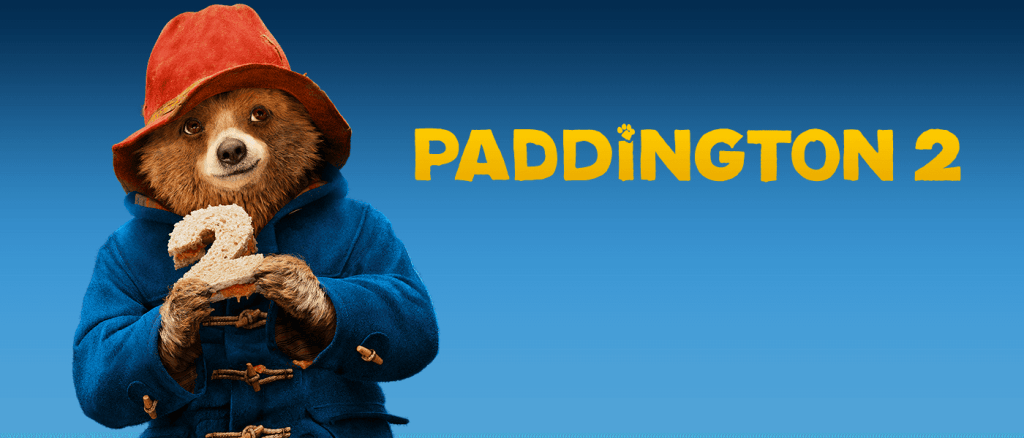
  • Film review: “Paddington 2” (2017)

    “Paddington 2” (2017)

    Animated Comedy

    Written by: Paul King & Simon Farnaby

    images

    Directed by: Paul King

    Featuring: Ben Wishaw, Hugh Bonneville, Sally Hawkins, Brendan Gleeson, Julie Walters, Jim Broadbent, Peter Capaldi and Hugh Grant

    Henry Brown: Paddington wouldn’t hesitate if any of us needed help! He looks for the good in all of us.

    There is no doubt that the release of “Paddington” in 2016 was not only a huge success but defied odds to become one of the best films of that year. When the original trailer was released with not great animation as well as Colin Firth woefully miscast as the voice of our furry hero there was not much to look forward to. But with some time and the recasting of Ben Wishaw as the almost too perfect voice of Paddington the film became a real success story – with a sequel sure to arrive, and it has with bells on. It not only lives up to the original hit, but surpasses it by moving the story forward, with a goal based plot as well as upping the villain stakes with Hugh Grant, here showing why he can play pretty much anything without any ironic detachment that can haunt some actors in similar kinds of films.

    The great news is that writer/director Paul King has retuned to not only bring a new story to life but also reinvigorate the narrative with his unique visual style, which canny viewers will recognize from his stellar work on “The Mighty Boosh” (2005-2012), as well as the cast which is rounded out with many of his cohorts from the same show or similar projects. Of course with the first movie firmly planted in peoples minds there has to be something to not only remind viewers of the greatness, as well as uniqueness, and their introduction to Paddington but there needs to be an addition to keep the story fresh as well as the supporting characters real – this has been and King makes it looks easy.

    The story begins with Paddington, having settled with the Brown family in London’s Windsor Gardens, has become popular in his community, offering people emotional support in various ways, apart from Mr. Curry who still distrusts him. The Browns have changed in many ways. Mary Brown is training to swim the English channel; Henry Brown does not get the promotion at work he has hoped for; Judy has broken up with her boyfriend, Tony, and has started a newspaper; Jonathan has dropped his old, independent self and has become a classic teenage boy. To purchase a unique pop-up book of London in Samuel Gruber’s antique shop for Aunt Lucy’s 100th birthday, Paddington performs several odd jobs and saves his wages over time, finding a good niche as a window-cleaner after a failed attempt as a hair dresser.

    When he is just a day away from having enough money for the book, he witnesses it being stolen from the shop by a bearded thief, and is accused of the crime when the true culprit flees after a brief chase. Unable to obtain evidence of the thief’s existence, Paddington is wrongfully convicted and detained. The thief soon returns home, removing a disguise to be revealed as Phoenix Buchanan, an egotistical has been actor who lives opposite the Browns and whom Paddington met at a carnival opening ceremony some days prior and had shared the existence of the pop-up book, which Buchanan had thought to have been lost.

    When any film relies completely on a CGI created central character as its hero, as well as acting as the point of view of the audience there is a requirement that everything else looks completely real as well as having a supporting cast that can make you believe that a talking bear exists and is able to interact with the world around him. Of course like the first film, in fact like almost all reasonably budgeted UK based movies, “Paddington 2” has an outstanding cast that is peppered with successful actors in their own right. Starting with Paddington’s adopted families led by Hugh Bonneville and Sally Phillips who lend an authenticity as parents, so much so that you feel they are three dimensional characters that are more than paper thin stereotypes. Then there are the two new major character’s that have been added for this new adventure, those being Hugh Grant as actor (and villain) Phoenix Buchanan and Brendan Gleeson as convict (and Paddington ally) Knuckles McGinty. There are far too many actors to specifically identify as well as many marvelous cameos to go into here, so I will make a few comments about Grant and Gleeson.

    It has been a real joy to see Hugh Grant making a comeback (but was he ever away?), which in my mind began with the massively underrated “The Pirates! Band of Misfits” (2012) and continued through to his scene stealing performance “Florence Foster Jenkins” (2016), here he plays what must be an original character creation based I am sure on some unkind descriptions of him or an actor like him. Grant here is not only attempting to make a myriad of characterizations, but he is also being very physical as well as funny, when you think of Hugh Grant the words ‘physical comedy’ do not immediately spring to mind, but he is successful in everything he tries here – much like Nicole Kidman in the first film. Then there is the always-terrific Irish actor Brendan Gleeson who here is playing his part for big laughs as a cook in a prison, his friendship of Paddington has some clear messages for children as well as adults, if only people would be as accepting of everyone as Paddington is we would all be better off. Gleeson is a force onscreen, completely in charge of his performance as well as being brave enough to expose himself to some comedy greats.

    The MVP of this movie is definitely Paul King who had only directed one other film, the quirky “Bunny and the Bull” (2009) before writing and directing the first Paddington movie. What King has done is to take his knack of being able to take real life situations and skew them so that they turn to fantasy. The director has applied this to a fictional character, taken an existing property, used the current time as well as a real location, that being London and created a world where a talking bear is the norm, as well as being accepted by the general populace. The other aspect of the film is that while this is a children’s film there is more to the narrative than a simple story, everything within the plot can be understood by young and old so that all audiences can be fully engaged with a story about a talking bear.

    Much like the first movie Paddington 2 has so much to offer audiences of all ages, while the first movie acted as a kind of origin movie of sorts, we see Paddington and his entire family moving on from their initial adventure into new places where they have all grown individually as well as a family which all people can relate to. This is highly recommended to all audiences, the CGI is top notch, the performance are all excellent and the action as well as thrills are original but at the same time offer fitting homages to other action movies, something the original did brilliantly.

    Paddington 2 is out now in cinemas.


  • Film review: “Last Flag Flying” (2017)

    “Last Flag Flying” (2017)

    Drama

    images

    Written by: Richard Linklater & Darryl Ponicsan

    Directed by: Richard Linklater

    Featuring: Steve Carell, Bryan Cranston, and Laurence Fishburne

    Larry ‘Doc’ Shepherd: “I’m not going to bury a marine. I’m just going to bury my son.”

    This new movie co-written and directed by the great Richard Linklater is not something that you might immediately expect from him after his last two films, the Oscar nominated “Boyhood” (2014) and the absolutely under rated Everybody wants some!!” (2016) – which were deeply personal as well as unique, with their take on very different parts as well as times of America. That is not to say that this new movie, “Last Flag Flying” (2017) is not, but it does touch on elements that Linklater has never addressed, the US military, getting old in America, death as well as Americas obsession with war – fighting enemies that the US has no reason trying to dominate. It is always fascinating viewing Linklater’s movies in terms of his craft, as well as what he is saying about life in both general as well as specific terms.

    Linklater has crafted a movie that acts as a time capsule, for a period in the US when the shadow of the terror attack on 9/11 is still fresh, as well as all the mistakes made then by the Bush administration, the price being paid by people who are innocent, trying to contribute to efforts that end up being false. Linklater looks back at events over fifteen years ago through the eyes of Vietnam veterans who are living in a time that echoes their own pasts, with one of them paying a price that should never have been paid. This movie attempts to ask more questions than it answers by posing them through the plot as well as character traits of the three main protagonists, using a road movie narrative to keep the pace moving along – a wise decision made as this could have been mired in nostalgia over two troubled time periods.

    Set in December 2003, Larry “Doc” Shepherd (Steve Carell) visits the bar of Sal Nealon (Bryan Cranston), a former Marine that he served with in Vietnam. After a wild night Sal and Doc drive to the church of another friend from Vietnam, Richard Mueller (Laurence Fishburne), where he is the pastor. At Mueller’s house that evening, Doc reveals that his wife had recently passed away, and the purpose of his trip was to ask his friend to accompany him to retrieve and bury his son, Larry, who had recently been killed in Iraq. Sal agrees, while Mueller is initially reluctant to leave; at the insistence of his wife he eventually agrees and they begin the trip to Washington DC.

    This is a very special film with memorable actors that are all performing at the top of their games. This is enhanced by the fact that they are being directed by someone who is, surely, one of the greatest (possibly underrated) as well as prolific American directors working today. This director has proven time and again that he has a rare insight into not only people but also the American landscape through very different time periods. This is something rarely seen with writer/directors but with a career spanning over four decades Linklater is always searching for the next story.

    Over the last decade as some prominaent male actors reach their sixties, seventies and eighties there have been a number of ‘old men’ movies that started with “Wild Hogs” (2007), which was a huge hit, and is directly traceable to “Last Flag Flying”. In saying that none of those movies have dealt with the themes that Flags has, which adds another level to this new genre, in my mind a welcome one.

    The central casting of the three main characters is actually quite inspired as well as being obvious once you view the film. These actors are all multi talented having anchored almost every genre going, as well as being in touch with the politics of this piece. The central character of ‘Doc’ played by Steve Carell is the emotional heart of the film as well as the central aspect driving the plot, as well as the narrative, he is the one that has to make many decisions as well as corral the other two players, Richard (Laurence Fishburne) and Sal (Bryan Cranston). These are three quality actors in roles that while spelt out on the page bring to life real three-dimensional characters that are affected by not only their own distant pasts but also the recent one that is having terrible repercussions not only on their present but ours as well. The last third of the movie does take some turns, one thing it does show is the ability of the main character to actually change his thinking in a way that not only does justice to himself as well we his son, but also the Marines in which both of them served to varying degrees of success. There is a definite dogmatic approach by many people in this movie, but ‘Doc’ is the one that makes compromises as well as facing up to truths that for a lessor man may have been too much to deal with especially in relation to the death of his only son.

    As I have already said this film is a departure of sorts for Richard Linklater, not only is it a Studio picture (Lionsgate) but it is also a co-production with Amazon Studios. Having been scarred by working on other projects with major studios it seems Linklater has made it an aim to work independently without studio interference, but he has made an exception here with “Last Flag Flying”. Linklater has created a movie that works on many levels, not only is it a comment on the Vietnam War which these characters are veterans of, it is also addressing very realistic post-9/11 concerns that are inherent in the time we live in now. The one thing I did take note of was the way in which the director treated not only the story but all of the people, this was a relaxed film that took its time finding its feet as well as what kind of movie it wanted to be. It could be that Linklater is becoming more reserved as he ages which would not be unheard of, in fact Last Flag Standing echoed Clint Eastwood’s oeuvre in a way I found quite heartening.

    With many of Linklater’s films (and like many filmmakers of his generation) music especially non diegetic music plays an important part in narrative, here the director uses the songs of Levon Helm, Bob Dylan, Neil Young and Albert King to illustrate some of the salient points behind the film. In fact there is a section of the movie that uses Eminem to highlight attitudes of race, culture and age between Richard and Sal.

    I recommend this film to all who enjoy the movies of Richard Linklater as well as those who also enjoy a healthy dose of politics in their entertainment. There is no doubt in my mind that this marks a different direction for the writer/director that will be interesting to see if he stays the course or this was a deviation into new territory.

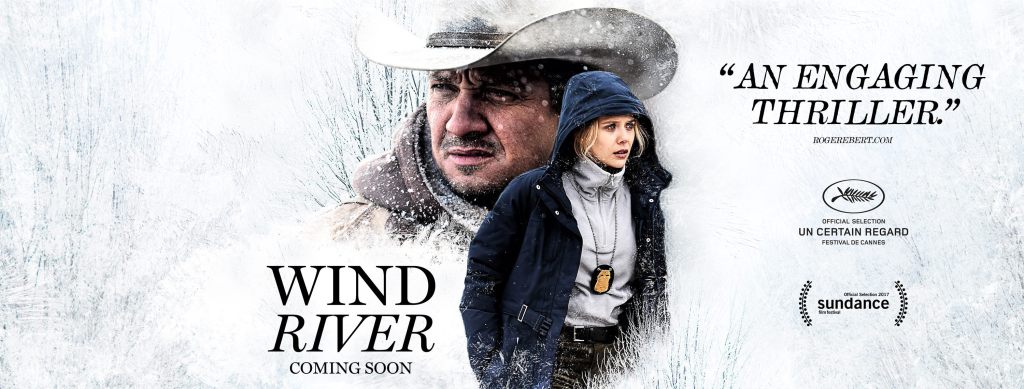
  • DVD & Blu-ray review: “Wind River” (2017)

    “Wind River” (2017)

    Drama/Thriller

    images

    Running Time: 111 minutes

    Written and Directed by: Taylor Sheridan

    Featuring: Jeremy Renner, Elizabeth Olsen, Gil Birmingham and Graham Greene

    Cory Lambert: “I’d like to tell you it gets easier, but it doesn’t. If there’s a comfort, you get used to the pain if you let yourself, I went to a grief seminar in Casper. Don’t know why, just, It hurt so much, I was searching for anything that could make it go away That’s what I wanted this seminar to do, make it go away. The instructor come up to me after the seminar was over, sat beside me and said, “I got good news and bad news. Bad news is you’ll never be the same. You’ll never be whole. Ever. What was taken from you can’t be replaced. You’re daughter’s gone. Now the good news, as soon as you accept that, as soon as you let yourself suffer, allow yourself to grieve, You’ll be able to visit her in your mind, and remember all the joy she gave you. All the love she knew. Right now, you don’t even have that, do you?” He said, “that’s what not accepting this will rob from you”. If you shy from the pain of it, then you rob yourself of every memory of her, my friend. Every one. From her first step to her last smile. You’ll kill ’em all. Take the pain, Take the pain, Martin. It’s the only way to keep her with you.”

    A director that is given a broad canvass to work with as well as top talent in front of as well as behind the camera can count themselves very lucky, but when the film they work on turns out as well as “Wind River” (2017) it is an auspicious occasion indeed, especially when that director is a screenwriter as well. In this case writer/director Taylor Sheridan has already had a pretty good start to his career with his first produced screenplay being the incredibly successful and criminally underrated “Sicario” (2015), directed by Canadian auteur Denis Villeneuve. Sheridan then quickly followed up that triumph with the Oscar nominated screenplay for the David McKenzie directed “Hell or High Water” (2016). The success of both of these films, both making money as well as being critically lauded, meant that Sheridan had the power to direct his next screenplay. I must say this was a wise choice as this is a truly great film, it seems September has been a very good month for film releases in general.

    Sheridan has been able to line up two extremely experienced leads in the always-reliable Jeremy Renner as well as the talented Elizabeth Olsen who after an auspicious debut in “Martha Marcy May Marlene” (2011) has finally found a film that matches her early promise. Sheridan has written a film that is at once a character piece but is more than that, in dealing with familial loss as well as racial issues that haunt not only the US but almost every country in the world. He asks what does it mean to be a man, or a women (although to a lesser extent), where do we come from as people and the brutality that one person (or persons) can inflict on another for nothing more than the promise of a thrill or a boredom breaker? It seems that Sheridan is always querying the human condition and all that entails, something that possibly comes from his acting background as well any education he may have.

    The film is et in the Winter on the Wind River Indian Reservation in Wyoming, U.S. Fish and Wildlife Service agent Cory Lambert discovers the body of Natalie Hanson, an 18-year old resident of the reservation. Her corpse is frozen solid, she is without shoes and proper winter attire, and there is a blood stain on her pants at her groin. Rookie FBI special agent Jane Banner arrives to determine whether a murder has been committed, as the federal government has jurisdiction over capital crimes on reservations.

    This film rests squarely on Jeremy Renner’s shoulders as the lead, as well the emotional tether that really binds all the characters in this film together. He does a wonderful job as being the ‘know everything’ character that really leads his co-star around the general area they are operating in. Renner has been nominated for best actor twice at the Oscars, it is roles like this where you see his strengths as an actor (in particular a film actor) who can really get under the skin of whomever he portrays. Even in his MCU movies as the archer Hawkeye he brings something deeper to the character, as well as the movie, than he needs to. Over the past fifteen years since his lead role in “Dahmer” (2002) Renner has been an actor to watch, it is no fluke that he gives his all to his work, which you can plainly see onscreen. It is a little unfortunate then that the character played by Elizabeth Olsen really is nothing more than a fill in for the audience. She is playing a fish out of water right up to the end of the movie, which is a shame because she is a diminished character, as well as this being a tired trope in a film that is original. In saying that I understand why Sheridan has created this role, it is a way to answer any questions or situations that may crop up for the audience. The highlights of the rest of the cast are two Native American actors Graham Greene and Gil Birmingham who have long been around in a variety of films so have experience to burn in films of this ilk. They both offer very different aspects of tribal life as well as the reflection of how Native Americans are seen by not only non-Native Americans but by the government where they are still being persecuted in more insidious ways than ever. Both actors represent where their people have finally ended up with nothing more than isolation and silence – something that can’t be taken away from them, until the actions taken by some non-Native American visitors to their small isolated and insular world.

    Sheridan definitely writes from a male perspective which of course is his prerogative, women in his movies are all either out of time or out of touch or both. Even taking that into account this is still a beautiful movie that, like many other movies today uses the geographic location of its setting as a definite character – more often than not the main character has many of the same elements as the area they live in, this is more obvious as you work through each of his movies. In fact it is this very hostile environment that is responsible for (indirectly) all of the death that has taken place, believe me there is a lot of it. The way in which the loss by all the main players in this film has been framed is done so well. Not only are all the people isolated by their own emotions, but they are landlocked by the continent itself, then the weather plays a major part with all the inherent dangers that it represents (literally) – which we see twice in the movie. Sheridan has made the main character the only person with any real agency, he has taken responsibility for many things in his life, we see him throughout the movie making his own mark, with his own actions – we see him tracking animals, offering advice, making his own bullets, not afraid about owning up to loss and advising a father on what happens if grief is not embraced in a conscious way. This is different to all the other characters as they seem to stumble around lost in the physical or emotional world.

    As I have already said this is a film about loss as well as the consequence of loss, what it means to lose a part of life that will never come back. This loss is physical, the loss of life, but is also the loss of identity whether that be as a father, or, in the wider context, the loss of Nationhood, what that does to a people and how this can lead down self destructive paths. We see small elements of personal self-destruction as well as, in many instances self-sabotage. One of those losses is what becomes the inciting incident, where choices are made along sexual, political and racial lines, people go too far in their decisions and its too late to go back on them – something the US could take a page from in its dealings with its own people as well as on the international stage.

    If you enjoyed Sheridan’s other films you will love this. It is a murder mystery with layers that go deep; they help to illustrate the effects of loss, a society on the edge of disappearing as well as what can happen when people actually care for others. There are many elements to a Taylor Sheridan movie, these are all present here, the older wider man, someone who is clueless to what is really going in and of course a crime. I recommend this film highly and I would not be surprised to see Sheridan shortlisted for a screenplay Oscar in a few months.

  • DVD & Blu-ray review: “It” (2017)

    “It” (2017)

    Horror

    images

    Running Time: 135 minutes

    Written by: Chase Palmer, Cary Fukunaga and Gary Dauberman

    Directed by: Andy Muschietti

    Featuring: Jaeden Lieberher, Bill Skarsgård, Jeremy Ray Taylor, Sophia Lillis, Finn Wolfhard, Wyatt Oleff, Chosen Jacobs, Jack Dylan Grazer, Nicholas Hamilton and Jackson Robert Scott

    Ben Hanscom: “Derry is not like any town I’ve been in before. People die or disappear, six times the national average. And that’s just grown ups. Kids are worse. Way, way worse.”

    After a dreadful Summer at the US box office comes a movie that could redeem it somewhat as the prestige film season begins in earnest – that is the horror remake/adaptation of one of Stephen Kings most famous (and largest) novels, ‘It’ written in 1986, adapted once already as a television mini-series in 1990. Whilst the miniseries was set up in the present and told in flashbacks that featured the now infamous ‘Pennywise the Dancing Clown’ played with inimitable ferociousness by the great Tim Curry – leaving a mark on a generation as one of the most terrifying clowns in either TV or cinema – this new movie tracks slightly differently in tone as well as its narrative structure.

    Originally set up at Warner Bros. with Cary Fukunaga as the both writer and director, after his huge success with the first season of HBO’s “True Detective” (2014 – present) he was the top choice, as well as Will Poulter as Pennywise this seemed like a slam-dunk. But as with many modern big budget films, or when studios have second thoughts Fukunaga left over differences, Poulter quickly followed suit, it looked like the project may be dead, but in stepped relative newcomer Andy Muschietti and Pennywise was recast with another gamble in the form of Bill Skarsgård. The challenge was always going to be how to condense a thousand page book into a possible two hour running time, but this I am happy to say has been solved in what must be one of the greater leaps of faith for a studio to make with unproven talents in front and behind the camera.

    The plot has been split between the younger and older selves of the book with the frst film serving as a period piece set in the 1980s and if the sequel is to happen it will be set in modern times (2016) with a few possible flashbacks (apparently already filmed). The good news is that this film will already be enough of a hit for the sequel to be green lit and will be filmed early next year. The other piece of great news is that this movie stands on its own even if a sequel was never to be made with an ending that makes sense, but if you know the plot leaves a door open for one more visit to Derry.

    “It” takes place in Derry, Maine in the summer of 1989, a group of outcast preteens known as “The Losers Club” fight against an immortal, shape-shifting entity responsible for the disappearance of dozens of children in their town, and are forced to confront their own personal demons in the process.

    This is actually quite a unique film, particularly in the horror genre in that it has a large budget (compared to the cost of modern Horror movies), is based around children, but does not treat them as such, in fact they are for all intents and purposes the adults of the film – as well as all of this the film is aimed at an adult audience not the PG soaked one that has to be pandered to with only small amounts of violence, gore and coarse language. One other aspect of this film that I loved was the choices that each of the protagonists makes, they seem to be honest, as well as real in terms of the world they are inhabiting, something that is from the novel as well as the miniseries. If you have seen recent horror movies like “Annabelle: Creation” (2017) you will know about illogical, nonsensical decisions that are the inciting incidents that make absolutely no sense.

    This film is well directed by Andy Muschietti, whose only other movie was the 2013 horror hit “Mama” produced by Guillermo del Toro based on his own short film. Here Muschietti must bring a well loved book to the screen with not only a sense of style, but an inexperienced cast as well as having one eye on the future, but always maintaining that this movie live in its own present. He has done an excellent job by marshaling his cinematographer Chung-hoon Chung, who brings a fresh originality with his work on his South Korean movies that mix genres as well as acting and directing styles. The film is not without its tropes and this is probably as a result from a mix of screenwriters that have taken passes at Fukunaga’s original script to try and boost parts that the studio thought were appealing – luckily though this is a visual film with many thrilling elements to hide any narrative flaws, which do exist.

    “It” is the very definition of an ensemble piece with a few characters that take more of the screen time than others, those being Jaeden Lieberher as Bill, Jeremy Ray Taylor as Ben and Sophia Lillis as Beverly, all heroes to be sure. Within this group though it is newcomer Sophia Lillis who shines as the real center of the group, she plays her part as heroine, victim and sometime love interest of both Ben and Bill. Lillis has the unenviable job of being the only girl in the group as well as coming of age in a town full of children that make up stories about her with a home life that is full of possible molestation and of course a killer clown that by the end of the movie she comes face to face with, she is definitely someone to keep an eye on in the future, a star turn then for her in this film. On the other side of the coin there is Nicholas Hamilton as Henry Bowers the human protaganost and Bill Skarsgård as Pennywise the otherworldly villain who causes all of the mischief. This really is Skarsgård’s movie with him obviously having a great time bringing one of the more iconic villains to life and scaring anyone he comes across – if they do make another movie I look forward to his return, I just hope I don’t have to wait long.

    Another aspect of this film that dovetails with a current resurgence is the fact that is in set in the 1980s (although barely as it is 1989) much like the recent amazing “Stranger Things” (2016 – present) and the disappointing “Atomic Blonde” (2017). The 1980s pedigree is clear with music from ‘The Cure’, ‘The Cult’ and ‘Anthrax’ as well as movies present like “Batman” (1989), Lethal Weapon 2” (1989) and “A Nightmare on Elm Street 5: Dream Child” (1989). There are even jokes when Beverly discovers Ben listening to ‘New Kids on the Block’, and when they enter his bedroom a poster of the same – exceptionally funny. Of course the reason for the film to be set in the 1980s is that the next one will be twenty seven years later, which will be 2016 – I am assuming there will be some past references to make this workable – we shall have to wait and see.

    This movie works extremely well on all levels, it works as a horror movie, a coming of age movie, a thriller and really a multitude of other genres as well, that is what is great about it, it also introduces a new crop of young actors as well the solidification of a visionary director in Andy Muschietti who I hope will direct the sequel. I can only assume that Cary Fukunaga will have no more to do with these movies as he has moved on but that is a shame as I can not help but think he is a large part of the success of this movie.

    I recommend “It” to you if you love Stephen King, horror movies or just a good film; it looks great on the big screen with performances that really jump off the screen with scares as well as humor – if you are going to see one movie this month it should be this one.

    “It” is out now on DVD & Blu-ray.

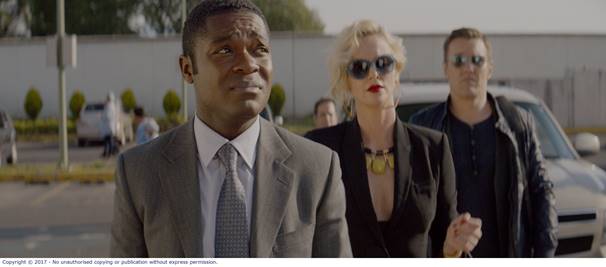
  • “Gringo” (2018) – Official Trailer Debut

    “Gringo” (2018) – Official Trailer Debut

    Error
    This video doesn’t exist

    A dark comedy mixed with white-knuckle action and dramatic intrigue, GRINGO explores the battle of survival for businessman Harold Soyinka (David Oyelowo) who finds himself in over his head after traveling to Mexico. He soon crosses the line from citizen to criminal while tangling with shady colleagues, international mercenaries, drug lords and the DEA.

    GRINGO is directed by Nash Edgerton and stars David Oyelowo, Joel Edgerton, Charlize Theron, Amanda Seyfried, Thandie Newton, Yul Vazquez and Sharlto Copley.

    GRINGO releases in New Zealand cinemas on May 10, 2018.

    image001

  • “Ocean’s 8” (2018) – Official Trailer

    “Ocean’s 8” (2018) – Official Trailer

    Error
    This video doesn’t exist

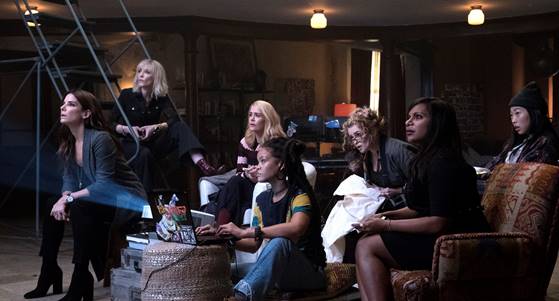
    Debbie Ocean gathers a crew to attempt an impossible heist at New York City’s yearly Met Gala.

    OCEAN’S 8 is directed by Gary Ross and stars Sandra Bullock, alongside Cate Blanchett, Anne Hathaway, Richard Armitage, Mindy Kaling, Awkwafina, Sarah Paulson, James Corden, with Rihanna and Helena Bonham Carter.

    OCEAN’S 8 releases in New Zealand cinemas on June 7, 2018.

    image007

  • “Sicario 2: Soldado” (2018) – Official Trailer

    “Sicario 2: Soldado” (2018) – Official Trailer

    Error
    This video doesn’t exist

    In Sicario 2: Soldado, the drug war on the US – Mexico border has escalated as the cartels have begun trafficking terrorists across the US border. To fight the war, federal agent Matt Graver reteams with the mercurial Alejandro.

    SICARIO 2: SOLDADO is directed by Stefano Sollima and stars Benicio Del Toro, Josh Brolin, Isabela Moner, Jeffrey Donovan, Manuel Garcia-Rulfo and Catherine Keener

    SICARIO 2: SOLDADO releases in New Zealand cinemas on June 28, 2018.

  • Blu-ray review: “The Red Turtle” (2016)

    “The Red Turtle” (2016)

    Drama/Animated

    Running Time: 80 minutes

    images

    Written & directed by: Michaël Dudok de Wit

    When watching this film I was struck by the majesty of its beauty as well as the eeriness of its silence. I also found it difficult to believe that this was Michaël Dudok de Wit, the Danish writer/director, first full-length film after four other animated shorts over the past fifteen years. This film’s plot is simple, it has been told many times before, a ‘Robinson Crusoe’ affair, which has been animated, the difference and strength being it  is able to transcend formal story telling by making a leap into the mind of a man who has no hope of rescue. His only possible salvation from going mad is to embrace his surroundings, by becoming a character in his own life. This is a film where survival is the most important objective, not only physical survival but also survival of the mind and the soul. There are also elements of wish fulfillment throughout the film which we see mostly in dream sequences, as well as from the survivors point of view – which like all narratives told from one point of view can be deceptive.

    “The Red Turtle” concerns a nameless man set adrift by a storm wakes up on a deserted island. Finding fresh fruit and water, as well as variety of animals and a sweeping forest of bamboo, the man decides to leave the island. The man builds a raft from bamboo, and attempts to sail away. However, an unseen sea creature destroys the raft, forcing the man back to the island. Attempting to escape with another raft, his plan is foiled again by the sea creature. Trying a third time his raft being destroyed again, but once he is in the water he finds a female red turtle facing him. The turtle doesn’t harm the man. The man retreats back to the island.

    That evening, the man sees the red turtle crawling on the shore, attempting to go inland. In revenge, he hits the red turtle on the head with a bamboo stick, and pushes it over on its back. After halfway through building another raft, the man starts to feel guilty about leaving the turtle upside down, so he catches a fish and tries to feed it to the turtle, but finds that it has died. The turtle’s shell splits down the middle during the night, and to the man’s surprise, the turtle turns into a woman.

    The plot to this film is simple in its concept, but the real revelation is in the magical narrative, which is at once relatively abstract as well as having hints of a sort of magical realism. This is of course accentuated by the fact that it is animated with such care that the story envelopes the viewer with ease – in effect we are watching the final part of a mans life unencumbered by technology, any modern comforts, with the only comfort being satisfaction from his own primal nature. It asks questions about what it means to be a man, a human being, what we will do to survive and what it is we really need to have in a full and effective life when the spark that holds us together is so finite. In the story of his own life this man who is isolated from the rest of humanity attains what many lack, a family, not only a human one as you can see occurring in front of your eyes, but an understanding with the natural world that says while you can try and control nature it will always have the final say, whether in terms of the natural environs or the lack of respect shown when ‘man’ may be under the misconception he is at the top of the food chain.

    The film’s story is complemented with breathtaking animation by a team that are aware of what they are required to show as well as how they are required to get this personal narrative across. The fluidity of movement of the human as well as the animal characters is so breathtaking that it defies description, whilst obviously not photo realistic I couldn’t help think about how real they all seemed without being distracting to the narrative. The movie uses static backgrounds with movement within the frame to highlight not only importance, but adding another aspect of realism that adds to the movie in terms of how we should view this new world, while it being an unknown element within the story.

    The way in which the story progresses from the introduction to the ending, visually through the animation is interesting in itself. The palate of the animation moves from a washed out looking landscape to one that is not only full of color but boats a point of view that enhances the natural world in which the man is now living – he is no longer apart from the natural world but is living within it, becoming part of it, learning from his many mistakes to co habit with the flora, fauna and other animals – including some very close to home.

    The other aspect that I found compelling was that no matter what the man ultimately needs to survive, it is supplied, for want of a better word, by nature. This is almost immediately illustrated when he first lands on the island – when he realises he is thirsty, he finds a puddle of water, no sooner does he start slurping it up than it begins to rain. Not to give away any spoilers but his entire life is built around the island, so when he requires something, even when he does not realise it, is somehow supplied – it is like he is becoming one with his environment. The other beautiful aspect of this film is that for a man to be stranded on an island he actually has a full life, having a family, once again without spoilers he goes through many life experiences any father or husband might have, this is a triumph of story telling that is not seen very often at all – it is a true experience.

    This movie is a masterpiece; my only refret was that I did not see this at the cinema at the time of its initial release in 2016. If you have not yet seen “The Red Turtle” you need to buy this DVD, it has immense watchability and will have you transfixed for its eighty minutes running time. If you have seen it you should have it as part of your home library.

    “The Red Turtle” is out now on DVD.

  • New trailer Disney’s “THE NUTCRACKER AND THE FOUR REALMS” (2017)
    Error
    This video doesn’t exist

    All Clara (Mackenzie Foy) wants is a key – a one-of-a-kind key that will unlock a box that holds a priceless gift from her late mother. A golden thread, presented to her at godfather Drosselmeyer’s (Morgan Freeman) annual holiday party, leads her to the coveted key—which promptly disappears into a strange and mysterious parallel world. It’s there that Clara encounters a soldier named Phillip (Jayden Fowora-Knight), a gang of mice and the regents who preside over three Realms: Land of Snowflakes, Land of Flowers and Land of Sweets. Clara and Phillip must brave the ominous Fourth Realm, home to the tyrant Mother Ginger (Helen Mirren), to retrieve Clara’s key and hopefully return harmony to the unstable world. Starring Keira Knightley as the Sugar Plum Fairy and featuring a special performance by Misty Copeland, Disney’s new holiday feature film “The Nutcracker and the Four Realms” is directed by Lasse Hallström and inspired by E.T.A. Hoffmann’s classic tale.

    In Cinemas November 2018.

    nutcracker_Logo_poster_NZ

  • DVD & Blu-ray review: “Dunkirk” (2017)

    “Dunkirk” (2017)

    Historical Drama

    images

    Running Time: 106 minutes

    Written & Directed by: Christopher Nolan

    Featuring: Fionn Whitehead, Tom Glynn-Carney, Jack Lowden, Harry Styles, Aneurin Barnard, James D’Arcy, Barry Keoghan, Kenneth Branagh, Cillian Murphy, Mark Rylance, and Tom Hardy

     Commander Bolton: “You can practically see it from here.”

    Captain Winnant: “What?”

    Commander Bolton: “Home.”

    Apparently this is a film that writer/director Christopher Nolan has wanted to make for quite some time but had to wait some time so that he was able to prove to Warner Brothers that he could make the film within a limited budget, as well as within a running time that would be less than many of his previous movies. Nolan has done this by paring down the true story of Dunkirk by sidestepping many of the tropes that have haunted movies set during World War II, that is, he only shows scenes that are directly relevant to the plot and nothing else. As well as this he uses a varied time scheme to tell aspects of Dunkirk from three different points of view.

    I have to admit that I have never been the biggest Nolan fan, I enjoyed “Batman Begins” (2005) but felt the two sequels were for the most part, bloated, as well as self-important. I did love his one two punch of “Insomnia” (1999) as well as “The Prestige” (2001) where he not only used narrative as well as plot ingeniously but also drew out some of the best performances from A-listers, Al Pacino, Robin Williams. Hugh Jackman and Christian Bale. In “Dunkirk”, the second movie this year about the biggest defeat of England by the Nazis, I am happy to say that this is a movie with extremely strong performances, great realistic action as well as a plot and narrative that are simple but at the same time extremely effective. This film was going to be a big ask of not only Nolan to deliver a compelling story but of audiences worldwide to take part in what is a truly emotional journey by all of the characters within this story.

    Primarily “Dunkirk” is based around the allied soldiers from Britain, Belgium, Canada, and France who have been surrounded by the German Army on the beaches of Dunkirk, being evacuated in ‘Operation Dynamo’ between 26 May and 4 June 1940, during the early stages of what would become the Second World War.

    One of the first things that hits you about this World War II action film is its cast all of UK origin, led by the increasingly compelling Kenneth Branagh as Commander Bolton who is trying to get his men back to blighty. Recent Oscar winner Mark Rylance plays a man trying to pitch in by sailing in his own boat to pick up the boys to bring home. He encounters Cillian Murphy one soldier who really does not want to see any action – his story is revealed later. The genius of casting such big names in a film that is more about the everyday soldiers is genius, it gives the audience who may not know much about the retreat at Dunkirk something to hang onto as the film unfolds. This aspect of the film also means that the audience is engaged from the beginning of the film to the very end, which is important as there is very little dialogue to explain what is happening in the various locations that Nolan is concentrating on in this version of the very real historical event.

    This is by no means the first film about the events that occurred at Dunkirk, in fact it is not even the first film this year, that honor goes to the touching “Their Finest” (2017) which was a unique way of folding in many ideas about the war in England, as well as the defeat that the English faced at Dunkirk and how they were attempting to come back and win the war. The one film I would recommend to watch is “Weekend at Dunkirk” (1964), a French movie featuring the great Jean-Paul Belmondo – this gives an alternate view to what was going on with the French soldiers that were soon to be overrun by the Nazis with the invasion of France. There is in fact a lovely homage to this film early on in the initial section of “Dunkirk”. The reason for bringing these two films to your attention is that they give an alternate view of the event, one that Nolan’s film does not, in fact it does not show any other aspects other than the view of the immediacy of the British experience.

    The beauty about this film is that Nolan has chosen to tell a single story that involves a limited time period of a few days, something he has not attempted since his excellent remake “Insomnia” (1999), everything he has completed since then has been sprawling; “The Dark Knight Trilogy” or extremely complex, “Inception” (2012). For an audiences to immediately identify with, I would argue that “Dunkirk” represents not only a return to simpler more formal film-making but also represents Nolan’s best work in over a decade, at least since the excellent “Batman Begins” (2005). The other more obvious part of this film is the running time; at a brisk 106 minutes it is Nolan’s shortest film since his debut “The Following” (1998). The reason this running time aspect of my review is important is because it physically highlights the greatest aspect of this film as well as the filmmaker himself – it also goes along way to establish the narrative peculiarities of this film, which while not unique in cinema could be seen as a break in the plodding narratives of Summer blockbusters.

    “Dunkirk” is set over three distinct parts of the evacuation that is true, but it is also further narratively complex by having each segment of the plot set over very different time periods. So while almost every film compresses time to tell a story, “Dunkirk” does this to, but through three different parts of the plot. So, we have the first part of the story, titled “The Mole” set on the beaches of Dunkirk taking place over one week, the second part of the story titled “The Sea” set over one day and finally the third part titled “The Air” set over just one hour. This may seem confusing at the outset but one of the reasons to play with the timelines on specific stories is to bring them all together at the end for the climax of the movie – although there is a coda at the conclusion after the three strands of plot come together. The other reason to offer the three strands as well as the three timelines is to illustrate how the events at Dunkirk unfolded as well as where the significant areas were being fought by the British as well as the French. In fact in looking at this film the playfulness with the timing of the narrative is one of the bravest conceits in a studio movie for some time, and it is kudos to Warners for allowing Nolan to take such a step bearing in mind that this could have been a confusing element for some people to grasp.

    This is indeed a Christopher Nolan film; right from the outset we are thrust into the film with only a small piece of preamble about what is occurring at Dunkirk, but no more. In fact there is so little dialogue you could be forgiven to thinking there is no dialogue at all, of course that is not true as there is some dialogue, the most compelling as well as contributing to some exposition is given by the excellent Kenneth Branagh as ‘Commander Bolton’ who has the showiest role. This is a film that shows how hard it was physically to leave the shores of Dunkirk through action and little else. We see through the eye of unnamed infantrymen how fast things could happen, in particular I was struck by how quickly ships would sink as well as how hard it was for men to leave these same ships – it is a tragedy to behold. The performances of the cast are excellent as you would once again expect, Tom Hardy as the fighter pilot, Farrier, as well as Mark Rylance the pleasure craft captain, Mr Dawson. But, as you might not expect it is the young Harry Styles who shines as bright as anyone as the infantryman, Alex, who enters the story late but is as effective as any other actor, we follow him and touch upon the emotion he offers, one of many boys among men who must come to terms with their mortality in what must seem a senseless waste.

    In my mind this is the first truly great film of 2017, Nolan has to be acknowledged as a master film maker, mainly because of the ability of him to be able to fashion a simple plot of a real event that shaped the future of World War II, as well as steeling the British public for the horror that was to unfold over the next five years. This kind of film is a rare thing indeed, a war film not involving the Americans, but dealing with loss, the ease in which people take others lives in battle – the strength that is shown by people who do not need to help but overcome fear to put strangers needs before their own.

    “Dunkirk” is out now on DVD & Blu-ray.

  • DVD review: “Hinterland”(2013 – 2016)

    “Hinterland” (2013 – 2016)

    Television/Action/Thriller

    images

    25 Episodes

    Featuring: Richard Harrington, Mali Harries, Alex Harries, Hannah Daniel, Aneirin Hughes

    If you have not heard of the television show “Hinterland”(2013 – 2016) then you have been missing out on a real treat, that, if you are a fan of dark, moody, nourish police dramas this will suit you down to the ground. The general conceit is not only different (for UK based shows) but also adds another layer to a format that lives and dies on differences that make them unique. The highly original aspect is that half of the show is in spoken English (with Welsh subtitles) and the other half is in spoken Welsh (with English subtitles) – which gives the show and immediate feel you will be hard pressed to discover in many other English television shows.

    Even the title of the show is subtitles in Welsh; it is called Y Gwyll in Welsh (the translation for this is ‘The Dusk’) retitled “Hinterland” for English audiences.

    The series first broadcast in 2013 was made up of four stories, each a two-parter; the 2015 series was the same but with a New Years Special; with the latest series in 2016 reverting back to the same format as 2013.

    Even though the show can be seen as a procedural there is a main thread that runs through each story which is DCI Tom Mathias, who is on the run from his London past – there is no doubt that his inner workings which are somber also reveal a brilliant but troubled man, who continually isolates himself on the outskirts of a town that from the first episode indicate that they are filled with secrets as dark and destructive as his own.

    It is simplistic to say that is a neo noir crime story set in modern times as Wales does add a layer that could be compared to the under layer that existed in post World War II America. If you look at some of the plot descriptions you get a feel for how the locale is portrayed not only through the people but the geography is important as is the climate that is in start contrast to the Noir of Los Angeles of the classic noir period. Of course the show is built around the central character of Tom Mathias who is as anti hero as ever there was, he is not a PI but at times he is not far removed from a hard boiled character. Instead of having been through the war or seen some horrors as a cop he has had some personal losses that inform not only his personality but the way he interacts with his colleagues, the families of victims, suspects as well as the guilty.

    Of course it would not be much of a show if Mathias did not start to grow or find some closure, release and get to a place where he started to move forward – which can be something that happens in noir-ish stories.

    Other aspects of the show that are integral to its difference is the location, set in Wales, that has been largely unknown, in particular the semi rural landscape which looks incredible, adding an aspect that is in stark contrast to other procedurals. That is not to say that the rural aspect is unique or new, because it most definitely isn’t – the difference is that those shows will show a quirky, fun or unusual type of local person, this program reflects a more hard boiled, hidden personality that struggles with reflecting what people actually are like and not what they are perceived as.

    This, like many other UK based police shows are a slow burn normally over a period of an hour and a half which means that you go through many story points as well as emotional points on the way to the conclusion which is normally quite a way from the beginning of the story arc. This of course has become a trope within this genre, but “Hinterland” does offer something more as well as unique, that is the central character of Mathias who as we move through the series becomes a more whole individual than he is at the outset.

    Overall I would recommend this highly and once again with a box set just released beg to be binged over a long weekend. This is at times a dark show but always has some positive point of view, mainly from the work mates of Mathias.

    “Hinterland” is out now on DVD.

    Series 1 (2013)

    1. Devils Brigade – On his first day in his new job in Aberystwyth, DCI Tom Mathias is called out to investigate a suspicious disappearance. In a quiet seaside bungalow, he discovers a bathroom covered in blood but no sign of the resident owner, Helen Jenkins. Discovering that Jenkins was once the manager of a children’s home, DCI Mathias and DI Mared Rhys venture up into the mountains, where DCI Mathias uncovers evidence which suggests Helen has been thrown from the parapet at Devil’s Bridge into the water below.
    2. Night Music – DCI Mathias investigates the brutal murder of 69-year-old Idris Williams, who was found bludgeoned to death in his farmhouse on the Aberystwyth mountains. Despite the lack of an apparent motive for the attack, the disappearance of camera equipment and one picture from the victim’s dark room suggest that whilst photographing the local landscape, Williams pictured something that nobody wanted him to see.
    3. Penwyllt – In the isolated village of Penwyllt, the body of a young labourer, Michael Reynolds, is found in the murky depths of a quarry lake. Initial forensics reveal that Reynolds did not drown where he was found, as water samples found in his lungs contain traces of sheep urine and faeces. As the investigation draws DCI Mathias into the heart of the close-knit community, he discovers that Reynolds was having an affair with the wife of the local pub landlord, and was taking the son of one of his co-workers deep into the forest to visit an hermetic villager, who some years previously had torched his own home and nearly killed his estranged wife and two children.
    4. The Girl in the Water – The carefully posed body of a young woman in a red dress is found in Borth Initial suspicion points towards an ex-boyfriend, who was assaulted by the girl’s father shortly before the girl died, and whose alibi is false. However, Mathias soon discovers the girl was also romantically involved with her university professor, who had tried to end their relationship on the night she died. As Mathias begins to grow close to the girl’s grieving mother, he realizes the investigation has missed one key suspect.

    Series 2 (2015)

    1. In the Dead of Night – With blood on his hands, and his future hanging in the balance, DCI Mathias is forced to return to the front line after an arson attack on an isolated farmhouse leaves a mother and child fighting for their lives. Drawn into a community of failing farms and long-standing feuds, what is it about the case that draws Mathias in, pulling him back from the brink?
    2. Ceredigion – Mathias finds that his world has been turned upside down after his wife Meg turns up in Aberystwyth, and an investigation by the IPCC into his conduct is about to reach its conclusion.
    3. The Tale of Nant Gwrtheyrn – The murder of a local dignitary and barrister leads to the uncovering of a tragic story of love and loss, fueled by distrust and suspicion in the depths of the hinterland.
    4. Dark River – The discovery of a body in a lake leads to an investigation about a local teacher from a small rural school.
    5. The Sound of Souls – A burnt body on the dunes embroils the team in a long-standing family feud associated with the murder of a young mother, 13 years earlier.

    Series 3 (2016)

    1. Aftermath – The murder of local minister Elwyn Jones leads a recovering DCI Mathias and his team deep into the secrets of a small farming village in rural Aberystwyth. Meanwhile, DS Owens leads the investigation into the attack on Mathias, and suspects that Iwan Thomas is more than likely responsible.
    2. A Poacher’s Discovery – Following the disappearance of Iwan Thomas, Prosser decides to distance himself from the case by pointing the finger of suspicion at Mathias. Meanwhile, the murder of a curator who is found buried in woodland leads Mathias and the team into the seedy history of a local artist, Lewis John, until he provides a solid alibi for the night of the murder.
    3. Both Barrels – A shooting at a rural petrol station leads Mathias and the team in search of a schizophrenic man who later resorts to kidnapping his own son.
    4. Return to Pontarfynach – The suicide of convicted murder Caitrin John gives Mathias a surprising new lead into the suspicious death of Iwan Thomas. With Powell having closed the case following pressure from on high, Mathias seeks Mared’s help to run a private investigation.

    “Hinterland” is out now on DVD.

  • DVD review: “Law & Order: UK” (2009 – 2014)

    “Law & Order: UK” (2009 – 2014)

    Television

    images

    53 Episodes

    images

    Created by: Dick Wolf

    Featuring:  Bradley Walsh, Freema Agyeman, Jamie Bamber and Ben Daniels, Dominic Rowan, Georgia Taylor, Paul Nicholls and Ben Bailey Smith

    Narrator: “In the criminal justice system, the people are represented by two separate yet equally important groups. The police who investigate crime, and the Crown Prosecutors who prosecute the offenders. These are their stories.”

    There are many examples of successful television shows being extremely popular in one country, then being remade and transplanted to a new country to bring a local flavor to that successful brand. Many do not succeed either because the execution is poor, or there is a misunderstanding about what made the show popular in the first place. However with the now defunct “Law & Order: UK” (2009 – 2014) the production took a route that really should have made the show more successful – it casted up with well known actors that had been part of other successful international productions. However, where they missed the boat was that instead of either making stand alone only episodes (which was a strength of the US franchise) or making long interconnected stores they stranded themselves in-between, meaning there was an element of confusion which flowed through to the inevitable audience that came and then left.

    The format was simple, the first half of any episode focusing on the perpetration of a crime and the related police investigation typically culminating in an arrest, while the second half follows the legal and court proceedings in an effort to convict the suspect. In the early episodes there was little about the characters outside lives with the focus on their lives at work, but as the series progressed this did change as there was little life outside the job for most of the cast – which if you stop and think about that aspect is highly unrealistic. The opening narration is largely the same as that of the American series, staying on brand, but replaces “district attorneys” with “Crown Prosecutors”.

    The Formula:

    The police are represented in the show by Metropolitan Police Force Murder Investigation Unit, with two Criminal Investigation Department (CID) detectives, a senior detective sergeant (DS) and a junior detective sergeant (DS), who report directly to their boss, a detective inspector (DI) or detective chief inspector (DCI).

    The detectives often have few or no good clues and must usually chase several dead ends before finding a likely suspect. They investigate the crime by collecting evidence at the crime scene (with the help of Scenes of Crime Officers (SOCOs)), visit the coroner or forensic pathologist for clues to the victim’s cause and time of death (sometimes the victim’s identity from dental records or fingerprints). The police will also inform relatives of the victim’s death, interview witnesses, trace the victim’s last known movements (by talking to the victim’s family and friends). as well as visiting the crime laboratory for evidence, records and research for information on financial details and background information on both victim and suspect.

    When the investigation leads to one or more suspects, the police will take the case to their boss, who decides if there is enough for a search and/or arrest. The detectives will then arrest the suspects(s), with sometimes the police having to chase the accused through the streets of London. The scene then shifts to the interrogation room where the detectives interrogate the suspect(s), until they ask for a solicitor, their defence barristers show up and asks the suspect not to talk anymore or the Crown Prosecution Service decides they have enough to press charges.

    The matter, at this stage, is taken over by a pair of crown prosecutors, a senior crown prosecutor and a junior crown prosecutor from the office of the London Crown Prosecution Service. They discuss deals, prepare the witnesses and evidence, and conduct the Crown’s case in the trial. The crown prosecutors work together and with the coroner’s office, the crime laboratory, and psychologists and/or psychiatrists all of whom may be needed to testify in court for the prosecution. The police may also reappear to testify in court or to arrest another suspect, but most investigation in the second segment is done by the CPS office, who always consult with the local London CPS Director for advice on the case. If the case is very weak then the police would re-investigate.

    Unlike many legal dramas the court proceedings are shown from the prosecution’s point of view, with the regular characters trying to prove the defendant’s guilt, not innocence. The second half usually opens with the arraignment of defendants and proceeds to trial preparation, including legal research and plea negotiations. Some episodes include legal proceedings beyond the testimony of witnesses, including motion hearings, (often concerning admissibility of evidence); jury selection; and allocutions, usually as a result of plea bargains. Many episodes employ motions to suppress evidence as a plot device, and most end with evidence or statements being suppressed, often on a technicality. This usually begins with the service of the motion to the CPS team, follows with argument and case citations of precedent before a judge in court, and concludes with visual reaction of the winning or losing attorney.

    As with many “Law and Order” episodes from many of the different variations the cases can be based on either real events, real cases or topics that can be shoehorned into a narrative and played out in front of the audience. The show has a strength with this type of narrative as the cast is made up of not only different genders, but age, culture and socio economic status so a variety of points of view can be taken into account as well as being presented of people to make up their own minds. So we see the accused offering such defenses as Diminished responsibility and Temporary insanity. Also episodes revolve around moral and ethical debates including the right to die, the right to life and the right to bear arms. The episode usually ends with the verdict being read by the jury foreperson and a shot of both the winning and losing parties.

    There is much to enjoy about this series, which in my mind could have lasted longer than it did on television screens, especially with the popularity of not only the franchise itself, but the advent of international streaming services. Not only that but this show always casted well with the later introduction of other actors, in particular the great Peter Davison in a major part.

    The real strength of the show was the cast who were all almost huge stars in their own right, leading the way from the police end was Jamie Bamber as Matt Devlin (who lasted until season five) and Bradley Walsh (who stayed with the entire eight seasons of the show) who were perfectly cast as a young and old cop teaching each other old as well as new tricks – they both had demons but these did not play huge parts in their own development. Casting Bamber and Walsh immediately gave the show some credibility with Bamber coming off the great genre show “Battlestar Galactica” (2004 – 2009), and Walsh being a mainstay of UK television. On the Law side the casting was equally as canny with the legend that is Bill Patterson as the director of the CPS (until series four), character actor Ben Daniels as James Steel, the senior CP and finally the outstanding Freema Agyeman as Alesha Phillips (until series six). All of these actors brought something unique to the show, when one or more left they were always replaced by others that gave different spins on similar jobs, which was always refreshing.

    The first four seasons have recently been released as a box set, which is ideal as these are probably the best seasons on offer as well as the very best cast that was available. The stories are enjoyable but the camaraderie between all of the characters is in top form, as is the locales that are used for each story. You will find it easy to watch as well as later re-watching these episodes – there is no doubt in my mind that this show could have lasted longer, especially if they were able to keep the cast that was assembled for these particular episodes.

    In terms of the crew there is a vast array of writers as well as directors on oofer here but like all good workmen they keep to not only the script of the show but also the look and feel so that it really is difficult to put any kind of personal stamp on any given episode. This is a good as well as detrimental aspect of not only this show but any of these franchise shows as they become a little like visual McDonalds – you know exactly what you are getting and there is comfort in that, but there is a lack of originality as well as spontaneity. Of course what the show has done is to stick to three main cinematographers which assists in keeping the general look the same, so one could say that they are having the most say of any perceived style the show has-.

    The first four seasons have recently been released as a box set, which is ideal as these are probably the best seasons on offer as well as the very best cast that was available. The stories are enjoyable but the camaraderie between all of the characters is in top form, as is the locales that are used for each story. You will find it easy to watch as well as later re-watching these episodes – there is no doubt in my mind that this show could have lasted longer, especially if they were able to keep the cast that was assembled for these particular episodes.

    “Law & Order: UK Series 1 – 4″ is out now on DVD.


  • Trailer: “The 15:17 To Paris” (2018)

    From Clint Eastwood comes “The 15:17 to Paris,” which tells the real-life story of three men whose brave act turned them into heroes during a highspeed railway ride.

    Error
    This video doesn’t exist

    In the early evening of August 21, 2015, the world watched in stunned silence as the media reported a thwarted terrorist attack on Thalys train #9364 bound for Paris—an attempt prevented by three courageous young Americans traveling through Europe. The film follows the course of the friends’ lives, from the struggles of childhood through finding their footing in life, to the series of unlikely events leading up to the attack. Throughout the harrowing ordeal, their friendship never wavers, making it their greatest weapon and allowing them to save the lives of the more than 500 passengers on board.

    THE 15:17 TO PARIS is directed by Clint Eastwood and stars the heroic trio Anthony Sadler, Oregon National Guardsman Alek Skarlatos and U.S. Air Force Airman First Class Spencer Stone, who play themselves in the film. Alongside Jenna Fischer, Judy Greer, Ray Corasani, PJ Byrne, Tony Hale and Thomas Lennon.

    THE 15:17 TO PARIS releases in New Zealand cinemas on February 8, 2018.

    1517-To-Paris-Trailer-Clint-Eastwood-Movie

  • Film review: “Star Wars: Episode VIII – The Last Jedi” (2017)

    “Star Wars: Episode VIII – The Last Jedi” (2016)

    Science Fiction

    images

    Running Time: 152 minutes

    Written and Directed by: Rian Johnson

    Featuring:  Mark Hamill, Carrie Fisher, Adam Driver, Daisy Ridley, John Boyega, Oscar Isaac, Andy Serkis, Lupita Nyong’o, Domhnall Gleeson, Anthony Daniels, Gwendoline Christie, Kelly Marie Tran, Laura Dern, and Benicio del Toro

    Luke Skywalker: “Breathe. Just breathe. Now reach out. What do you see?”

    Rey: “Light. Darkness. A balance.”

    Luke Skywalker: “It’s so much bigger.”

    Is it my imagination but now that production has been ramped up by Disney, and we can now expect to see a new “Star Wars” movie in some shape or from each year, has the anticipation been somewhat muted? I can remember not only when there were three years between productions but the long gaps between each trilogy as well, it is not surprising that each new beginning of a trilogy broke records in each decade it was released. It will be interesting to see how this new movie is greeted by cinemagoers as well as how successful it will be with critics. Although judging by additional screenings that are being organized this is tipped to break all time records.

    This new installment already has a lot going for it to bait audiences, with the critical darling in Rian Johnson, who was hot off his own sci-fi excursion, the extremely well received “Looper” (2012), the final appearance of Carrie Fisher, the returning ingénue in Daisy Ridley, supported by the impressive John Boyega, Adam Driver and Oscar Isaac, the answering of questions asked or at least hinted at in the previous movie, Mark Hamill appearing as well as acting his tail off, as well as all the other elements that make a new “Star Wars” a must for fans to head to cinemas in droves. The good news is that this movie moves into some actual uncharted territory thanks to a script by Johnson that is not just a retread that we received with J.J. Abrams, which was fresh but in the end a remake –  with “Star Wars: The Force Awakens” (2015) – as well as yet another prequel in the interesting “Rogue One: A Star Wars Story” (2016). “The Last Jedi” (2016) was always going to be the movie that either moved things in a forward direction or just ended up being an uninspired rip-off, I am happy to report it is the former.

    This movie sees Rey developing her newly discovered abilities with the guidance of Luke Skywalker, who is unsettled by the strength of her powers. Meanwhile, the Resistance prepares to do battle with the First Order. I am not going to say anymore about the story as it is fantastic so go and see it!

    I don’t think it’s a secret but the production of the next two “Star Wars” movies, the Han Solo movie as well as Episode IX have had major problems, in particular with the directors that were hired to bring these two behemoths to the big screen. There is no doubt that when a director is brought on to one of these movies their vision is important but it must be in service to the overall vision of not only the producers but also the studio who is footing the bill  – usually in excess of US$200 million dollars. The gatekeeper of these movies was George Lucas who was also footing the bill, but now it is producer Kathleen Kennedy (one time protégée of Steven Spielberg) who is the public face as well as boss of the Star Wars Universe – she has no problem in getting her way, both publicly as well as professionally. Thats way it is great to see someone like Rian Johnson who is a writer/director, coming from independent movies and producing a movie that is as good as “The Last Jedi”. Johnson, has been able to expertly sail the waters that exist between the ports of the audience, the producers, his actors, the crew as well as his own lofty expectations, delivering a movie that is not only a worthy successor to the previous entry, but in its own way measures up to the greatest in franchise history, “Star Wars: Episode V – The Empire Strikes Back” (1980). This may seem like a lofty comparison, especially so soon after “The Last Jedi’s” theatrical release but there is no doubt that this is a great movie, one that not only looks back but has an eye on a future where this story must eventually conclude.

    This movie must take into account a sprawling plot with many characters, possibly the most in any Star Wars movie, giving them all their own time in the sun as well as motivations that make them at least believable, if not they just become excuses for moving the story along to the inevitable conclusion. After “The Force Awakens” introduced a new generation of heroes and villains such as Kylo Ren, Poe Dameron, Rey, Finn, Hux and Snoke, we not only catch up with them directly after the last film but we are let in on their own stories, to an extent that is surprising for such a large canvassed movie. Johnson has expertly balanced not only the loss of a main character (the untimely death of Carrie Fisher), but deals with immense action, special effects as well as not taking his eye off the ball in terms of the very personal stories of Rey and Luke. Whilst not all questions are answered, we are definitely being moved along in terms of the story as well as the destiny of these people we have only been introduced to – Johnson has proven himself to be indispensible to this franchise as writer and director.

    With these giant and outsized movies comes the expectation of large and outsized actors to complete the picture of how this story will unfold, after all these movies have to primarily be about people. As well as the established actors, there are a few new characters that have been added, there is Laura Dern as Vice Admiral Amilyn Holdo, Benicio Del Toro as DJ and Kelly Marie Tran as Rose Tico. There is also a variety of special celebrity appearances that follow the last movies Daniel Craig as a stormtrooper appearance, except Johnson has dialed them up to eleven. Normally I would find these distracting but the quality of this movie is so high that they are welcoming, but not something I would recommend other filmmakers follow. Now while each of these new characters does not take up a huge amount of running time or add a major amount of plot, they are all unique as well as delivering some great dialogue.

    As you would expect the special effects are just great, there is a mix of both practical as well as CGI – there are also some extremely original sets, mixed with new creatures that will leave you breathless, they are all vivid, mixing natural creatures with their environments, the crystal foxes were my personal favourites. There are also homages to previous movies, in particular the already mention Empire, as well as some new space faring ships, in particular from The First Order. This is a well thought out movie with many resources given over to grand mise en scène as well as the most epic and personal space battles I have ever seen. Some of the explosions are gorgeous, one towards the end is epic in its silence and light.

    Now I don’t want to let any spoilers slip but special mention must be paid to Mark Hamill who at 66 finally not only gets the movie he deserves, but lets loose a performance that is career defining – make no mistake this is his movie, he has saved one of his best performances of his career for this version of a jaded Luke, that could have easily been phoned in, but he delivers, showing an actor who has so much more to give to cinema. If you think you know the character of Luke Skywalker think again, this is the character we have been promised, Hamill delivers with what seems like ease, but then thats the trick, isn’t it?

    Finally for this review, I have to mention cinematographer Steve Yedlin who has been working with Johnson since “Brick”(2005), which this shows, in particular the last quarter of the movie looks nothing like any Star Wars film that has gone before. Looking at the way in which characters, as well as action, is framed you would be forgiven for thinking you were watching a Western, or a movie from Asia, the wide angle lenses, as well as the colors are just breathtaking. This move will be nominated for technical Oscars at least – look for some other categories as well I hope, it deserves it.

    I recommend this movie as a must see, in fact the bigger the screen the better, a Star Wars movie has never looked this good, or the story been so effective in pushing a story forward, going back to “The Empire Strikes Back”. There are so many moments where you might think you know what’s going to happen or even what’s happening in a scene, but then Johnson pulls that rug – it is also shows what the force is as well as how powerful it can be – something Lucas and Abrams never really did. Also whilst Poe Dameron is a hero, being set up as a leader, just count how many times he is right about something – he is just hilarious. Have fun with this movie they don’t come this good very often at all.

    “Star Wars: Episode VIII – The Last Jedi” (2017) is out in cinemas right now.