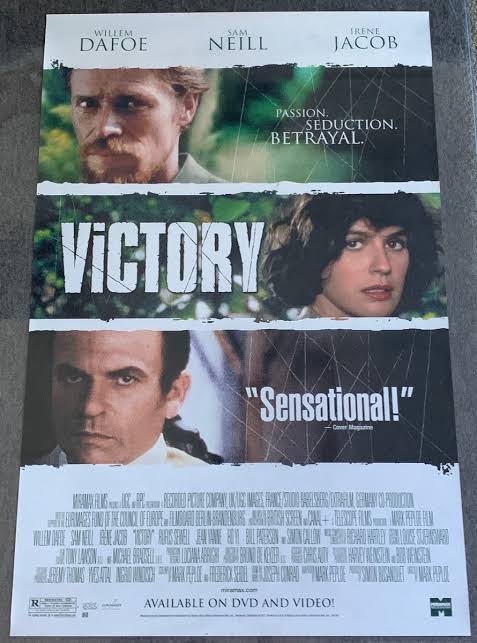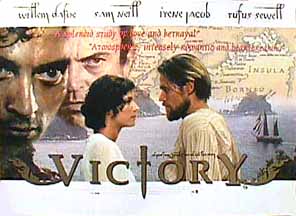
“Victory” (1996)
Drama

Running Time: 99 minutes
Written by: Mark Peploe and Frederick Seidel
Directed by: Mark Peploe
Featuring: Willem Dafoe, Irène Jacob, Sam Neill and Rufus Sewell
Capt. Davidson: “Where ever he is, she really did save his life. She taught him how to love. That was her victory.”
There is something particularly satisfying about seeing a film as obscure and difficult to find as Mark Peploe’s Victory finally receive a proper Blu-ray release. A film that has spent decades lurking at the edges of the reputations of its considerably better-known stars, Victory is exactly the sort of title that the boutique-label Blu-ray era has been rescuing from obscurity. Imprint’s release is, fittingly, the worldwide first Blu-ray edition of the film, giving collectors an opportunity to revisit one of the more unusual literary dramas of the 1990s in high definition. JJB Hi-Fi NZ+1
Released in 1996, Victory was written and directed by Mark Peploe and adapted from Joseph Conrad’s 1915 novel. Peploe was hardly an unknown quantity: his screenwriting credits included Michelangelo Antonioni’s The Passenger and Bernardo Bertolucci’s The Last Emperor. The film consequently arrives with rather more literary and artistic pedigree than its relatively obscure status might suggest. The cast is equally impressive, with Willem Dafoe, Irène Jacob, Sam Neill and a young Rufus Sewell leading the ensemble. WWikipedia+1
And yet Victory is not the kind of film that announces itself immediately. It is slow, atmospheric, strange and deliberately elusive. Rather than functioning as a conventional adventure or romance, it is closer to a psychological colonial melodrama in which isolation, paranoia, desire and violence gradually become impossible to separate from one another.
The film
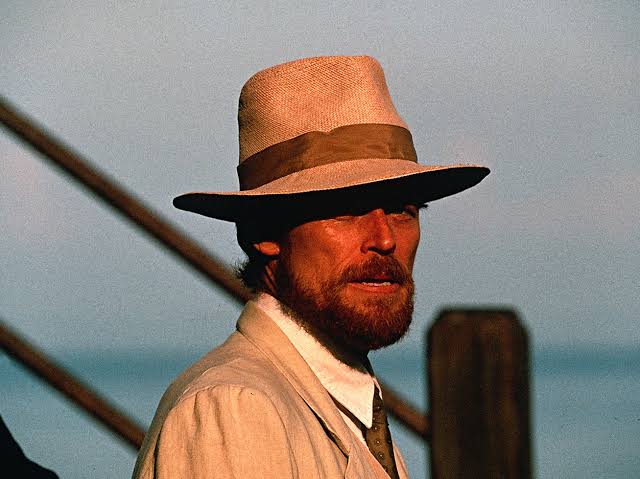
The story takes place in the Dutch East Indies, where Axel Heyst (Willem Dafoe) has withdrawn from society and adopted a life of almost complete isolation. Heyst is a fascinating Conrad protagonist: intelligent, detached and seemingly immune to the passions that govern everyone around him. His philosophy of emotional distance has become a kind of personal religion.
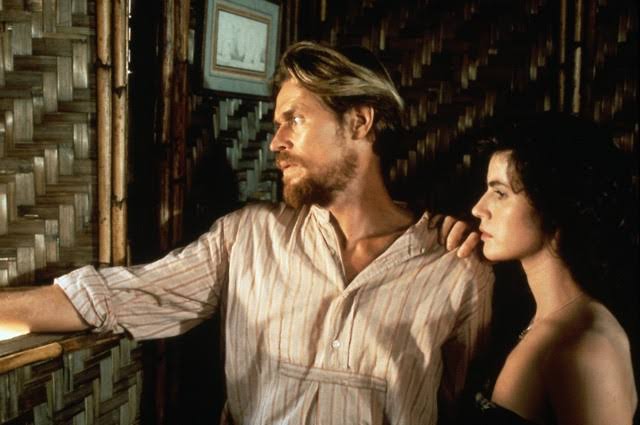
That changes when he encounters Alma (Irène Jacob), a musician who is effectively trapped and exploited by the people around her. Heyst helps her escape, and the pair retreat to his remote island. For a time, the film seems as though it might become an unconventional tropical romance.
But Conrad’s universe does not permit such tranquillity to last.
Three men eventually arrive on the island, ostensibly by accident. Sam Neill plays Mr Jones, a sinister and almost hypnotically composed figure whose outward civility conceals an increasingly obvious capacity for cruelty. Martin Ricardo and Pedro, played by Rufus Sewell and Ho Yi, complete the trio.
From this point onward, Victory becomes a story about the impossibility of escaping human nature. Heyst wants to live outside society, but society—and particularly its capacity for greed, violence and manipulation—comes looking for him.
The premise sounds like a conventional thriller. The actual film is much stranger.
Peploe is less interested in constructing a tightly paced suspense picture than in creating a sense of impending doom. The island gradually ceases to resemble a paradise and starts to feel like a psychological trap. The physical isolation of the characters mirrors their emotional isolation, and the result is a film that can feel almost dreamlike.
That quality will either be one of the film’s greatest attractions or its biggest obstacle.
Willem Dafoe
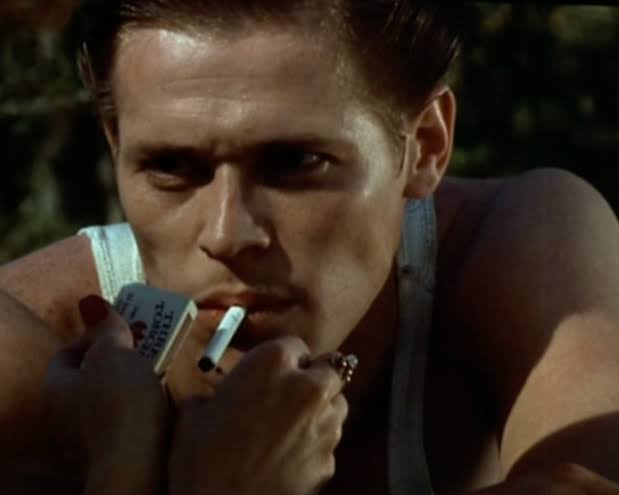
Willem Dafoe is perfectly cast as Heyst.
His performance is restrained to the point of abstraction. There is a sense that Heyst is perpetually watching the world rather than participating in it. Dafoe has always been capable of making characters seem slightly alien, even when playing recognisably human roles, and that quality works exceptionally well here.
Heyst is not a traditional romantic hero. He doesn’t sweep Alma away through charm or confidence. His defining characteristic is withdrawal. Even when he is trying to protect her, there is a strange passivity to him.
That makes Dafoe’s performance more interesting than it might initially appear.
The character’s central contradiction is that he believes detachment can protect him from suffering, only to discover that caring for another person makes detachment impossible. Dafoe communicates that transformation largely through physical presence and small changes in behaviour rather than grand speeches.
It is a quiet performance, and one that suits the film.
Irène Jacob
Irène Jacob brings an entirely different energy to the movie.
Her Alma is vulnerable but never simply passive. There is desperation in the character, but also an emotional openness that contrasts sharply with Heyst’s self-imposed isolation.
Jacob’s performance is particularly important because the film could otherwise become overwhelmingly dominated by its male characters and their philosophies. Alma gives the story its emotional centre.
The relationship between Alma and Heyst is unusual because neither character fits neatly into a conventional romantic archetype. Their attraction is bound up with rescue, loneliness and the desire for a different life. Consequently, their relationship has an uneasy quality even during its most tender moments.
This is not a comfortable romance. It is a romance built on the knowledge that the world surrounding these people is fundamentally hostile.
Sam Neill steals the film
If Dafoe provides the film’s emotional restraint, Sam Neill supplies its menace.
His Mr Jones is one of the movie’s most memorable creations.
Neill does not play him as a screaming psychopath. Instead, Jones is controlled, polite and almost eerily relaxed. The character’s calmness makes him considerably more frightening. There is a sense that violence is not an emotional outburst for him but simply another option available when convenient.
Neill understands that the most effective villain in a film like this is somebody who doesn’t need to demonstrate his power constantly.
His scenes consequently have an almost theatrical quality. Jones seems to exist outside ordinary morality, and Neill gives the character an unnerving elegance.
The casting of Neill is one of the film’s strongest decisions, and his presence becomes increasingly important as the story moves toward its darker second half.
Rufus Sewell before the fame
Another pleasure for modern viewers is seeing Rufus Sewell in one of his earlier screen performances.
Sewell would go on to build a substantial career across film and television, but here he plays one of the members of Jones’s sinister entourage. It is a relatively early role, yet there is already something recognizable about his screen presence.
The supporting cast also includes Bill Paterson and Simon Callow, further reinforcing the impression that Victory was a considerably more prestigious production than its obscurity might suggest.
A beautiful but unsettling film
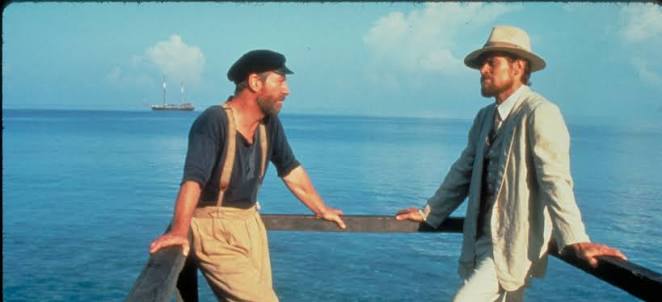
One of the strongest reasons to revisit Victory is its visual atmosphere.
The film was photographed by Bruno de Keyzer, and the tropical environment is used beautifully. But Peploe and de Keyzer are not interested in turning the Dutch East Indies into postcard scenery.
The landscapes are beautiful, but they are also isolating.
The sea surrounds the characters. The vegetation conceals things. The island provides apparent safety while simultaneously preventing escape.
That contradiction is central to the film’s visual identity.
There is an almost European art-film sensibility to the way the locations are photographed. This isn’t a conventional Hollywood jungle adventure. The environment becomes part of the psychological architecture of the film.
The widescreen composition is particularly effective in this respect. The 2.35:1 presentation gives the characters considerable space around them, often emphasizing how small and exposed they are within the landscape. Imprint lists the Blu-ray’s aspect ratio as 2.35:1. VVia Vision Entertainment
The film’s biggest problem: its pacing
If there is one major reservation about Victory, it is pacing.
The film is only around 99 minutes long, but it often feels longer. That isn’t necessarily because it is badly made. Rather, Peploe allows scenes to linger and atmosphere to accumulate.
Viewers expecting a conventional thriller may therefore become impatient.
The movie’s narrative is straightforward enough, but its presentation is deliberately indirect. Characters spend a great deal of time watching, waiting, talking and trying to understand one another.
In retrospect, this makes considerably more sense as a Conrad adaptation than as a conventional commercial thriller.
The film is fundamentally concerned with the idea that people cannot simply withdraw from the world. Heyst believes that avoiding emotional involvement can spare him pain. Instead, it makes him vulnerable to precisely the things he is trying to avoid.
Unfortunately, the film’s intellectual and atmospheric ambitions occasionally overwhelm its dramatic momentum.
There are stretches where Victory feels as though it is circling its subject rather than moving toward it.
For some viewers that will be the point. For others, it will be the reason the film never quite becomes the classic it perhaps wants to be.
The Conrad adaptation
The film’s literary origins are important.
Joseph Conrad’s fiction is notoriously difficult to adapt because so much of its power comes from atmosphere, psychology and narration. Victory is not as famous as Heart of Darkness, but it contains many of the same preoccupations: colonialism, isolation, moral ambiguity, European alienation and the unsettling presence of violence beneath supposedly civilized society.
Peploe’s screenplay attempts to preserve that atmosphere rather than transforming the material into a straightforward adventure.
That decision deserves credit.
The film feels like a European production from the 1990s rather than an attempt to imitate a traditional studio melodrama. It has an unusual rhythm and an unusually sombre temperament.
It is also easy to understand why some viewers have championed it while others have found it frustrating.
Victory is a film that asks the audience to meet it halfway.
The Imprint Blu-ray
This is where the release becomes particularly significant.
Imprint’s Victory is the worldwide first Blu-ray release, making the disc considerably more interesting to collectors than a simple upgrade from an existing Blu-ray edition. The release is part of the Imprint Collection as title #612 and is limited to 1,500 copies. VVia Vision Entertainment+1
The film receives a 1080p high-definition presentation, with English LPCM 2.0 stereo audio and optional English hearing-impaired subtitles. VVia Vision Entertainment
For a film that has been so poorly represented on physical media, simply having a legitimate HD presentation is a major advantage.
The cinematography also makes this an appropriate title for Blu-ray. The tropical landscapes, shadowy interiors and deliberately composed widescreen imagery benefit enormously from increased resolution.
This is not a film whose visual identity is based on aggressive colour or elaborate effects. Its appeal is subtler: textures, faces, foliage, water, architecture and light. A good HD presentation therefore allows the viewer to appreciate aspects of the photography that can easily disappear in inferior standard-definition presentations.
It is worth stressing, however, that this is a 1080p Blu-ray rather than a 4K UHD release. Collectors expecting an elaborate restoration with HDR will need to adjust their expectations.
For this particular title, though, the absence of a UHD edition is less troubling than it might be with a major studio classic. The real achievement here is getting Victoryonto Blu-ray at all.
Audio
The release uses English LPCM 2.0 stereo.
That may sound modest compared with the DTS-HD and Dolby Atmos soundtracks appearing on many modern boutique releases, but it is entirely appropriate for the film.
Victory isn’t an effects-driven picture. Its soundscape is dominated by dialogue, ambience, music and environmental sounds.
A clean lossless stereo presentation is therefore perfectly adequate.
The film’s atmosphere benefits from hearing the quieter environmental elements properly—the sea, wind, jungle and general ambience of the island. These details help establish the isolation that is so important to the story.
The presentation isn’t designed to turn Victory into an artificially immersive surround experience. Instead, it preserves the film in a form that is faithful to its original character.
Michael Brooke’s commentary
The most substantial new extra is an audio commentary by film writer and historian Michael Brooke. VVia Vision Entertainment
This is exactly the kind of supplement a film like Victory needs.
Because the movie isn’t widely discussed in mainstream film culture, contextual information is especially valuable. A commentary can help explain the film’s production history, its relationship to Conrad’s novel, Peploe’s career and the place Victory occupies within the European/British filmmaking landscape of the 1990s.
For collectors who enjoy approaching obscure films from a historical perspective, this is probably the single most important extra on the disc.
It also makes the release feel more substantial than a bare catalogue rescue.
Bill Paterson: “Hidden Depths”
The other new feature is Hidden Depths, an interview with actor Bill Paterson. VVia Vision Entertainment
Again, this is the kind of supplement that makes sense for a film that has effectively disappeared from the mainstream conversation.
Cast interviews on boutique releases can sometimes feel like contractual filler, but an interview with someone who actually worked on the production is inherently valuable when there is so little existing material about the movie.
Paterson’s involvement also helps flesh out the production beyond its headline stars.
Packaging and collector appeal
As an Imprint Collection release, Victory is aimed squarely at collectors.
The limited run of 1,500 copies gives it an obvious appeal to people who specialize in obscure catalogue titles, particularly films that have never previously appeared on Blu-ray. JJB Hi-Fi NZ+1
This is also one of those releases where the physical-media philosophy behind boutique labels becomes apparent.
A major studio might reasonably look at Victory and decide that there isn’t enough commercial demand to justify a restoration and Blu-ray release.
Imprint looks at the same film and sees something else: a neglected 1990s title with a distinguished cast, literary source material, an established filmmaker and a small but potentially enthusiastic collector audience.
That is exactly the sort of film that physical media labels have become increasingly important for preserving.
Is Victory actually a good film?
Yes—but with qualifications.
It is not a lost masterpiece.
It isn’t going to suddenly reveal itself as a forgotten The English Patient or The Last Emperor.
What it is, however, is a fascinating, atmospheric and unusually ambitious 1990s literary drama that has enough distinctive qualities to justify rediscovery.
The performances are excellent. The photography is evocative. The Conrad material gives the film thematic depth. Sam Neill is especially memorable, and Willem Dafoe is perfectly suited to the role of the withdrawn Heyst.
The problem is that the movie is sometimes too restrained for its own good.
There are moments when the atmosphere becomes more interesting than the drama. The deliberate pacing can become frustrating, and the film’s psychological ideas aren’t always integrated as smoothly into the narrative as they could be.
But those shortcomings are also part of what makes the film interesting.
Victory feels like the work of filmmakers attempting something more literary and European than the commercial marketplace necessarily wanted from them.
Final verdict
Imprint’s Blu-ray is an important release for an overlooked film.
The movie itself remains something of an acquired taste. Viewers wanting a fast-moving tropical thriller should probably look elsewhere. Those willing to settle into a slow, atmospheric adaptation of Joseph Conrad’s psychological themes will find much more to appreciate.
The cast alone makes the film worth investigating. Dafoe gives the movie its emotional restraint, Jacob provides its vulnerable human centre, and Sam Neill delivers the standout performance as one of the most quietly sinister characters in the story.
The Blu-ray is even easier to recommend.
A worldwide first Blu-ray presentation, 1080p HD video, LPCM 2.0 audio, English HOH subtitles, a new Michael Brooke commentary and a new Bill Paterson interview make this a thoughtful catalogue release rather than a barebones dump. VVia Vision Entertainment
For fans of 1990s cinema, Joseph Conrad adaptations, Willem Dafoe, Sam Neill or obscure literary dramas, it is particularly welcome.
Ultimately, Victory is an imperfect film that becomes more intriguing the more one thinks about it. Its story of a man trying to escape the world only to discover that the world has followed him is appropriately Conrad-esque, and its combination of romance, colonial melodrama, psychological thriller and existential tragedy gives it a personality that few contemporary studio films possessed.
Imprint has done exactly what a boutique label should do: it has taken a film that could easily have remained forgotten and given it a new physical-media life.
Film: 7/10
Blu-ray: 8/10
Overall: Recommended for collectors and fans of atmospheric 1990s cinema.
If you’re approaching Victory expecting an undiscovered masterpiece, you may come away disappointed. If you’re approaching it as a strange, beautifully photographed, occasionally frustrating and genuinely distinctive piece of 1990s filmmaking, the experience is considerably more rewarding.
And that makes the Imprint release worthwhile. It isn’t merely preserving a film—it is giving curious viewers a reason to discover it again.