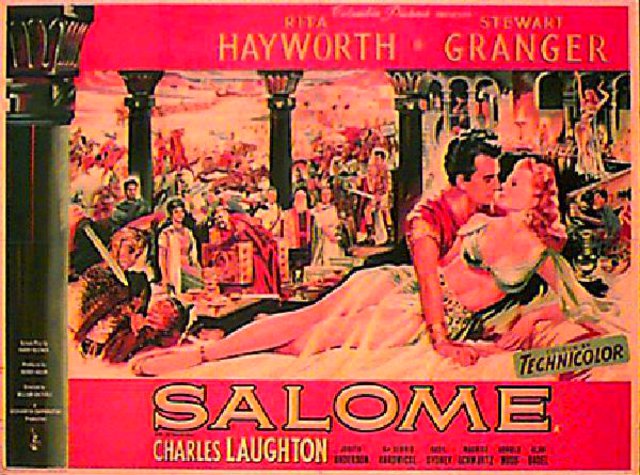
“Salome” (1953)
Fantasy

Running Time: 76 minutes
Written by: Harry Kleiner
Directed by: William Dieterle
Featuring: Rita Hayworth, Stewart Granger, Charles Laughton, Judith Anderson, Sir Cedric Hardwicke, Basil Sydney, Maurice Schwartz, Arnold Moss and Alan Badel
Queen Herodias: “The desperate can only survive by taking desperate measures.”
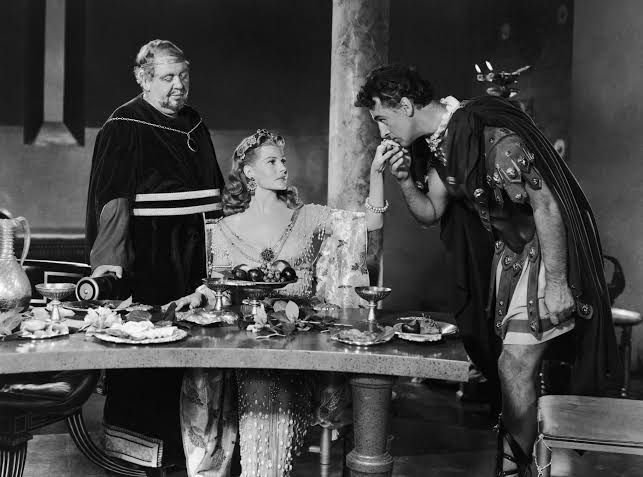
There is something wonderfully excessive about Salome. Almost everything about the film seems to have been designed to make the audience look twice. Rita Hayworth is presented as a spectacular Technicolor goddess; Stewart Granger arrives as the handsome, heroic romantic lead; Charles Laughton and Judith Anderson play Herod and Herodias with enormous theatrical gusto; Cedric Hardwicke and Basil Sydney add further prestige; the sets are lavish; the costumes are extravagant; and somewhere in the middle of all this grandeur is one of the most famous dance sequences of Hayworth’s career.
It is a very 1950s Hollywood film.
More importantly, it is a film that was constructed around a star. Salome was produced by Hayworth’s own Beckworth Corporation and distributed by Columbia Pictures, making it not merely another studio assignment but an important project in the actress’s career. It was also the final production made by her company.
The Imprint Blu-ray is therefore more than just another catalogue release. It gives collectors the opportunity to revisit an unusually extravagant chapter in Hayworth’s career and to appreciate the movie as a piece of Hollywood craftsmanship as well as a rather eccentric biblical drama.
The film
The screenplay by Harry Kleiner, from a story by Kleiner and Jesse Lasky Jr., takes considerable liberties with the familiar biblical story. Rather than simply presenting Salome as the temptress who dances for Herod and demands the head of John the Baptist, the film turns her into a sympathetic romantic heroine caught between the political and religious forces surrounding her.
That decision is fundamental to understanding the movie.
This is not really the traditional story of Salome. It is a romantic adventure constructed around the name, imagery and mythology of Salome.
The film begins in the world of Tiberius Caesar and the Roman Empire. Salome, played by Hayworth, has been living away from Galilee after being banished from Rome. When she returns, she becomes entangled in the increasingly dangerous situation involving her family, John the Baptist and the Roman authorities.
Herod and Herodias are already locked in a poisonous domestic and political relationship. John the Baptist has condemned Herodias for her marriage to Herod, and Herodias wants him silenced.
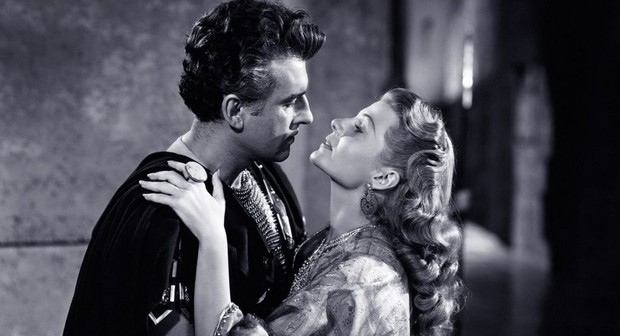
Salome’s position is complicated further by her relationship with Claudius, the Roman commander played by Stewart Granger.
The result is a mixture of romance, palace intrigue, religious drama and adventure.
It is not subtle.
But subtlety is hardly what Salome is attempting to deliver.
Rita Hayworth
The entire production revolves around Rita Hayworth.
Hayworth was one of Hollywood’s great screen stars, and Salome arrives during an interesting period of her career. She had already established herself through musicals, romances, film noir and dramatic roles, but this picture gives her a particularly old-fashioned star showcase.
The camera adores her.
That is not a criticism. In a movie such as this, it is part of the entire point.
Hayworth’s Salome is glamorous, determined, vulnerable and romantic. The character is considerably removed from the traditional image of Salome as a dangerous seductress. Instead, she becomes a woman attempting to protect John the Baptist while navigating a dangerous political environment.
The transformation is quite remarkable.
The film asks the audience to accept Hayworth not as a biblical villain but as its heroine. She is the moral centre of the story, even though the surrounding characters continually attempt to manipulate her.
Hayworth handles the role with considerable charm.
There are moments when the dialogue is plainly old-fashioned and the drama becomes highly theatrical, but Hayworth possesses something that cannot be manufactured by production design or expensive costumes: genuine screen presence.
Even when she is simply standing in a room, the movie seems to revolve around her.
That was one of the great gifts of the Hollywood star system.
The Dance of the Seven Veils
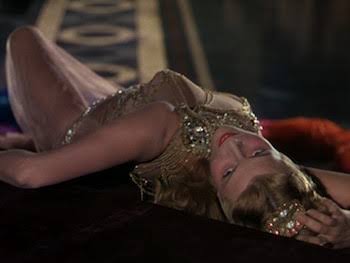
Inevitably, the great attraction is the famous dance.
The sequence is the film’s centrepiece and the reason Salome remains of interest even to viewers who might otherwise have little enthusiasm for 1950s biblical epics.
Hayworth’s dancing is extraordinary.
The choreography was created by Valerie Bettis, who had previously worked with Hayworth, and the production placed considerable emphasis on making the dance a major spectacle.
What makes the sequence fascinating is the way it combines sensuality with strict Hollywood-era presentation.
The production could suggest much more than it was actually permitted to show.
Hayworth’s costume, lighting, choreography and camera placement all work together to create an atmosphere of eroticism without allowing the sequence to become explicitly sexual. The famous dance therefore becomes a lesson in the visual language of 1950s Hollywood censorship.
The result is still spectacular.
Hayworth moves with astonishing control and confidence. There is an athletic quality to the performance as well as the obvious sensuality. The sequence does not merely rely on her beauty; it demonstrates genuine dancing ability.
Hayworth herself later regarded the dance as one of the most demanding of her career, requiring extensive rehearsal and repeated takes.
Watching the sequence today, it is easy to understand why it became such a major selling point.
The movie essentially stops everything to let Rita Hayworth perform.
And audiences were presumably quite happy with that arrangement.
A star-studded supporting cast
The supporting cast is extraordinary.
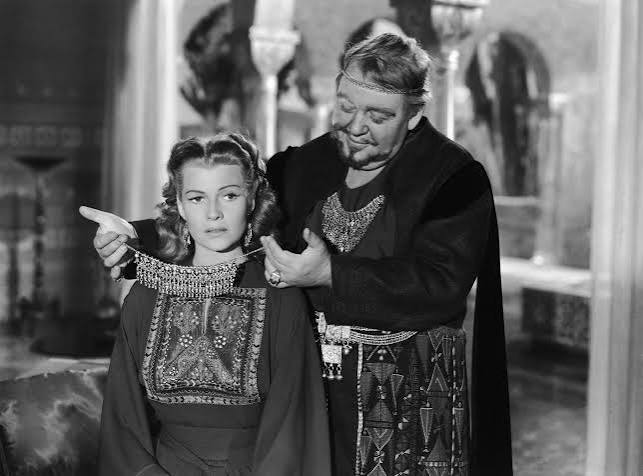
Charles Laughton plays Herod.
This is a role that gives Laughton the opportunity to be larger than life, and he takes it. His Herod is unstable, powerful, frightened and increasingly trapped by circumstances he cannot control.
Laughton was one of the great actors of his generation, and his presence gives the picture a level of dramatic weight that it might otherwise lack.
He also understands that this is not a restrained historical drama.
He plays to the back row.
And that is exactly what the movie requires.
Judith Anderson is equally memorable as Herodias.
Anderson’s screen persona was already strongly associated with severe, intimidating and psychologically formidable women, most famously through Rebecca. Here she uses that same intensity to create a Herodias who is manipulative and dangerous.
The scenes between Anderson and Laughton are among the movie’s most entertaining.
They have the feeling of two great stage actors being given permission to go completely over the top.
Stewart Granger, meanwhile, provides the romantic adventure component.
Granger was perfectly suited to this kind of role. He had already established himself in swashbuckling and adventure films, and his presence gives Salome a conventional Hollywood hero around whom the romance can develop.
He and Hayworth make an attractive couple.
Granger is not asked to do anything particularly radical, but that is not necessarily a problem. He is there to provide romance, action and masculine heroism while Hayworth remains the centre of attention.
The film also benefits enormously from Cedric Hardwicke as Tiberius Caesar and Basil Sydney as Pontius Pilate.
Then there is Alan Badel as John the Baptist.
Badel’s performance is an interesting contrast to the flamboyance elsewhere. John is supposed to represent spiritual conviction in a world dominated by political ambition, lust and power. His presence gives the story its moral and religious dimension.
The cast is one of the great attractions of the movie.
Even when the material becomes ridiculous, there is pleasure in watching performers of this calibre attack it with such commitment.
William Dieterle’s direction
William Dieterle was an interesting choice to direct a production such as this.
He had already demonstrated his ability to handle prestige material and major stars, and he brought a strong visual sense to Salome. AFI credits him as director, with Buddy Adler producing and Charles Lang handling the cinematography.
Dieterle does not attempt to disguise the artificiality of the production.
Instead, he embraces it.
The film is constructed from enormous sets, carefully arranged crowds, lavish costumes and dramatic compositions. The result is unmistakably studio-made Hollywood spectacle.
There is little interest in gritty historical realism.
This is mythology as imagined by Columbia Pictures.
That is one reason the film remains so enjoyable.
Modern viewers may look at the story and see historical inaccuracies and melodramatic inventions, but that misses part of the appeal. The film was never really attempting to function as a history lesson.
It is fantasy.
The ancient world becomes a stage upon which Hollywood can display its stars.
Charles Lang’s cinematography
The Technicolor photography is one of the film’s major attractions.
Charles Lang was an enormously experienced cinematographer, and the production gives him plenty to work with. The film is filled with elaborate costumes, architectural spaces, desert landscapes, Roman interiors and large crowd scenes.
The colour is especially important.
Hayworth’s costumes are designed to stand out against the architecture and landscapes, while the production makes extensive use of contrasting textures and tones.
The result is exactly what one wants from a classic Hollywood epic.
It looks expensive.
Even when the narrative slows down, the visual design keeps providing things to look at.
The film’s 1.33:1 presentation on the Imprint disc is also significant. Via Vision lists the release as a 1080p high-definition presentation with a 1.33:1 aspect ratio, English LPCM 2.0 dual-mono audio and optional English hearing-impaired subtitles.
That presentation is particularly appropriate for a film of this vintage.
The Imprint Blu-ray presentation
The most important reason to welcome this release is simple: Salome deserves to be seen in a presentation that allows its Technicolor photography and production design to breathe.
The Imprint release provides a 1080p high-definition presentation.
This is not one of those modern restorations where every frame has been scrubbed until the film begins to look digitally manufactured. Classic films need texture. They need the slight softness, grain and photographic character associated with their original film elements.
With Salome, that is particularly important.
The picture is built around colour and texture.
Costumes need to look like costumes rather than digital shapes. Faces need to retain their photographic quality. The large sets need to possess depth.
The high-definition presentation makes it much easier to appreciate the craftsmanship involved.
The Technicolor photography remains the star of the image.
The desert exteriors have an impressive sense of scale, while the interiors benefit from the richness of the production design.
Hayworth herself looks spectacular.
That is hardly surprising, but high-definition presentation makes the difference between simply knowing that Hayworth was a glamorous movie star and actually seeing why.
Aspect ratio
Imprint presents the film in 1.33:1, which is an important specification for collectors.
This is especially worth noting because some databases and modern listings can provide inconsistent aspect-ratio information for older films.
The Imprint release therefore gives collectors a clearly specified presentation rather than leaving the viewer wondering whether a cropped image has been used.
The Academy-style framing suits the compositions.
The characters are often arranged in layers, with large groups surrounding the central performers. The vertical space is useful for the elaborate sets and costumes, and the dance sequences benefit from having room for Hayworth’s full body to be seen.
For a performance-based film, that matters enormously.
Sound
The audio is presented in English LPCM 2.0 dual mono, with English hearing-impaired subtitles.
Again, this is exactly the sort of presentation that makes sense for a 1953 production.
There is no reason to artificially inflate a vintage mono soundtrack into some kind of fake modern surround experience.
The original sound design is perfectly adequate for the material.
Dialogue remains central, and the music has an important role in establishing the film’s epic atmosphere.
George Duning’s score contributes substantially to the movie’s sense of grandeur, while the dance material has its own musical identity. The soundtrack therefore plays a major role in transforming the picture from a conventional romantic drama into something approaching spectacle.
The music
The score deserves more attention than it sometimes receives.
George Duning understood the requirements of a picture such as this. The music needs to make everything feel important.
A conversation is important.
A character entering a room is important.
A Roman procession is important.
A romantic encounter is important.
And, naturally, Hayworth’s dance is extremely important.
The music gives the picture its emotional scale.
Without it, some scenes would probably feel much more ordinary.
With it, they acquire the kind of heightened atmosphere that audiences expected from biblical epics during the period.
The screenplay’s greatest weakness
The biggest problem with Salome is undoubtedly the screenplay.
The movie has an interesting premise but spends much of its running time constructing a romantic adventure around historical and biblical events that are already familiar to the audience.
The film’s decision to make Salome sympathetic is intriguing, but it also means that the story becomes somewhat convoluted.
Instead of embracing the darker implications of the traditional story, the screenplay continually tries to make its heroine admirable.
This makes the film more conventional but arguably less interesting.
The traditional Salome is a figure associated with danger, sexuality, manipulation and death.
Hayworth’s Salome is essentially a good woman caught in a bad situation.
There is nothing wrong with that approach, but it removes much of the ambiguity that makes the legend so powerful.
The film’s melodrama
The melodramatic quality of Salome is both its weakness and its charm.
Characters announce their intentions.
Villains plot.
Heroes declare their principles.
Romance develops rapidly.
Political developments occur with extraordinary convenience.
And every emotional reaction seems to be accompanied by music.
It is glorious.
If one approaches the movie expecting historical realism, it may be frustrating.
If one approaches it as a 1950s Hollywood spectacle, it becomes much easier to appreciate.
The film is not embarrassed by its own artificiality.
It wants to entertain.
Rita Hayworth and the question of age
One aspect that modern audiences may notice is Hayworth’s age relative to the character.
Hayworth was in her mid-thirties when she made the picture, and she was playing a character whose traditional associations are considerably younger. Contemporary and later commentary has sometimes drawn attention to this issue.
Yet this is another situation where the Hollywood star system changes the rules.
The movie does not really ask the audience to believe that Hayworth is an ordinary young woman.
It asks the audience to believe that she is Rita Hayworth.
And that distinction matters.
She is presented as a mature Hollywood goddess, and the film builds its entire visual strategy around that fact.
The costumes, lighting and choreography are designed to emphasise her glamour.
Rather than attempting realism, the production creates an idealised fantasy version of its star.
The costumes
Jean Louis’ costume work is another major reason to watch the film.
The costumes are spectacular without necessarily being historically accurate.
But historical accuracy is clearly not the primary objective.
The costumes are designed for Rita Hayworth.
They create silhouettes.
They emphasise movement.
They provide colour.
They allow the dance sequences to work.
And they transform Hayworth into the larger-than-life figure the production requires.
The famous dance is particularly dependent on costume design.
Every movement has been considered.
Every reveal is carefully controlled.
Every moment is calculated to maintain the illusion of danger and sensuality while remaining within the restrictions of the period.
The supporting performers
Another pleasure of the film is spotting the supporting players.
This is one of those productions where virtually every character seems to have been cast by someone who understood the value of a distinctive face.
Laughton, Anderson, Hardwicke, Sydney and Badel all bring different forms of authority to the movie.
That variety keeps the film lively.
Even when the story becomes predictable, the performances provide texture.
Judith Anderson in particular is terrific.
Her Herodias is almost a force of nature.
There is an operatic quality to her performance, and her scenes with Laughton provide some of the movie’s best theatrical entertainment.
The religious dimension
The film’s treatment of John the Baptist is also interesting.
Rather than making him simply a background religious figure, the screenplay places him at the centre of the political conflict.
His condemnation of Herodias threatens the existing order.
He represents a moral authority that cannot be controlled through ordinary political means.
This allows the film to create a conflict between spiritual conviction and political power.
Thematically, it is one of the stronger aspects of the screenplay.
Unfortunately, the movie is often so distracted by romance and spectacle that the theme does not receive the full dramatic development it might have had.
Still, Alan Badel gives John a strong presence.
The final act
As the story moves toward its inevitable conclusion, the film becomes increasingly dramatic.
The palace intrigue reaches its peak, Salome’s relationship with John becomes more important, and the various political tensions finally collide.
The conclusion is considerably more optimistic than the traditional story would suggest.
This is deliberate.
The filmmakers wanted a heroic romantic conclusion rather than a tragedy centred entirely on Salome’s corruption.
Whether one prefers this interpretation or the darker traditional version will depend largely on one’s expectations.
But it is certainly an unusual way to approach the material.
A fascinating piece of Hollywood history
Perhaps the best way to appreciate Salome today is as a document of the Hollywood star system.
This was a period when a major star could essentially become the organising principle of an entire production.
Rita Hayworth was not merely cast in Salome.
The movie was constructed around her.
Her dancing.
Her beauty.
Her costumes.
Her romance.
Her close-ups.
Her dramatic scenes.
Her relationship with the audience.
Everything leads back to Hayworth.
That makes the film fascinating even when the story itself becomes somewhat ridiculous.
Imprint’s place in the restoration landscape
Imprint has developed a particularly useful niche for collectors by bringing a wide range of catalogue titles to Blu-ray, including films that might otherwise have remained difficult to obtain in high definition.
Salome is an excellent example.
It is not the sort of film that routinely receives the same attention as Gilda or The Lady from Shanghai. Yet it is an important Rita Hayworth title, a Technicolor production, a biblical epic and a showcase for several major performers.
The fact that it has been given its own catalogue number within the Tales of Adventure series demonstrates how broad Imprint’s approach to classic cinema has become. The release is part of a limited-edition four-disc hardbox containing The Magic Carpet, Sudan, Salome, The Sword of Ali Baba, and the high-definition bonus presentation of 1001 Arabian Nights. The set was limited to 1,500 copies.
That context is important.
Salome is not being treated as an isolated prestige title.
It is being rediscovered as part of the great tradition of Hollywood adventure and spectacle.
And that is arguably the perfect home for it.
Extras
One unusual aspect of this particular release is that Salome itself is presented primarily as a feature presentation rather than being loaded down with newly commissioned extras.
Via Vision’s official specifications list the 1080p presentation, LPCM 2.0 mono soundtrack and English HOH subtitles for the film.
The more extensive newly commissioned material in the overall collection is attached to The Magic Carpet and The Sword of Ali Baba, including new commentaries and a video essay.
For Salome, therefore, the main attraction is the film itself.
And that is not necessarily a negative.
Sometimes the best extra a catalogue release can provide is simply a substantially better opportunity to see an important old film.
Final assessment of the film
Salome is an imperfect movie.
Its screenplay is often clumsy.
Its historical liberties are substantial.
Its romantic subplot can feel conventional.
Its melodrama is frequently excessive.
And its interpretation of the Salome story is much more interested in creating a sympathetic heroine than exploring the darker implications of the legend.
But none of those criticisms entirely diminish its appeal.
Because the movie is spectacular.
It has Rita Hayworth.
It has Charles Laughton.
It has Judith Anderson.
It has Stewart Granger.
It has Cedric Hardwicke.
It has Technicolor.
It has lavish costumes.
It has elaborate sets.
It has biblical spectacle.
And, of course, it has Rita Hayworth’s extraordinary dance.
That combination makes Salome impossible to dismiss.
It is exactly the sort of film that becomes more enjoyable when approached on its own terms.
Do not watch it expecting a serious historical reconstruction.
Do not watch it expecting psychological realism.
Watch it as a great Hollywood star vehicle.
Watch it as a Technicolor fantasy.
Watch it for Hayworth.
Watch it for Laughton and Anderson chewing through their scenes.
Watch it for the production design.
Watch it for the costumes.
And watch it for the extraordinary spectacle of a major Hollywood studio taking one of the most famous stories in religious history and reshaping it into a romantic adventure.
Final thoughts on the Imprint Blu-ray
The Imprint release is a valuable addition to any collection devoted to Rita Hayworth, classic Hollywood or 1950s biblical cinema.
The 1080p high-definition presentation, 1.33:1 aspect ratio, English LPCM 2.0 dual-mono soundtrack and English hearing-impaired subtitles provide the essential technical specifications expected from a modern catalogue Blu-ray.
Most importantly, the release allows the film’s Technicolor photography to become a major part of the viewing experience.
And that is where Salome really comes alive.
The film may not be one of the absolute masterpieces of the biblical epic, but it is a hugely entertaining example of the era’s ability to turn star power, colour, music, costumes and spectacle into cinema.
Rita Hayworth dominates every frame.
The movie belongs to her.
Even Charles Laughton’s enormous performance, Judith Anderson’s formidable presence and Stewart Granger’s heroic romanticism ultimately orbit around the central attraction of Hayworth.
That makes Salome a fascinating film in the history of the Hollywood star vehicle.
It is also a particularly good candidate for rediscovery on Blu-ray.
Imprint’s release ensures that this flamboyant, extravagant and occasionally wonderfully silly piece of 1950s filmmaking can be appreciated again not simply as an old biblical epic, but as a showcase for one of Hollywood’s greatest stars.
For collectors, it is another strong example of why catalogue releases matter. Films that once seemed peripheral to the history of classic Hollywood can suddenly become much more interesting when presented properly and given a place alongside better-known titles.
Salome may not be Rita Hayworth’s greatest film.
But it is unmistakably one of her most visually spectacular.
And for Hayworth fans, Technicolor enthusiasts and admirers of old-fashioned Hollywood spectacle, the Imprint Blu-ray offers a very welcome opportunity to return to this lavish and wonderfully excessive production.