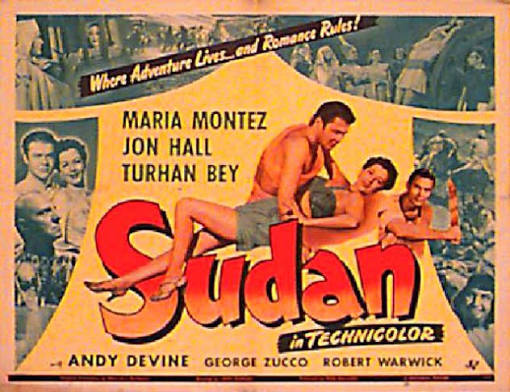
“Sudan” (1945)
Fantasy

Running Time: 76 minutes
Written by: Edmund L. Hartmann
Directed by: John Rawlins
Featuring: Maria Montez, Jon Hall and Turhan Bey
Nebka: “An unruly horse and a dangerous woman – only evil can come of this!”
There are some films that seem to have been made primarily to tell a story, some that were designed around performances, and others that exist because the filmmakers wanted to create an entire world of colour, spectacle, romance, danger and adventure. John Rawlins’ Sudan, released by Universal Pictures in 1945, belongs very firmly in that third category.It is a movie in which reality is secondary to fantasy, historical accuracy is cheerfully sacrificed to Hollywood glamour, and the desert becomes a vast playground for slave revolts, secret identities, palace intrigue, horse chases, sword fights, romance and treachery. It is exactly the kind of film that modern viewers can either dismiss as ridiculous or embrace as enormously entertaining cinematic escapism.The latter approach is by far the more rewarding.And Imprint’s Blu-ray is a terrific opportunity to rediscover it.Released as Imprint Collection #579, Sudan forms part of the label’s Tales of Adventure – Collection 10, alongside The Magic Carpet, Salome and The Sword of Ali Baba, with 1001 Arabian Nights included as a high-definition bonus film. The collection is housed in a limited-edition four-disc hardbox, with 1,500 copies produced. Sudan itself receives a 1080p high-definition presentation, English LPCM 2.0 dual-mono audio, optional English HOH subtitles, a new audio commentary by writer and Cereal at Midnight host Heath Holland, and a new video essay, Golden Days of the Arabian Nights, by film scholar Josh Nelson.For admirers of Maria Montez, classic Hollywood fantasy adventure or Technicolor spectacle, this is exactly the sort of release that boutique labels exist to produce.
The Queen of Technicolor
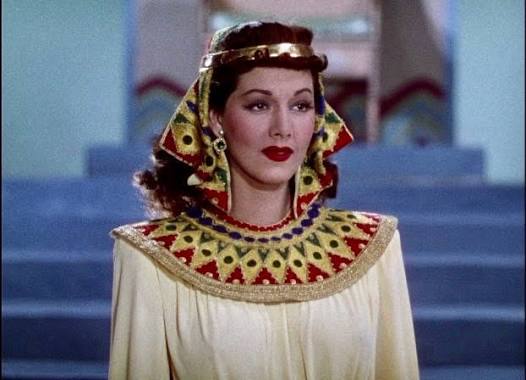
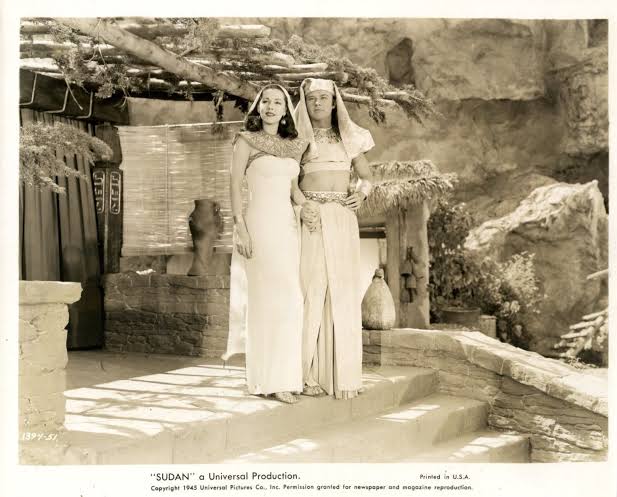
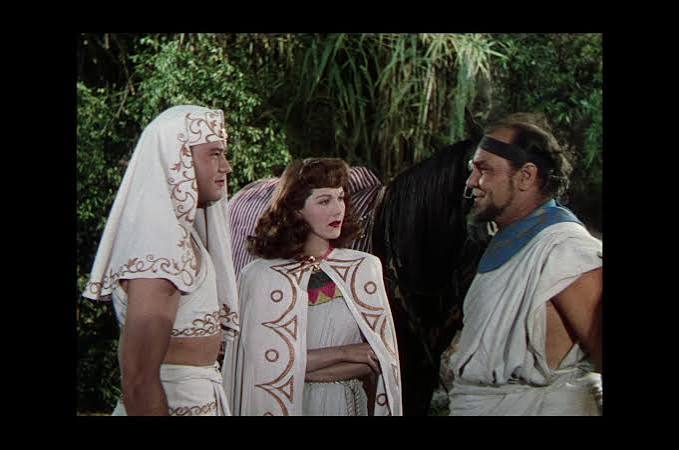
Maria Montez occupies a fascinating place in Hollywood history.She was never treated by the studio system in quite the same way as a Bette Davis, Barbara Stanwyck or Joan Crawford. Her particular talent was something different. Montez became one of the great stars of Hollywood’s exotic adventure cycle, films designed around her extraordinary screen presence and the promise of another world.She could walk into a frame wearing an elaborate costume and immediately make the surrounding sets seem secondary.That quality is essential to Sudan.Montez plays Naila, the young queen of the fictional Egyptian kingdom of Khemis. After her father is killed during a slave revolt, she assumes the throne. But rather than sitting safely inside her palace and leaving the dangerous business of rebellion and revenge to her advisers, Naila goes out among her people in disguise in an attempt to discover the truth.This decision leads her directly into danger.The rebel leader Herua, played by Turhan Bey, becomes central to the story, while Jon Hall plays Merab, a rather different kind of adventurer. Andy Devine is Nebka, Merab’s comic sidekick, and George Zucco plays Horadef, one of those wonderful Hollywood villains who appears to have been born knowing how to plot against a queen.The cast also includes Robert Warwick, Philip Van Zandt, Harry Cording and, memorably for horror fans, Tor Johnson.The film’s casting tells you almost everything you need to know about the sort of movie Sudan is.This is not archaeology.This is Hollywood mythology.
An Egypt That Never Existed
One of the most entertaining aspects of Sudan is its complete lack of concern with historical realism.The film’s fictional kingdom of Khemis exists somewhere in a fantasy version of ancient Egypt, populated by beautiful queens, sinister advisers, rebellious slaves, wandering adventurers, slave traders and assorted colourful villains and heroes.The film itself even acknowledges this approach. According to the AFI catalogue, Sudan opens with a spoken foreword explaining that stories from ancient Egypt have become mixtures of truth and fantasy through the passage of centuries.That introduction effectively gives the filmmakers permission to do whatever they want.And they certainly do.The costumes are extravagant. The sets are theatrical. The dialogue is heightened. Characters have names that sound as though they were created specifically to appear in an adventure serial. Every palace corridor looks like it was designed to conceal a secret passage, and every desert landscape appears to be waiting for somebody to gallop across it.That is the appeal.Trying to watch Sudan as a realistic reconstruction of ancient Egypt would be missing the point completely. This is fantasy adventure in the tradition of Arabian Nights, The Thief of Bagdad and the many sword-and-sandal entertainments that Hollywood produced for audiences who wanted to escape into a world of spectacle.
Maria Montez and the Art of Being a Movie Star
The most important reason the film works is Maria Montez.Montez had an almost surreal quality on Technicolor film. Her beauty was not merely photographic. It became part of the film’s production design.Every costume seems to have been created to make her stand out from the scenery. Every close-up is an opportunity to display her face against a sea of colour. She doesn’t need to deliver a complicated psychological performance because the role isn’t really written that way.Naila is a heroine of adventure rather than introspection.She is courageous, determined, impulsive and capable of taking matters into her own hands. She is also constantly placed in situations in which she must escape, deceive, fight or outwit her enemies.That makes Montez the centre of the entire production.She understands the genre.She knows that the audience has come to see Maria Montez in a spectacular costume in a spectacular landscape doing spectacular things.And she gives them exactly that.
Turhan Bey’s Herua
One of the most interesting elements of Sudan is that the conventional romantic pairing between Montez and Jon Hall is disrupted.Hall had been Montez’s familiar leading man in this cycle of Universal adventures, but here Turhan Bey’s Herua becomes the romantic figure.That makes Sudan something of an unusual entry in the Montez-Hall partnership.Bey brings a different quality to the film. He has the darkly romantic screen presence necessary for the role, and the relationship between Herua and Naila gives the picture more emotional interest than its rather formulaic plot might initially suggest.Herua is not simply the standard villainous rebel that Naila expects to find. He becomes someone whose motivations are considerably more complicated.The result is a romantic adventure in which attraction develops alongside suspicion, political conflict and the struggle between revenge and justice.It is one of the film’s more successful elements.
Jon Hall and Andy Devine
Jon Hall’s Merab is a very different kind of hero.Rather than playing the grand romantic adventurer, Hall is involved in a lighter and more comic strand of the story. He is essentially an opportunist, and his relationship with Andy Devine’s Nebka gives the movie much of its humour.Devine is particularly entertaining.His physical presence, voice and comic timing are almost impossible to suppress, and the film makes excellent use of him as a contrast to the elaborate melodrama surrounding Montez and Bey.The comedy is broad, but that is appropriate.Sudan is not a subtle film.It wants its villainous plotting to be obvious, its romance to be romantic, its adventures to be adventurous and its jokes to be jokes.There is something wonderfully uncomplicated about that.
George Zucco Steals the Movie
If Maria Montez owns the film visually, George Zucco practically steals it whenever he appears.Zucco was one of those magnificent character actors who could turn even the most ridiculous dialogue into something memorable.As Horadef, he plays the sort of villain who seems permanently surrounded by shadows.He is ambitious, manipulative and dangerous, and Zucco understands that the character needs to be played with absolute seriousness.This is crucial.If Zucco had treated Horadef as a joke, the character would have collapsed.Instead, he behaves as though the fate of civilisation genuinely depends upon his latest scheme.The contrast between Zucco’s seriousness and the inherent absurdity of the material makes the character wonderfully entertaining.
Adventure Rather Than History
The story itself is deliberately straightforward.Naila’s father is killed.Naila becomes queen.A rebellion threatens the kingdom.There are conspiracies within the palace.Naila seeks the truth.She goes undercover.She is captured.Herua becomes involved.Merab and Nebka provide comic complications.The villain reveals himself.The heroes eventually confront the forces working against them.And everything builds towards the inevitable final confrontation.It is classic adventure-story architecture.The pleasure comes not from wondering whether the good characters will ultimately triumph, but from discovering exactly how the film will get them there.There are escapes, betrayals, chases, disguises, revelations and confrontations.The movie moves rapidly from one episode to another.At only around 76 minutes, Sudan does not have time to become excessively complicated. The original film was released in 1945 and runs approximately 76 minutes.That short running time works in its favour.There is very little padding.The picture arrives, delivers its spectacle and adventure, and gets out.
The Technicolor Experience
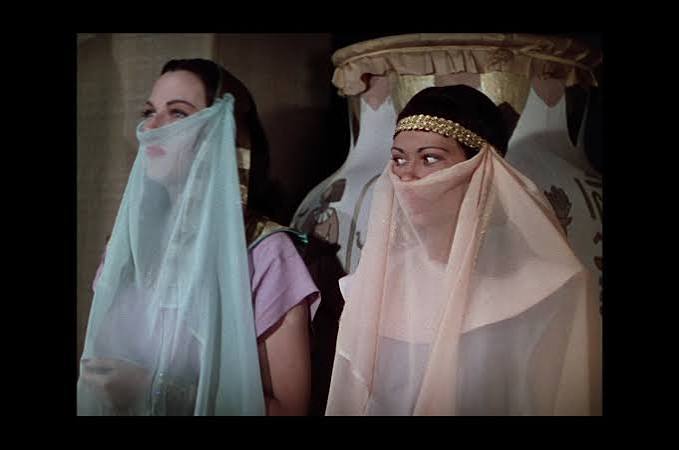
The real star of Sudan, however, may be Technicolor itself.The film belongs to an era when colour photography was still sufficiently expensive and special that filmmakers had to justify its use.Sudan certainly does.Costumes, architecture, landscapes, props and lighting are all designed to create an intensely colourful fantasy environment.The colour isn’t merely decorative.It is part of the storytelling.Naila’s costumes help establish her identity as royalty. The palace interiors have a richness that separates them from the rougher environments outside the court. The desert landscapes provide a visual contrast to the enclosed interiors.This is cinema designed to be looked at.And the film’s outdoor photography is particularly impressive.Some of the locations give the picture an unexpectedly epic scale. Rather than relying entirely on studio sets and rear projection, the production makes use of spectacular American landscapes to create its fantasy version of Egypt.The result is one of the film’s greatest strengths.You can occasionally see the limitations of the production, but you can also see why audiences of the period would have found this enormously attractive.
John Rawlins’ Direction
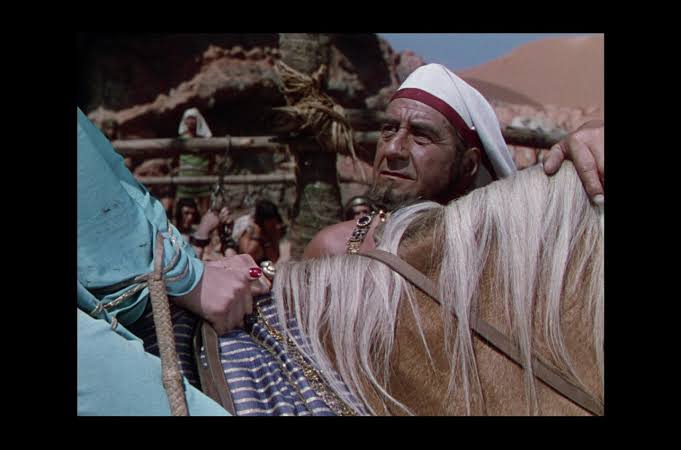
Director John Rawlins deserves more credit than he usually receives.His filmography includes a considerable amount of adventure, western and action material, and that experience serves Sudan well.He understands movement.The film is rarely static for long.Characters ride, run, fight, escape, pursue and scheme.The camera is frequently required to accommodate the movement of horses and people across large landscapes, and Rawlins gives the picture a useful sense of momentum.He also knows when to allow the spectacle to dominate.Rather than constantly cutting away from the environment, the film sometimes allows the landscapes to become part of the attraction.That gives Sudan a surprisingly expansive quality.
The Production Design
The sets are pure Hollywood fantasy.They are not convincing in a documentary sense, but they are convincing as movie sets.This distinction is important.The palace of Khemis looks like a palace because the filmmakers have created an environment full of columns, decorative elements, arches, costumes and extras.The slave markets look like movie slave markets.The royal chambers look like movie royal chambers.The secret locations look like movie secret locations.Everything is slightly exaggerated.But exaggeration is precisely what the genre requires.This is not an attempt to recreate the ancient world as accurately as possible. It is an attempt to create the ancient world as the audience imagined it.
The Romance
The romantic dimension is also important.Naila’s relationship with Herua gives the story its emotional centre.Initially, she believes she is pursuing someone connected to the death of her father. Herua is therefore both a political enemy and a potential romantic interest.That contradiction provides the film with a useful dramatic engine.The romance develops through danger rather than conversation.Characters learn about each other because circumstances force them together.This is romance as adventure.It is not especially psychological, but it doesn’t need to be.The performances are broad enough to fit the style, and Montez and Bey have enough chemistry to make the relationship believable within the heightened conventions of the film.
The Film’s Problematic Elements
Watching Sudan today inevitably raises questions about Hollywood’s treatment of race, ethnicity and the Middle East/North Africa.The film’s ancient Egypt is fundamentally a Hollywood fantasy, and much of the casting reflects the racial conventions of the era rather than historical authenticity. Jon Hall and Andy Devine, in particular, are conspicuous examples of the genre’s tendency to cast white American stars in roles supposedly representing Middle Eastern or North African characters.This is something modern viewers are likely to notice immediately.The film also treats slavery and rebellion primarily as adventure-story material rather than exploring their human consequences in the way a modern historical drama might.That doesn’t make the film historically authoritative.Quite the opposite.It makes Sudan an interesting document of the fantasy conventions and cultural assumptions of 1940s Hollywood.The best way to appreciate it today is therefore to understand what it is rather than pretending that it is something it isn’t.
A Surprisingly Influential Style
There is something fascinating about the visual language of Sudan when viewed from the perspective of later fantasy-adventure cinema.The combination of vast landscapes, colourful costumes, heroic rebels, princesses, villains, comic sidekicks and exotic settings would become part of the visual vocabulary of countless later adventure films.It is easy to see why viewers interested in the history of fantasy cinema might find Sudan rewarding.The film belongs to the same broad tradition that would eventually feed into television adventure series, European sword-and-sandal pictures, fantasy films and even the visual language of later space opera.The basic storytelling grammar is remarkably durable:A powerful ruler.A threatened kingdom.A heroic outsider.A beautiful queen.An evil adviser.A rebellion.A secret identity.A romantic complication.A spectacular climax.It is a formula because it works.
The Imprint Presentation
This is where Imprint’s release becomes particularly attractive.The film has been given a 1080p high-definition presentation, with its original 1.37:1 aspect ratio preserved. Audio is presented in English LPCM 2.0 dual mono, with optional English HOH subtitles.That is exactly the sort of technical presentation a film like this deserves.The 1.37:1 ratio preserves the Academy-frame appearance of the original theatrical presentation, while high-definition allows the extraordinary amount of detail in the costumes, sets and locations to become much more apparent.The colour photography is the main attraction.A good presentation of Sudan should allow the Technicolor palette to dominate without making the image look artificially modern.This is not a film that needs to be scrubbed of its age.Its age is part of its character.The slight softness, photographic texture and characteristics of the original image belong to the experience of watching a 1945 Technicolor production.The high-definition presentation allows the film to look considerably more impressive than it might have done on older television prints or previous home-video editions.
The Audio
The English LPCM 2.0 dual-mono soundtrack is equally appropriate.This isn’t a film designed around elaborate stereo effects.The original soundtrack is a traditional Hollywood mono presentation, and preserving that character is preferable to artificially expanding it.The dialogue is central, the music is important, and the effects provide the necessary punctuation for sword fights, horse chases and other action sequences.For a 1945 film, the soundtrack comes across as perfectly suited to the material.The inclusion of English HOH subtitles is also useful, particularly for viewers who want to follow every line of dialogue or are watching the film at lower volume.
Heath Holland’s Commentary
One of the major attractions of this particular release is the new audio commentary by writer and Cereal at Midnighthost Heath Holland.Commentaries can be especially valuable on films such as Sudan because there is so much surrounding context to discuss.The Montez-Hall partnership.Universal’s adventure cycle.The history of Technicolor.The production’s relationship to the Arabian Nights tradition.The careers of the supporting cast.The genre’s conventions.The cultural assumptions of 1940s Hollywood.The production history.The development of the film.All of these subjects add another dimension to a picture that can initially appear to be nothing more than colourful escapism.Holland’s involvement makes the release feel considerably more substantial than a barebones catalogue presentation.
Golden Days of the Arabian Nights
The other significant extra is Golden Days of the Arabian Nights, a new video essay by film scholar Josh Nelson.This is an especially appropriate inclusion.Sudan is best understood as part of a larger tradition rather than as an isolated movie.The Hollywood Arabian adventure was a genre unto itself, drawing on literary fantasy, theatrical spectacle, colonial-era adventure stories and earlier cinematic traditions.Films such as these helped establish a visual shorthand for exotic adventure that remained influential for decades.A video essay examining that tradition gives viewers a useful opportunity to place Sudan within its historical context.It also makes the release much more valuable for collectors interested in film history rather than simply in the movie itself.
The Imprint Packaging
The fact that Sudan appears within Tales of Adventure – Collection 10 is appropriate.The collection contains The Magic Carpet (1951), Sudan (1945), Salome (1953), The Sword of Ali Baba (1965), and the high-definition bonus film 1001 Arabian Nights (1959). It is a four-disc limited-edition hardbox, restricted to 1,500 copies.There is something pleasing about this approach.Instead of treating Sudan as an isolated curiosity, Imprint places it within a broader history of Hollywood adventure.That allows viewers to compare different periods of the genre and see how the visual and narrative conventions developed.For collectors, the hardbox presentation also gives the release the physical presence expected from a boutique Blu-ray.
Why Sudan Works
The great virtue of Sudan is that it doesn’t pretend to be sophisticated.It is entertainment.Pure, unapologetic, brightly coloured, melodramatic entertainment.The film wants you to cheer for Naila.It wants you to dislike Horadef.It wants you to be intrigued by Herua.It wants you to laugh at Merab and Nebka.It wants you to admire the costumes.It wants you to enjoy the scenery.It wants you to wait for the inevitable confrontation.And it wants the whole thing to be over within roughly 76 minutes.There is something refreshing about that economy.Modern blockbusters can take two and a half hours to tell stories that could probably have been told in 90 minutes.Sudan wastes no time.Something happens.Then something else happens.Then there is a chase.Then a revelation.Then a fight.Then another complication.The pace is wonderfully old-fashioned.
The Camp Factor
There is also an undeniable camp quality to the picture.But “camp” shouldn’t necessarily be used as a criticism.Maria Montez’s costumes are extravagant.George Zucco’s villainy is deliciously excessive.The dialogue can be wonderfully theatrical.The sets are larger than life.The historical inaccuracies are spectacular.The entire production seems to exist in a heightened state of unreality.And that is precisely why the film remains fun.There is a difference between a film being unintentionally funny and a film becoming enjoyable because its conventions are so exaggerated.Sudan frequently occupies that wonderful territory where sincerity and absurdity coexist.The filmmakers are completely serious.The audience doesn’t have to be.
A Film Made for Saturday Afternoon
Perhaps the best description of Sudan is that it is a Saturday-afternoon movie.It belongs to an era when audiences could walk into a cinema and be transported somewhere else for a little over an hour.No complicated cinematic universe.No lengthy mythology.No elaborate backstory.Just Maria Montez, a desert, a palace, a rebellion, a villain, a romance and plenty of adventure.It is cinema as escape.And that is something worth preserving.
Final Thoughts
Sudan is not a film that should be approached expecting historical realism, psychological depth or sophisticated drama.It is a fantasy adventure.More specifically, it is one of the colourful, flamboyant Technicolor adventures that made Maria Montez such an enduring cult figure.The movie has plenty of weaknesses.Some of the acting is exaggerated.The historical setting is essentially fantasy.The racial and cultural assumptions are very much those of 1940s Hollywood.Some of the special effects have aged considerably.The plot is predictable.But none of those things prevent the film from being enormous fun.Indeed, many of them are part of the reason it remains so entertaining.Maria Montez is magnificent.Turhan Bey provides a strong romantic presence.Jon Hall fits comfortably into the adventure formula.Andy Devine supplies the comedy.George Zucco gives the film a superb villain.The Technicolor photography is the real visual attraction.The locations provide genuine scale.And John Rawlins keeps the whole thing moving at a brisk pace.Imprint’s Blu-ray is therefore a very welcome release.The 1080p presentation, original 1.37:1 framing, LPCM 2.0 dual-mono audio and English HOH subtitles provide a solid technical foundation, while the new Heath Holland commentary and Josh Nelson’s Golden Days of the Arabian Nights video essay provide the historical and critical context that turns the release into something considerably more substantial.For fans of Maria Montez, classic Universal adventure films and vintage Technicolor, this is exactly the kind of title that deserves to be rescued from obscurity.Sudan may not be historically accurate.It may not be sophisticated.It may not even be particularly interested in reality.But it is colourful, energetic, romantic, theatrical and gloriously old-fashioned.And sometimes that is precisely what an adventure film should be.Imprint’s presentation reminds us that there was a time when a movie could simply promise spectacle, romance and adventure—and then deliver all three.
For anyone with an affection for the great Technicolor fantasy adventures of Hollywood’s golden age, Sudan remains a wonderfully entertaining piece of cinematic escapism, and this Imprint release gives it the kind of respectful treatment that allows its particular brand of old-fashioned magic to shine again.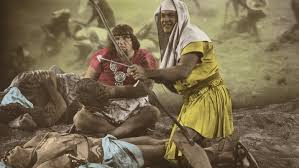


Leave a Reply