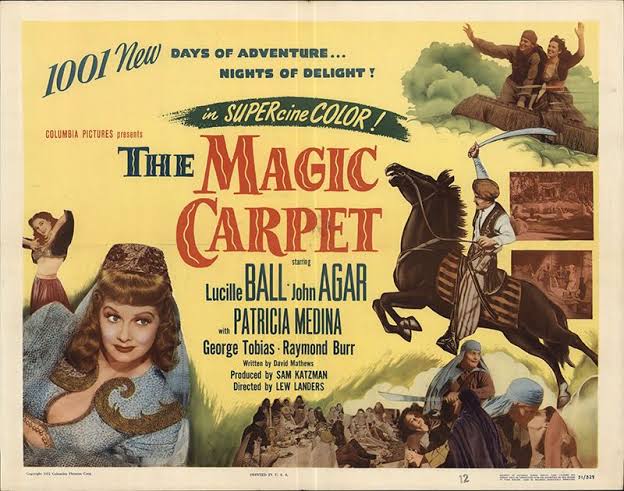
“The Magic Carpet” (1951)
Fantasy

Running Time: 84 minutes
Written by: David Mathews
Directed by: Lew Landers
Featuring: Lucille Ball, John Agar, Patricia Medina, George Tobias, Raymond Burr, Gregory Gaye, Rick Vallin and Gary Klein
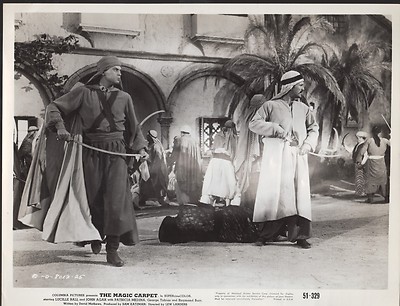
Grand Vizier Boreg al Buzzar: [waving his scimitar] “This time. Doctor, you must tend to a man and not on the ladies of the Harem!”
There are some films that seem almost tailor-made for the home-video collector. They may not be regarded as major works of cinema, they may never have received the critical attention given to the acknowledged classics of their era, and they may have disappeared almost completely from mainstream circulation. Yet when they finally appear in a good-quality Blu-ray edition, their very obscurity becomes part of the attraction. The Magic Carpet is exactly that kind of film.
Released by Columbia Pictures in 1951 and directed by Lew Landers, The Magic Carpet belongs to the colourful cycle of Arabian Nights-inspired adventures that flourished in Hollywood during the 1940s and 1950s. It is a film of magic carpets, evil rulers, secret identities, beautiful women, palace intrigues, sword fights, imprisoned heroes and conveniently timed rescues. It is also a film featuring the extraordinary combination of John Agar, Patricia Medina, Raymond Burr, George Tobias and, most intriguingly of all, Lucille Ball.
The Imprint Blu-ray, part of Imprint’s Tales of Adventure collection, gives this neglected fantasy an especially welcome new lease of life. Imprint’s release is significant because it is the worldwide first Blu-ray edition of the film. The disc presents the movie in 1080p, in its original 1.37:1 aspect ratio, with LPCM 2.0 mono sound and English SDH subtitles.
For collectors of vintage adventure cinema, that alone makes the release interesting. But the greater pleasure comes from discovering just how entertaining this strange little film can be when approached on its own terms.
A lost world of Hollywood fantasy
By 1951, Hollywood had become extremely comfortable with the Arabian adventure formula. These movies were designed as escapist entertainment, offering audiences exotic locations, colourful costumes, romance, action and fantasy at a time when the studios were increasingly competing with television for the public’s attention.
The Magic Carpet was released on 18 October 1951, and its production dates back to December 1950. It was made in SuperCinecolor, photographed by Ellis W. Carter, with sets designed by Paul Palmentola and costumes by Jean Louis.
That combination tells you quite a lot about the film. This is not supposed to be historical drama. It is a fantasy playground. The costumes, palace interiors, villains and heroic disguises are all deliberately larger than life. The film takes the mythology of the Arabian Nights and combines it with the conventions of the Saturday matinee adventure.
There is something wonderfully uncomplicated about that approach.
The story begins with political treachery. Caliph Omar and Queen Yasmina are preparing to establish their infant son as heir when the ambitious Ali stages a coup. The royal family is destroyed, but the baby escapes on the titular magic carpet and is eventually raised by his uncle Ahkmid.
The child grows into Ramoth, unaware of his royal identity. Eventually he learns the truth and becomes the mysterious Scarlet Falcon, fighting against the tyrannical regime that has taken control of his homeland.
It is an old-fashioned adventure structure, but it works because the film understands that these stories are fundamentally about identity. The hero is an orphan who discovers that he is a prince. The villain is an impostor who has stolen the throne. The woman he loves becomes involved in the struggle. The magic carpet itself becomes both a symbol of his royal destiny and a practical device for getting the characters out of impossible situations.
In other words, the film is operating in fairy-tale territory rather than attempting realism.
John Agar as the reluctant hero
John Agar is an interesting choice for Ramoth. He had established himself in Hollywood in a variety of roles, including military and adventure parts, and he possesses the straightforward screen presence necessary for this kind of hero.
Ramoth is essentially the classic lost prince. He has strength, courage and a natural sense of justice, but he does not initially know who he really is.
Agar plays him without excessive self-consciousness. That is important because the film itself never winks at the audience. There is no attempt to make the material ironic. Agar simply plays the hero and allows the story to carry him from one adventure to the next.
His transformation into the Scarlet Falcon gives the film one of its most enjoyable pulp-adventure elements. The masked or disguised hero was a familiar figure in serials and adventure films, and The Magic Carpet happily embraces the tradition.
Ramoth is not particularly psychologically complicated, but that isn’t really the point. He is the embodiment of the righteous hero who discovers that he has both the responsibility and the opportunity to restore justice.
And in a film like this, that is enough.
Patricia Medina brings warmth to the adventure
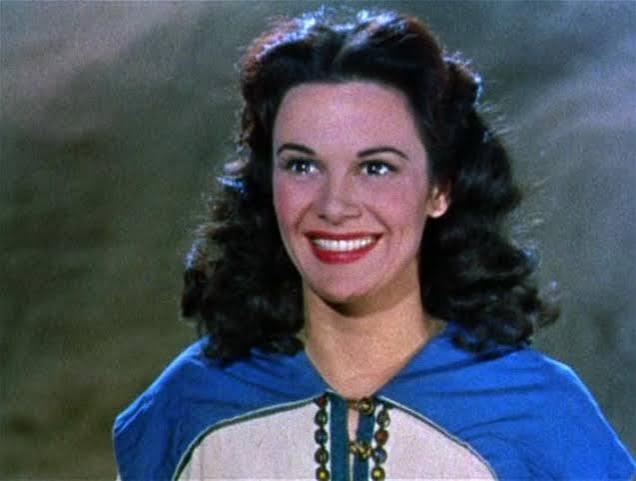
Patricia Medina plays Lida, Ramoth’s love interest, and she gets considerably more to do than simply stand around waiting for the hero to rescue her.
One of the pleasant aspects of The Magic Carpet is that Lida becomes an active participant in the adventure. She infiltrates the enemy’s forces, disguises herself and becomes involved in the attempt to free Ramoth.
Medina brings an appealing combination of glamour and determination to the role. She fits perfectly into the visual style of the film, but she is never merely decorative.
That is particularly important because the movie is packed with the conventions of the era. There are palace dances, elaborate costumes and beautiful women, but the story repeatedly allows its female characters to influence the action.
Lida is especially effective because her relationship with Ramoth gives the fantasy a romantic centre. The stakes are not simply political. The characters are fighting for a future together.
Lucille Ball before I Love Lucy
Perhaps the most fascinating element for modern viewers is Lucille Ball.
The Magic Carpet arrived in cinemas in October 1951, just three days after the premiere of I Love Lucy. That coincidence makes the film an especially interesting snapshot of Ball’s career. According to the AFI, it was her final film before she and Desi Arnaz began their hugely successful television series.
Watching Ball here is fascinating because she is not playing Lucy Ricardo.
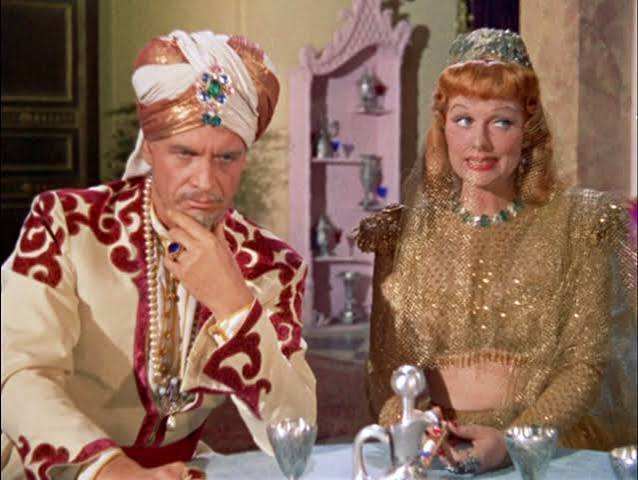
She plays Narah, the daughter of the usurper Ali, and the character is positioned on the villainous side of the story. Ball is glamorous, serious and occasionally threatening. It is a reminder that before television transformed her into one of the most famous comic performers in American history, she had spent years working in a wide variety of movie roles.
There is something almost surreal about seeing Lucille Ball in this environment.
Modern audiences inevitably bring I Love Lucy with them. It is almost impossible not to imagine Lucy Ricardo appearing somewhere in the middle of the palace. But Ball does not play Narah as a sitcom character. She belongs to the melodramatic world of the film.
That makes The Magic Carpet a fascinating piece of Ball’s filmography.
The movie also benefits from the fact that Narah is not simply a cardboard villain. Ball gives her an element of personality and sensuality that makes the character memorable even when the screenplay is functioning according to familiar adventure conventions.
For fans of Lucille Ball, the film alone makes the Blu-ray worth investigating.
Raymond Burr as the villain
Raymond Burr is another major attraction.
Long before Perry Mason made him a television institution, Burr was one of Hollywood’s great character actors, and his imposing physical presence made him an ideal villain.
Here he plays Boreg, the grand vizier and one of the principal agents of the evil regime.
Burr understands exactly what kind of movie he is in.
He does not attempt subtle realism. He gives the character the necessary authority, menace and theatricality. His voice, posture and imposing frame immediately communicate that this is someone who should not be trusted.
Burr was particularly good at playing men who appeared respectable on the surface but were actually ruthless underneath. The Magic Carpet gives him a more openly villainous role, but the basic appeal remains the same.
His scenes add a welcome sense of danger to the film.
George Tobias and the supporting cast
George Tobias plays Razi, Ramoth’s friend and ally. Tobias was a wonderfully versatile character actor, and his presence helps give the film some personality outside the central romantic and heroic story.
There is also Gregory Gaye as Ali, the usurping ruler.
The supporting cast is important because films like The Magic Carpet depend on a sense of a complete fantasy world. The characters do not need complicated backstories. They need to establish the atmosphere of the kingdom and keep the plot moving.
The film does exactly that.
Sam Katzman’s fingerprints
Producer Sam Katzman was one of the great craftsmen of economical Hollywood exploitation and genre entertainment.
His films were rarely intended to be expensive prestige productions. They were designed to deliver the goods.
That philosophy is visible throughout The Magic Carpet.
The film has spectacle, but it is economical spectacle. It has palace sets, but they are studio sets. It has action, but the action is efficiently staged. It has romance, dancing, villains and fantasy without allowing any single element to become too expensive or elaborate.
There is something charming about this economy.
The movie is constantly trying to convince the audience that they are somewhere exotic and far away, and for much of its running time it succeeds.
This is Hollywood fantasy assembled by professionals who understood that audiences did not necessarily need realism. They needed imagination.
Lew Landers and efficient direction
Director Lew Landers had a long career across many genres, and The Magic Carpet suits his ability to keep a production moving.
The film is not interested in lingering over atmosphere for too long. The plot progresses rapidly from one development to another.
A betrayal leads to an escape.
The escape leads to the hero’s upbringing.
The hero discovers his identity.
The villain attempts to stop him.
The heroine becomes involved.
The magic carpet eventually becomes crucial.
There is a very appealing efficiency to the storytelling.
At around 82–84 minutes, depending on the source listing, the film does not have much room for padding. The AFI catalogue records a running time of 82 minutes, while the Imprint/Blu-ray listings give approximately 84 minutes.
Either way, it is a compact adventure.
And that is probably the best way to experience it.
The SuperCinecolor experience
One of the great pleasures of vintage fantasy cinema is colour, and The Magic Carpet was photographed in SuperCinecolor.
This is important because colour in early-1950s adventure films is not simply a technical feature. It is part of the storytelling.
The costumes, palace interiors, deserts and theatrical sets all benefit from the heightened colour palette. The movie is intended to look like an illustrated storybook brought to life.
The colours have an appropriately old-fashioned quality. They are not necessarily the immaculate, ultra-refined colours that modern viewers associate with contemporary digital cinematography. Instead, they possess the character of period colour photography.
That is exactly what one wants from a film like this.
The Imprint Blu-ray
For collectors, the most important question is how the movie fares in this new presentation.
Imprint’s release is particularly significant because it represents the worldwide first Blu-ray release of The Magic Carpet.
The disc uses an AVC 1080p presentation and preserves the film’s approximately 1.37:1 original aspect ratio. Audio is presented in LPCM 2.0 mono, with English SDH subtitles.
That is precisely the kind of presentation this film deserves.
The 1.37:1 framing is especially important. A movie from 1951 should not be cropped into a modern widescreen shape simply because contemporary home-video displays are widescreen. Retaining the original proportions preserves the visual composition of the film.
The SuperCinecolor photography is allowed to breathe, and the image has considerably more presence than an old standard-definition presentation would provide.
Naturally, expectations need to be realistic.
This is an approximately seventy-five-year-old film, not a modern production photographed yesterday. Vintage elements can display signs of age, and collectors approaching a release such as this should appreciate the restoration and presentation within the context of the surviving source material.
But that is part of the fascination.
The Blu-ray does not need to make The Magic Carpet look as though it was photographed in 2026. It needs to make it look like a well-preserved 1951 adventure film.
That is the ideal.
Sound
The original mono soundtrack is presented in LPCM 2.0.
Again, this is the correct approach.
There is no reason to artificially manufacture a modern surround presentation for a film that was designed for a mono theatrical soundtrack.
The music and dialogue have the character expected of a period recording, while the lossless presentation gives the soundtrack a clean and direct quality.
The score is particularly important because the music helps create the film’s fantasy atmosphere. Adventure movies of this era relied heavily on orchestral scoring to turn relatively modest sets into places of excitement and danger.
The soundtrack therefore contributes enormously to the sense of period authenticity.
English subtitles
English SDH subtitles are included, which is another useful feature for a film of this vintage.
Dialogue in older movies can sometimes be difficult to catch because of recording characteristics, orchestral scoring or variations in vocal delivery. Subtitles provide an excellent alternative for viewers who want to make sure they do not miss anything.
For collectors, it is another indication that Imprint is treating this as a proper catalogue presentation rather than simply putting an old movie onto a disc.
Part of the Tales of Adventure collection
The Magic Carpet forms part of Imprint’s Tales of Adventure – Collection 10, alongside Sudan, Salome, The Sword of Ali Baba and the bonus film 1001 Arabian Nights. The collection was issued as a limited-edition four-disc hardbox, with 1,500 copies produced.
This context is particularly appropriate.
These films belong to a fascinating area of Hollywood history in which studios repeatedly returned to stories of exotic kingdoms, adventure and romance.
They may not always be sophisticated, but they possess a visual and cultural identity that is increasingly difficult to find in contemporary cinema.
For collectors of classic adventure films, the collection provides a useful snapshot of the genre.
The magic carpet itself
The title object is, of course, one of the film’s biggest attractions.
The magic carpet is a perfect example of the way fantasy cinema of the period could transform a relatively simple effect into something magical.
Today, audiences are accustomed to digital effects in which practically anything can be created. In 1951, the limitations of special-effects technology meant that filmmakers had to rely on ingenuity, staging and suggestion.
The result can be more charming.
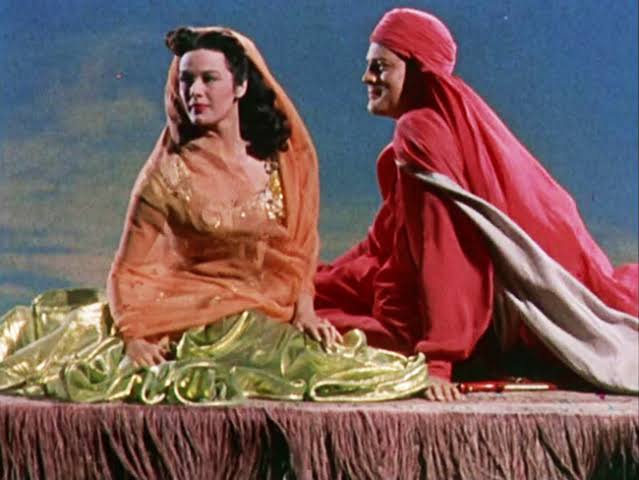
The carpet becomes a physical symbol of Ramoth’s destiny. It is connected to his royal heritage, his survival and ultimately his escape.
It is also simply fun.
There is something inherently appealing about a movie in which a hero can eventually escape danger by taking to the skies on a flying carpet.
That is the sort of fantasy premise that makes The Magic Carpet worthwhile.
A film that knows what it is
One of the greatest virtues of The Magic Carpet is that it does not apologise for its own simplicity.
It is not attempting to be Lawrence of Arabia. It is not attempting to reconstruct an authentic historical Middle East. It is a fantasy adventure assembled from fairy tales, melodrama, serials and Hollywood spectacle.
Judged by those standards, it becomes much more enjoyable.
The plot is straightforward.
The heroes are heroic.
The villains are villainous.
The romance is romantic.
The costumes are extravagant.
The palace intrigue is uncomplicated.
The magic carpet flies.
That is the contract between the film and its audience.
And once you accept that contract, there is considerable pleasure to be found.
Historical interest
The film is also valuable as a document of Hollywood’s changing landscape.
The fact that The Magic Carpet was released almost simultaneously with the beginning of I Love Lucy gives it a fascinating historical position. Lucille Ball was about to become a television superstar, and the nature of American entertainment was changing rapidly.
Television would soon transform the way audiences consumed comedy, drama and entertainment.
Yet The Magic Carpet represents the older Hollywood model: a theatrical feature designed to offer an escape into a brightly coloured fantasy world.
That makes the film more interesting with every passing year.
It is not simply an adventure film.
It is a time capsule.
Why the film deserves rediscovery
It would be easy to dismiss The Magic Carpet as minor Hollywood fantasy.
And, on one level, that description is fair.
It is not a masterpiece.
The characters are conventional, the plot is familiar and the special effects are obviously products of their period.
But those limitations are also part of its charm.
There is a particular pleasure in discovering films that existed outside the canon.
Not every film needs to be a masterpiece.
Some movies are valuable because they capture an era, a genre or a style of filmmaking that has disappeared.
The Magic Carpet is one of those films.
It demonstrates how Hollywood could take a familiar fairy-tale formula and turn it into an economical adventure feature. It showcases actors who would go on to become much more famous for other work. It preserves the visual style of early-1950s SuperCinecolor filmmaking. And, thanks to Imprint, it can now be experienced in high definition.
Final thoughts
Imprint’s Blu-ray release of The Magic Carpet is precisely the kind of catalogue release that makes physical media so rewarding.
The film itself may never have been one of Columbia’s most celebrated productions, but its combination of fantasy, adventure, romance and eccentric casting makes it a fascinating rediscovery.
John Agar provides the square-jawed heroism the story requires. Patricia Medina gives the romance warmth and adventure. Raymond Burr is thoroughly enjoyable as the villainous Boreg. George Tobias provides welcome character support. And Lucille Ball is the real curiosity, offering a glimpse of the actress immediately before I Love Lucy changed her career forever.
The movie’s 1951 setting is equally important. This is Hollywood fantasy before the genre became dominated by the increasingly sophisticated visual-effects techniques of later decades. Its magic is created through costumes, sets, performance, music, colour and imagination.
And that is exactly why the film remains enjoyable.
The Imprint presentation gives this forgotten adventure a level of respect it has rarely received. The 1080p image, original 1.37:1 framing, LPCM mono soundtrack and English SDH subtitles make it a very welcome upgrade for collectors. Most importantly, the release preserves the character of the original film rather than attempting to modernise it.
For anyone interested in Lucille Ball’s film career, the release is particularly attractive. For fans of John Agar, Raymond Burr, Patricia Medina or Sam Katzman’s genre productions, it is another worthwhile piece of the puzzle. And for collectors of vintage fantasy and Arabian adventure films, it is an unusually welcome addition to the Blu-ray catalogue.
The Magic Carpet may be a modest film, but modest films can have enormous charm.
It is colourful, silly, romantic, melodramatic and thoroughly old-fashioned. It belongs to a Hollywood that was perfectly happy to send audiences into an imaginary world for eighty-odd minutes and ask them simply to enjoy the ride.
And perhaps that is the most appropriate way to approach it.
Forget realism.
Forget historical accuracy.
Forget modern special effects.
Spread out the carpet, settle back, and allow this wonderfully old-fashioned piece of Hollywood fantasy to take you somewhere else.


Leave a Reply