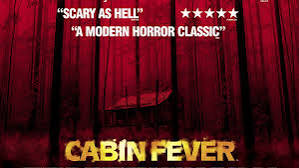
“Cabin Fever” (2002)
Horror

Running Time: 133 minutes
Written by: Eli Roth and Randy Pearlstein
Directed by: Eli Roth
Featuring: Rider Strong, Jordan Ladd, James DeBello, Cerina Vincent, Joey Kern, Arie Verveen and Giuseppe Andrews
Justin: “Yeah, he’s a professor… OF BEING A DOG! OOOH, FACED!… Scratch moded!”
.There is something particularly effective about horror films that take an ordinary, familiar situation and turn it into something profoundly unpleasant. A group of friends going away for a few days, staying in an isolated cabin in the woods, drinking, partying and enjoying their freedom sounds like the perfect setup for a carefree weekend. In horror cinema, however, the isolated cabin has become one of the most dependable locations for disaster. With Cabin Fever, Eli Roth took that familiar scenario and injected it with something altogether more uncomfortable: disease.
Released in 2002, Cabin Fever arrived at an interesting point in the history of American horror. The big-budget teenage slasher had largely run its course, while a new generation of filmmakers was beginning to rediscover the pleasures of low-budget, visceral horror. Roth’s film belongs firmly to that transitional period. It is part teen comedy, part gross-out body horror, part survival movie and part black comedy, with an infectious sense of nastiness running through almost every frame.
More than two decades later, Cabin Fever remains an unusually divisive horror film. Some viewers admire its simplicity, practical effects and willingness to be disgusting. Others have been frustrated by its characters, deliberately unpleasant humour and tonal inconsistencies. Yet those very qualities are also what make the film distinctive. It is not polished horror, nor is it particularly interested in behaving itself. It is an aggressive, grubby and frequently grotesque movie that seems determined to make the audience uncomfortable.
The arrival of a 4K release from Imprint Films provides an excellent opportunity to revisit the film. Whatever one’s opinion of the movie itself, there is no denying that Cabin Fever is a fascinating time capsule of early-2000s horror. Seeing it in a carefully presented high-definition or 4K environment allows its cinematography, production design, practical effects and deliberately ugly textures to be appreciated in a way that earlier home-video presentations could not always provide.
The premise is remarkably straightforward.
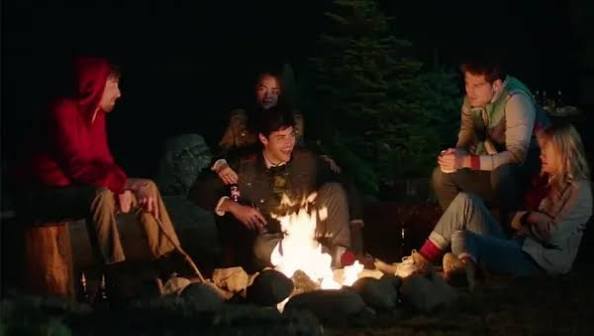
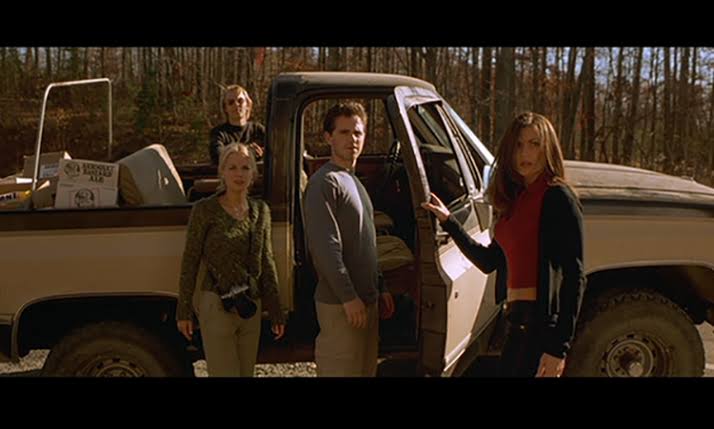
Paul, Bert, Marcy, Jeff and Karen are five college friends who travel to a remote cabin in the woods for a holiday. They want to drink, have sex, relax and escape the pressures of everyday life. Unfortunately, their idyllic getaway is interrupted when they encounter a strange infected man who appears to be suffering from some kind of horrifying skin disease.
The danger initially seems distant. Then Karen becomes infected.
From there, the film steadily strips away the group’s sense of security. The cabin, which initially represents freedom and privacy, becomes a prison. The woods, which appeared peaceful, become threatening. Their own bodies become sources of fear.
The simplicity of the premise is one of the film’s greatest strengths. There is no elaborate mythology to learn, no supernatural explanation and no complicated conspiracy. The enemy is microscopic, invisible and completely indifferent.
That makes the disease particularly frightening.
A vampire can be seen. A masked killer can be fought. A supernatural creature can potentially be defeated. Infection is different. The characters cannot see what is happening inside their bodies until the consequences become impossible to ignore.
That basic idea gives Cabin Fever a surprisingly effective psychological dimension.
Eli Roth’s direction is rough around the edges, but that roughness is an important part of the film’s personality.
There is a clear desire to make Cabin Fever feel like a dirty, unpredictable genre movie rather than a slick Hollywood production. Roth constantly moves between different horror traditions. One moment the movie resembles a conventional slasher; the next it becomes body horror; then it veers into comedy.
The film’s tonal instability can be frustrating, but it is also unmistakably deliberate.
Roth was obviously fascinated by the horror movies he had grown up watching, and Cabin Fever often feels like a young filmmaker enthusiastically throwing different influences into a blender. There are echoes of The Evil Dead, The Texas Chain Saw Massacre, The Thing, zombie movies and classic seventies survival horror.
Yet the film does not simply imitate those movies.
The central idea of infection gives Cabin Fever its own identity.
Roth also understands the value of anticipation. The film does not immediately reveal everything about the disease. Instead, it gradually introduces disturbing symptoms: skin irritation, sores, bleeding and eventually horrific physical deterioration.
The progression is important because the audience is given time to imagine how bad the disease might become before the film actually shows us.
And when it does show us, it does not hold back.
This is where Cabin Fever remains most memorable.
The film’s greatest strength is its physicality.
The disease is not abstract. It affects the skin, the flesh and eventually the entire human body. The audience is forced to look at infected skin, peeling flesh, blood and other unpleasant symptoms.
The practical effects give these moments an unpleasant immediacy.
Modern horror can sometimes become overly dependent on digital effects, and there is something refreshing about watching a movie in which the horror feels tangible. The makeup effects have texture. The wounds look physical. The infected flesh appears like something that could actually be touched.
That quality is particularly important when revisiting the film on a modern format.
High-resolution presentation can sometimes make practical effects look even more convincing because the viewer can appreciate the texture and workmanship involved. At the same time, it can reveal the limitations of older effects work. In the case of Cabin Fever, however, that is part of the charm.
The effects do not need to look perfect.
They need to look disgusting.
And they do.
The infamous shaving scene is perhaps the clearest example of Roth’s approach. The film takes something completely ordinary and turns it into an ordeal. A simple act of removing hair becomes an act of self-mutilation and panic.
The audience understands exactly what is happening and yet wants to look away.
That is effective body horror.
The characters in Cabin Fever are intentionally flawed.
Paul is the central figure, played by Rider Strong, and he is probably the most recognisable protagonist. Strong gives Paul enough vulnerability to make him sympathetic without turning him into a conventional heroic character.
Bert, played by James DeBello, is considerably less sympathetic.
He is selfish, irresponsible and frequently obnoxious. Yet this is an important part of the film’s social dynamic. These are not perfectly likeable horror protagonists who always make sensible decisions. They are young people, and they behave like young people who believe they are largely invulnerable.
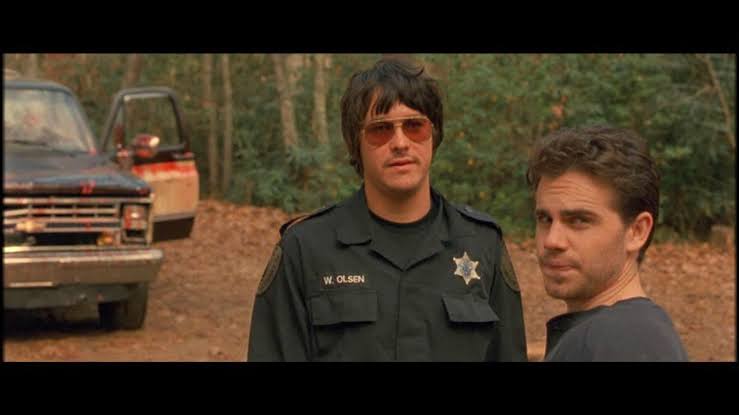
Marcy, played by Cerina Vincent, provides another dimension to the group, while Giuseppe Andrews’ performance as Deputy Winston adds an almost surreal comic energy.
Perhaps the most interesting aspect of the characters is how the disease gradually destroys their ability to trust one another.
At first, they are simply friends on holiday.
Then one becomes infected.
Then everyone becomes suspicious.
Who has been exposed?
Who is contagious?
Who is lying?
Who should be allowed inside the cabin?
The film’s real horror eventually becomes less about the disease itself and more about what fear of infection does to human behaviour.
Isolation
Isolation has always been one of horror cinema’s most powerful weapons.
Cabin Fever understands that isolation does not necessarily mean being hundreds of miles from civilisation. The characters are technically surrounded by other people, but they are effectively trapped.
The woods prevent easy escape. Their vehicle becomes unreliable. Communication is limited. Local people are strange and unhelpful.
The result is a growing sense that the normal rules of society no longer apply.
The cabin gradually changes from a holiday destination into a contaminated space.
This is particularly effective because the cabin initially feels comfortable. It is warm, rustic and inviting. It represents everything the characters think they want.
As the disease spreads, however, every surface becomes potentially contaminated.
The floor.
The bed.
The bathroom.
The kitchen.
The characters themselves.
The familiar becomes threatening.
That transformation is central to the film’s success.
The Horror of Contamination
There is something remarkably universal about the fear at the centre of Cabin Fever.
The characters are not merely afraid of dying. They are afraid of touching one another.
They are afraid of sharing food.
They are afraid of bodily fluids.
They are afraid of their own skin.
That gives the film a particular psychological unpleasantness.
The infection is also democratic. It does not care whether somebody is attractive, wealthy, intelligent or morally good. Everyone is vulnerable.
In that respect, the film’s horror is almost existential.
The characters have no meaningful control over their fate.
Once infection begins, the question is not simply whether somebody will die.
It is whether they can remain human while they are dying.
Black Comedy
One of the more controversial aspects of Cabin Fever is its humour.
The film can be genuinely funny, but it can also be extremely crude and intentionally juvenile.
Roth seems to enjoy making the audience laugh immediately before making them uncomfortable. This produces a peculiar rhythm in which scenes can move from comedy to horror with little warning.
Some viewers will find this entertaining.
Others will find it irritating.
Personally, the tonal instability is one of the reasons the movie remains interesting. A straightforward serious horror film about infectious disease would probably be more consistent, but it might also be less distinctive.
Cabin Fever is messy.
Its sense of humour is messy.
Its characters are messy.
Its storytelling is messy.
The disease itself is messy.
There is an almost thematic relationship between the film’s content and its filmmaking style.
Everything is contaminated.
The Importance of the Setting
The location work is another major strength.
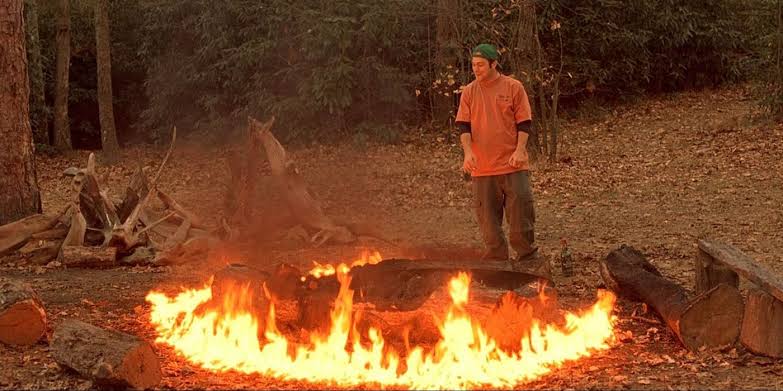
The rural setting gives the film a sense of physical isolation without requiring a huge production budget. The woods appear beautiful during daylight but threatening at night.
Roth makes effective use of the contrast between natural beauty and human vulnerability.
The characters are surrounded by trees, fresh air and open space, yet none of those things can save them.
The cabin becomes increasingly claustrophobic as the film progresses.
This contrast between wide exterior landscapes and cramped interiors is important to the film’s visual identity.
The woods promise escape.
The cabin promises safety.
Neither delivers.
Cinematography
The cinematography has an earthy, naturalistic quality that suits the story.
Rather than making everything look glossy, the film embraces a somewhat dirty visual palette. The rural environment feels tangible, and the interiors often appear warm but slightly oppressive.
The high-definition presentation makes this especially apparent.
Textures in wood, walls, clothing and skin become much more visible. The visual contrast between the natural environment and the increasingly diseased bodies of the characters is particularly effective.
The film’s visual style is not necessarily beautiful in a traditional sense.
It is tactile.
And for a body-horror film, that is more important.
Sound and Atmosphere
Sound plays an important role in creating the film’s unease.
The sound design often emphasises physical discomfort. Scratching, coughing, breathing, movement and other bodily sounds become increasingly significant as the infection spreads.
The score also helps maintain the uneasy mixture of horror and dark comedy.
The soundtrack never allows the movie to settle comfortably into one genre.
That is appropriate.
Cabin Fever is fundamentally a movie about discomfort, and its soundscape frequently reinforces that feeling.
Rewatching the Film in 4K
The biggest question for collectors is, of course, what the film gains from the 4K treatment.
The answer is that Cabin Fever is an unexpectedly good candidate for a modern restoration.
This is not a film whose appeal depends on pristine, immaculate imagery. Instead, its rough textures and naturalistic cinematography benefit from greater resolution.
The wood grain of the cabin becomes more apparent.
The foliage in the woods has greater definition.
Faces reveal more detail.
And, perhaps most importantly, the makeup effects gain a physical presence.
The diseased skin and practical effects have considerably more impact when the image has sufficient resolution and contrast to reveal their texture.
The film’s darker scenes also benefit from improved presentation when compared with older, less capable transfers.
Of course, viewers should not expect Cabin Fever to suddenly look like a modern digitally photographed blockbuster. The source material and original production impose their own limitations.
That is not a criticism.
A good restoration should preserve the character of a film rather than make it look artificially new.
In that respect, Cabin Fever remains recognisably a 2002 horror movie.
And that is exactly how it should look.
The Imprint Presentation
Imprint Films has established a reputation among physical-media collectors for treating catalogue titles with considerable respect, and Cabin Fever is a welcome addition to that philosophy.
The appeal of an Imprint release is not simply the promise of a higher-resolution picture. It is the idea that a film once regarded as disposable genre entertainment can be given the sort of presentation normally reserved for more prestigious titles.
Cabin Fever deserves that treatment.
The film may be crude and occasionally ridiculous, but it is an important example of early-2000s independent horror.
A release such as this encourages viewers to reconsider it as more than simply a gross-out movie.
The improved presentation also makes the production design easier to appreciate.
The cabin itself is an important visual element, and the details of its construction, furniture and surroundings contribute substantially to the atmosphere.
Likewise, the rural environment feels much more convincing when the transfer retains fine detail rather than reducing everything to a soft mass of green and brown.
Special Features and Collector Appeal
For collectors, the supplementary material is an important part of the package.
A film like Cabin Fever is particularly suited to behind-the-scenes material because its production history is fascinating. The movie represents the beginning of Eli Roth’s career and became an important stepping stone toward his later work.
Looking back at the film from the perspective of Roth’s subsequent career adds considerable interest.
It is possible to see the filmmaker experimenting with ideas that would become more pronounced in his later films: extreme physical horror, uncomfortable humour, confrontational imagery and an interest in provoking strong audience reactions.
The extras also provide an opportunity to reconsider the film’s place within the evolution of horror cinema.
In the early 2000s, horror was beginning to change.
Cabin Fever arrived before the full explosion of what would later be labelled “torture horror”, but it helped establish an appetite for more physically explicit and confrontational genre filmmaking.
Its influence should not be exaggerated, but its timing is significant.
The Film’s Legacy
Perhaps the most interesting thing about Cabin Fever is that it has aged better than one might expect.
Not necessarily because every element works perfectly.
It doesn’t.
The film is uneven.
Some characters are irritating.
Some jokes have aged badly.
The tonal shifts can be jarring.
And there are moments when Roth’s desire to shock seems more important than narrative logic.
But the basic horror concept remains effective.
Disease is still frightening.
Isolation is still frightening.
Contamination is still frightening.
And the sight of a human body deteriorating remains one of the most primal images horror cinema can offer.
The movie’s greatest achievement is therefore not its plot.
It is its ability to make the audience physically uncomfortable.
Cabin Fever as a Product of Its Time
There is also something fascinating about watching Cabin Fever today as a period piece.
The early 2000s are all over it.
The clothing.
The hairstyles.
The attitudes.
The humour.
The music.
The technology.
Even the way the characters interact feels distinctly pre-social-media.
That gives the film an unexpected nostalgic quality.
Of course, nobody watching Cabin Fever in 2026 is likely to describe a movie about people being infected by a flesh-eating disease as “comfort viewing”, but there is nevertheless something strangely appealing about revisiting a horror movie from an era when digital technology had not yet transformed every aspect of filmmaking.
The movie feels handmade.
It feels physical.
And it feels like a group of filmmakers trying to get away with something.
Final Thoughts
Cabin Fever is not a perfect horror film.
In fact, it is precisely the sort of movie that invites argument.
Its mixture of body horror, comedy, teen drama, survival horror and social paranoia will either entertain you or drive you crazy depending on your tolerance for tonal experimentation.
But it is impossible to deny that the movie has personality.
There are countless horror films about people trapped in remote locations.
There are countless films about mysterious diseases.
There are countless films about groups of attractive young people making terrible decisions.
Yet Cabin Fever manages to combine those familiar ingredients into something recognisably its own.
The film’s greatest weapon is its disgust.
Roth understands that horror is not always about making the audience jump.
Sometimes it is about making them squirm.
Sometimes it is about making them cover their eyes.
Sometimes it is about making them think twice about touching the person sitting beside them.
And sometimes the simplest idea is the most effective: something is inside your body, you cannot see it, you cannot reason with it, and you cannot easily escape it.
The Imprint 4K release gives the film an opportunity to be rediscovered in the best possible environment. The increased resolution and improved presentation allow the physical textures of the movie to become more apparent, while the practical makeup effects benefit enormously from being presented with greater clarity.
For fans of early-2000s horror, Eli Roth, practical effects or cult cinema, this is a particularly worthwhile revisit.
It may not be elegant.
It may not be subtle.
It may not always be tasteful.
But Cabin Fever was never designed to be any of those things.
It is designed to get under your skin.
And more than twenty years later, it still does.




Leave a Reply