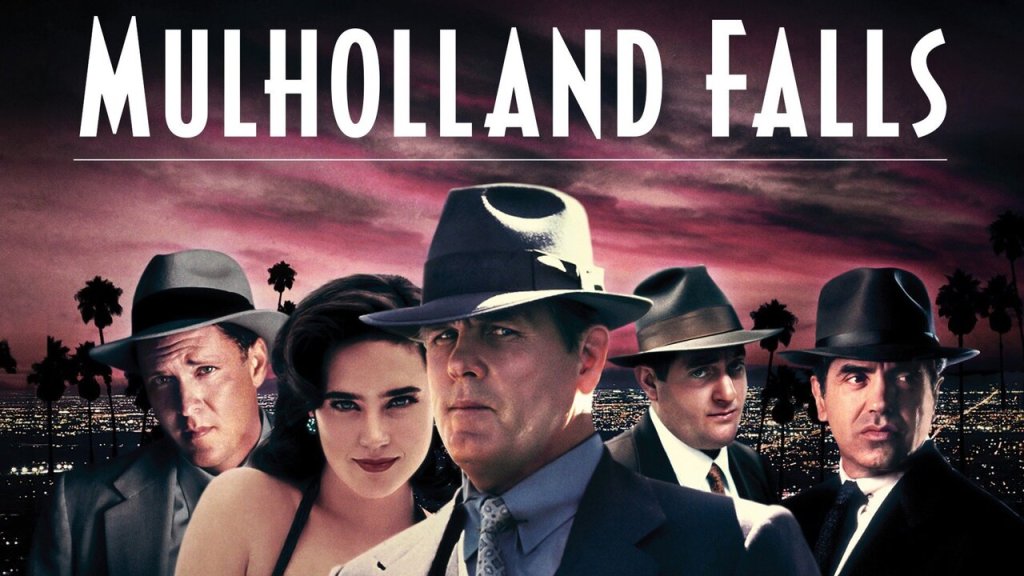
“Mulholland Falls” (1996)
Drama / Thriller

Running Time: 107 minutes
Written by: Pete Dexter
Directed by: Lee Tamahori
Featuring: Nick Nolte, Melanie Griffith, Chazz Palminteri, Michael Madsen, Chris Penn, Treat Williams, Jennifer Connelly, Andrew McCarthy and John Malkovich
Lieutenant Max Hoover: “See, that’s federal property. This isn’t. This is L.A. This is my town. Out here you’re a trespasser. Out here I can pick you up, burn your house, fuck your wife, and kill your dog. And the only thing that’ll protect you is if I can’t find you. And I already found you.”
There is something wonderfully old-fashioned about Mulholland Falls. Released in 1996 and directed by Lee Tamahori, the film arrives from a period when Hollywood was still willing to spend serious money on adult-oriented crime dramas populated by difficult characters, morally compromised heroes and stories that were not necessarily interested in making their protagonists particularly likeable. It is a film that looks back towards the great film noirs of the 1940s and 1950s while simultaneously embracing the glossy, muscular filmmaking style of the 1990s. The result is an intriguing hybrid: part police thriller, part period noir, part gangster picture and part character study.
Imprint’s Blu-ray release provides an excellent opportunity to revisit this ambitious and frequently underrated crime film. Mulholland Falls may not have received the critical or commercial recognition that it perhaps deserved upon release, but time has been reasonably kind to it. Its atmosphere remains its greatest strength, its cast is exceptionally good, and its portrait of 1950s Los Angeles is sufficiently dark and unsettling to give the movie an identity all its own.
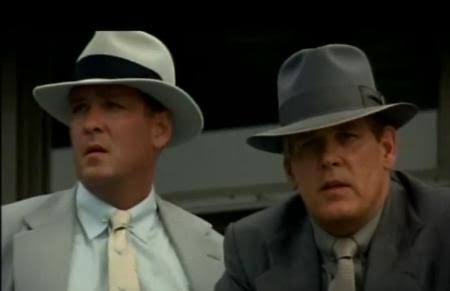
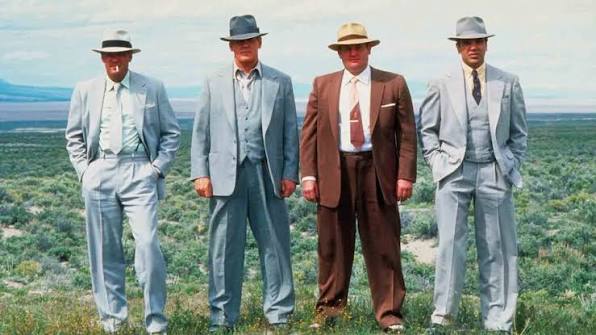
At the centre of the film is Los Angeles in 1954, a city that is rapidly expanding but is still capable of feeling isolated, corrupt and dangerous. The film’s police department is represented by an elite group of detectives known as the “Hat Squad”, led by Lieutenant Max Hoover, played by Nick Nolte. Hoover and his colleagues are not conventional lawmen. They operate according to their own rules, dispensing brutal street justice to criminals who cross them. They are effective because they are feared, and feared because they are prepared to do things that respectable police officers would never contemplate.
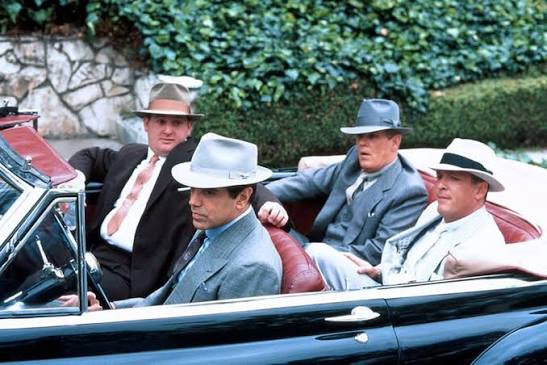
Hoover’s colleagues include Coolidge, played by Chazz Palminteri, Eddie Hall, played by Michael Madsen, and Arthur Relyea, played by Chris Penn. Together they form a particularly unpleasant but fascinating police unit. They are corrupt by modern standards, casually violent and frequently contemptuous of due process. Yet the film does not portray them simply as monsters. They exist within a particular moral environment, and the movie understands that the distinction between the police and the criminals they pursue can sometimes be remarkably thin.
The murder of a young woman changes everything.
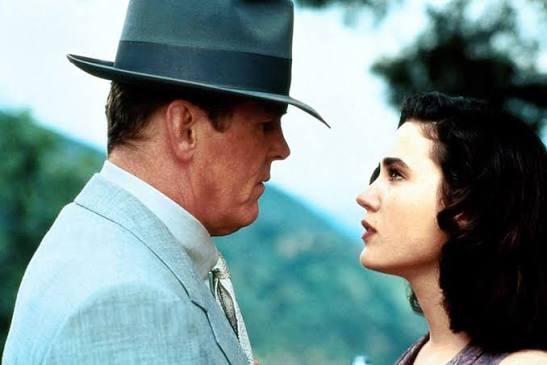
When a mysterious woman is discovered dead after apparently falling from a considerable height, Hoover begins investigating. The dead woman is Allison Pond, played by Jennifer Connelly, and it soon becomes clear that her relationship with Hoover was far more intimate than anyone initially understands. The investigation therefore becomes both professional and deeply personal.
This is where Mulholland Falls becomes considerably more interesting than a standard police procedural. Hoover is not simply attempting to discover who killed Allison. He is attempting to understand why she was murdered, what secrets she possessed and how those secrets might threaten not only him but also powerful figures within Los Angeles.
The screenplay, written by Pete Dexter, deliberately builds an atmosphere of conspiracy. Government officials, businessmen, police officers and organised criminals occupy overlapping worlds, and the closer Hoover gets to the truth, the more dangerous his investigation becomes.
The film’s title itself evokes the geography of Los Angeles. Mulholland Drive and its surrounding hills become a symbolic landscape: beautiful from a distance, but isolated and dangerous once you venture away from the city. Tamahori makes tremendous use of the Los Angeles locations, presenting the city as a place of contrasts. There are bright streets, glamorous nightclubs and expensive homes, but there are also empty roads, dark interiors and enormous stretches of wilderness.
One of the most impressive things about Mulholland Falls is its visual style. Tamahori had already demonstrated a strong interest in masculine crime stories with Once Were Warriors, and here he brings a similarly forceful visual sensibility to Hollywood noir. The film looks expensive, polished and deliberately cinematic.
The cinematography by Haskell Wexler is particularly important. Los Angeles is photographed in a way that recalls classic noir without simply attempting to imitate it. There are shadows, stark contrasts and night-time exteriors, but the film also takes advantage of widescreen compositions and the possibilities of a much larger production budget.
The result is a Los Angeles that feels simultaneously authentic and heightened. The movie is not trying to reproduce the exact visual language of The Big Sleep or Chinatown. Instead, it creates its own version of 1950s Los Angeles, one that exists somewhere between historical reality and Hollywood mythology.
The production design is another major asset. Cars, clothing, offices, restaurants, police stations and residential properties all contribute to the period atmosphere. The movie understands that period crime films depend heavily on physical detail. It is not enough for actors to wear appropriate costumes. The entire environment needs to feel as though it belongs to another era.
Fortunately, Mulholland Falls succeeds in that respect.
The costumes are especially effective. The detectives look like men who belong to a particular masculine culture: expensive suits, broad shoulders, hats and an almost deliberately intimidating physical presence. Hoover is not dressed like a modern action hero transported backwards in time. He looks like a policeman of his period who happens to be unusually ruthless.
Nick Nolte is extremely well cast.
His performance as Max Hoover is one of the film’s major strengths. Nolte possesses a naturally weathered physicality that makes him convincing as a man who has spent years operating on the wrong side of conventional morality. His Hoover is tough without being cartoonishly macho. There is an exhaustion behind the character’s eyes, as though he has spent so long fighting criminals that he has gradually begun to resemble them.
Nolte also understands that Hoover cannot simply be played as an invincible tough guy. The murder of Allison exposes his vulnerability. He is haunted by what happened and increasingly desperate to find answers. The character’s emotional contradictions give the film much of its dramatic weight.
Hoover is also a fascinatingly old-fashioned protagonist. He believes in loyalty above almost everything else. His loyalty to his fellow detectives is stronger than his loyalty to the law, and his personal relationship with Allison complicates everything further.
The character is therefore caught between several worlds. He is a policeman, but he behaves like a gangster. He is a husband, but he has been unfaithful. He is a detective seeking justice, but he is perfectly comfortable using torture and violence. He is simultaneously the person trying to uncover corruption and a participant in a corrupt system.
That contradiction is central to the film.
Chazz Palminteri is equally effective as Coolidge. Palminteri was particularly well suited to the crime genre during this period, possessing a commanding presence that could suggest menace even when he was doing very little. His performance here gives the Hat Squad a sense of camaraderie that makes their brutality all the more disturbing.
Michael Madsen is another strong presence. His performance is understated in the way that suits him best, and he contributes to the group’s sense of dangerous professionalism. Chris Penn rounds out the team effectively, giving the unit another dimension.
The casting throughout is impressive.
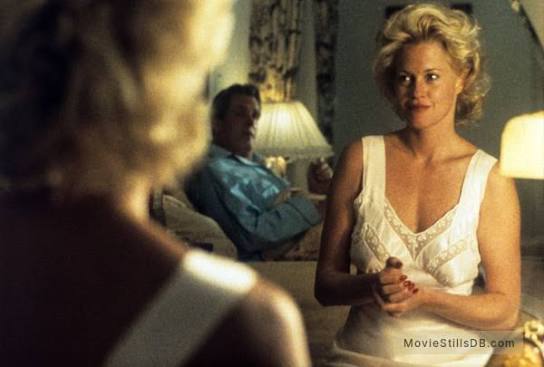
John Malkovich appears as General Timms, while Treat Williams plays General Thomas Timms, depending on the character’s place within the narrative, and Melanie Griffith has an important role as Max’s wife Katherine. The film’s supporting cast is packed with familiar faces, and this contributes to its larger-than-life quality.
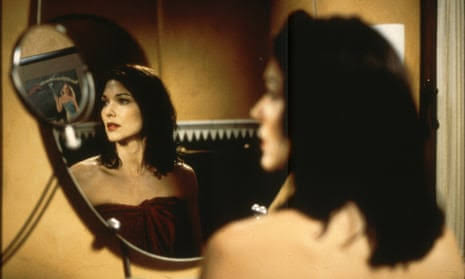
Jennifer Connelly is particularly memorable despite appearing primarily through the mystery surrounding Allison. Her presence is crucial because she needs to represent more than simply a murder victim. Allison becomes the mysterious centre of the film, and the fact that Hoover knew her intimately gives the investigation a personal urgency.
The film’s portrayal of sexuality is also very much of its era. Allison is presented through an eroticised noir aesthetic, with the movie using her beauty and sexuality as part of the mystery. Some aspects of this approach now feel dated, but they are nevertheless consistent with the film’s attempt to position itself within the tradition of classic noir.
If there is a major weakness in Mulholland Falls, it is the screenplay.
Pete Dexter’s story has plenty of good ideas, but the plotting can occasionally feel overcomplicated. The film introduces several layers of conspiracy and political intrigue, and not every element receives the dramatic development it deserves. There are moments when the story seems to be rushing to explain information that would perhaps have been more effective if it had been allowed to remain mysterious.
This is one reason the film can feel slightly uneven.
The first half is extremely atmospheric. The characters are introduced, the murder establishes the mystery, and the movie builds an increasingly sinister portrait of Los Angeles. The second half becomes more plot-driven, and some of the subtlety of the early sections gives way to exposition and conventional thriller mechanics.
Nevertheless, the film remains compelling because the central mystery is surrounded by such strong characters and atmosphere.
The violence is another important component. Mulholland Falls does not romanticise the Hat Squad’s methods, but neither does it apologise for them. These men routinely use physical intimidation and violence as part of their investigations. They beat suspects, threaten criminals and operate outside the normal boundaries of police procedure.
For modern audiences, this can make the protagonists difficult to embrace.
But that is also part of what makes the movie interesting. The Hat Squad represents an era when certain forms of police brutality could be portrayed as evidence of toughness rather than incompetence. The film is clearly aware of the moral ugliness of this world, even if it sometimes enjoys the macho spectacle of it.
The movie therefore sits in an interesting position between admiration and criticism.
Hoover and his colleagues are undeniably cool in the traditional Hollywood sense. They drive impressive cars, wear expensive clothes, enter rooms with confidence and terrify criminals. Yet they are also damaged men. Their methods have consequences, and the film repeatedly suggests that their seemingly absolute control over Los Angeles is an illusion.
This is where the noir influence becomes most apparent.
Classic noir is fundamentally concerned with corruption. The hero discovers that the world is not what it appears to be, that institutions cannot necessarily be trusted and that personal morality becomes increasingly difficult to maintain. Mulholland Falls embraces all of those ideas.
The film also has a strong political dimension, particularly in its treatment of the relationship between the police, organised crime and government power. The implication is that the official version of history is often constructed by those powerful enough to control the evidence.
That makes the film surprisingly relevant.
Its central question is not simply “Who killed Allison?” It is also “Who gets to decide what the truth is?”
The answer, inevitably, is complicated.
One of the pleasures of revisiting Mulholland Falls is seeing how much of the film depends on atmosphere rather than dialogue. Tamahori understands the value of silence. Long drives through Los Angeles, isolated locations and ominous interiors allow the movie to breathe.
The landscape becomes almost another character.
The hills around Los Angeles are especially effective. They provide an extraordinary contrast with the city below. The hills are beautiful, but the film repeatedly associates them with death and secrecy. The famous Mulholland landscape becomes a place where people can disappear.
That idea gives the title its significance.
The soundtrack by Dave Grusin also contributes considerably to the film’s atmosphere. It is a sophisticated score that combines period sensibilities with the darker emotional demands of the thriller. Rather than simply reproducing a 1950s sound, Grusin creates something that feels cinematic and contemporary to the film’s production period while still supporting its historical setting.
The music is particularly effective during the quieter investigative sequences. It helps create the feeling that Hoover is descending deeper and deeper into a conspiracy from which there may be no easy escape.
Imprint’s presentation of Mulholland Falls is very welcome for collectors and fans of 1990s crime cinema. The label has developed an enviable reputation for giving catalogue titles the attention they deserve, and Mulholland Falls is exactly the kind of film that benefits from being revisited in a carefully presented home-video edition.
The film’s cinematography makes high-definition presentation particularly valuable. The widescreen compositions, dark interiors and Los Angeles night scenes all benefit from a good transfer. The visual texture of the movie is important: it needs to retain the slightly filmic quality of its 1990s production rather than being scrubbed clean into an artificially digital-looking image.
The Imprint presentation allows the movie’s period production design and photography to shine.
Fine detail is strong, particularly in close-ups. Faces, clothing and environmental textures are rendered with pleasing clarity. The various suits and period interiors are especially impressive in high definition because there is so much visual information in the production design.
The darker sequences are perhaps the most important test. Noir-inspired films live or die by their shadows, and Mulholland Falls contains plenty of them. A good presentation needs to preserve shadow detail without flattening the contrast, and the Blu-ray gives the film the kind of presentation that makes revisiting these sequences especially rewarding.
Colours also have an important role. The film is not simply monochromatic noir. Its Los Angeles landscapes, period costumes and interiors contain plenty of colour, and the presentation allows these elements to retain their richness without overwhelming the darker mood.
The result is a transfer that respects the film’s original visual identity.
The soundtrack is equally important. Dialogue is clear, the score has appropriate presence and the sound effects provide the necessary impact during the more violent sequences. This is not a film that depends upon wall-to-wall action, so clarity and atmosphere are more important than sheer volume.
For collectors, the physical presentation is another attraction of the Imprint release. Imprint has established itself as a label willing to seek out films that might otherwise receive little attention on physical media, and Mulholland Falls fits neatly into that philosophy.
This is exactly the kind of catalogue title that benefits from a boutique Blu-ray release.
Perhaps the biggest surprise when revisiting Mulholland Falls is how well it captures the particular character of 1990s adult Hollywood cinema.
There is something almost extinct about this kind of movie today.
It is an expensive studio production aimed at adults, featuring a serious cast, a complicated story, period production design and a deliberately sombre tone. It is neither a straightforward blockbuster nor an independent art film. It occupies that middle ground that was once a significant part of American cinema.
That alone makes the movie historically interesting.
But it is more than an artefact.
The performances remain strong. The visual design remains impressive. The Los Angeles locations remain evocative. The central mystery continues to work, even if some of the conspiracy elements become increasingly elaborate. And Nick Nolte gives the movie a bruised, world-weary centre.
The film is also fascinating because it arrived at the tail end of a particular cycle of neo-noir filmmaking. The 1970s had produced films such as Chinatown, The Long Goodbye and Night Moves. The 1980s continued the tradition in different forms, while the early and mid-1990s brought a new generation of crime films influenced by both classical noir and contemporary thrillers.
Mulholland Falls belongs firmly within that lineage.
It is not as psychologically intricate as Chinatown, nor as formally radical as some of the great neo-noirs. But it has its own identity. Its greatest achievement is the creation of a believable cinematic Los Angeles where the police are almost as frightening as the criminals.
The film’s moral ambiguity is perhaps its most enduring quality.
Hoover is not a hero in the conventional sense. He is a man trying to navigate a world that has taught him violence is the most effective solution to violence. His methods have worked for him for years, but Allison’s death forces him to confront the limitations of that philosophy.
The question becomes whether a man who has spent his career ignoring the rules can suddenly expect the truth to be delivered through conventional justice.
That is an excellent noir dilemma.
The supporting characters also benefit from repeated viewing. The Hat Squad’s relationships become more interesting as the film progresses, particularly because their friendship is based upon shared experience and mutual trust rather than conventional morality. They have spent years protecting one another, and that loyalty is simultaneously their greatest strength and their greatest weakness.
There is a tragic inevitability to the way their world begins to collapse.
Mulholland Falls is an underrated 1990s crime thriller that deserves to be rediscovered. It is not a perfect film. The conspiracy becomes somewhat convoluted, the screenplay occasionally explains too much, and some of the sexual politics and macho attitudes belong very clearly to the period in which the movie was made.
But its strengths considerably outweigh its weaknesses.
Nick Nolte is excellent as the damaged and morally compromised Max Hoover. Chazz Palminteri, Michael Madsen and Chris Penn give the Hat Squad an intimidating collective presence. Jennifer Connelly provides the mystery at the heart of the story, while the supporting cast gives the film the sense of scale appropriate to a major Hollywood production.
Most importantly, Lee Tamahori creates a film with a strong visual personality.
The Los Angeles locations are beautifully photographed, the period production design is convincing and the film consistently maintains an atmosphere of corruption, secrecy and impending violence. It may not always be subtle, but it is rarely dull.
Imprint’s Blu-ray is therefore a very welcome release. The high-definition presentation gives the film the opportunity to look as good as it should, allowing the cinematography, production design and performances to receive the attention they deserve. For fans of 1990s cinema, neo-noir, police thrillers or Nick Nolte, this is precisely the sort of catalogue title that belongs in a serious collection.
There is also something satisfying about seeing Mulholland Falls receive this kind of second life. Films do not necessarily become classics because they were universally acclaimed when they were first released. Sometimes they need time. Sometimes changing tastes allow audiences to appreciate qualities that were overlooked. Sometimes a good physical-media release simply gives a neglected film another opportunity to be seen properly.
Mulholland Falls deserves that opportunity.
It is stylish, atmospheric, violent, occasionally excessive and thoroughly steeped in the mythology of Los Angeles. It captures a city where glamour and corruption exist side by side and where the people responsible for enforcing the law can be every bit as compromised as the people they arrest.


Leave a Reply