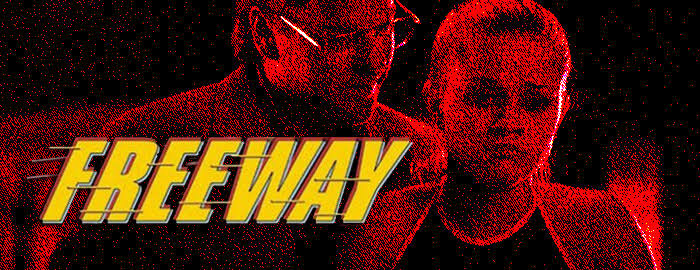
“Freeway” (1996)
Drama / Thriller

Running Time: 104 minutes
Written and directed by: Matthew Bright
Featuring: Kiefer Sutherland, Reese Witherspoon, Wolfgang Bodison, Dan Hedaya, Amanda Plummer, Brooke Shields, Michael T. Weiss, Bokeem Woodbine and Brittany Murphy
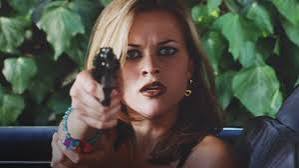
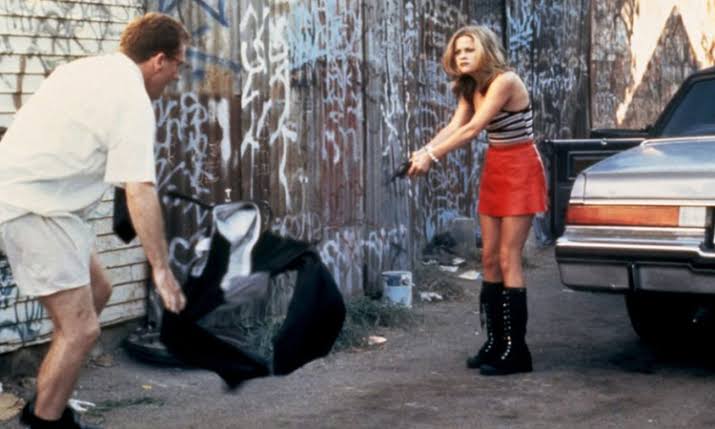
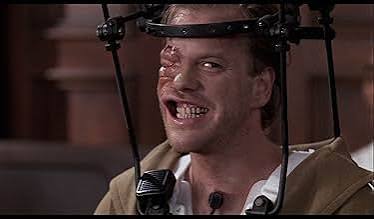
Vanessa Lutz: “Holy shit! Look who got beaten with the ugly stick! Is that you, Bob? I can’t believe such a teeny weeny little gun made such a big mess out of someone! You are so ugly, Bob! And, hey, I heard you have one of those big poop bags that’s like attached to where the shit comes out the side, you’re just a big old shitbag ain’t you, Bob! You just think of me every time you empty that motherfucking thing, motherfucker!”
There are films that age gracefully, films that become dated curiosities, and films that somehow become even more outrageous with the passage of time. Matthew Bright’s Freeway belongs very firmly in the third category. Released in 1996, this vicious, profane and frequently hilarious reworking of Little Red Riding Hood is one of the great cult movies of the 1990s: a film that takes the familiar structure of a fairy tale and drags it through the gutters of contemporary Los Angeles.
Imprint’s Blu-ray release, issued as part of the company’s After Dark: Neo-Noir Cinema Collection Four, gives this extraordinary little film another welcome opportunity to be discovered. Freeway is Imprint Collection #572 in the six-film set, which also includes Wild at Heart, Unlawful Entry, The Getaway, Mulholland Falls and City of Industry. The collection was released in April 2026 as a limited-edition hardbox set.
What makes Freeway particularly fascinating is that it doesn’t merely transpose a fairy tale into a modern setting. Bright understands the underlying brutality of the original story and exaggerates it until the film becomes a grotesque collision of crime thriller, black comedy, exploitation movie, road movie and social satire. At the centre of it all is Reese Witherspoon, giving one of the most fearless performances of her career, and Kiefer Sutherland, playing against his established screen persona as one of the most disturbingly charming predators of the decade.
The result is funny, ugly, disturbing, exhilarating and surprisingly intelligent.
At first glance, Freeway sounds like one of those high-concept ideas that should collapse almost immediately. Take Little Red Riding Hood, replace the woods with the freeways and suburbs of California, turn Red Riding Hood into an angry, illiterate teenage girl, and make the Big Bad Wolf a respectable-looking serial killer.
Yet somehow Bright makes the idea work.
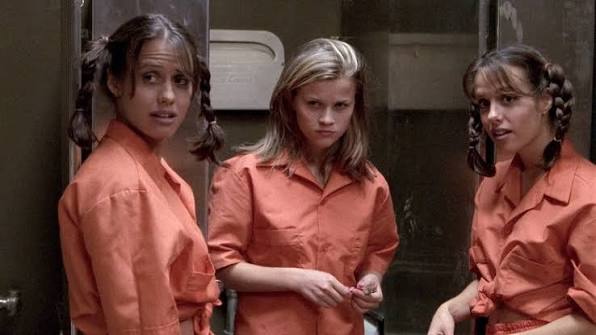
Vanessa Lutz, played by Witherspoon, is a product of a society that has essentially abandoned her. Her mother is a prostitute, her stepfather is abusive, and the world around her is defined by poverty, violence and institutional indifference. When her mother is arrested, Vanessa decides to travel to find her grandmother.
This is where the fairy tale begins.
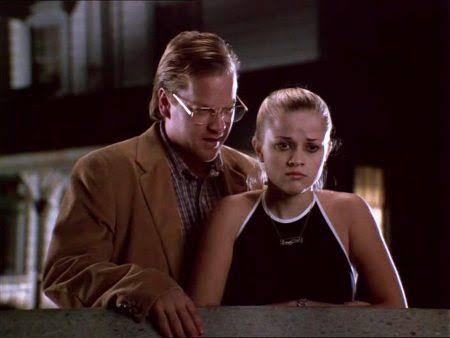
Vanessa’s journey puts her into the path of Bob Wolverton, a seemingly respectable school counsellor played by Kiefer Sutherland. Bob is articulate, polite and apparently concerned about Vanessa’s welfare. He is also the notorious I-5 Killer.
The contrast between the two characters is one of the film’s greatest strengths. Vanessa looks like the vulnerable one. Bob looks like the respectable one. Bright proceeds to dismantle those assumptions.
Vanessa may be rough, violent, foul-mouthed and barely capable of navigating conventional society, but she possesses something Bob desperately lacks: an instinct for survival.
The film consequently becomes a battle between two kinds of predators.
The film simply would not work without Reese Witherspoon.
Before Freeway, Witherspoon was already establishing herself as a talented young actress, but this performance demonstrates a ferocity that wasn’t necessarily associated with the star she would eventually become.
Vanessa Lutz is an astonishing creation.
She is loud. She is aggressive. She is ignorant. She is funny. She is frightened. She is vulnerable. She is capable of extraordinary violence. And she is almost completely incapable of expressing herself in the polite language expected by respectable society.
Witherspoon doesn’t attempt to make Vanessa conventionally sympathetic. Instead, she makes her believable.
That distinction is crucial.
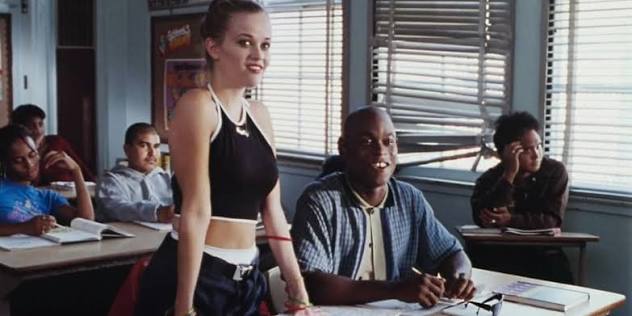
Vanessa doesn’t behave like a Hollywood teenager. She behaves like someone who has spent her entire life learning that politeness doesn’t protect you. Her language is crude because that’s the language she knows. Her worldview is distorted because the world that produced her is distorted.
There is also a wonderful physicality to the performance. Witherspoon gives Vanessa an almost feral quality. Her body language, facial expressions and delivery of Bright’s aggressively profane dialogue create a character who seems permanently ready either to run away or attack.
And then there are the moments when Vanessa’s bravado cracks.
Those moments are important because they reveal the frightened child beneath the armour. Without them, Freeway could easily become a two-hour exercise in attitude. With them, Vanessa becomes a tragic figure.
Witherspoon somehow manages to make her both terrifying and enormously funny.
If Witherspoon gives the film its explosive energy, Kiefer Sutherland gives it its sinister centre.
Bob Wolverton is one of Sutherland’s most memorable performances precisely because the character initially seems so ordinary.
He isn’t a traditional cinematic monster.
He isn’t lurking in an abandoned building wearing a mask. He isn’t announcing his evil intentions. He is a clean-cut, articulate professional who knows how to appear trustworthy.
That makes him considerably more frightening.
Sutherland understands the importance of understatement. Bob doesn’t need to shout to establish his authority. He talks. He listens. He smiles. He manipulates.
Then, gradually, the mask slips.
The film’s central confrontation between Vanessa and Bob is essentially the moment when the fairy tale reveals itself. The supposedly helpless Red Riding Hood has encountered the Wolf, except this Red Riding Hood isn’t innocent and the Wolf has discovered that his intended victim isn’t quite as defenceless as expected.
Sutherland plays Bob with an almost gleeful perversity. He understands that the character’s respectability is part of his weaponry.
It is one of the performances that makes Freeway considerably more interesting than a simple exploitation film.
Matthew Bright’s direction is deliberately abrasive.
He doesn’t want the audience to settle into one genre.
One moment Freeway is a thriller. The next it is a black comedy. Then it becomes an exploitation picture. Then a road movie. Then an almost absurd satire of American social structures.
This instability is part of its identity.
Bright was never interested in making conventional films. His career as a writer-director was relatively small, but Freeway remains his defining achievement. The film takes the fairy-tale structure and fills it with the vocabulary of 1990s American trash culture.
There is a punk attitude running through the entire production.
The film is not polished in the traditional Hollywood sense. Nor should it be. Its ugliness is part of the aesthetic.
Bright wants Los Angeles to feel like a landscape where people are constantly moving but rarely escaping. The freeway becomes a perfect metaphor. Everybody is going somewhere, but Vanessa has no real destination beyond survival.
One reason Freeway has endured is that it refuses to fit neatly into any category.
Calling it a thriller is inadequate.
Calling it a comedy is equally inadequate.
Calling it horror isn’t quite right either.
It is all of these things, but none of them exclusively.
That is precisely what makes cult cinema work.
The film is also very much a product of its time. The mid-1990s were a fascinating period for American independent cinema, when filmmakers could take enormous stylistic risks and actors could use relatively low-budget projects to demonstrate how far they could stretch.
Freeway belongs in the same broad cultural landscape as the era’s other aggressively unconventional movies, but it is much more deliberately trashy.
Its influences include fairy tales, exploitation cinema, film noir, road movies and television crime drama. Bright throws these influences into a blender and refuses to clean up the resulting mess.
The supporting cast is another major pleasure.
Amanda Plummer is perfectly cast as Vanessa’s mother. Her performance contributes enormously to the film’s strange combination of misery and comedy.
Brooke Shields is also memorable in a role that plays against the glamorous image with which she had become associated. Her presence helps reinforce one of Bright’s recurring themes: respectable appearances are often meaningless.
Bokeem Woodbine, Dan Hedaya, Alanna Ubach and a young Brittany Murphy also contribute to the film’s eccentric ensemble.
Murphy’s appearance is particularly interesting from a retrospective perspective. Seeing her in the film adds another layer of fascination for viewers familiar with her later career.
But this is fundamentally Witherspoon and Sutherland’s film.
Their performances give Freeway its unforgettable personality.
There is no pretending that Freeway is a gentle film.
The violence is frequently nasty, and Bright is happy to make the audience uncomfortable. Yet the film’s humour is just as important as its brutality.
The comedy doesn’t come from clever one-liners alone. It comes from the collision between Vanessa’s worldview and the conventions of respectable society.
She simply doesn’t understand why she is supposed to behave differently.
That gives the movie a wonderfully anarchic quality.
At times the humour is almost cartoonish. At other times it becomes deeply uncomfortable because the joke is sitting directly beside something genuinely disturbing.
This is a difficult tonal balance to achieve, and Bright occasionally pushes it too far. But even when the film becomes excessive, that excess is part of its appeal.
Freeway isn’t trying to make the audience comfortable.
Imprint’s decision to include Freeway in an After Dark: Neo-Noir Cinema collection is entirely appropriate.
The film may initially look like a garish exploitation picture, but underneath the profanity and violence it possesses many characteristics of noir.
There is a morally compromised world.
There are damaged characters.
There is a journey through a hostile urban landscape.
There is deception.
There is violence.
There is an atmosphere of social decay.
Most importantly, there is the sense that the conventional institutions supposedly protecting people have already failed.
Vanessa’s journey is therefore not simply a trip to visit her grandmother. It is a journey through a society that has abandoned her.
That gives the movie considerably more weight than its reputation as a “crazy Reese Witherspoon movie” might suggest.
Imprint presents Freeway on Blu-ray in 1080p high definition with a 1.78:1 aspect ratio and English LPCM 2.0 stereo audio. English HOH subtitles are also provided.
For collectors, it is worth noting that this Imprint release is distinct from Vinegar Syndrome’s earlier 4K edition. Vinegar Syndrome’s release presented a newly scanned and restored version from the 35mm original camera negative, in 4K UHD with HDR, and included a substantially larger collection of new interviews and archival material.
The Imprint release should therefore be viewed on its own terms rather than as a replacement for that UHD edition.
The Blu-ray image is attractive and appropriately filmic. Freeway isn’t the sort of movie that should be scrubbed clean of its photographic texture. The grain, somewhat harsh lighting and slightly dirty visual character are integral to the movie’s atmosphere.
The high-definition presentation brings out considerably more detail than older DVD presentations, particularly in faces and outdoor sequences. The urban environments benefit enormously from the upgrade because the film contains so many textures: concrete, asphalt, vehicles, shabby interiors and suburban locations.
The colours also have greater presence.
The reds are particularly effective, which is fitting for a film inspired by Little Red Riding Hood. Bright’s visual palette frequently juxtaposes ordinary California daylight with much darker material.
Black levels are strong enough to preserve the mood during the nighttime sequences, while shadow detail remains reasonably visible.
Most importantly, the image still looks like film.
That is exactly what a movie such as Freeway needs.
The LPCM 2.0 stereo soundtrack is clean and perfectly suited to the film.
Dialogue is the priority, and that is important because Bright’s script is so dependent on rapid exchanges and Witherspoon’s delivery.
Vanessa’s voice is essentially an instrument in the soundtrack. Her shrieks, insults, threats and confused observations need to remain intelligible.
The soundtrack also handles Danny Elfman’s score effectively.
Elfman’s music adds another strange dimension to the movie. It doesn’t simply underline the suspense. It contributes to the heightened, almost fairy-tale quality of the film.
The combination of score, dialogue and environmental sound creates a pleasingly aggressive presentation.
Imprint’s extras are particularly worthwhile for fans.
The release includes Matthew Bright’s 1997 audio commentary, which is an important archival piece because Bright was the person most responsible for the film’s peculiar vision.
There are also archival interviews with Bright, executive producer Oliver Stone, executive producer Samuel Hadida, Amanda Plummer and composer Danny Elfman.
These interviews provide useful historical context, particularly for viewers interested in how this strange project came together.
The Trailers from Hell segment featuring Josh Olson discussing Freeway is another welcome addition, while the making-of featurette offers further background. The theatrical trailer rounds out the package.
One thing collectors should appreciate is that Imprint hasn’t simply thrown the film onto a disc with a trailer and called it a day. There is genuine archival material here.
At the same time, those who have seen Vinegar Syndrome’s 4K release will know that the latter contains a much more extensive supplemental package, including new interviews with Bright, producer Brad Wyman, editor Maysie Hoy and several members of the supporting cast.
That doesn’t diminish the value of Imprint’s release. It simply means collectors who own multiple editions have legitimate reasons to keep both.
One of the most interesting aspects of Freeway‘s home-video history concerns censorship.
The film has existed in various versions, and some releases were cut. The history is particularly complicated in Australia, where the uncut version encountered classification problems while a shorter version was approved.
This is significant because Freeway is a film in which the extremity is part of the artistic point.
The ugliness, profanity and violence aren’t incidental decorations. Bright is deliberately confronting the audience with a world that is itself grotesque.
Consequently, having access to the fullest presentation possible is important for collectors.
It also makes the film’s history as a cult object even more interesting.
Part of the reason is that the film has become increasingly easy to identify as a product of its era while simultaneously feeling strangely timeless.
The fashions are unmistakably 1990s.
The dialogue is unmistakably 1990s.
The soundtrack and visual style belong to that period.
But the film’s central concerns remain remarkably relevant: poverty, abuse, institutional failure, sexual predators hiding behind respectable identities and the way society treats people who don’t fit conventional expectations.
Vanessa is an extreme character, but she represents something recognisable. She has been failed by almost everyone around her.
Bob, meanwhile, represents the opposite problem: the respectable person who is secretly monstrous.
That inversion is the film’s most intelligent idea.
The supposedly dangerous teenager is ultimately the person who survives.
The respectable adult is the monster.
The fairy tale has simply been rewritten for a world where appearances are no longer reliable.
Freeway is one of those wonderful cult movies that cannot be recommended to everybody — but for the right audience, it is unforgettable.
It is crude, violent, profane, tasteless, funny, disturbing and wildly entertaining.
And beneath all that is a surprisingly sophisticated piece of filmmaking.
Matthew Bright takes the most recognisable fairy tale imaginable and transforms it into a nightmare version of contemporary America. Reese Witherspoon gives an astonishing performance as Vanessa Lutz, creating a character who is simultaneously repellent, hilarious, vulnerable and heroic. Kiefer Sutherland is equally memorable as Bob Wolverton, a predator whose respectable exterior makes him considerably more frightening than a conventional movie monster.
The Imprint Blu-ray is a very welcome addition to the company’s After Dark collection. Its high-definition presentation gives the movie the kind of upgrade it deserves, the LPCM stereo soundtrack is clean and effective, and the collection of archival extras provides valuable background on the production and its key participants. The 1.78:1 presentation, English HOH subtitles and substantial archival material make it an attractive package for fans and newcomers alike.
It is also particularly satisfying to see Freeway alongside the other films in Imprint’s neo-noir collection. Although it may initially seem like the odd one out, its themes of corruption, violence, damaged individuals and morally compromised society make it a surprisingly appropriate companion to Wild at Heart, Unlawful Entry, The Getaway, Mulholland Fallsand City of Industry.
Ultimately, Freeway survives because it has personality.
There are hundreds of crime thrillers.
There are hundreds of black comedies.
There are countless films about serial killers.
But there is only one Freeway.
It is a filthy, funny, vicious fairy tale for adults, powered by two extraordinary performances and the singular imagination of Matthew Bright. Nearly thirty years after its release, it remains just as confrontational, just as strange and just as impossible to forget.
For anyone who appreciates 1990s cult cinema, neo-noir, exploitation filmmaking or fearless performances, the Imprint Blu-ray is an excellent opportunity to revisit one of the decade’s most gloriously unhinged films.


Leave a Reply