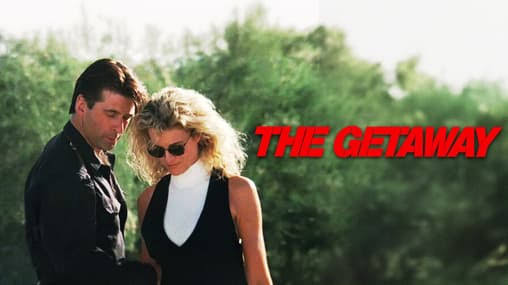
“The Getaway” (1994)
Drama / Action

Running Time: 116 minutes
Written by: Walter Hill and Amy Holden Jones
Directed by: Roger Donaldson
Featuring: Alec Baldwin, Kim Basinger, Michael Madsen, Jennifer Tilly, Richard Farnsworth and James Woods
Carol: “I’m not spending the next twenty years without you.”
There are some films that exist almost entirely in the shadow of another movie. Roger Donaldson’s 1994 The Getaway is one of them. The original 1972 film, directed by Sam Peckinpah and starring Steve McQueen and Ali MacGraw, has long been regarded as one of the defining crime pictures of its era, and the decision to remake it was always going to invite comparisons. Add Alec Baldwin and Kim Basinger, who were married at the time and were already major Hollywood stars, and the remake had all the ingredients of a major commercial action film.
Yet dismissing the 1994 The Getaway simply because it is a remake would be a mistake.
It is a bruising, fast-moving, sometimes surprisingly nasty crime thriller that deserves to be considered on its own terms. It may not possess the rough-edged poetry or violent individuality of Peckinpah’s film, but Roger Donaldson brings considerable craftsmanship to the material, Walter Hill’s screenplay retains the basic architecture of Jim Thompson’s story, and the cast gives the film a muscular, star-driven personality. The new Imprint Blu-ray, included as part of the label’s After Dark: Neo-Noir Cinema – Collection Four, provides a welcome opportunity to revisit a film that has spent far too much time being treated as merely “the remake of The Getaway.”
The film is presented by Imprint as part of a limited-edition seven-disc collection containing six films from the 1990s neo-noir cycle. The Getaway occupies one of the Blu-ray discs and is presented in 1080p high definition with English DTS-HD Master Audio 5.1 and LPCM 2.0 options, along with English hearing-impaired subtitles. The disc also contains a useful collection of new and archival supplementary material.
At the centre of The Getaway are Doc McCoy and his wife Carol.
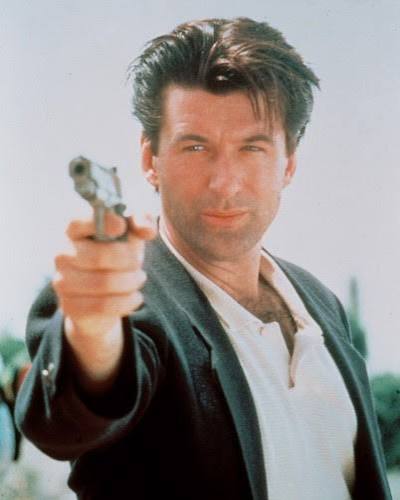
Alec Baldwin plays Doc as a physically imposing, intelligent and dangerous criminal who has spent time in prison and knows exactly what he is capable of. He is not presented as an innocent man caught in circumstances beyond his control. He is a professional thief, a man accustomed to violence and deception, and somebody who understands that the criminal world operates according to its own rules.
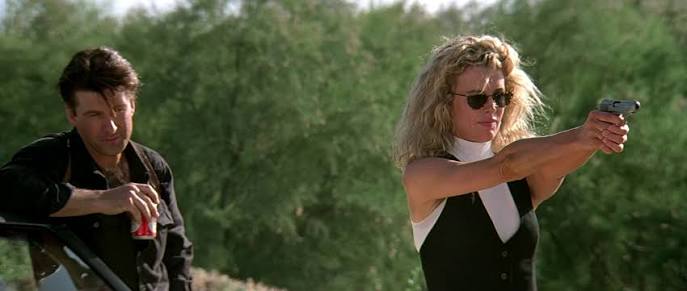
Kim Basinger’s Carol is equally important. She is not simply the devoted wife waiting at home for her husband to return. She is deeply involved in Doc’s life and understands the world he inhabits. Her relationship with Doc is complicated by the compromises she has made to secure his release and by the fact that survival in their world frequently requires betrayal.
The central relationship therefore becomes much more interesting than the conventional action-movie romance might suggest.
Doc and Carol genuinely love each other, but theirs is not a healthy or uncomplicated relationship. Trust is continually tested. Both characters know that the other is capable of making difficult choices when survival is at stake. The film’s suspense consequently comes not just from police officers and criminals chasing them, but from the possibility that the two people at the centre of the story may not be able to trust each other completely.
That is one of the strongest elements of the remake.
Baldwin was an interesting choice for Doc. He does not have Steve McQueen’s effortless cool, and that is probably a good thing. Baldwin’s Doc is more physically aggressive and intimidating. There is a sense that violence is never very far beneath the surface. He can be charming, but he can also become frighteningly cold.
Basinger, meanwhile, gives Carol a mixture of vulnerability and determination. The actress had already demonstrated her ability to play characters who could move between glamour and danger, and the film makes considerable use of her star persona without allowing Carol to become simply an accessory to Doc.
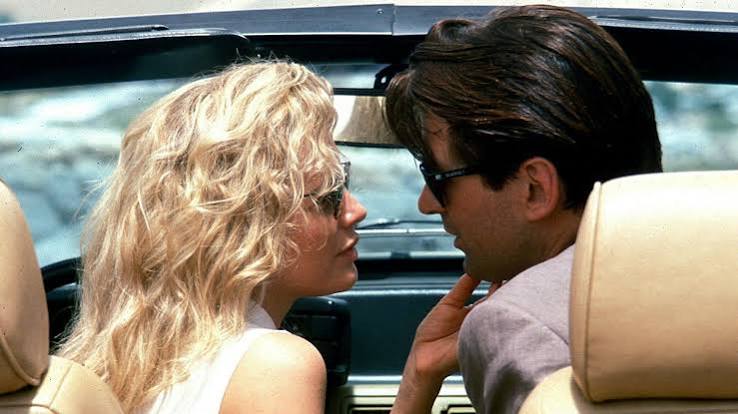
Their chemistry is one of the movie’s selling points, and there is an unmistakable intensity to the scenes between them.
Roger Donaldson is sometimes an underrated director.
His filmography includes No Way Out, White Sands, Species, Dante’s Peak and the original The Bounty, and one of the things that connects many of his films is his ability to take commercial material and give it a solid visual and dramatic structure.
With The Getaway, Donaldson understands that the movie has to move.
This is a road movie, a crime movie, a romantic thriller and an action film simultaneously. The narrative constantly changes location and circumstance, with the protagonists moving from one dangerous situation to another. Donaldson keeps the pace brisk without turning the entire film into an exhausting succession of explosions.
There is a welcome physicality to the filmmaking.
Cars move through real environments. Characters run, fight, hide and improvise. The film has an appropriately dirty and uncomfortable quality in its locations. This is not a glossy fantasy version of criminal life in which every getaway vehicle looks immaculate and every criminal has a perfectly designed wardrobe.
There is sweat, dust, blood and desperation.
The director also understands that action works best when the audience can understand geography. The chases are not simply collections of spectacular images. We generally understand where the characters are, where they are trying to go and what stands in their way.
That makes the larger action sequences considerably more effective.
The screenplay is credited to Walter Hill and Amy Holden Jones, adapting Jim Thompson’s original novel.
Hill’s involvement is particularly significant because he has spent much of his career exploring men, violence, crime and survival. His writing frequently strips stories down to their essential components, and The Getaway benefits from that directness.
The characters want something.
They want money.
They want freedom.
They want revenge.
They want each other.
And virtually everybody standing between them and those objectives represents another potential problem.
This simplicity gives the film its propulsion.
There is also a pleasingly old-fashioned quality to the story. The characters cannot simply solve their problems with a smartphone, a satellite tracker or some convenient piece of computer technology. They have to physically travel from one place to another. They have to find people. They have to steal cars. They have to hide in motels and abandoned locations.
The physicality of the plot is one reason the movie still works.
One of the great pleasures of this version of The Getaway is its supporting cast.
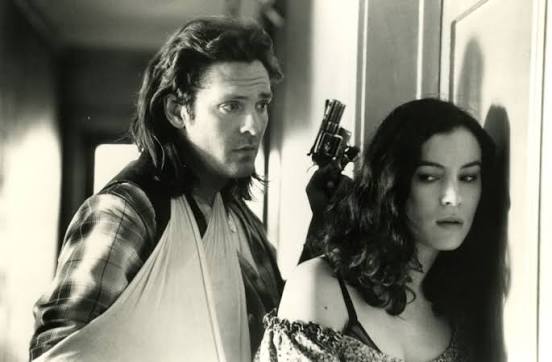
Michael Madsen is perfectly suited to the world of the film. He has the ability to make even relatively quiet scenes feel dangerous, and his presence contributes considerably to the film’s sense of menace.
James Woods is another major attraction. Woods has always been an actor who can make intelligence and instability coexist within the same character, and he gives the movie an unpredictable energy.
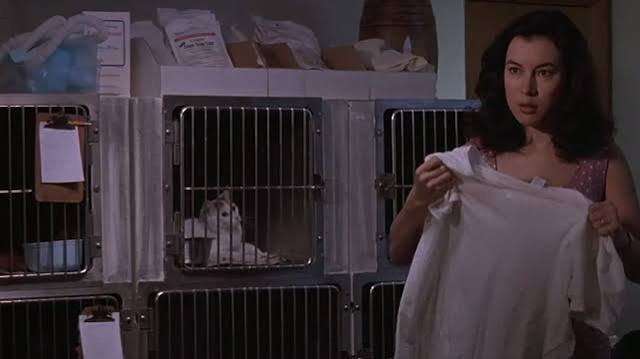
Jennifer Tilly also makes an impression, bringing a very different personality to the film.
And then there is the pleasure of seeing Philip Seymour Hoffman in one of his earlier film roles. His appearance is relatively small compared with what would come later in his extraordinary career, but it is fascinating to watch an actor of such immense eventual reputation beginning to establish himself.
The ensemble helps make the movie feel larger than its central romance.
If the 1972 Getaway is famous for Peckinpah’s approach to violence, the 1994 film takes a somewhat different route.
The violence is still brutal, but Donaldson’s approach is more conventional. There is less of Peckinpah’s abstract editing and less of the fascination with violence as a visual language.
Instead, the violence is designed primarily to push the narrative forward.
People are shot because they represent obstacles.
People are beaten because somebody needs information.
People are killed because the characters are operating within a criminal ecosystem where human life is expendable.
The film does not attempt to turn Doc into a romantic outlaw in the traditional Hollywood sense. He is a dangerous man who happens to love his wife.
That distinction is important.
The movie’s emotional investment in Doc and Carol does not erase their criminality. It simply asks the audience to remain interested in whether these two people can escape the consequences of their choices.
The decision by Imprint to include the movie within its After Dark: Neo-Noir Cinema collection makes considerable sense.
The 1990s were an especially interesting period for neo-noir. Hollywood was rediscovering the visual language of classic crime movies while mixing it with more explicit sexuality, violence and psychological darkness.
The Getaway sits comfortably within that tradition.
It has the familiar ingredients of noir: criminals, betrayal, doomed relationships, greed, corruption, double-crosses and people trying to escape from a world that seems designed to trap them.
The major difference is scale.
This is not a small, claustrophobic film about a private detective wandering through dark streets. It is an expansive action picture.
But beneath the action is a noir story.
Doc and Carol are trapped by the choices they have made. Their future depends upon their ability to stay ahead of people who want them dead. The further they travel, the more difficult it becomes to distinguish between freedom and another form of imprisonment.
That makes the movie a much better fit for neo-noir than its reputation might suggest.
Baldwin’s performance deserves particular appreciation.
There is something deliberately physical about his interpretation of Doc. He looks like someone who could survive a fight, and the film repeatedly uses his imposing screen presence.
Baldwin was also in an interesting period of his career when The Getaway was made. He could still play romantic leads, but he was increasingly demonstrating his ability to inhabit darker and more complicated characters.
Doc is not necessarily a likable man.
But he is compelling.
Baldwin also understands that the character’s relationship with Carol is essential. Without that emotional connection, the film would simply become another chase movie.
His best moments are therefore not necessarily the shoot-outs or car chases. They are the quieter scenes in which Doc and Carol have to decide whether they can continue trusting one another.
Kim Basinger is equally important to the film’s success.
Carol could easily have been written as the stereotypical action-film wife: somebody who screams, cries and waits for the hero to rescue her.
Instead, she has her own moral compromises and survival instincts.
Basinger gives her an appealing mixture of toughness and vulnerability.
She also brings glamour to the film without making Carol seem disconnected from the world around her. This is still a woman who has to deal with criminals, violence and constant danger.
The marriage between Baldwin and Basinger inevitably adds an extra layer to the film for modern viewers because the two actors were married in real life when the film was made. Their relationship therefore has a certain immediacy that is difficult to separate entirely from the movie itself.
The action remains the principal reason to revisit The Getaway.
The film has car chases, shoot-outs, robberies, escapes and violent confrontations, but it is the sense of momentum that really holds everything together.
Donaldson knows how to build an action sequence.
There is usually a clear objective.
The characters are trying to get somewhere.
Something goes wrong.
The situation becomes worse.
They improvise.
And then another problem emerges.
That structure gives the action genuine suspense.
It is also why the film works so well as entertainment even when the story occasionally becomes melodramatic. Once the chase gets underway, the movie knows exactly what it wants to be.
The Imprint Blu-ray is particularly welcome because the film has never had quite the same home-video profile as some of its contemporaries.
This is not a 4K UHD presentation; the film is presented on Blu-ray in 1080p high definition. Imprint supplies English DTS-HD Master Audio 5.1 as well as an LPCM 2.0 option, with English hearing-impaired subtitles.
The picture is pleasing and appropriate for the film’s gritty 1990s aesthetic.
The cinematography has enough depth and contrast to make the film’s darker interiors work effectively, while the brighter outdoor sequences retain the hard, contemporary look associated with the period. The image does not suddenly transform The Getaway into a pristine modern production, nor should it. The texture of the film is part of its identity.
What matters is that the presentation allows the viewer to appreciate the cinematography, performances and action without the distractions associated with poor catalogue transfers.
The 5.1 soundtrack is particularly useful for an action film of this type.
Gunfire, engines, explosions and the score have room to breathe, while dialogue remains central. The alternative LPCM 2.0 track is a welcome inclusion for viewers who prefer a more straightforward presentation.
Imprint has given the film a considerably more interesting package than simply dropping the movie onto a bare disc.
The major new attraction is an audio commentary by film critic Travis Woods. There is also Ambushed: Scoring The Getaway, an interview concerning composer Mark Isham, and Double Crossed: Inside The Getaway, an interview with author and film historian C. Courtney Joyner. These are joined by archival making-of material, behind-the-scenes footage, interviews with Alec Baldwin and Kim Basinger, the theatrical trailer and an image gallery.
For collectors, these extras significantly increase the value of the release.
The commentary is especially welcome because the remake is a film that benefits from reassessment. There is so much baggage surrounding it because of Peckinpah’s original that a thoughtful discussion of Donaldson’s version is useful.
The Mark Isham material is also a nice addition. Music is an important part of the identity of any crime thriller, and the score helps establish the film’s emotional atmosphere.
The archival interviews provide another reason to keep the disc rather than simply stream the movie. Modern streaming releases frequently give audiences only the feature itself, whereas boutique Blu-ray labels have increasingly become repositories for the history surrounding older films.
That is exactly what makes an Imprint release attractive.
The film is part of Imprint’s After Dark: Neo-Noir Cinema – Collection Four, which brings together six films from 1990 to 1997: Wild at Heart, Unlawful Entry, The Getaway, Mulholland Falls, Freeway and City of Industry. Imprint released the collection as a limited-edition seven-disc hardbox with only 1,500 copies produced.
It is a particularly appropriate home for The Getaway.
The other movies demonstrate the diversity of 1990s neo-noir, and The Getaway occupies the more traditionally commercial action-oriented end of the spectrum.
That variety is one of the collection’s strengths.
It also means that the film can finally be appreciated in the context of the decade that produced it rather than solely through comparison with the 1972 original.
It is impossible to discuss the 1994 Getaway without mentioning Peckinpah.
The original is the more historically important film. Steve McQueen’s presence is iconic, Peckinpah’s direction is unmistakable and the movie occupies an important place in early-1970s American cinema.
But the remake does not need to defeat its predecessor.
It needs to entertain.
And it does.
The 1994 film is slicker, more conventionally structured and more recognisably a mainstream Hollywood action thriller. It lacks some of the strange, abrasive qualities of Peckinpah’s filmmaking, but it compensates with strong production values, an impressive cast and a propulsive narrative.
In some respects, comparing them is like comparing two different generations of action filmmaking.
The 1972 film belongs to an era when American directors were experimenting with violence, morality and narrative structure.
The 1994 film belongs to an era when Hollywood had refined the action genre into a highly efficient commercial machine.
Both approaches have their merits.
One of the pleasures of revisiting The Getaway today is discovering that it is considerably more enjoyable than its reputation might suggest.
The movie has never completely escaped the accusation that it was an unnecessary remake.
That criticism is understandable.
But unnecessary does not mean unsuccessful.
There are countless remakes that have nothing to offer. The Getaway at least has the advantage of being competently made and strongly cast.
The action sequences work.
The central relationship works.
The locations work.
The supporting cast is excellent.
The film moves.
And most importantly, it understands the pleasures of the crime genre.
It is not trying to reinvent cinema.
It is trying to tell a tough, violent, romantic story about two criminals attempting to survive.
Sometimes that is enough.
Imprint’s release of The Getaway is a welcome reassessment of a film that has spent decades living in the shadow of its predecessor.
Roger Donaldson’s 1994 remake is not Sam Peckinpah’s 1972 classic, nor does it pretend to be. It is a different kind of crime movie: faster, glossier and more conventionally constructed, but still packed with violence, betrayal, romance and suspense.
Alec Baldwin gives the film a strong central presence, while Kim Basinger brings emotional weight to Carol. The supporting cast is loaded with memorable performers, and the film benefits enormously from the talents of Michael Madsen, James Woods, Jennifer Tilly and an early Philip Seymour Hoffman appearance.
The action remains entertaining, the production is impressive and the neo-noir atmosphere makes the film a natural companion to the other titles in Imprint’s After Dark collection.
Most importantly, the film deserves to be judged as more than simply “the remake of The Getaway.”
It is an enjoyable, tough, occasionally brutal 1990s crime thriller in its own right.
And the Imprint edition is an excellent way to rediscover it.
The 1080p presentation is solid, the lossless audio options are welcome, and the collection of new and archival extras gives the release genuine collector appeal. The film is not presented on 4K UHD, but within the context of this particular box set, the Blu-ray presentation is a worthwhile upgrade and a satisfying archival edition.
For fans of Alec Baldwin, Kim Basinger, Roger Donaldson, Walter Hill, 1990s action cinema or neo-noir, this is a release worth seeking out.
And for anyone who has always dismissed the 1994 Getaway simply because Steve McQueen got there first, this Imprint edition provides a very good excuse to give the remake another chance.


Leave a Reply