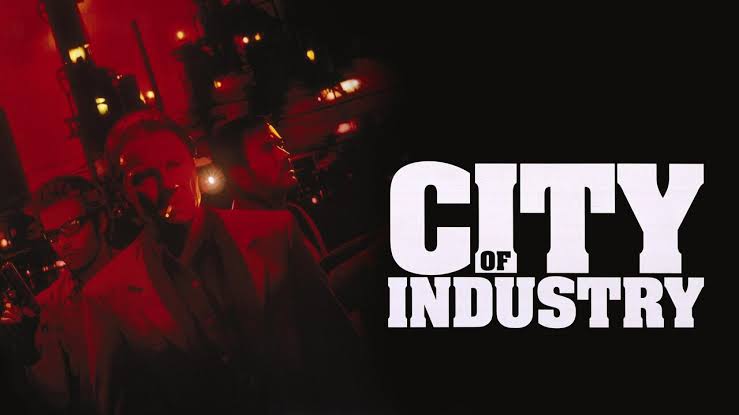
“City of Industry” (1997)
Drama / Thriller

Running Time: 97 minutes
Written by: Ken Solarz
Directed by: John Irvin
Featuring: Harvey Keitel, Stephen Dorff, Timothy Hutton, Famke Janssen and Wade Dominguez
Lee Egan: “We’ll give him a little crash course in free enterprise. Besides, it’s the black market. What’s he gonna do? Go to the consulate?”
City of Industry is the kind of film that seems almost designed to be rediscovered years after its original release. Arriving in 1997 at a time when American crime cinema was overflowing with gangsters, professional thieves, double-crosses, sudden violence and stylish Los Angeles locations, John Irvin’s film was easily overlooked. It had Harvey Keitel in the lead, Timothy Hutton, Stephen Dorff and Famke Janssen in major roles, and a story involving diamonds, betrayal and revenge, yet it never achieved the cult status of some of its contemporaries.
That is a shame, because City of Industry is a considerably tougher, stranger and more melancholy film than its basic premise suggests.
It is also exactly the sort of film that makes an ideal candidate for a label such as Imprint Films. The movie is not a forgotten masterpiece, and it certainly has imperfections, but it is a fascinating late-1990s crime picture with a distinctive atmosphere, a terrific central performance from Harvey Keitel and an unusually bleak view of the professional criminal world. Imprint’s new Blu-ray gives the film the kind of collector-oriented presentation it has long deserved, while the substantial collection of supplementary material provides an opportunity to reassess a film that has spent far too long in the shadows.
The release features a 1080p high-definition presentation, English LPCM 2.0 audio and optional English SDH subtitles. More importantly for collectors, it includes a new audio commentary from director John Irvin, a second commentary carried over from the earlier Kino Lorber release, new interviews with Famke Janssen and composer Stephen Endelman, archival interviews and featurettes, behind-the-scenes material and the theatrical trailers.
There is even a 126-page hardback book accompanying the collection, with an essay on City of Industry by Roxana Hadadi.
For anyone who appreciates overlooked 1990s crime cinema, this is an exceptionally welcome release.
At first glance, City of Industry seems to promise a familiar story.
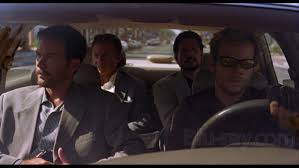
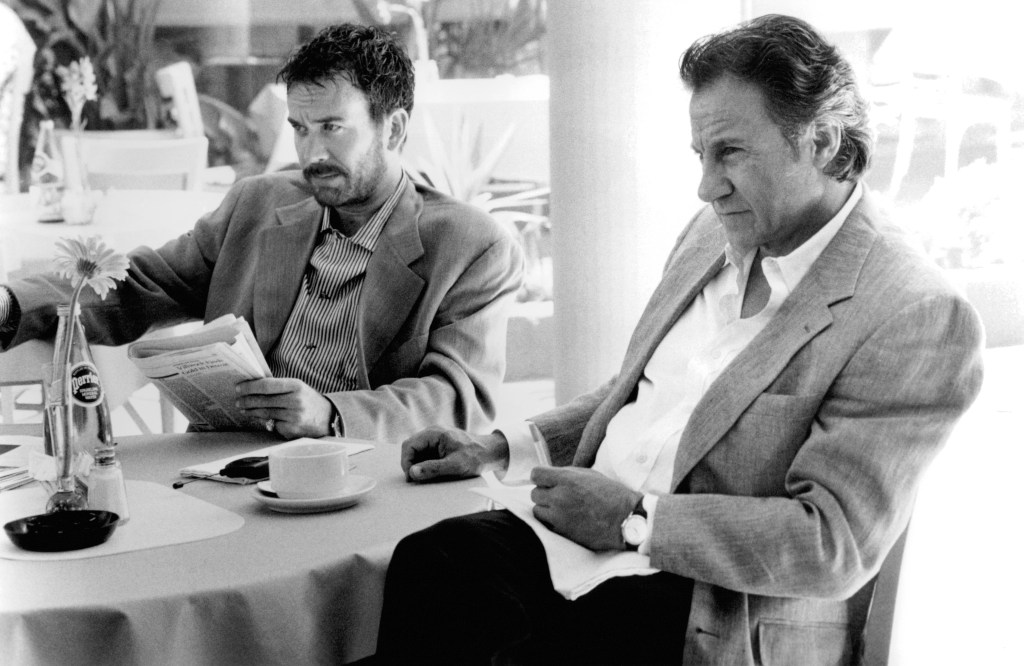
Roy Egan, played by Harvey Keitel, is an experienced professional thief who has retired from the business. His younger brother Lee, played by Timothy Hutton, persuades him to participate in one final job. The target is a shipment of diamonds in Palm Springs, and the plan involves Lee, Roy, Jorge Montana and Skip Kovich.
The robbery itself is not really the film’s destination.
It is the starting point.
The heist succeeds, but the group immediately falls apart when Skip betrays the others and attempts to take the diamonds for himself. Lee and Jorge are murdered, while Roy survives, badly wounded. From that point forward, the movie becomes a pursuit narrative as Roy begins hunting Skip.
That structure allows Irvin to strip away the conventional pleasures of the heist film. The audience does not get an elaborate extended sequence in which everyone survives, celebrates the success of the robbery and then watches the complications develop. Instead, the movie effectively destroys its own ensemble almost as soon as it has established it.
This is one of the film’s most unusual decisions.
Timothy Hutton, Wade Dominguez and Stephen Dorff initially appear to be members of a four-man ensemble, while Keitel seems almost like the veteran actor brought in to provide additional weight. But after the betrayal, City of Industrybecomes almost entirely Keitel’s movie.
And that is where it becomes interesting.
Roy is not a glamorous criminal. He does not behave like the witty, sophisticated thieves found in countless other crime movies. He does not deliver endless speeches about professionalism or honour. He simply knows what he is doing.
He is old-school.
He is patient.
And he is frightening.
The film’s memorable line, “I’m my own police,” neatly encapsulates Roy’s philosophy. It is not merely a tough-guy statement. Roy exists outside conventional authority. He doesn’t expect the police to solve his problems because he has spent his life operating outside the law. His morality is personal rather than institutional.
That makes the revenge story more complicated than it initially appears.
There are many reasons to watch City of Industry, but Harvey Keitel is the biggest.
Keitel was already one of the defining faces of American independent and crime cinema by the time this film appeared. His career had included Mean Streets, Taxi Driver, The Piano, Reservoir Dogs, Bad Lieutenant and countless other performances in which he could suggest violence, vulnerability, rage and moral uncertainty simultaneously.
Roy Egan is another variation on that persona, but Keitel gives him an unusual degree of restraint.
He barely needs to speak.
His face tells us that Roy has seen everything.
The character is tired rather than simply angry. His revenge mission is not fuelled by the exuberance of a younger man. There is no sense that Roy is enjoying himself. He is doing what he believes has to be done.
That distinction makes the violence considerably more disturbing.
When Roy hurts someone, Irvin doesn’t generally present the moment as a crowd-pleasing action spectacle. The violence is abrupt, ugly and uncomfortable. Roy gets injured himself, and the film makes a point of showing the physical consequences of what he is doing.
This is one of the qualities that separates City of Industry from the more fashionable crime films of the period.
After Reservoir Dogs and Pulp Fiction, there was an enormous appetite for crime movies featuring colourful criminals, pop-cultural dialogue and stylised violence. City of Industry superficially belongs to the same generation, but its sensibility is very different. As critics have noted, Irvin’s film is closer in spirit to older hard-edged crime pictures and urban Westerns than to Tarantino’s deliberately self-conscious style.
Irvin himself discusses this approach in his new commentary, including his desire to make something closer to the smaller genre films he remembered from his youth rather than simply assembling a cast of major stars.
That philosophy is important.
City of Industry isn’t trying to convince us that its criminals are cool.
It wants us to understand them.
And occasionally to fear them.
If Keitel represents the old generation of professional criminals, Stephen Dorff’s Skip represents something younger, more reckless and more dangerous.
Skip is volatile.
He is arrogant.
He is unpredictable.
Most importantly, he doesn’t possess Roy’s code.
That makes their conflict about more than stolen diamonds.
It is a conflict between two approaches to criminal life.
Roy believes in professionalism. Skip believes in opportunity.
Roy understands that the people around him are dangerous. Skip seems to believe that he is the most dangerous person in the room.
Dorff plays him with an almost reptilian energy. His appearance, mannerisms and body language immediately suggest somebody who is permanently on edge. There is something deliberately unpleasant about him, and Dorff wisely doesn’t attempt to make the character sympathetic.
It is a very good performance.
Dorff was still relatively early in his career when he made the film, and the contrast between his youthful energy and Keitel’s weathered physicality gives the picture much of its tension.
Whenever the two men are moving toward each other, the film becomes more interesting.
Timothy Hutton’s Lee Egan is one of the film’s more intriguing elements precisely because the character disappears so early.
Hutton is excellent at suggesting that Lee is competent but perhaps not quite as experienced as his older brother. He is the younger man who thinks he has discovered a perfect opportunity.
The opening sections allow us to see Roy operating alongside Lee, Jorge and Skip, and there is an almost old-fashioned quality to the way the group prepares for the robbery.
The film initially appears to be heading toward a conventional ensemble heist movie.
Then Irvin pulls the rug out from underneath us.
The robbery succeeds, but the aftermath becomes a slaughter.
The decision has divided viewers because it removes several potentially interesting characters from the story. Roger Ebert, for example, criticised the film for introducing numerous characters and relationships without always providing satisfying development or payoff.
That criticism is fair.
There are moments when City of Industry feels like it contains the remains of a larger film.
But there is also something compelling about the emptiness created by the early deaths.
Roy is suddenly alone.
And the world feels much larger because of it.
Famke Janssen is particularly good as Rachel Montana, Jorge’s wife.
Rachel could easily have become the conventional female character in a male-dominated crime thriller: the widow who needs protection and gradually becomes romantically involved with the protagonist.
Fortunately, the movie doesn’t push the relationship in that direction too aggressively.
There is attraction between Roy and Rachel, but it remains understated. What matters more is their shared understanding of loss.
Both have been damaged by the criminal world.
Both understand what Jorge’s death means.
And Roy’s relationship with Rachel introduces something that the rest of the film largely suppresses: tenderness.
Janssen’s performance is remarkably grounded. She had already appeared in GoldenEye, but City of Industry deliberately strips away much of the glamour associated with her Bond role. Here she is vulnerable, suspicious and exhausted.
The new Imprint interview, A Different Light, is therefore an especially welcome addition. Janssen discusses her background, her move from Holland to America, her career, GoldenEye and City of Industry. She also talks about her difficult working relationship with Keitel during the production. The interview runs approximately 21 minutes.
It is one of the most valuable new additions on the disc because Janssen’s contribution to the film is often overlooked.
The title City of Industry is particularly appropriate because the film’s environment feels almost as important as its characters.
This is not the glamorous Los Angeles of Hollywood fantasies.
It is industrial Los Angeles.
Factories, warehouses, motels, strip clubs, rundown streets, parking lots and anonymous buildings replace the familiar postcard imagery.
The city feels exhausted.
It is a place where people are constantly buying, selling, stealing, hiding and negotiating.
That atmosphere gives the film its neo-noir identity.
Cinematographer Thomas Burstyn photographs Los Angeles in a way that emphasises texture rather than beauty. The city frequently seems harsh and artificial, with brightly coloured neon and harsh lighting contrasting with grimy interiors.
There are plenty of striking locations, and one of the pleasures of the film is simply watching Roy move through this strange underworld.
Roger Ebert complained that the film sometimes seemed to move through too many exotic locations, but that very quality can also be viewed as part of its dreamlike noir atmosphere.
The city seems endless.
Roy keeps moving.
Skip keeps running.
And neither man appears capable of escaping the world that produced them.
City of Industry is violent.
Very violent.
But its violence is not especially glamorous.
That distinction is crucial.
There is a bluntness to the film’s action that makes it feel closer to a hard-edged 1970s crime picture than the knowingly stylised violence that dominated much of the 1990s.
Gunshots hurt.
People bleed.
Bodies collapse.
Roy is injured repeatedly.
And the film does not treat his injuries as minor inconveniences.
This gives the revenge narrative a physical weight.
Roy is not a superhero.
He is an ageing criminal who is increasingly battered by the pursuit.
The more he hunts Skip, the more damaged he becomes.
There is something almost tragic about watching him continue.
Another major strength is Stephen Endelman’s music.
The score gives City of Industry much of its identity.
Instead of turning every violent scene into a conventional action-movie cue, the music often creates an uneasy atmosphere of alienation and danger.
Electronic sounds and darker tonal textures reinforce the film’s urban nightmare.
The Imprint release includes a new interview with Endelman, Dissonance and Melody, running approximately 16 minutes. He discusses how Irvin persuaded him to join the project and explains the musical approach to the film, including the intention to support its dark film-noir atmosphere.
This is exactly the sort of supplementary feature that a collector wants.
It doesn’t simply say, “I composed the music.”
It helps explain why the music sounds the way it does.
And hearing the composer discuss the creative process makes the soundtrack easier to appreciate.
John Irvin is an interesting filmmaker.
His career doesn’t immediately suggest that City of Industry should have become one of his signature films. He had worked across television and film and had demonstrated an ability to handle action, military drama and genre material.
His direction here is deliberately unfussy.
He doesn’t try to impress us with elaborate camera movements.
Instead, he concentrates on atmosphere, location and physicality.
The action is generally easy to follow.
The violence is not romanticised.
And the characters are allowed to inhabit the environments rather than constantly performing for the camera.
There are certainly weaknesses.
The screenplay occasionally feels overstuffed.
Some of the criminal subplots involving different groups and associates aren’t developed as fully as they might have been.
Several characters appear briefly and then disappear.
Some of the narrative transitions are abrupt.
And there are continuity issues that critics have pointed out over the years.
But the film’s overall atmosphere is remarkably consistent.
It feels like a dirty, exhausted world.
That counts for a lot.
One reason City of Industry has remained obscure is that it occupies an awkward position.
It isn’t a straightforward action film.
It isn’t quite a character drama.
It isn’t as stylish as the best neo-noir.
It isn’t as narratively tight as the best revenge thrillers.
And it isn’t trying to be funny.
The result is a film that can seem oddly unfashionable.
Roger Ebert was particularly critical of its narrative construction, arguing that the pieces did not always fit together.
Other critics have been much more enthusiastic.
Slant’s later reassessment described it as a nasty and woefully underappreciated crime thriller, praising Irvin’s ability to use Keitel’s screen presence and describing the performance as one of the actor’s particularly ferocious lead turns.
That difference in critical response makes perfect sense.
If you approach the movie expecting a perfectly engineered crime narrative, you may become frustrated.
If you approach it as an atmospheric piece of 1990s neo-noir built around Harvey Keitel, it works considerably better.
This is where the new Imprint release becomes especially important.
Previous Blu-ray editions have existed, but they have not necessarily treated the film as the significant piece of 1990s genre cinema that it deserves to be.
The new release presents the movie in 1080p high definition at its original 1.85:1 aspect ratio. The audio is English LPCM 2.0, with optional English SDH subtitles.
The improvement is particularly valuable for a film that depends so heavily on atmosphere.
The cinematography contains a mixture of harsh daylight, dark interiors, neon, industrial locations and night photography. A good high-definition presentation allows the texture of those locations to become much more apparent.
The film’s gritty appearance is not something that should be cleaned away.
Grain is part of the experience.
The image should look like a 1990s film.
And that is particularly important with City of Industry, because its roughness contributes to the mood.
Earlier home-video presentations have not always represented the film particularly well. The previous Kino Lorber release, for example, was criticised for relying on a weak older master.
The Imprint presentation is therefore a significant upgrade in terms of the overall collector experience.
The LPCM 2.0 soundtrack is another important aspect of the release.
Endelman’s music benefits from a clean presentation, while the gunshots and environmental effects have considerably more impact when the soundtrack is properly reproduced.
The film’s quieter moments also benefit.
Footsteps.
Cars.
Doors.
Voices.
Distant city noise.
Cigarettes being lit.
The little details help establish the atmosphere.
This is not a movie that needs an enormous multichannel remix.
The original stereo presentation is perfectly appropriate.
Indeed, preserving the original character of the soundtrack is preferable to artificially expanding it.
For me, the single most important extra on the release is John Irvin’s new commentary.
Whenever a director returns to a film decades later, there is the possibility that the commentary will be either defensive or superficial.
Fortunately, Irvin provides useful insight.
He discusses the film’s controversial title, his approach to casting, the kind of older crime pictures that influenced him, Harvey Keitel’s transformation for the role, the action sequences and Endelman’s electronic score.
The commentary is valuable because it changes the way we understand the movie.
What might initially seem like a slightly awkward attempt at 1990s neo-noir begins to look more like a deliberate attempt to recreate the atmosphere of the leaner crime pictures Irvin admired.
That doesn’t magically eliminate the film’s flaws.
But it makes the choices more comprehensible.
And that is what a good commentary should do.
The archival extras are also useful.
The making-of featurette is brief, running approximately six minutes, but features Keitel, Hutton, Dorff, Dominguez and Janssen discussing their characters, along with comments from Irvin.
There are also longer archival interviews with the cast, as well as approximately five minutes of behind-the-scenes footage.
None of this is likely to revolutionise our understanding of the film, but together it provides a fascinating snapshot of a production from the late 1990s.
It is also interesting to see the younger versions of actors who would become much more familiar to audiences in later years.
Lucy Liu’s presence is another nice reminder of the film’s eclectic cast, while Michael Jai White is also featured.
The cast list makes the movie seem considerably more prestigious in retrospect than it did upon release.
The release also carries over the earlier commentary by Steve Mitchell and film critic Nathaniel Thompson.
This provides a useful companion to Irvin’s own commentary.
Where Irvin talks about making the movie, Mitchell and Thompson place it in a broader cinematic context.
They discuss the locations, the actors, the crime-film landscape of the 1990s and the film’s visual style.
Having both commentaries is therefore a genuine advantage.
One provides production history.
The other provides critical context.
They complement each other rather than simply repeating the same information.
One of the more unusual extras is an alternate UK version of the film.
This version is presented in standard definition, 1.33:1 and LPCM 2.0, running approximately 97 minutes.
For collectors, this is exactly the kind of oddity that makes a special-edition release more interesting.
It isn’t the preferred way to watch the movie, particularly when the main presentation is available in high definition and the correct 1.85:1 ratio, but having the alternate version included provides useful documentation of the film’s home-video history.
Imprint’s physical packaging is another attraction.
The release includes an exclusive 126-page hardback book containing production stills and essays on the films included in the wider collection. The City of Industry essay is written by Roxana Hadadi.
This is becoming one of Imprint’s strengths.
The company isn’t simply putting a film onto a disc.
It is treating the release as an archival object.
For collectors of 1990s cinema, that makes a difference.
Perhaps the most interesting thing about City of Industry is how different it feels now.
In 1997, the film could easily be dismissed as another violent crime picture arriving in the wake of Heat, Reservoir Dogs, Pulp Fiction and the broader explosion of American independent crime cinema.
Today, it looks less derivative.
The genre landscape has changed.
We have seen countless imitators.
We have watched the stylish crime film become a familiar commodity.
Against that background, Irvin’s film’s refusal to glamorise its criminals becomes more distinctive.
It is dirty.
It is cold.
It is melancholy.
And it is surprisingly interested in the consequences of violence.
Roy isn’t trying to build a criminal empire.
He isn’t trying to become rich.
He isn’t trying to become famous.
He is trying to settle a score.
And by the time he reaches the end of that journey, it is difficult to say whether he has gained anything.
That sense of emptiness is perhaps the movie’s defining characteristic.
City of Industry is not perfect.
The screenplay could be tighter.
Some of the supporting characters deserved more development.
Certain plot mechanics are questionable.
The film occasionally seems to introduce ideas it doesn’t have enough time to explore.
And the narrative can feel episodic.
But those weaknesses shouldn’t obscure what works.
Harvey Keitel is magnificent.
Stephen Dorff is memorable.
Famke Janssen is excellent.
The Los Angeles locations are superb.
The violence has genuine impact.
Stephen Endelman’s music gives the movie a distinctive identity.
And John Irvin’s direction gives the entire production a hard, grimy atmosphere that has aged surprisingly well.
Most importantly, City of Industry feels like a genuine film rather than a product manufactured to imitate the latest crime-movie trend.
It may borrow familiar ingredients, but it has its own personality.
The Imprint Blu-ray is therefore an excellent opportunity to revisit it.
The new Irvin commentary is the headline extra, but the Janssen and Endelman interviews, archival material, alternate UK version, trailers and substantial hardback book make this a far more satisfying package than a bare-bones catalogue release. The inclusion of both new and previously available contextual material means that the disc works not only as a way of watching the film but also as a document of its production and its place in 1990s neo-noir.
In some ways, the film’s obscurity is appropriate.
City of Industry is about people operating in the shadows.
It is about criminals who are already disappearing.
It is about an older generation being replaced by a younger, more reckless one.
And it is about a man pursuing revenge through a world that seems increasingly empty.
Nearly thirty years after its theatrical release, that bleakness has become one of its greatest strengths.
It is not Heat.
It is not Reservoir Dogs.
It is not Pulp Fiction.
And perhaps that is exactly why it deserves another look.
It is City of Industry—a tough, atmospheric, sometimes flawed, frequently compelling piece of late-1990s neo-noir anchored by one of Harvey Keitel’s most underrated performances.