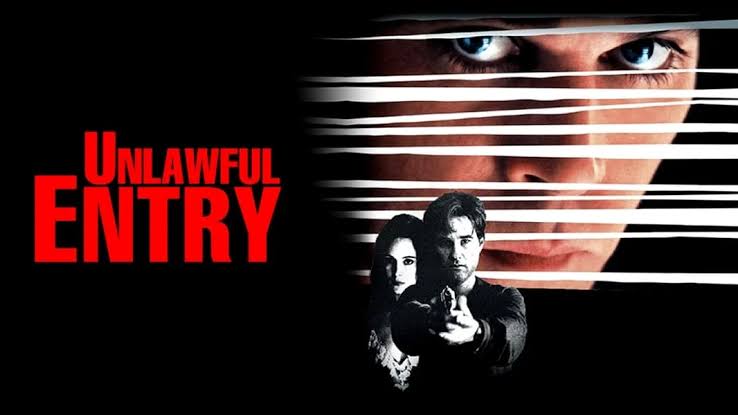
“Unlawful Entry” (1992)
Drama

Running Time: 112 minutes
Written by: Lewis Colick
Directed by: Jonathan Kaplan
Featuring: Kurt Russell, Ray Liotta and Madeleine Stowe
Officer Pete Davis: “Arrest you? I could kill you.”
There is something particularly effective about a thriller that takes an ordinary source of security and turns it into a source of fear. In Unlawful Entry, the danger does not initially come from some anonymous killer hiding in the shadows or a criminal mastermind plotting an elaborate scheme. It comes wearing a police uniform. More unsettlingly, it comes into the home because the victims themselves have invited it in.
Jonathan Kaplan’s 1992 psychological thriller is a very entertaining example of the early-1990s domestic thriller, built around a simple but potent idea: what happens when the person who is supposed to protect you becomes the person you need protecting from? Kurt Russell, Madeleine Stowe and Ray Liotta make an exceptionally strong trio, with Liotta delivering one of his most memorable performances as the increasingly obsessive Officer Pete Davis. The film may not always be subtle, and some of its plotting belongs firmly to the world of commercial Hollywood thrillers, but when it works, it works extremely well.
Imprint’s Blu-ray release gives the film the sort of attention that collectors have come to expect from the label. More importantly, this edition makes Unlawful Entry look and sound considerably better than its reputation as a somewhat forgotten early-’90s thriller might suggest. The release also comes with a generous collection of archival and newly produced extras, making it an especially attractive package for fans of the film, Kaplan, Liotta, or the neo-noir thrillers of the period. The release is presented as part of Imprint’s continuing commitment to rescuing genre titles that deserve another look.
Unlawful Entry opens with a home invasion. Michael and Karen Carr are a happily married couple living a comfortable Los Angeles life. Their sense of security is suddenly destroyed when a burglar breaks into their home. The sequence is deliberately frightening because the house, normally the place where they should feel safest, is transformed into a trap.
They call the police, and Officer Pete Davis arrives.
At first, Davis appears to be precisely the sort of policeman anyone would want responding to a crisis. He is friendly, reassuring and apparently sympathetic to the Carrs’ situation. He helps arrange improvements to their security and becomes sufficiently friendly with Michael and Karen that the relationship begins to extend beyond the original police call.
That is where the nightmare begins.
The brilliance of the premise is that Pete does not immediately appear dangerous. If he had arrived as an obviously sinister character, the film would have become much less interesting. Instead, Liotta plays him as somebody who can move effortlessly between friendliness and menace. There is always something slightly wrong about him, but it takes time for that wrongness to become unmistakable.
Pete becomes fascinated by Karen and increasingly resentful of Michael. What begins as admiration gradually becomes possession. He wants the life the Carrs have, and particularly wants Karen. His obsession becomes so extreme that he begins manipulating circumstances around the couple, using his position as a police officer to undermine Michael and make himself indispensable to Karen.
The premise plays directly into one of the most effective fears of the domestic thriller: the fear that nobody will believe you.
That element gives Unlawful Entry considerably more substance than its exploitation-style premise might initially suggest. Michael cannot simply confront Pete. Pete is a police officer. He has authority, credibility and institutional protection. If Michael becomes aggressive, Pete can portray him as unstable. If Michael complains, Pete can dismiss the allegations. If Michael attempts to expose him, Pete can manipulate the system.
This is what makes the film’s title so appropriate. Pete’s intrusion is not merely physical. He gradually invades every part of the Carrs’ lives.
The film belongs to Ray Liotta.
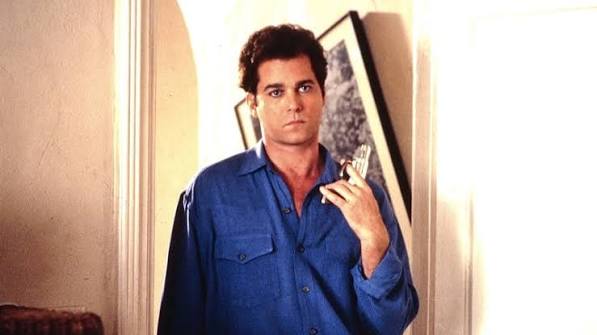
There is no question that Kurt Russell is an excellent leading man, and Madeleine Stowe provides an important emotional centre, but Liotta is the actor who gives Unlawful Entry its electricity. Officer Pete Davis is one of those characters who could easily have become a generic movie psychopath. Liotta makes him considerably more disturbing.
Pete does not behave like a lunatic from the beginning. He behaves like a man who believes he is completely justified.
That distinction is crucial.
Liotta’s performance is based on small shifts in behaviour. Pete can smile warmly, speak politely and appear completely reasonable. Then something changes in his eyes or his tone, and suddenly the audience understands that there is something deeply unhealthy beneath the surface.
His performance also benefits from the character’s professional competence. Pete is not frightening merely because he is violent. He is frightening because he understands the machinery of authority. He knows how police procedures work. He knows how evidence can be interpreted. He understands how a uniform affects people’s perceptions.
That makes him much more dangerous than a conventional stalker.
Liotta had already demonstrated his ability to play volatile and morally complicated characters, but Unlawful Entry gives him an opportunity to build a villain almost entirely through psychological manipulation. The eventual violence is effective precisely because so much of the character’s menace has been established beforehand.
The film also makes good use of Liotta’s physical presence. There is something inherently unsettling about the way Pete occupies the Carr household. He becomes increasingly comfortable there, and his confidence grows as Michael becomes more suspicious.
It is almost as though Pete is gradually rehearsing the role of Michael.
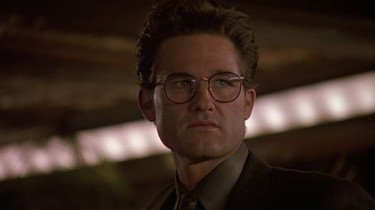
Kurt Russell is often associated with tougher, more overtly heroic characters, which makes his performance as Michael Carr particularly interesting.
Michael is not an action hero. He is an ordinary successful man who finds himself in a situation he cannot control. Russell therefore has to spend much of the movie playing frustration, uncertainty and fear rather than confidence.
The character’s problem is that he initially believes rational behaviour will solve the situation. He tries talking to Pete. He tries avoiding him. He tries explaining the problem. But every attempt to push Pete away seems to make things worse.
Russell handles the gradual transformation effectively.
Michael becomes increasingly angry, but the audience can understand why. The film is essentially watching a reasonable man being pushed into unreasonable behaviour. Pete is deliberately provoking him, and Michael eventually reaches the point where his anger becomes a weapon that Pete can use against him.
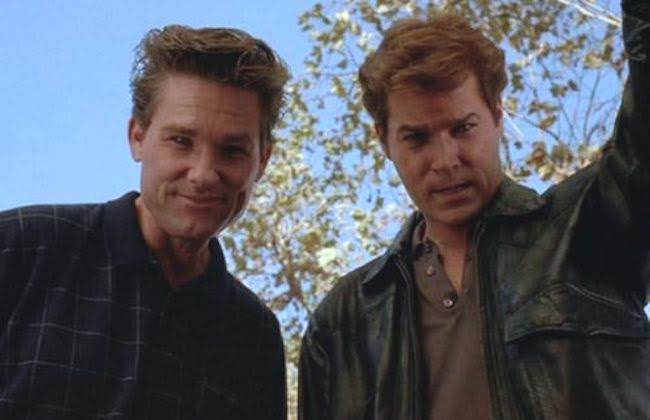
There is an important contrast between Russell and Liotta. Russell’s performance is grounded and restrained, while Liotta’s is increasingly theatrical and unpredictable. The tension comes from watching these two personalities collide.
Madeleine Stowe’s Karen is sometimes criticised for being less developed than the two male characters, and there is some truth in that criticism. The film is primarily constructed around Michael and Pete, with Karen becoming the object around which their conflict revolves.
Nevertheless, Stowe gives Karen warmth and intelligence.
Her mistake is not that she is deliberately encouraging Pete. Rather, she fails to recognise the seriousness of his behaviour quickly enough. Pete initially appears to be a lonely, helpful policeman, and Karen responds to that apparent friendliness. The tragedy is that she gradually discovers that the friendliness was a disguise.
This is important because it prevents Karen from simply becoming a stereotypical helpless victim. She is an active participant in the story, even though the film ultimately places her in an increasingly dangerous position.
Stowe’s performance is also useful in making Pete’s obsession believable. If Karen were cold or hostile from the beginning, his fixation would become more difficult to understand. Instead, she behaves like a normal person dealing with someone she assumes is fundamentally decent.
And that is exactly how Pete gets inside the family.
Jonathan Kaplan approaches the material as a commercial thriller, but there is a genuine Hitchcockian influence running throughout the film.
Kaplan himself discusses his admiration for Alfred Hitchcock in the archival commentary included on this release, explaining how Hitchcock’s ideas about character and mise-en-scène influenced his approach.
That influence is evident in the way Kaplan turns ordinary environments into threatening spaces.
The Carrs’ house is especially important. At first it represents comfort, wealth and security. Following the burglary, however, the same environment becomes psychologically contaminated. Doors, windows, hallways and rooms acquire different meanings.
The film understands that a thriller does not always need to show the villain. Sometimes it is enough to know that he has been there.
Kaplan also does a good job of allowing Pete’s presence to grow gradually. The first half of Unlawful Entry is arguably the strongest because it relies more heavily on psychological tension. Once the audience understands what Pete wants, the film becomes more conventional, but Kaplan maintains enough momentum to carry the story through its more familiar later stages.
The movie’s Los Angeles setting is also effectively used. Rather than presenting the city purely as an anonymous urban landscape, Kaplan gives the story a very specific early-1990s atmosphere. The Carrs’ comfortable lifestyle, security technology, police culture and suburban anxiety all belong unmistakably to the period.
One of the most interesting aspects of Unlawful Entry is its obsession with security.
The entire story begins because the Carrs’ security has failed. They respond by attempting to improve it. Yet the person who becomes involved in that process is precisely the individual who ultimately destroys their sense of safety.
The film therefore creates an ironic cycle.
The Carrs want better locks.
They want an alarm.
They want protection.
And they trust a policeman.
But the greatest threat comes through the very systems designed to protect them.
This gives the film an unexpectedly cynical edge. It is not simply saying that dangerous individuals exist. It is suggesting that institutions and systems can be exploited by dangerous individuals.
That idea remains one of the movie’s most effective qualities.
Watching Unlawful Entry today is also an enjoyable trip back to the commercial thriller cinema of the early 1990s.
This was an era when Hollywood produced a remarkable number of films built around domestic paranoia, obsession and apparently respectable people whose lives suddenly become nightmares.
The genre often involved professional middle-class protagonists whose comfortable lives were threatened by outsiders. Unlawful Entry fits perfectly into that tradition.
The film is also part of a fascinating period in which Hollywood thrillers became increasingly interested in corrupt or psychologically unstable law-enforcement characters. Its themes have an obvious relationship to films such as Internal Affairs, which appeared only a couple of years earlier.
The similarities are difficult to ignore, but Unlawful Entry has its own identity because the central conflict is so personal. Pete is not simply a corrupt policeman. He wants Michael’s life.
That makes the story feel more intimate.
James Horner’s score is another important part of the film’s atmosphere.
Horner was one of the defining composers of Hollywood cinema during this period, and his work here provides the thriller with an appropriately uneasy musical identity.
The score does not constantly announce itself. Instead, it helps establish the psychological instability beneath the seemingly ordinary situations.
Imprint’s release is particularly useful in this regard because the extras include Symphonic Intruder: Inside the Thriller Scores of James Horner, a featurette in which music historian Daniel Schweiger discusses Horner’s career, musical style and the characteristics of his score for Unlawful Entry.
It is exactly the kind of supplement that adds value to a catalogue release.
The major attraction of this Imprint release is, of course, the presentation.
The current Imprint edition is actually a two-disc 4K Ultra HD and Blu-ray package rather than a standard Blu-ray-only release. The restoration is presented in native 4K with Dolby Vision and HDR10, in the original 1.85:1 aspect ratio, with English DTS-HD Master Audio 5.1 and LPCM 2.0 options. Both discs are region free.
For collectors who specifically describe it as the Imprint Blu-ray, the important point is that the Blu-ray disc is included as part of this combo package and contains a substantial portion of the supplementary material.
The restoration is particularly impressive.
The 4K restoration was sourced from the original camera negative, and the resulting image offers substantially improved clarity, depth and tonal separation. The period appearance of the film has been retained rather than being subjected to an excessively modern digital makeover.
That is exactly what you want from a restoration of a 1992 thriller.
The film should look like a beautifully preserved 1992 film, not like something shot yesterday.
Grain remains visible, colours are convincing and the darker scenes retain an appropriate sense of atmosphere. Flesh tones and production design benefit enormously from the increased resolution. The Los Angeles locations acquire greater dimensionality, while interiors have substantially more texture.
The 1080p Blu-ray presentation also benefits from the new restoration, although the 4K disc is naturally the preferred way to experience the movie.
One minor criticism concerns the Blu-ray disc itself. Because it carries a large quantity of supplementary material, some darker sequences can show slightly less than ideal grain presentation and encoding. It is a relatively minor issue, but it is worth mentioning for those expecting absolute perfection.
The audio presentation is equally strong.
The English DTS-HD Master Audio 5.1 track gives the film a fuller and more immersive soundscape than one might expect from a 1992 thriller.
Dialogue is clean and stable, which is particularly important in a film where so much tension comes from conversation. Pete’s seemingly innocent remarks become increasingly threatening, and having clean dialogue makes those scenes considerably more effective.
The action sequences also benefit. The home invasion, confrontations and pursuit sequences have greater dynamic impact, while Horner’s score receives enough separation to occupy the surrounding channels effectively.
For purists, the inclusion of the LPCM 2.0 option is welcome, allowing viewers to experience the soundtrack in a more traditional presentation.
This is where the Imprint release becomes especially impressive.
The archival commentary by Jonathan Kaplan is an essential extra. Kaplan discusses his Hitchcock influences, the casting of Russell and Liotta, the construction of individual scenes and decisions concerning editing.
For anyone interested in how commercial thrillers are made, it is extremely valuable.
The newer interview material is equally worthwhile.
Unrestrained Realism features Kaplan discussing his career and the development of Unlawful Entry, including the fact that Liotta was already attached when Kaplan became involved. Kaplan also discusses changes made to the original screenplay.
Too Tightly Wound: Inside the Filming of Unlawful Entry focuses on cinematographer Jamie Anderson and his collaboration with Kaplan. The discussion of locations and the visual construction of the movie is particularly welcome.
There are also archival featurettes, interviews with Russell, Liotta, Stowe and other members of the production, behind-the-scenes material, B-roll, the theatrical trailer and television spots.
The Ray Liotta interview is especially interesting today. His discussion of how he prepared to play Pete offers another perspective on a performance that remains the film’s greatest asset.
The package is rounded out by a substantial 126-page hardback book containing production stills and essays on Unlawful Entry and several other films in the collection.
That is an extraordinary amount of supplementary material for a title that might once have been regarded as merely another early-’90s thriller.
Despite all its strengths, Unlawful Entry is not a perfect film.
The biggest weakness is that the screenplay eventually becomes predictable.
Once Pete’s true intentions become clear, the audience is largely waiting for Michael and Karen to catch up. Some of the plot mechanics are also rather convenient. Pete’s ability to manipulate circumstances occasionally stretches credibility, and certain developments feel more like requirements of the thriller formula than organic consequences of the characters’ behaviour.
The final section also becomes more conventional than the excellent early material.
The film is strongest when it is about uncertainty.
Is Pete merely friendly?
Is Michael becoming paranoid?
Will anyone believe him?
How much authority does Pete actually have?
Those questions create genuine tension.
Once the movie answers them, it has fewer surprises available.
Yet this is hardly fatal. The performances remain strong enough to keep the film engaging, and Kaplan’s direction ensures that the movie never becomes completely routine.
The reason Unlawful Entry has survived better than many of its contemporaries is simple: Ray Liotta.
Pete Davis is an unforgettable character.
There is something almost frighteningly plausible about the way he moves from helpful policeman to obsessive stalker. His uniform gives him instant credibility, and his ability to weaponise that credibility is what makes him so dangerous.
The film also benefits from Kurt Russell’s grounded performance. Russell gives the audience someone to identify with while Liotta gives them someone to fear.
That combination works.
The film was released theatrically on June 26, 1992, and runs approximately 111 minutes. Its principal cast consists of Russell, Liotta and Stowe, with Roger E. Mosley and Ken Lerner among the supporting players.
It received a reasonably positive critical response when released, and the basic consensus remains understandable: the story may not be particularly original, but the cast and direction make it effective.
Roger Ebert, in his contemporary review, particularly recognised the movie’s central fear: being trapped in a situation where the authorities themselves are arrayed against you and proving what is happening becomes almost impossible.
That remains the film’s strongest idea.
Unlawful Entry is exactly the kind of film that benefits from the attention of a boutique label.
It is not a forgotten masterpiece, nor is it an especially revolutionary thriller. Its story borrows heavily from familiar psychological-thriller territory, and its later stages occasionally surrender the subtlety of its opening half to conventional action and suspense.
But it is a very good commercial thriller.
Jonathan Kaplan understands how to build tension from ordinary surroundings. Kurt Russell provides a convincing portrait of a man gradually losing control of his life. Madeleine Stowe gives the film emotional credibility. And Ray Liotta delivers a superbly sinister performance that elevates the entire production.
The Imprint release is therefore easy to recommend.
The new restoration provides a handsome presentation of the film, with the 4K disc offering excellent clarity, depth and HDR/Dolby Vision options, while the accompanying Blu-ray provides a strong 1080p presentation and houses an impressive collection of supplementary material. The DTS-HD Master Audio 5.1 soundtrack is clean and dynamic, and the archival and newly produced extras make this considerably more than a bare-bones catalogue release.
Most importantly, the package encourages a reassessment of a film that has too often been reduced to “the Ray Liotta psycho-cop movie.”
It is more than that.
Unlawful Entry is an entertaining, atmospheric and occasionally genuinely unsettling portrait of misplaced trust. Its central nightmare remains remarkably simple: you call the police because someone has invaded your home, only to discover that the person you trusted to protect you has decided that your home, your wife and your entire life should belong to him.
That is a pretty effective nightmare.
And thanks to Imprint’s excellent presentation, Unlawful Entry has rarely looked better.





Leave a Reply