
“Wild at Heart” (1990)
Drama

Running Time: 124 minutes
Written & Directed by: David Lynch
Featuring: Nicolas Cage, Laura Dern, Willem Dafoe, Crispin Glover, Diane Ladd, Isabella Rossellini and Harry Dean Stanton
Lula: “This whole world’s wild at heart and weird on top.”
David Lynch’s Wild at Heart is one of those films that seems to become more fascinating the further it gets from the period in which it was made. When it arrived in 1990, following the critical and commercial impact of Blue Velvet and the television phenomenon of Twin Peaks, Lynch was already established as one of American cinema’s great outsiders. Yet Wild at Heart proved to be a particularly strange proposition even by Lynch’s standards. It was a romantic road movie, a crime picture, a grotesque black comedy, a dream fantasy, a celebration of rock ’n’ roll and an unapologetically excessive melodrama, all wrapped around a surprisingly sincere love story.
The new Imprint Blu-ray, released as part of the label’s After Dark: Neo-Noir Cinema – Collection Four, gives this extraordinary film another opportunity to be appreciated in high definition. Imprint Collection #568 is included in the seven-disc limited-edition hardbox alongside Unlawful Entry, The Getaway, Mulholland Falls, Freeway and City of Industry. The collection was limited to 1,500 copies, and Wild at Heart itself receives a substantial collection of supplementary material, including several new interviews, a new commentary and, most significantly for collectors, the uncensored Bobby Peru scene.
What makes this release especially welcome is that Wild at Heart has never really been a film that benefited from being treated as simply another catalogue title. Lynch’s imagery, colour, music and sound design are so important to the experience that a good presentation can dramatically change the way the film is perceived. At its best, this is a movie that assaults the senses while simultaneously presenting an almost old-fashioned story about two people who simply refuse to stop loving one another.
At its heart, Wild at Heart is the story of Sailor Ripley and Lula Fortune, played by Nicolas Cage and Laura Dern. They are young lovers who want to escape together after Lula’s mother, Marietta Fortune, played by Diane Ladd, attempts to destroy their relationship. Sailor has already served time in prison after killing a man in self-defence, and Marietta considers him entirely unsuitable for her daughter.
After Sailor is released, Lula joins him on the road despite her mother’s objections. They head towards California, with the intention of building a life together, but their journey becomes increasingly complicated by criminals, bounty hunters, jealous lovers, mysterious strangers and the increasingly unhinged behaviour of Marietta.
On paper, it sounds like a conventional lovers-on-the-run story.
In Lynch’s hands, it becomes something else entirely.
There are moments of genuine tenderness followed almost immediately by grotesque violence. Characters seem to wander in from another film. Time and reality frequently appear unstable. The characters inhabit a recognisable America of highways, motels, bars, diners and dusty towns, but Lynch transforms that America into something closer to a fever dream.
The film’s connection with The Wizard of Oz is particularly important. Lula repeatedly invokes the movie, while the yellow brick road becomes an almost subconscious metaphor for the journey undertaken by the two lovers. Lynch takes one of the most comforting fantasies in American popular culture and places it alongside murder, sexual menace, drug abuse, violence and psychological trauma.
It is a deliberately contradictory movie.
It is romantic and ugly.
It is funny and horrifying.
It is sentimental and cynical.
It is artificial and strangely emotionally honest.
That contradiction is precisely what makes it so memorable.
The film simply would not work without Nicolas Cage and Laura Dern.
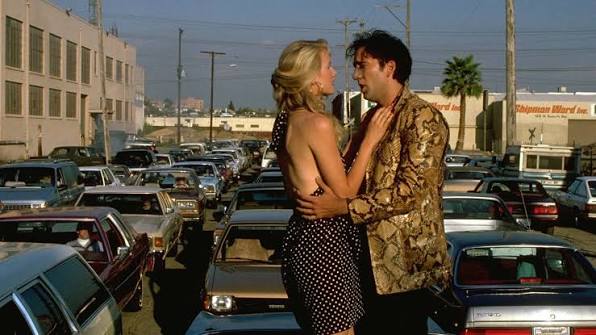
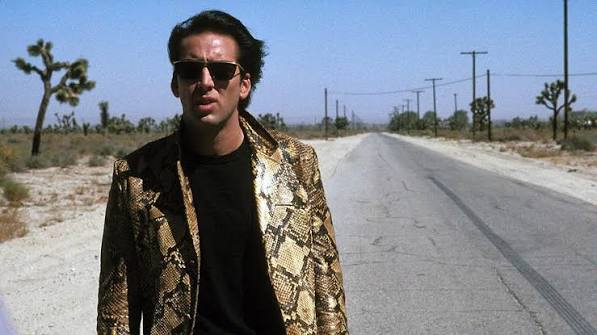
Cage’s Sailor is one of his great early performances because he understands that the character must be ridiculous and heroic at exactly the same time. Sailor wears his famous snakeskin jacket as though it were a suit of armour. He is fiercely protective of Lula, stubborn, vain, violent when necessary and completely devoted to his own image.
Cage plays Sailor as a man who has constructed his personality from rock ’n’ roll mythology.
There is Elvis in the swagger, James Dean in the rebellion and something almost comic-book-like in the way he carries himself. Sailor does not merely listen to music; he appears to believe that music has given him a code by which to live.
The wonderful thing about Cage’s performance is that he never completely mocks Sailor. The character may be absurd, but Cage treats his feelings as genuine. When Sailor sings Elvis Presley’s “Love Me,” the sequence could easily have become a joke. Instead, it becomes one of the film’s defining expressions of romantic devotion.
Laura Dern is equally good, and arguably has the more difficult role.
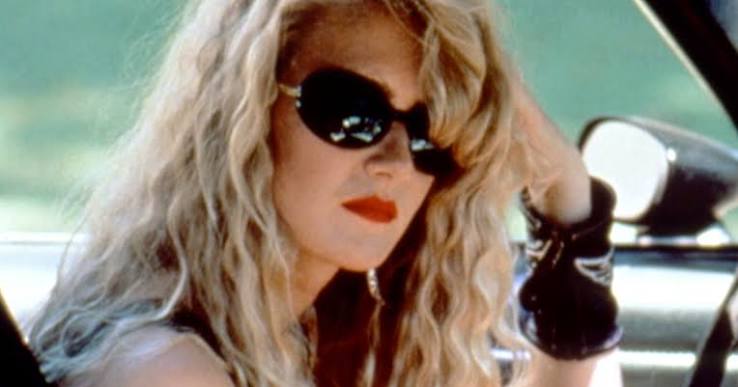
Lula has to live in a world of Lynchian extremes while still providing the emotional centre of the film. Dern gives her enormous vulnerability but also considerable strength. Lula is not merely a frightened young woman being dragged around by a dangerous man. She is making choices, taking risks and deliberately choosing Sailor despite the consequences.
Dern also understands the film’s tonal instability. Lula can be frightened in one scene, sexually confident in another, hysterically funny somewhere else and genuinely traumatised a few minutes later.
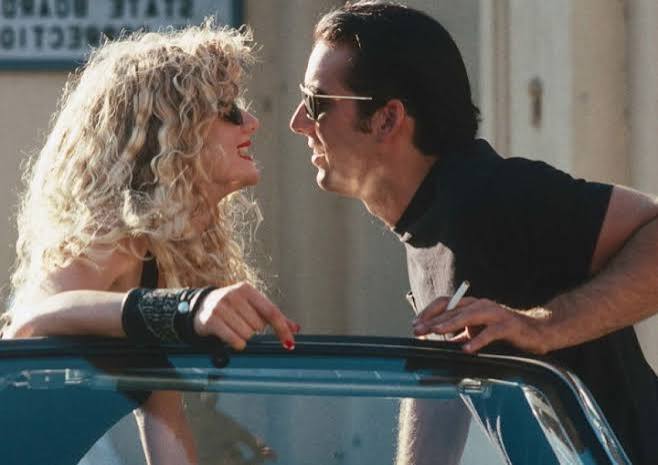
The chemistry between Cage and Dern is essential.
Their relationship is excessive, but that is the point. They love each other with the kind of absolute commitment normally reserved for fairy tales. In a world where almost every other relationship is contaminated by manipulation, violence or betrayal, their devotion becomes strangely pure.
Diane Ladd’s Marietta Fortune is one of the great pieces of casting in Lynch’s filmography.
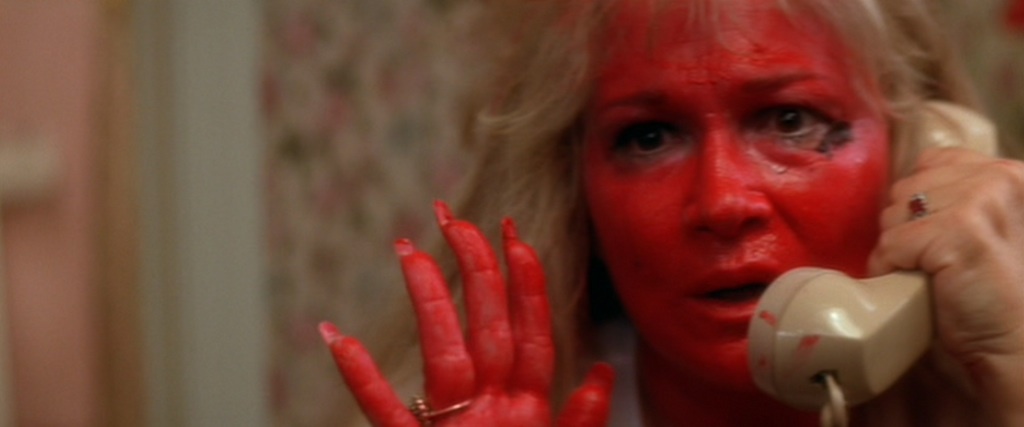
Ladd, Dern’s real-life mother, gives a performance so enormous that it threatens to overwhelm every scene in which she appears. Marietta is hysterical, manipulative, sexually repressed, sexually obsessive, violent and completely consumed by her hatred of Sailor.
Yet she is not simply a comic villain.
There is something deeply damaged about Marietta. Her hatred is bound up with jealousy, desire, fear and the inability to accept that her daughter is becoming an independent adult.
Ladd plays all of this at maximum volume.
The result is one of those performances that could have been disastrous in another film but is completely appropriate here. Marietta does not behave like a realistic human being because Wild at Heart is not particularly interested in realism. She behaves like an emotional force of nature.
Ladd deservedly received an Academy Award nomination for the performance, and watching the film again makes it easy to understand why.
If Diane Ladd represents the film’s hysterical emotional energy, Willem Dafoe’s Bobby Peru represents its purest nightmare.
Bobby Peru is one of the most repulsive characters Lynch ever created.
Dafoe completely disappears into the part. The greasy hair, rotten teeth, strange facial expressions and unpleasant mannerisms are only the surface details. What makes Bobby Peru so disturbing is the way Dafoe plays him as somebody who appears to enjoy making other people uncomfortable.
He is not merely dangerous.
He enjoys danger.
His appearance in the film changes the atmosphere immediately. Suddenly the surreal comedy becomes genuinely threatening.
The extended Bobby Peru sequence is among the film’s most notorious passages, and the Imprint release’s inclusion of the uncensored version is therefore particularly significant. Earlier home-video editions have presented different configurations of the material, making the inclusion here especially interesting for collectors and Lynch devotees. The Imprint disc specifically lists the “Uncensored Bobby Peru Scene” among its extras.
Dafoe’s performance remains one of the most unforgettable supporting performances in American cinema of the early 1990s.
Harry Dean Stanton brings a completely different quality to the film.
As Johnnie Farragut, he is caught up in the nightmare created by Marietta, but Stanton gives the character a weary humanity that helps ground the movie. His presence is also important because Stanton was such a natural Lynch performer. He could communicate sadness, eccentricity and mystery without appearing to be acting at all.
The supporting cast is extraordinary.
Crispin Glover appears as Dell, bringing his own peculiar energy to the film. Isabella Rossellini, Sherilyn Fenn, J. E. Freeman, Grace Zabriskie, Calvin Lockhart and a host of familiar faces populate the strange universe through which Sailor and Lula travel.
One of the pleasures of Wild at Heart is simply watching these performers appear and wondering what Lynch is going to do with them.
The film is visually extraordinary.
Frederick Elmes’ cinematography captures an America that looks both familiar and unreal. Neon lights, dark highways, desert landscapes, cheap motels and garish interiors become part of Lynch’s visual vocabulary.
Colour is especially important.
Red is everywhere.
Fire is everywhere.
Black leather, yellow lights, blue night skies and intensely saturated interiors create a world that feels closer to an illustrated nightmare than documentary reality.
The famous opening sequence immediately establishes this approach. Violence erupts suddenly, accompanied by Lula’s scream, before the film moves into the intensely stylised world of Sailor and Lula.
Lynch never wants the viewer to forget that they are watching a constructed fantasy.
That is why the snakeskin jacket matters.
It is not merely a piece of clothing. It becomes Sailor’s declaration of identity. When he tells Lula that it is a symbol of his individuality and belief in personal freedom, the ridiculousness and sincerity of the statement exist simultaneously.
That is Wild at Heart in miniature.
Imprint presents Wild at Heart on Blu-ray in 1080p high definition with its 2.35:1 presentation, retaining the film’s widescreen cinematic appearance. The disc carries English DTS-HD Master Audio 5.1 and LPCM 2.0 audio options, with optional English hearing-impaired subtitles.
The important point here is that the film’s visual character is not merely about resolution.
A modern presentation of Wild at Heart needs to preserve the film’s grain, contrast, colour intensity and deep blacks without attempting to make it look like a digitally photographed movie. The earlier Blu-ray editions were generally regarded as solid but ultimately dependent on older HD masters. Reviews of the Twilight Time edition, for example, praised its vibrant colours and detail while noting that some darker sequences exhibited heavier grain and that the transfer was not quite definitive by Blu-ray standards.
The Imprint presentation is therefore welcome primarily because it provides another high-definition opportunity to appreciate Lynch’s deliberately heightened imagery.
The colours are fundamental to the film.
The reds need to look red rather than brown.
The night scenes need to retain atmosphere without crushing everything into featureless black.
The desert sequences need to have texture and depth.
And the numerous interiors need to retain the deliberately artificial quality of Lynch’s production design.
This is not a movie that should be scrubbed clean of its cinematic texture. Grain is part of its personality.
If the image is important, the soundtrack is absolutely essential.
Angelo Badalamenti’s music is one of the defining components of Wild at Heart. His score can be romantic, threatening, mournful or completely surreal, often within the same sequence.
Then there is the rock music.
Lynch uses music almost like dialogue.
The songs tell us who these characters are.
Sailor’s relationship with Elvis Presley is part of his mythology, while the broader soundtrack creates the film’s emotional landscape. Chris Isaak’s “Wicked Game” is particularly memorable and became permanently associated with the movie.
The DTS-HD Master Audio 5.1 presentation is well suited to this material. The film contains enough music, effects and environmental sound to benefit from a strong surround presentation, while the LPCM 2.0 option provides an alternative for viewers who prefer a more straightforward stereo presentation. The isolated music-and-effects track is another valuable inclusion for enthusiasts.
This is the kind of movie where a good sound system makes a substantial difference.
The roar of engines, the sound of gunfire, the music emerging from bars and jukeboxes, the ambience of motels and diners and Badalamenti’s score all contribute to the sense that the characters are travelling through a heightened version of America.
One of the major attractions of the Imprint edition is the new audio commentary by producer Monty Montgomery.
For a film like Wild at Heart, a commentary from someone involved in the production is particularly valuable because the movie has generated so much mythology over the years.
Montgomery’s perspective offers an opportunity to understand the practical realities behind Lynch’s surrealism: the casting, production, adaptation of Barry Gifford’s novel and the process of transforming the material into something unmistakably Lynchian.
The commentary is also useful because Wild at Heart can sometimes appear effortless.
It is anything but.
The apparently chaotic nature of the film is the result of enormous amounts of filmmaking craft. Production design, cinematography, music, editing, performances and sound all have to work together to sustain Lynch’s unstable tonal balance.
A commentary from the producer helps reveal the machinery behind the madness.
The Imprint release also adds three particularly welcome new interviews.
There is a new interview with Willem Dafoe, a new interview with editor Duwayne Dunham, and a new interview with casting director Johanna Ray.
These are excellent choices.
Dafoe’s participation is especially desirable because Bobby Peru is one of the film’s most discussed characters. Understanding how Dafoe approached such an extreme role gives the viewer another way of looking at the performance.
Dunham’s involvement is equally important because editing is often overlooked in discussions of Lynch. Wild at Heart is filled with abrupt tonal transitions, unusual rhythms and strange juxtapositions. The editing helps make those transitions feel natural within Lynch’s dream logic.
Johanna Ray’s interview adds another useful perspective because casting is fundamental to the film’s success. It is difficult to imagine anyone other than Cage, Dern, Ladd and Dafoe inhabiting these roles with such commitment.
Imprint has also carried over a considerable amount of previously released material.
Love, Death, Elvis & Oz: The Making of Wild at Heart remains one of the most worthwhile extras. Originally produced for the earlier DVD release, it includes contributions from Lynch, Cage, Dern, Dafoe, Ladd, Barry Gifford, Frederick Elmes and other members of the production.
Dell’s Lunch Counter collects extended interview material, while Specific Spontaneity: Focus on Lynch explores the director’s working methods and personality.
There is also the original 1990 making-of featurette, the Barry Gifford interview, the theatrical trailer, television spots and image gallery.
Some of this material is obviously archival and does not have the visual polish of a modern production.
That is not necessarily a weakness.
In fact, the older material has considerable historical value because it captures the film and its creators much closer to the time of production.
Barry Gifford’s contribution to Wild at Heart should never be underestimated.
Lynch adapted Gifford’s novel but transformed it considerably, making the film much more recognisably his own. The relationship between the book and movie is therefore fascinating.
Gifford’s presence in the supplementary material gives viewers an opportunity to consider what was gained and lost in the adaptation.
The film feels like Lynch reading Gifford through the prism of his own cinematic obsessions.
The result is not a straightforward literary adaptation.
It is a collision between two artists.
The new and archival material surrounding Gifford helps illuminate that relationship.
Perhaps the most remarkable thing about Wild at Heart is that underneath all the screaming, violence, surreal imagery and grotesque comedy is a remarkably simple love story.
Sailor and Lula want to be together.
Everything else gets in the way.
That simplicity is crucial.
If the film were merely an exercise in Lynchian eccentricity, it would eventually become exhausting. Instead, the emotional sincerity of Cage and Dern gives the movie a surprisingly warm centre.
The characters may live in a world of nightmares, but their love is real.
That is why the ending works.
Lynch has spent most of the movie showing us a world where goodness is constantly threatened. Then, rather unexpectedly, he allows Sailor and Lula a moment of genuine emotional release.
The appearance of the Good Witch, played by Sheryl Lee, pushes the film completely into fairy-tale territory.
It is sentimental.
It is ridiculous.
It is beautiful.
And it is completely right.
Wild at Heart remains difficult to classify.
Calling it a neo-noir is accurate but inadequate.
Calling it a road movie is accurate but inadequate.
Calling it a romance is accurate but inadequate.
Calling it a comedy is sometimes accurate and sometimes completely wrong.
It is a film that deliberately refuses to settle into one genre.
That is also why it can be divisive.
Lynch pushes almost every aspect of the movie beyond conventional boundaries. The violence is heightened. The performances are heightened. The colours are heightened. The dialogue is heightened. The music is heightened.
Some viewers will find this exhilarating.
Others will find it exhausting.
But that is part of the film’s identity.
There is no halfway version of Wild at Heart.
You either accept Lynch’s particular wavelength or you spend two hours wondering why everyone is behaving so strangely.
The movie itself would probably consider the second reaction a compliment.
For collectors who already own an earlier Blu-ray, the question is whether this edition offers enough to justify another purchase.
The answer depends largely on how important supplementary material is to you.
Earlier Blu-ray releases, particularly the Twilight Time and Shout Select editions, already offered solid HD presentations and substantial archival extras. The Shout Select release also included the extended and deleted scenes, while earlier editions carried the making-of material and other archival features.
Imprint’s major advantages are the new commentary, the new Dafoe, Dunham and Ray interviews, the uncensored Bobby Peru scene and the fact that it places the film within an attractive limited-edition neo-noir collection.
There is also an interesting historical footnote here. The new Criterion edition announced for November 2026 will use a new 4K restoration of the unrated international version, supervised by cinematographer Frederick Elmes and approved by the David Lynch Estate.
That means the Imprint Blu-ray is unlikely to be the final word on Wild at Heart as a home-video presentation.
But that does not make it irrelevant.
Quite the opposite.
For Australian collectors and fans of Imprint’s neo-noir line, this is a very appealing package, particularly because the film itself is accompanied by meaningful new material rather than simply being recycled as another catalogue title.
Wild at Heart remains one of David Lynch’s strangest and most emotionally direct films.
It is not as perfectly controlled as Blue Velvet, as mysterious as Mulholland Drive or as dreamlike as Lost Highway. It is messier, louder and more deliberately excessive.
But that is precisely its charm.
It is a film about two lovers travelling through an America populated by monsters, criminals, eccentrics and damaged people. It is a movie in which Elvis Presley, The Wizard of Oz, snakeskin jackets, road movies, murder, sex, violence, romance and surrealism can somehow coexist.
Nicolas Cage and Laura Dern are magnificent together. Diane Ladd is unforgettable. Willem Dafoe is terrifying. Harry Dean Stanton provides genuine emotional weight. Angelo Badalamenti’s music is superb. Frederick Elmes’ cinematography gives the film its feverish visual identity. And Lynch somehow holds all of these wildly different elements together.
The Imprint Blu-ray is a strong package for collectors. The 1080p presentation, DTS-HD Master Audio 5.1 and LPCM 2.0 soundtracks provide the necessary technical foundation, while the combination of archival material and new extras makes this considerably more than a bare-bones catalogue release. The new Monty Montgomery commentary and interviews with Dafoe, Dunham and Ray are particularly welcome, while the inclusion of the uncensored Bobby Peru scene adds genuine value for dedicated fans.
It is worth remembering that a more definitive 4K restoration is now on the horizon from Criterion, so collectors who are primarily concerned with having the very best possible image may reasonably decide to wait.
But judged on its own terms, the Imprint release is an excellent celebration of a film that deserves to be rediscovered.
Wild at Heart is excessive, bizarre, funny, violent, romantic, disturbing and occasionally absurd.
In other words, it is pure David Lynch.
And beneath all the madness is the film’s simplest and most enduring idea: the world may be completely insane, but sometimes two people can find each other and decide that they are going to keep loving one another anyway.
That is what gives Wild at Heart its beating heart.
And after more than three decades, it is still beating wildly.


Leave a Reply