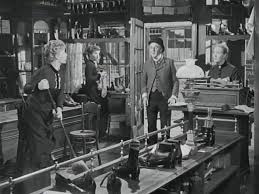
“Hobson’s Choice” (1954)
Drama

Running Time: 107 minutes
Written by: Wynyard Browne, David Lean and Norman Spencer
Directed by: David Lean
Featuring: Charles Laughton, John Mills, Brenda de Banzie, Daphne Anderson and Prunella Scales
Maggie Hobson: “I’ve been watching you for a long time and everything I’ve seen I’ve liked. I think you’ll do for me.”
Hobson’s Choice is one of the crowning achievements of British cinema, a richly entertaining and deeply humane comedy that perfectly balances sharp social satire, heartfelt romance, and subtle observations about class, family, and gender. Directed by David Lean in 1954 and adapted from Harold Brighouse’s beloved stage play, the film remains one of the finest literary adaptations ever produced. While Lean is often remembered today for his sweeping epics such as The Bridge on the River Kwai, Lawrence of Arabia, and Doctor Zhivago, Hobson’s Choice demonstrates that he was equally adept at intimate storytelling, finding remarkable cinematic possibilities within what might initially appear to be a modest domestic comedy.
Set in late Victorian Salford, the film explores the changing social landscape of England while never losing sight of its wonderfully eccentric characters. It is funny, touching, and surprisingly progressive, and nearly seventy years after its release it remains as fresh and relevant as ever.
The story centres on Henry Horatio Hobson, the blustering owner of a successful boot shop. Hobson is a widower whose business depends almost entirely upon the hard work of his three unmarried daughters and the extraordinary craftsmanship of his gifted but painfully shy bootmaker, Willie Mossop.
Hobson is a tyrant in his own household. Miserly, arrogant and stubborn, he refuses to allow his daughters to marry because they provide unpaid labour for both his home and his business. He firmly believes himself to be the unquestioned head of the family, and his booming confidence prevents him from recognising how completely he depends upon those around him.
His eldest daughter Maggie, however, has reached her thirtieth birthday and refuses to accept the future Hobson has planned for her. Intelligent, practical and fiercely independent, she makes a bold decision that shocks everyone around her. Recognising Willie’s hidden talent and gentle character, she proposes marriage to him—not from romance alone, but because she sees the opportunity to build a successful business together.
What follows is an enormously satisfying tale of determination, entrepreneurship and quiet revolution as Maggie and Willie gradually overturn Hobson’s assumptions about class, gender and social status.
Charles Laughton delivers one of the greatest comic performances in British cinema.
As Hobson, he creates a character who is simultaneously overbearing, ridiculous, infuriating and oddly sympathetic. Hobson is a bully whose excessive pride continually leads him into increasingly absurd situations, yet Laughton ensures he never becomes simply a cartoon villain.
His comic timing is impeccable. Every drunken stagger, every pompous declaration and every moment of wounded pride is delivered with astonishing precision. Lean frequently allows scenes to play out without rushing the punchlines, trusting Laughton’s extraordinary ability to control rhythm and pacing.
Perhaps the greatest achievement of the performance is that audiences gradually come to understand Hobson without necessarily liking him. His insecurities, fear of change and desperate need to maintain authority are recognisably human even as his behaviour grows increasingly foolish.
Laughton’s physical comedy is equally remarkable. His famous drunken walk through the deserted streets remains one of British cinema’s classic comic sequences, combining theatrical bravado with subtle character observation.
Although Laughton receives much of the attention, Brenda De Banzie gives what may actually be the film’s finest performance.
Maggie is one of the strongest female characters produced by British cinema during the 1950s. She is intelligent without arrogance, determined without cruelty and ambitious without selfishness. Rather than waiting for circumstances to improve, she simply decides to change them herself.
De Banzie never plays Maggie as domineering despite the character’s immense strength. Instead, she understands people better than anyone else in the story. She recognises Willie’s abilities long before he believes in himself, and she carefully nurtures his confidence rather than overwhelming him.
Her relationship with Willie forms the emotional heart of the film. What begins as a practical arrangement slowly develops into genuine affection built upon mutual respect rather than romantic fantasy.
For a film made in 1954, Maggie feels remarkably modern. She challenges traditional gender expectations not through speeches or rebellion but through competence, intelligence and unwavering confidence in her own judgement.
John Mills delivers one of the most charming performances of his career as Willie Mossop.
Initially Willie appears almost incapable of functioning independently. Timid, awkward and painfully lacking in self-confidence, he has spent years accepting Hobson’s constant insults as simply part of everyday life.
Mills perfectly captures Willie’s hesitant speech, nervous body language and overwhelming lack of self-esteem. Yet beneath the uncertainty lies genuine artistic brilliance. Willie is a master craftsman whose handmade boots are admired by wealthy customers, even though Hobson claims all the credit.
The pleasure of watching the film lies largely in observing Willie’s gradual transformation. As Maggie encourages him to believe in his own abilities, he slowly becomes a confident businessman, devoted husband and respected member of the community.
The performance avoids melodrama entirely. Willie’s growth feels believable because Mills allows confidence to emerge gradually rather than arriving suddenly.
Although Hobson’s Choice originated as a stage play, David Lean ensures the film never feels theatrical in the negative sense.
Lean opens up the story beautifully, using Victorian streets, bustling markets and atmospheric interiors to create a fully realised world. His camera moves with remarkable confidence through Hobson’s boot shop, transforming what could have been a static location into a dynamic working environment.
Every visual decision serves the story.
The boot shop itself becomes almost another character, representing Hobson’s authority while simultaneously revealing how dependent he is upon everyone working beneath him.
Lean’s direction demonstrates extraordinary confidence in performance. Rather than relying upon flashy camera techniques, he frequently uses carefully composed medium shots that allow actors to interact naturally. Comedy emerges from timing, character and situation rather than exaggerated visual tricks.
Yet Lean also knows precisely when to employ cinematic flourishes. The famous nightmare sequence, Hobson’s drunken wanderings and several beautifully composed street scenes reveal a filmmaker already developing the visual mastery that would define his later epics.
Jack Hildyard’s Academy Award-winning cinematography gives the film extraordinary visual richness.
The black-and-white photography perfectly captures industrial northern England while retaining a warmth that prevents the environment from appearing bleak.
Victorian streets possess remarkable texture, filled with smoke, brickwork and carefully observed architectural detail. Interior scenes are equally impressive, with naturalistic lighting creating depth throughout the crowded boot shop and Hobson household.
Lean and Hildyard make exceptional use of contrast, using shadows and carefully balanced compositions to emphasise emotional relationships between characters.
Even relatively simple conversations possess visual elegance.
One reason Hobson’s Choice has endured is that beneath its humour lies a surprisingly thoughtful examination of social change.
The film explores:
- Class mobility
- Women’s independence
- Economic self-determination
- Pride and humility
- Family responsibility
- The dignity of skilled labour
Unlike many social comedies, however, these themes emerge naturally through character rather than heavy-handed dialogue.
Maggie’s success challenges Victorian assumptions about women’s roles.
Willie’s rise questions rigid class structures.
Hobson’s decline illustrates the dangers of arrogance and refusing to adapt to changing times.
Remarkably, none of these ideas feel dated. Modern audiences can still recognise similar workplace dynamics, family conflicts and struggles for independence.
The supporting cast contributes enormously to the film’s success.
Prunella Scales and Daphne Anderson are delightful as Maggie’s younger sisters, each bringing distinctive personalities that avoid stereotype.
Helen Haye provides memorable warmth as Mrs. Hepworth, while Richard Wattis makes an entertaining appearance as the lawyer Vickers.
Every supporting character feels like part of a living community rather than simply serving plot functions.
The Blu-ray presentation allows modern audiences to appreciate the film’s craftsmanship more fully than ever before.
The restored black-and-white image is exceptionally detailed, revealing textures in costumes, architecture and facial expressions that were often softened on older home video editions. Fine grain is preserved naturally, giving the presentation an authentic filmic appearance rather than an artificially processed look.
Contrast is superb throughout, with deep blacks and bright highlights helping Jack Hildyard’s cinematography shine. Shadow detail is particularly impressive during the atmospheric night sequences, while daytime exteriors display remarkable clarity and depth. Damage has been carefully repaired without sacrificing the organic qualities of the original photography.
The mono soundtrack is clean and well balanced. Dialogue remains consistently clear, ensuring every witty exchange lands effectively, while the score and ambient effects complement the film without overwhelming it. Optional subtitles and any included supplements—such as commentaries, interviews or archival featurettes, depending on the edition—provide valuable insight into the production and the film’s enduring legacy.
Hobson’s Choice is one of the true masterpieces of British cinema. What begins as a delightful comedy gradually reveals itself to be a perceptive study of pride, independence and personal growth, all brought to life through David Lean’s assured direction and a cast performing at the peak of their powers.
Charles Laughton gives one of the finest comic performances ever captured on film, but the film belongs equally to Brenda De Banzie’s magnificent Maggie, whose intelligence, resilience and determination make her one of the great heroines of post-war British cinema. John Mills, meanwhile, provides the emotional anchor with a beautifully judged performance that charts Willie’s transformation from timid artisan to confident businessman with warmth and authenticity.
David Lean’s elegant filmmaking elevates the material beyond its theatrical origins, creating a richly textured portrait of Victorian England that is both visually sumptuous and emotionally engaging. Its humour remains genuinely funny, its observations about class and gender still resonate, and its celebration of self-belief and hard work has lost none of its appeal.
Nearly three-quarters of a century after its release, Hobson’s Choice remains an irresistible blend of laughter, heart and social insight. It is a timeless classic that showcases the very best of British filmmaking, and one that richly deserves its place among David Lean’s greatest achievements. For lovers of classic cinema, it is essential viewing and a film that rewards repeat visits with ever greater appreciation of its wit, craftsmanship and enduring humanity.