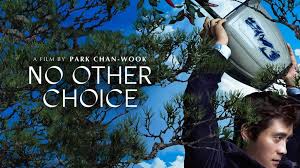
“No Other Choice” (2025)
Drama

Running Time: 139 minutes
Written by: Park Chan-wook, Lee Kyoung-mi, Don McKellar and Lee Ja-hye
Directed by: Park Chan-wook
Featuring: Lee Byung-hun, Son Ye-jin, Park Hee-soon, Lee Sung-min, Yeom Hye-ran and Cha Seung-won
“Losing your job is not the problem; the problem is with how you deal with it.”
Park Chan-wook’s No Other Choice arrives with the weight of enormous expectation. After decades of building one of the most distinctive careers in modern cinema through films like Oldboy, The Handmaiden and Decision to Leave, the South Korean master has reached a point where every new project feels less like a simple release and more like a cinematic event. Yet what is most remarkable about No Other Choice is not that it resembles the director’s earlier triumphs, but how confidently it shifts into different emotional territory while retaining his unmistakable fingerprints. The film is darkly funny, deeply unsettling, morally corrosive and unexpectedly sad, weaving social satire and psychological breakdown into a thriller that becomes increasingly impossible to shake off.
Based loosely on Donald E. Westlake’s novel The Ax, the story follows a middle-aged man whose life begins collapsing after he loses his job in a brutally competitive economy. What initially appears to be a familiar tale of unemployment and desperation slowly mutates into something far more disturbing. The protagonist convinces himself that survival requires ruthless action, and the film charts the terrifying ease with which ordinary frustrations can evolve into monstrous behaviour. Park handles this transformation with extraordinary control. He never rushes the descent, instead allowing each compromise to feel grimly logical until the audience suddenly realises how far both the character and the narrative have travelled into darkness.
The brilliance of the screenplay lies in its balance between absurdity and horror. There are stretches of No Other Choicethat feel almost like a black comedy about corporate culture and middle-class anxiety. Park has always possessed a wicked sense of humour, but here the comedy becomes especially acidic. Job interviews are staged like interrogations. Networking events resemble battlegrounds. Every interaction carries the underlying threat of humiliation. The protagonist’s desperation to remain economically relevant becomes simultaneously tragic and grotesque, reflecting a society where personal worth has become inseparable from productivity and status.
What makes the film so effective is that Park refuses easy moral simplifications. Lesser filmmakers might have turned the central character into either a sympathetic victim or a straightforward villain. No Other Choice instead traps the audience inside the unstable space between those extremes. The protagonist is selfish, manipulative and increasingly horrifying, yet Park continually reminds viewers of the social machinery that helped create him. The result is profoundly uncomfortable. The film never excuses evil, but it insists on examining the conditions that nurture it.
Visually, the film is another triumph of precision from Park Chan-wook. Every frame appears meticulously designed without ever feeling artificial. His compositions remain elegant and exact, using architecture, reflections and negative space to express emotional isolation. Offices become sterile prisons of glass and steel. Apartments feel cramped despite their apparent comfort. Even public spaces seem drained of warmth, reflecting the protagonist’s growing alienation from the world around him.
Park’s command of camera movement remains extraordinary. He glides through scenes with deceptive calm, often allowing the camera to move in ways that subtly reveal shifting power dynamics between characters. A conversation across a dinner table can become more suspenseful than an action sequence because the director understands exactly how to weaponise stillness and silence. There are moments in No Other Choice where a slight pause or sideways glance carries the emotional force of an explosion.
The cinematography deserves special praise for its use of colour and lighting. Park has always been a master of visual texture, and here he creates a world that feels simultaneously polished and rotten underneath. Cool corporate blues and greys dominate much of the film, punctuated by sudden bursts of warmer tones that often accompany moments of violence or emotional collapse. The contrast creates a constant visual unease, as though the film itself is struggling to maintain composure.
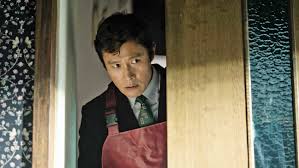
The performances are phenomenal across the board. The lead actor delivers one of the year’s finest performances, capturing the character’s gradual psychological deterioration with chilling subtlety. Rather than relying on grand emotional breakdowns, the performance is built from tiny shifts in posture, expression and vocal rhythm. Early scenes portray a man desperately trying to maintain dignity. Later scenes reveal someone whose moral boundaries have eroded so completely that he can barely recognise himself anymore.
What is especially impressive is how believable the transformation remains throughout. Even at the character’s worst moments, the performance retains traces of vulnerability and panic. This complexity prevents the film from slipping into cartoonish villainy. The protagonist is terrifying precisely because he remains recognisably human. He rationalises every terrible act with the same language of necessity and self-preservation that modern societies constantly encourage.
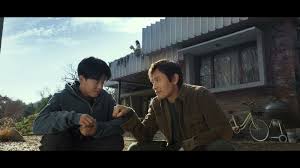
The supporting cast is equally strong, creating a social ecosystem filled with exhausted professionals, opportunists and emotionally detached authority figures. No one in No Other Choice feels entirely innocent. Even minor characters contribute to the film’s atmosphere of moral compromise and quiet desperation. Park populates the story with people who have learned to survive by suppressing empathy, and this collective emotional numbness becomes one of the film’s most disturbing elements.
Tonally, the film performs a delicate balancing act that few directors could sustain. Park moves effortlessly between satire, suspense, tragedy and horror without ever losing coherence. One scene may provoke uncomfortable laughter while the next leaves the audience horrified by what they have just found amusing. This manipulation of tone is one of the director’s greatest strengths. He understands that humour and violence are often psychologically intertwined, particularly in societies built on competition and repression.
The editing is razor sharp throughout. Park structures the narrative with increasing momentum, allowing tension to accumulate almost invisibly. Early scenes unfold with deliberate patience, immersing viewers in routines and frustrations. But as the protagonist spirals further into obsession, the pacing tightens and the film begins moving with frightening inevitability. By the final act, every scene feels charged with dread.
The score contributes enormously to the atmosphere. Rather than overwhelming scenes with melodrama, the music often operates with eerie restraint. Subtle motifs recur throughout the film, reinforcing the protagonist’s growing paranoia and emotional fragmentation. At times the soundtrack almost disappears entirely, leaving only ambient sounds that heighten the realism and discomfort of the violence.
One of the film’s greatest achievements is its relevance. While No Other Choice functions brilliantly as a thriller, it is equally powerful as a commentary on modern economic anxiety. Park explores the psychological damage caused by societies that define identity through career success and financial stability. The protagonist’s collapse is not simply personal but systemic. He inhabits a culture where failure is treated as shameful and disposability is normalised. The film suggests that beneath the surface of professional civility lies an environment driven by fear, resentment and predatory competition.
This thematic richness elevates the movie far beyond genre entertainment. Like the best works of Park Chan-wook, No Other Choice uses suspense and violence to interrogate deeper social and emotional realities. The film asks difficult questions about masculinity, self-worth and moral compromise without reducing them to simplistic messages. Its worldview is bleak, but never shallow.
There are echoes of other great films about alienation and desperation throughout the movie. One can sense traces of Parasite in its examination of class anxiety, hints of Falling Down in its portrait of male collapse and even shades of American Psycho in its satirical depiction of professional culture. Yet No Other Choice never feels derivative. Park synthesises these influences into something distinctly his own: elegant, vicious and emotionally devastating.
The violence, when it arrives, is handled with characteristic precision. Park has never treated brutality casually, and here every act of violence carries emotional and psychological consequences. Rather than functioning as spectacle, the violent scenes reveal the protagonist’s accelerating moral disintegration. The director understands that the anticipation of violence can be more disturbing than graphic imagery itself, and some of the film’s most unbearable moments occur before anything explicit happens.
Perhaps the most surprising aspect of No Other Choice is its sadness. Beneath the satire and suspense lies a mournful recognition of human fragility. Park depicts individuals trapped inside systems that reduce them to functions and statistics, leaving them emotionally isolated even from those closest to them. The protagonist’s crimes are monstrous, yet the film’s deepest horror may be the loneliness and emptiness that precede them.
By the conclusion, No Other Choice leaves viewers with no comforting resolution. Park refuses catharsis in the conventional sense. Instead, the ending lingers like a bad dream, forcing the audience to confront the moral compromises and anxieties that the film has exposed. It is an ending that feels both inevitable and hauntingly open-ended.
In many ways, No Other Choice represents another evolution for Park Chan-wook as a filmmaker. While it contains the visual sophistication and tonal audacity associated with his work, it also feels more restrained and mature in its emotional approach. The film trusts viewers to sit with ambiguity and discomfort rather than providing easy answers or sensationalism.
Ultimately, No Other Choice is a masterful piece of cinema: intelligent, unnerving and crafted with extraordinary confidence. It stands as one of the sharpest examinations of contemporary anxiety in recent years, wrapped inside a thriller that becomes increasingly horrifying precisely because it feels so plausible. Park Chan-wook once again proves himself one of the world’s essential filmmakers, capable of transforming social critique into something both viscerally entertaining and profoundly disturbing.
It is not an easy film to watch, nor is it intended to be. But for viewers willing to embrace its discomfort, No Other Choiceoffers a rich, uncompromising and unforgettable experience that lingers long after the credits roll.



Leave a Reply