• DVD review: “A Discovery of Witches: Season 1 – 3” (2018 – 2022)

    “A Discovery of Witches: Season 1 – 3” (2018 – 2022)

    Television/Drama/Fantasy

    3-stars

    Twenty Five Episodes

    Created by: Deborah Harkness

    Featuring:  Teresa Palmer, Matthew Goode, Edward Bluemel, Louise Brealey, Malin Buska, Aiysha Hart, Owen Teale, Alex Kingston, Valarie Pettiford

    Matthew Clairmont: “Once the world was full of wonders, but it belongs to the humans now. We, creatures, have all but disappeared. Daemons… vampires… witches… hiding in plain sight. Ill at ease even with each other. But, as my father used to say, in every ending, there is a new beginning.”

    There has been a real fascination with horror as well as fantasy stories since the dawn of the motion pictures as there has been in the written word, so it is logical that as the idea of peak television approaches that instead of adaptations going to the big screen they should end up on the small screen, not only on broadcast networks, but cable and now of course, streaming outlets. So it really is with little surprise as well as a small fanfare that Deborah Harkness’s ‘All Souls’ Trilogy should be brought to life on the small screen with her first book, “A Discovery of Witches” (2011) being turned into a series of the same name – with the other two following at a later date. To be fair if you have read or viewed other horror or supernatural novels/movies/series that involve any kind of monster then the stories being told here will not be new, in fact this new series plays out like an older more mature ‘Harry Potter’ or ‘Twilight’, although I for one found this new series a lot more like-able as well as more logical, less aggrandising as well as moving the plot along a lot more quickly – I found the aforementioned franchises plodding and drawn out to the extent that I was very happy they came to an end.

    This series is based around Diana Bishop, a historian and reluctant witch, unexpectedly discovers a bewitched manuscript in Oxford’s Bodleian Library. This discovery forces her back into the world of magic in order to unravel the secrets it holds about magical beings. She is offered help by mysterious geneticist and vampire, Matthew Clairmont. Despite a long-held mistrust between witches and vampires they form an alliance and set out to protect the book and solve the mysteries hidden within while dodging threats from the creature world.

    What is really different about “A Discovery of Witches” (2018-) is that it is all about adults, it is set in the real world, it involves witches as the mainstay of the series and it offers a very different glimpse into an original fantasy world. What is the same as any other fantasy narrative is that it does offer a heroes journey which is identifiable as well as atypical, it is all about a ‘chosen’ one’, it does offer cross species pollination which is now de rigueur for this genre and there is a larger mystery at play which will be revealed over time – I hope. What is great about this new series is that all of these very different elements compliment each other to provide something that is not only original but offers some real surprises from episode to episode, and I hope eventually from season to season.

    Another aspect of the show that I enjoyed was the slow revealing of the plot through the use of real locations across a few countries, which coupled with the very different actors provided the show with not only depth but breadth, something I think required for this new series to really set it up. It made a change from having people in a corner of a country or being transported to places through dubious magical means. “A Discovery of Witches” sets itself firmly in the real world with a nod to humans, who are not in danger, to the more fantastic elements that are set up in the first episode as well as laying the groundwork for the rest of the first season. The show also paints a picture of a group of beings who are all in peril with no one agreeing on what is occurring as well as what to do about it, which is in fact a reflection of a myriad of problems we face on a global scale, something that always works so well with the horror/fantasy genre. The other element of the show is that while it is does revolve around a main character who is a woman, it is also gives most of the power to women in just about all aspects with men attempting to hijack that power in many cases. Not only that but Diana Bishop has agency in all her decisions, she makes her own way through the first season with little fear or apprehension. These are all aspects that I enjoyed thoroughly and kept me engaged for most of the running time of the season.

    “A Discovery of Witches” is led by two very good actors in Teresa Palmer and Matthew Goode who have had chances in bigger budgeted fair but nothing has really hit, so they have been character actors in a great many other projects, however here they both get to shine together as well as separately in very different ways which is a gift for an actor over a number of episodes. In particular it is Palmer who has the heroes arc, she is young but ends up playing an old soul who has lost much but still has people around her for support who she does listen to which is something unique in this fantasy genre. Goode on the other hand has to be reserved for much of the series but does have moments of real emotion which have to be believable, luckily he is such a good fit that he has no issues in whatever he goes for within the character. Other highlights of the show are great English character actors Trevor Eve, Owen Teale, Alex Kingston Sophia Myles and Lindsay Duncan who all offer very different takes on archetypical genre characters, that could be bland but are all engaging in one way or another, especially in relation to the two main stars which is extremely welcoming.

    The look of the show is subdued as it should be with origins that derive from the gothic as well as having directors that are experienced in the sci-fi/horror/fantasy genre, which is exactly what is required to frame the performances around. They all coalesce well to have a narrative that is cohesive, easy to follow as well as engaging the audience for the run of the first season. There can be a tendency in genre narratives to set people against each other with a technique of hiding information from each other, here that does not happen, in most cases information is shared between the two central characters which again will lengthen the appeal of this new series.

    All in all this is a vey good first season and although it ends on a hard cliff-hanger which I am not fond of this is an engaging watch which I recommend audiences stick with, the good news is that it already has been renewed for a further two seasons which is success in anyone’s book.

    Episodes

    Season One

    1. Things get creepy for historian and closet witch, Diana Bishop, when she calls up a magical manuscript. Her discovery is about to throw her back into the world of magic and into the path of Matthew Clairmont, a centuries old vampire.
    2. As Matthew fights to control his cravings, he leaves Diana to face her enemies alone. And those include powerful witch Peter Knox.
    3. There is another dark turn in store for Diana when an alarming package is slipped under her door. Meanwhile, her relationship with Matthew moves forward, but something is about to happen that will cast them both further into danger.
    4. Diana gets a chilly welcome when she seeks safety at the Clairmont family home. Back in Oxford, trouble is brewing. Juliette shows up and throws Marcus’ life into danger, while Satu pays the price for her curiosity.
    5. Tensions between the creatures grow as the witches find out the vampires are studying DNA. Matthew crosses a line when he returns to Oxford. Diana discovers his dark past, before something unexpected tears them apart.
    6. Matthew and Baldwin race to save Diana from Satu’s dangerous dark magic. In Oxford, Sophie shocks Agatha with a confession.
    7. Diana’s aunts’ home gives up all sorts of secrets when Diana and Matthew pay a visit. Danger looms as Juliette breaks free from Gerbert.
    8. With danger at every turn, Diana and Matthew are forced to run. But will they escape in time?

    Season Two

    1. In Madison, Satu, Knox and Gerbert arrive at the Bishop house to find that Matthew and Diana have disappeared. The couple arrives in 1590’s London and are confronted by a face from Matthew’s past.
    2. As Diana continues her search for a mentor she meets a wealthy alchemist Mary Sidney. London’s vampire ruler demands fealty from Matthew.
    3. In the present, Domenico makes a disturbing discovery in Oxford. Back in 1590, Matthew must beg for forgiveness from Father Hubbard.
    4. Another vicious vampire murder rocks present-day Oxford. Marcus makes a breakthrough.
    5. Matthew and Diana arrive in France on their journey to face Philippe. Elsewhere, Louisa and Kit cut a swathe through London.
    6. Philippe makes a troubling discovery, provoking a conflict with Matthew. Ysabeau, Em and Sarah start to look for a message.
    7. Matthew and Diana go to Bohemia to search for Edward Kelley and the Book of Life. There, they encounter the strange Emperor Rudolf II.
    8. In 1590, Diana is transfixed as she tries to work out what the Book is telling her. Matthew worries over the Book’s power.
    9. As Diana and Matthew return to London, Diana learns news that could change everything. The Queen holds Matthew to account.
    10. Realising that she must return to the present, Diana aims to complete her training.

    Season Three

    1. Matthew and Diana return from Elizabethan London to find tragedy at Sept-Tours. Agatha challenges Knox in the Congregation. Diana learns she’s carrying twins.
    2. Diana is forced to make a confession to Matthew after the pair are shocked by the appearance of another familiar face – Jack Blackfriars.
    3. In New Orleans, Matthew and Marcus struggle to reconnect with Marcus’s children. In London, Diana and Phoebe find a lead in their hunt for the missing pages.
    4. Struggling to pin down T.J. Weston, Diana, Phoebe, and Sarah seek help from other witches. Benjamin has a proposition for Satu. Matthew finally returns home.
    5. Benjamin’s plan to bring down the de Clermonts is set into motion. Matthew and Diana return to Sept-Tours with the twins. Gerbert demands to examine the babies.
    6. After receiving Benjamin’s message, Matthew leaves Sept-Tours at dawn to track him down; Diana enlists Sarah’s help to finally get the Book of Life.
    7. As Benjamin tortures Matthew to near death, Diana makes plans to rescue him. Revelations from the Book of Life illuminate the long-hidden secrets of creatures.
  • DVD review: “Lewis: The Complete Series” (2006-2015)

    “Lewis: The Complete Series” (2006-2015)

    Television

    Forty Episodes

    Created by: Colin Dexter

    Featuring: Kevin Whately, Laurence Fox, Rebecca Front, Clare Holman, Angela Griffin and Steve Toussaint

    [examining the scene of a murder – the victim has been hit over the head with a large mirror]

    Dr. Laura Hobson: “The jugular vein and carotid arteries were sliced right through.”

    DS James Hathaway: “By a piece of the mirror?”

    Dr. Laura Hobson: “On reflection, yes.”

    DS James Hathaway: [groans] “It’s too early for jokes.”

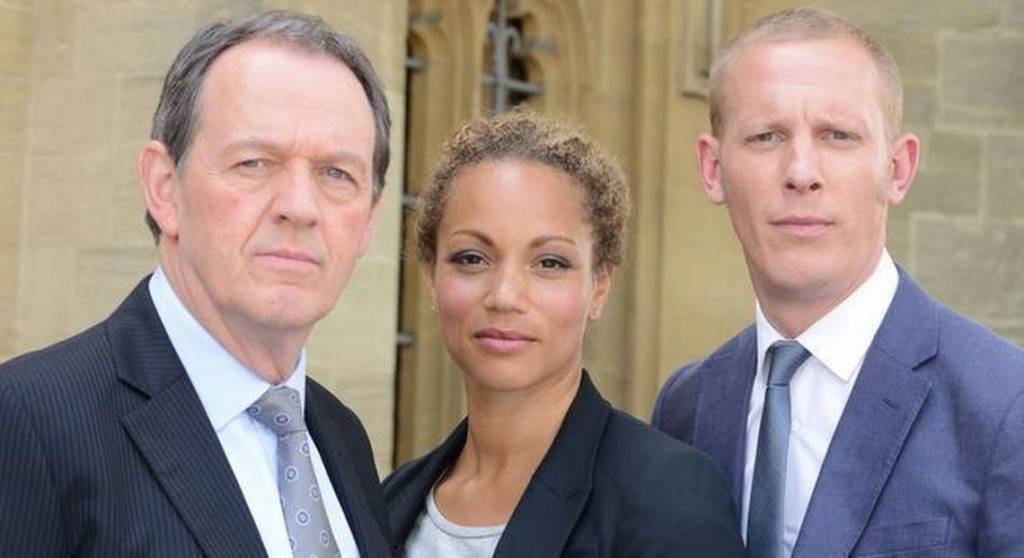
    Released recently on DVD is the entire series of the English crime drama “Lewis: The Complete Series” (2006-2015) which itself is a spinoff of the long running “Inspector Morse” (1987-2000) which featured John Thaw as Detective Chief Inspector Morse and Kevin Whately as Sergeant Lewis who were a mismatched pair that were always solving crime in Oxford.

    This new series sees the now promoted Detective Inspector Robbie Lewis, still played by the excellent Kevin Whately, now he is assisted by his partner D.S. James Hathaway played by newcomer (to the series) Laurence Fox who as an educated police officer does an excellent job acting the part Morse used to, which is still a priceless dynamic.

    As you would expect the relationship commences on a rocky note but as all odd couples do, both police officers find their feet over the series which, because of all those involved is done as smartly as possible with excellent directors and a great supporting cast with some excellent guest stars in each story. Together they investigate murder mysteries against the historic and glorious backdrop of Oxford and its University campus. With Clare Holman as Dr Laura Hobson and Rebecca Front as Chief Superintendent Innocent.

    It’s pretty simple in terms of whether you will enjoy this series, if you enjoy mysteries that are set in idyllic locations as well as a storied University with all that entails you will love this series. It has a number of excellent actors who take their job seriously so they inhabit their characters which is fun to watch. I had never watched much of “Inspector Morse” but when it came to this series I really enjoyed it and was sad when it ended.

    Episodes

    Series One

    Repuatation: DI Robert Lewis teams up with DS James Hathaway to look into the murder of an Oxford mathematics student.

    Whom the Gods Would Destroy: A middle-aged Oxford graduate is found murdered. The investigation implicates a senior university figure and leads to a long-hidden secret.

    Old School Ties: A former criminal computer hacker turned best-selling celebrity and one of his student sponsors are murdered after being invited to lecture at Oxford.

    Expiation: When an Oxford housewife is found hanged in her home, Lewis and Hathaway unearth a far darker murder case than the initial suicide verdict suggests.

    Series Two

    And the Moonbeams Kiss the Sea: The murder of a maintenance worker at the Bodleian Library and the death of a popular Art student seem to be linked.

    Music to Die For: Lewis investigates the garroting of an aging Oxford don planning an Wagnerian festival and discovers a tenuous connection to his former boss, Inspector Morse.

    Life Born of Fire: The suicide of Hathaway’s old friend tests his relationship with Lewis as he must come to terms with ambivalence about his own sexual past.

    The Great and the Good: Lewis and Hathaway become involved in the drugging and rape of a schoolgirl and discover that it is connected to several bizarre murders.

    Series Three

    Allegory of Love: The fabulously successful Oxford-based fantasy novelist seems to Lewis to be the key to solving the bizarre murder of a beautiful woman with a mirror.

    The Quality of Mercy: Lewis investigates the murder of student Richard Scott. He was killed just before premiering The Merchant of Venice. During the investigation Lewis gets personally involved.

    The Point of Vanishing: A former religious fanatic who deliberately tried to kill an outspoken atheist in a car crash but only succeeded in crippling his daughter is murdered.

    Counter Culture Blues: The lead singer of a 60s rock band who is believed to have committed suicide 35 years earlier suddenly materializes and wants to reorganize the group.

    Series Four

    The Dead of Winter: Murders occur in Crevecoeur Hall, a lavish Oxford estate where Hathaway’s father was in service and he spent his boyhood.

    Dark Matter: An Oxford professor, also an amateur astronomer and recently renewed churchgoer, is found dead in the school observatory under suspicious circumstances.

    Your Sudden Death Question: Six couples gather at Chaucer College for a competitive weekend 5000 pound trivia contest but several of the participants are summarily murdered.

    Falling Darkness: During a Halloween, one of Dr Hobson’s college roommates is found dead with a stake through her heart and a garlic bulb in her mouth.

    Series Five

    Old, Unhappy, Far Off Things: As the last remaining all-women’s college in Oxford is bidding farewell to one of its most distinguished professors, murder rears its ugly head.

    Wild Justice: During an ecumenical conference in formerly Catholic St. Gerard’s college, the poisoning of a female black American bishop triggers a series of bizarre murders.

    The Mind Has Mountains: The ethics of a questionable drug on the Oxford campus of anti-depressants calls into account the questionable judgment of a psychiatry professor.

    The Gift of Promise: When a retired MI5 official writes her best-selling memoirs, a chapter in her book about an unsolved IRA cold case causes consternation and ultimately several murders.

    Series Six

    The Soul of Genius: A scholar obsessed with Lewis Carroll’s poem “The Hunting of the Snark” is found buried in the botanical gardens frequented by the author during his life.

    Generation of Vipers: When it becomes widely known that a best-selling feminist author and lecturer has joined an Internet dating site, she apparently commits suicide.

    Fearful Symmetry: After a pretty graduate student moonlighting as a baby sitter is found bound on a bed and smothered, it is found that she posed for provocative bondage photos.

    The Indelible Stain: A visiting lecturer at the college of criminology who holds controversial theories on genetic predisposition toward criminal behavior is found hanged.

    Series Seven

    Down Among the Fearful: A psychic, Randolph James, is found dead in his consulting rooms, murdered. Upon investigation it is discovered that he was living a double life: he is actually Rueben Beatty, a psychological researcher.

    The Ramblin’ Boy: When a body discovered in a wooded area is found already embalmed, the logical conclusion is that a murder victim must have been cremated in his place.

    Intelligent Design: The day after an alcoholic college professor who killed a young girl in a drunken accident is released from prison and returns home, he is run over by his own car.

    Series Eight

    Entry Wounds: Hathaway has been promoted to inspector after an extended break, and Lewis is enjoying retired life until he’s asked to team up with his old colleague again.

    The Lions of Nemea: After Lewis returns to his old job, he, Hathaway and DS Maddox are swept up in another murder investigation when an American classics student is killed.

    Beyond Good and Evil: Lewis’ reputation is jeopardized when the very first case that he solved as a DI is reopened for appeal and new murders are committed with the original weapon.

    Season Nine

    One for Sorrow: Lewis and Hathaway are called in to investigate the apparent death by drug overdose of over achieving student and amateur taxidermist Talika Desai.

    Magnum Opus: When College Dean Phil Beskin is found bludgeoned to death with a rock in local woodland, Lewis and Hathaway are called in to investigate.

    What Lies Tangled: When an idyllic Oxford summer’s day is torn asunder by a gruesome parcel bomb, Lewis and Hathaway are called in to investigate.

  • DVD review: “Good Girls: Season Three” (2020)

    “Good Girls: Season Three” (2020)

    Television/Drama

    Eleven Episodes

    Created by: Jenna Bans

    Featuring: Christina Hendricks, Retta, Mae Whitman, Reno Wilson, Manny Montana, Lidya Jewett, Isaiah Stannard and Matthew Lillard

    Jane Boland: [narrating] “Girls today can be anything. CEO, Olympic gold medalist, even a Supreme Court Justice. We’ve finally broken that glass ceiling. And, wow, sure looks good from the top.”

    “Good Girls” (2018-present) follows three suburban Michigan mothers, two of whom are sisters, who are having a hard time trying to make ends meet. They are tired of having everything taken away from them so they decide to pull off an unlikely heist by robbing a supermarket, only to discover that they’re in for more than they bargained. Their successful robbery attracts the attention of the store manager after he recognizes one of the women, but for a different reason altogether than just the money.

    Generally network television doesn’t get much attention anymore as most of the trending and cool series are streaming, further from the pressures of supposed public decency, where TV is freer to be weird and dangerous. What a nice surprise it is, then, that there’s a show on network television that is daring and full of fun, that often feels as nervy as anything on HBO. That is there are precious few things but this new series is definitely worth a watch and is available now on DVD.

    “Good Girls” definitely borrows from other series, but what it does with those revisited tropes feels fresh and exciting. The series, created by Jenna Bans, has a nice coil to it, tense enough that cliff-hanger endings land with a crack, but loose enough that there’s room for playfulness, for sweetness, for discursive ramble that the show’s three leads maneuver with natural charm.

    Those performers are the major asset of Good Girls. Christina Hendricks takes the first-among-equals lead as Beth, a harried mother of four who realizes she maybe wouldst like to live deliciously as she takes a spin around the room with the devil. She’s the Walter White of the group, I guess, and Hendricks is great at communicating that dawning appetite for dark energy, the sudden conflict between Beth’s settled life and the one that until recently she never dared to imagine. Hendricks also has an irresistible chemistry with Manny Montana as a local gangster who becomes Beth’s main antagonizer and enticer. Their circling of one another, juggling threat and flirtation, is the stuff of perfect TV drama, sophisticated in its soapiness.WATCH NOW: 

    As Ruby, mother to an ailing daughter and the moral compass of the three women, Retta richly expands on her Parks and Recreationappeal, deftly crafting a complicated marital bond with Reno Wilson and managing all of Ruby’s gnawing, mounting worry with sharp humor. It’s a thrill watching an actor prove their range, and Retta would be on Emmy shortlists were there any justice in this world.

    Mae Whitman rounds out the trio as Beth’s scrappy sister, Annie, a single mom with an anarchic streak that is sometimes the teensiest bit cartoony, the show’s most frequent indulgence. Otherwise, though, Whitman is just as dialed-in as the other two; when the three of them are together, bickering and negotiating and consoling, the show hums along. They get able support from Wilson, Montana (swoon), Zach Gilford, David Hornsby, Matthew Lillard (yes!!), and especially this season, Allison Tolman as another exhausted mother hip to the crimes being perpetrated and wanting her cut for staying quiet. It’s a really well-curated group of actors, all reveling in the clever contours of the writing.

    Episodes:

    Find Your Beach: A new season of scheming begins as the ladies work to perfect their craft. Beth grapples with guilt and grief – and faces an unexpected visitor.

    Not Just Cards: Beth makes a choice that surprises those around her just as an old foe from the past returns; Annie finds a helpful outlet on her road to self improvement. 

    Egg Roll: A desperate Beth does everything she can to stay alive while dealing with the unexpected challenges of being a boss and finds help in the least likely of places.

    The Eye in Survivor: Beth takes a gamble to strike a new business deal, but it has consequences that put the women in an unwelcome position; Ruby worries her lifestyle is rubbing off on her family; Annie realizes that she has a crush on her therapist.

    Au Jus: Sick of working for Rio, the women take drastic measures to strongarm Lucy, their unwitting partner in crime, with gruesome results.

    Frere Jacques: Max’s emotional search for Lucy creates a moral debacle for Beth, Ruby and Annie. Meanwhile, Stan receives an update regarding his suspension.

    Vegas, Baby: The ladies consider their next move – with Max. Stan explores the risks and rewards of a new proposition. Dean stages a professional shake-up.

    Nana: Beth meets the boss and he asks her to do one more assignment which turns out to be collecting Annie’s old boss Leslie “Boomer” but he wants to see his Nana before anything happens.

    Incentive: Beth decides to find a solution to her Rio problem after he backs her into a corner; Ruby enlists Sara as reluctant help to replenish supplies after a key counterfeiting component dries up.

    Opportunity: Beth puts her plan for Rio in motion. The Hills meet the family of Sara’s kidney donor. Annie gets overwhelmed as she studies for her GED test.

    Synergy: Ruby and Stan seem to be at a crossroads; Beth and Dean make Gayle an offer she can’t refuse; FBI agent Finnegan tries to worm her way into the girls’ world.

  • DVD review: “Keeping Faith – Season 1 – 3” (2021)

    “Keeping Faith – Season 1 – 3” (2021)

    Television Drama

    Twenty Episodes

    Created by: Matthew Hall

    Featuring: Eve Myles, Hannah Daniel, Matthew Gravelle, Bradley Freegard, Mark Lewis Jones, Mali Harries and Aneirin Hughes

    Megan: “People just don’t go missing, even I know that.”

    Released recently on DVD is season 1,2 and 3 of the Welsh drama “Keeping Faith” that features Eve Myles in the lead role playing a complex character in a very complex television show.

    Faith, a small-town Welsh lawyer, is forced to cut short her extended maternity leave when her husband and business partner, Evan, disappears whilst she is on maternity leave following the birth of their third child. As the truth of his actions surface, Faith must fight to protect her family and her sanity.

    The second season picks up 18 months after the cliffhanger of the first season, we find Faith reassembling her life after Evan’s unexpected return — and outrunning the demons he brought with him — while plunging into a new mystery.

    While the first series was united by a central mystery, the second series without this felt messy and chaotic, with great performances unable to save the show from feeling more like a mess of stuff rather than a series with momentum and an engaging throughline.While this may not be the case, season one felt like a complete story that season two sometimes struggles to follow up.

    There is no doubt that while this is a finely crafted show by people who definitely know what they are doing and hopefully where they are going this show rest on the performance of Eve Myles who has been many places in her career, finding herself at the centre of a bonafide hit both in terms of the number of viewers and it becoming a critical darling.

    Episodes

    Season One

    1. Fun-loving Faith Howells is drawn into a mystery when her husband and business partner, Evan, vanishes. While searching for the truth, she uncovers secrets about his life and questions how well she really knows the man she loves.
    2. With Evan (Bradley Freegard) still missing, Faith (Eve Myles) represents a reformed criminal named Steve Baldini (Mark Lewis Jones), who may know something about her husband’s disappearance. Back at the office Tom (Aneirin Hughes) makes a troubling discovery in the company archives that will upset Faith’s trust of her husband, while DI Susan Williams (Eiry Thomas), a vindictive police officer who has crossed swords with Faith in the past, begins turning her attention towards Faith’s recent behaviour.
    3. With her husband still missing, Faith (Eve Myles) finds herself suspected of his murder by an old adversary. At work she defends a priest accused of petty theft while at home a showdown with her mother in law uncovers a long-buried family secret.
    4. Faith begins to understand that Evan has been involved in collusion with a notorious criminal family and finds herself drawn into Abercorran’s sinister underbelly. Meanwhile DI Williams continues to build her case against Faith and a search is mounted for Evan’s body in the local quarry.
    5. Despite being shaken by the aftermath of the break-in, Faith decides to represent an elderly farmer caught in a dispute with a ruthless landowner. Arthur receives a mysterious package, while Dr Alpay names a price for information about Evan, and Faith receives a disturbing visit from Gael Reardon.
    6. When Evan’s car is found abandoned at the docks, Faith is hauled in again for police questioning. Steve risks his life to help and finds himself in Williams’ firing line; Bethan’s erratic behaviour threatens her marriage, while Williams resorts to new tactics to break Faith.
    7. Following the crash, Williams resorts to dirty tricks to shift the blame onto Faith. Terry looks into Dr Alpay’s background and finds an ally in DCI Parry, and Delyth makes a shocking discovery in Evan’s will. Faith and Cerys push for a court hearing to get the children back.
    8. Faith fights for her children in a heated court battle that risks tearing the Howells family apart. Steve makes a desperate and deadly pact with his former employers to secure Faiths’ freedom. Faith finally learns the truth behind Evan’s disappearance.

    Season Two

    1. We return to the story of Faith Howells some 18 months after her husband Evan returned to Abecorran in time to see his wife in the arms of Steve Baldini. Evan has pulled Faith into a dark and dangerous world and she’s still paying the price.
    2. After Madlen sacks her lawyer, Faith, supported by Cerys, step in and accept her murder case, which leads to conflict with Tom. In prison, Evan receives good news from a mystery person, Steve still holds a candle for Faith, while the tense relationship between Faith and Gael Reardon catches DI Breeze’s attention.
    3. Just before Faith is due to appear in court she must take her son to the hospital. So Madlen testifies despite Faith’s objections. Steve meets Faith and tells her news about Evan.
    4. Faith fights to keep her family together and restrain her feelings for Steve as Evan’s release date approaches. PC Williams has news that threatens to swing Madlen’s case.
    5. Faith reveals worrying news as she continues to explore Madlen’s case, the Reardons threaten to ruin the Corran Energy deal, and Steve tries to play a dangerous game.
    6. Faith races against time to find the woman who could overturn Madlen’s conviction.

    Season Three

    1. Faith and Evan’s divorce and custody battle goes from bad to worse. Faith juggles being a mother and a lawyer, and an unwanted visitor returns.
    2. Unsettled by Rose’s reappearance in her life, Faith struggles to keep everything together and focus on Osian’s case. Evan decides to keep a closer eye on Faith’s every move.
    3. As Faith’s mind is on helping Mike get justice for Osian and keeping Rose away from her family, she loses sight of the effect the divorce is having on her children.
    4. Faith and Cerys fight for Osian at the Court of Appeal. Faith meets up with a friend from the past to get information on Rose. Evan continues to keep a watchful eye on Faith.
    5. As Faith ignores her attempts to make amends Rose puts the second stage of her plan into action, putting Steve and Evan’s futures in jeopardy. Time’s running out for Osian.
    6. Rose’s revenge steps up a gear and sees Faith having to fight for all that’s dear to her. Does Rose have more guts than Faith gives her credit for?

  • Blu-ray review: “Barabbas” (1961)

    “Barabbas” (1961)

    Biblical Drama

    Running Time: 137 minutes

    Written by: Nigel Balchin, Diego Fabbri, Christopher Fry and Salvatore Quasimodo based on Barabbas by Pär Lagerkvist

    Directed by: Richard Fleischer

    Featuring:  Anthony Quinn, Silvana Mangano, Katy Jurado, Arthur Kennedy, Harry Andrews, Ernest Borgnine, Vittorio Gassman and Jack Palance

    Pontius Pilate: “It seemed to me at the time, Barabbas, when you were given your liberty before, it wasn’t a fortunate exchange. They were calling for death and disorder when they called your name. This is what I thought and this is what has occurred. They put the scourge back into the fist. By that I mean you and your life. And many men have suffered and died in consequence.”

    Barabbas: [referring to Christ] “The other man, too. They’re dying because of that.”

    Critical Commentary

    Released recently on the Imprint label on Blu-ray is the Biblical epic “Barabbas” (1961) featuring Anthony Quinn in the titular role of a thief who is saved from crucifixion in place of Christ who suffers guilt for the rest of his life, a kind of survivors guilt. It’s literary source material is rock-solid, though: an eponymous Nobel Prize-winning 1950 source novel by Pär Lagerkvist, which was incidentally adapted into a 1953 Swedish film shot by cinematographer Sven Nykvist. The novel is built on antithesis: Jesus dies first among the three crucified – Barabbas dies last. Jesus dies among several of his friends – Barabbas dies alone. Jesus talks to God – Barabbas talks to the darkness. The novel starts with Jesus’ crucifixion and ends with Barabbas’ crucifixion in Rome.  The novel provoked a discussion among Swedish critics about religious matters, such as belief, doubt and the question of suffering in christianity. Some critics discussed it in the light of the existential wounds caused by World War II.

    “Barabbas” begins with Pontius Pilate who offers to release either Jesus of Nazareth or Barabbas, in keeping with the Passover custom. The crowd gathered for the pardoning chooses Barabbas, and Jesus is condemned to crucifixion. Returning to his friends, Barabbas asks for his lover, Rachel. His friends inform him that Rachel has become a follower of Christ. Rachel soon returns, but she is not happy to see Barabbas. Barabbas witnesses the crucifixion of Jesus. As Jesus dies, the sky turns black, and Barabbas is shaken. He watches Christ’s body sealed in the tomb. On the third morning, Barabbas finds the tomb open. Rachel tells him that Christ has risen, but Barabbas says it is an illusion or his followers have stolen the body. He visits the apostles; they do not know where he is, but also believe he is risen. From here we witness the fate of Barabbas of his life, it is better not to spoil this as the impact of the film I think depends on not knowing this story.

    “Barabbas” stands reasonably tall as an engaging and uplifting film whose spectacle and atmosphere outpace its script, but is largely led by Quinn’s reliably strong lead performance and a handful of memorable supporting roles filled out by the likes of Arthur Kennedy, Jack Palance, Ernest Borgnine, and others.

    For its time and considering this is a Hollywood movie“Barabbas” is a actually a very dark movie with a plot and themes that underly that. When Rachel is stoned, the camera doesn’t flinch from showing just how cruel an execution that was.  Nor does the camera flinch from the violent brutality of the gladiatorial games.  When Barabbas is sold into slavery, the sulfur mines of Sicily are depicted in Hellish detail and practically the only thing that saves Barabbas from spending the rest of his life being smothered under a cloud of sulfur is a giggly Roman woman who decides to buy Barabbas so that he can serve as a good luck charm.  The scenes of Barabbas’s skill of a gladiator are contrasted with the bloodthirsty crowd demanding and cheering death.  Even when Barabbas joins the Christians in the Roman catacombs, he discovers that they want nothing to do with him, suggesting that they believe in forgiveness for everyone but him.  The spectacle of Rome is displayed but so is the terror of what lies underneath the city’s ornate surface.  If Barabbas is occasionally a ruthless or unsentimental character, one need only look at the world he lives in to understand why.

    With the exception of a few slow scenes at the start of the film, director Richard Fleischer does a good job of keeping the action moving.  It’s a long film but it never becomes a boring one.  In the end, thanks to Quinn’s performance and the film’s unflinching portrayal of life in ancient Rome, “Barabbas” is a biblical epic for people who usually don’t like biblical epics.

    Technical Commentary

    Video

    “Barabbas” arrives on blu-ray with a caveat right of the bat even before the movie begins viewers are greeted with the following disclaimer before the main feature begins: “Due to the original source materials, viewers may notice some imperfections in the presentation of this film. The best available master from the copyright owner has been used.” Again this a pretty huge understatement, as “Barabbas” looks several generations removed from what its Technicolor roots actually deserve and suffers from most or all of the same immediately noticeable drawbacks as that other linked title. Fine detail, textures, contrast, density, black levels, and more are all well below average, and the regular appearance of edge enhancement and macro blocking once again rears its ugly head.

    Audio

    “Barabbas” has a substandard LPCM 2.0 track, the overall fidelity and presence have drawbacks and real dynamic range issues that combine to make an underwhelming listenable experience. Light hissing, popping, crackling, and other subtle distractions are regularly presence, as is a cramped high end that slightly hinders louder conversations, action, and the original score by composer Mario Nascimbene.

    Special Features

    • Audio Commentary – This track pairs up film historians Barry Forshaw and Kim Newman (recorded together), both of whom offer a solid mixture of comments that range from casual to informative.
    • Film Historian Sheldon Hall on “Barabbas” – Another familiar face from previous Imprint releases, Hall as usual takes a more formal and businesslike approach during this mid-length interview, also comparing and contrasting it to other religious epics. 
    • Richard Fleischer: Looking Back – Fleischer speaks quietly but candidly about his life’s work including earlier possible career paths, his favourite projects, battles with studio heads, happy accidents, stories about his contemporaries, the changing face of cinema, and other interesting topics from his 41-year career. 
  • Blu-ray review: “Nobody’s Fool” (1994)

    “Nobody’s Fool” (1994)

    Drama

    Running Time: 110 minutes

    Written and directed by: Robert Benton based on Nobody’s Fool by Richard Russo

    Featuring: Paul Newman, Jessica Tandy, Bruce Willis, Melanie Griffith, Dylan Walsh, Pruitt Taylor Vince, Gene Saks, Josef Sommer, Philip Seymour Hoffman and Philip Bosco

    Carl Roebuck: “Sixty years old and still getting crushes on other men’s wives. I would hope by the time I’m your age, I’m a little smarter than that.”

    Sully: “Can’t hurt to hope. You sure are off to a slow start.”

    Released recently on Blu-ray on the Imprint label is the excellent drama “Nobody’s Fool” (1994) featuring Paul Newman in one of his best roles with an absolutely fantastic supporting cast that all raise their own performances to match the acting legend. The film itself is based on the novel by Richard Russo and while the screenplay and novel do differ the film retains the themes and nature of the source material. 

    “Nobody’s Fool” is a film that is so well constructed and layered with multiple stories that it may seem that it was easy to construct or that this perceived simplicity reduces the film to something light and effortless. But this is not that film, what is easy is that watching this film draws you into these people’s lives, it becomes a genuine pleasure to spend time with them from the very start to the end. 

    Both written and directed by Robert Benton who over his career made some of the greatest dramas seen on film and worked with some of the best actors in cinema. Not only was he at the beginning of the ‘New Hollywood’ by writing “Bonnie and Clyde” (1967) but he was able to have a career right through to today with every iteration and business change in Hollywood with seemingly little effort. Not only that most of his films were successes moneywise but they become social juggernauts, just one example is the Oscar winning “Kramer vs. Kramer” (1982) which looked at divorce with a child at the centre.  

    “Nobody’s Fool” is based around Donald “Sully” Sullivan a stubborn old reprobate living in the peaceful, snowy northern New York state village of North Bath. He freelances in the construction business, usually with his dim-witted friend Rub by his side. He is often at odds with Carl Roebuck, a local contractor, suing him at every opportunity for unpaid wages and disability. Sully’s one-legged lawyer Wirf is inept, and his lawsuits are repeatedly dismissed. As a way to irritate him, Sully openly flirts with Carl’s wife Toby at every opportunity (which she enjoys). He is a regular at the Iron Horse Saloon, where he often has drinks and plays cards with Wirf, Carl, Rub, Jocko the town pharmacist, and Ollie Quinn, the town’s Chief of Police. This is a film about Sully as well as all the people he encounters coupled with life in an actual small town, it is on one hand an imagined Americana but it is also something some people will be able to identify with which in turn is something quite pure. 

    Paul Newman is simply brilliant as the rumpled Sully, he was nominate for his last Oscar for this role, that was the last of his eight Oscar nominations for Best Actor. Newman completely embodies Sully, wearing him as comfortably as he wears his scuffed and tattered old clothes, and never for a minute looks like he’s acting. Acerbic and cantankerous one minute and rueful, tender, and wise the next, Newman speaks sparingly, yet his actions speak volumes about who Sully was, who he is now, and who he hopes to become. I’ve always admired Newman’s work, but never more so than here. His performance is a master class in understatement. In her final role, the incredible Jessica Tandy is also incredible sparring with Newman like she is half her age. Then there is Bruce Willis who was paid scale for his role and was uncredited just for the chance to work with Newman, I mean who wouldn’t. Melanie Griffith makes an appearance as Toby, Willis’s wife who has an uneasy relationship with Sully and who plays the role as a sexy wife who wonders if she has settled for the wrong man, while Sully gives as good as he gets. Newman makes everyone better as I have already stated. 

    As I have said this is such an easy movie to fall in love with, I remember seeing it in cinemas, and I was a huge Paul Newman fan, this only cemented his career at the time, he could go on to act in challenging movies until his death. Many similar films like “Nobody’s Fool” are not cynical at all and make us, in the times we live in, remind us of how we can be as people used to be and still can be. This is a movie that exists at a time when we as people were not so polarised, I can easily believe that the character’s in this film are both on the left or right but still get on and if I can say love each other on their own way. I recommend this film highly, it is a standout for all those involved and is a nadir for many of them.

    Technical Commentary

    Video

    Paramount Pictures has been taking great care of its catalogue titles of late, and the top-notch 1080p/AVC MPEG-4 transfer of “Nobody’s Fool” is a perfect example of the studio’s superior stewardship. Vibrant, sharp, and packed with colorful accents that perk up the dreary winter canvas, this beautiful presentation instantly draws us into the intimate tale and holds our gaze from beginning to end. Faint grain preserves the film-like feel of this transfer that remains remarkably consistent throughout and faithfully honors John Bailey’s naturalistic cinematography.

    Audio

    Movies like “Nobody’s Fool” usually don’t require a DTS-HD Master Audio 5.1 track, but this mix subtly enhances the drama. Though most of the sound is front based, the lyrical score by Howard Shore enjoys a lovely surround presence. A wide dynamic scale handles all of its highs and lows without a hint of distortion, while sonic accents like a falling tree branch, shattering glass, cinder blocks crashing onto the flatbed of a pickup truck, the rumble of a snowblower, sirens, and a single gunshot are crisply rendered. Subtleties like footsteps crunching in the snow, faint honking horns, and the din of a diner are also distinct, and all the marvelous dialogue is clear and easy to comprehend. An LPCM 2.0 stereo track is also included for those who want to replicate the original theatrical experience, but hearing the score in multi-channel surround sound is a simple yet palpable pleasure that should not be missed.

    Special Features

    • Audio Commentary 
    • Featurette: “Nobody’s Fool: A Conversation with Catherine Dent” 
    • Featurette: “The Origins of Nobody’s Fool: A Conversation with Richard Russo” 
    • Featurette: “Somebody’s Spool: Interview with editor John Bloom” 
    • Theatrical Trailer
  • 4K Blu-ray Review: “Almost Famous” (2000)

    “Almost Famous” (2000)

    Drama

    Running Time: 161 minutes

    Written and directed by: Cameron Crowe

    Featuring: Patrick Fugit, Billy Crudup, Frances McDormand, Kate Hudson, Jason Lee, Anna Paquin, Fairuza Balk, Noah Taylor and Philip Seymour Hoffman

    Penny Lane: “I always tell the girls, never take it seriously, if ya never take it seriosuly, ya never get hurt, ya never get hurt, ya always have fun, and if you ever get lonely, just go to the record store and visit your friends.”

    Critical Commentary

    Released recently on 4K Blu-ray is the now classic “Almost Famous” (2000) which is now over twenty years old and has become Cameron Crowe’s best and most personal film. A “semi-autobiographical” look at his own life as a teenager writing for Rolling Stone magazine, we get to follow a different band (not the Allman Brothers Band), but this is one of those films with your typical “the characters and events in this film do not represent real people and events, and any coincidences are purely coincidental” disclaimer that exists solely to prevent lawsuits. Apparently, far too many of the events in this film are based on the real life events Crowe saw firsthand while, even if characters are mish-mashes of famous people, and the events from his entire career are crammed into this single tour.

    “Almost Famous” is based around a fifteen year old in 1973, with a controlling mother (Frances McDormand), and a sister who had to escape the crazy household (Zooey Deschanel), William Miller (Patrick Fugit) is hardly your ordinary teen. He’s been writing about music ever since his sister gave him her record collection, and has been sending his newspaper clippings to people in the industry. His enthusiasm lands him an assignment to cover Black Sabbath, but fate (and an asshole security manager) intervene, and instead, Miller finds himself implanted with the up-and-coming rock band Stillwater. It’s his job to write a three thousand word article (which may land the band on the cover of the magazine), when he’s never written more than a couple of pages, but this assignment of a lifetime will also prove to be an education that couldn’t be found in public school, full of life lessons, new friends, and insight into the music industry he idolizes.

    There is no doubt that “Almost Famous” is a nostalgic look back through a certain time in rock ‘n roll history, possibly through rose coloured glasses especially in terms of sexual revolution, gender rights, artists rights, money, friendship, personal responsibility, greed and any number of elements in life. Certainly some parts of this movie have aged badly, some have not. It would be nice to think the music was a pure form of art, which is something Crowe attempts to clumsily say, but even the main character can see that commerce is linked to it, and sometimes is far more important than it. Also the idea that Penny Lane and her crew are the ones in control is a complete joke and the musicians use of them is not altruistic but possibly a form of rape. At the time these musicians were becoming successful they were selling millions of albums and making huge amounts of money something really not addressed in this movie, which is easy to do because they are all made up. The great thing about “Almost Famous” is that it is possible to move beyond that as there are other parts that are very easy to enjoy. This is something that Crowe does well, think about all his other films, there are some very distasteful aspects to them that are glossed over by performance, music and humour. As time has moved on for him and societies point of view has changed it is harder to hide them, think the controversy with “Aloha” (2015) and his series “Roadies” (2016). One might argue that these are real events and so are not negative, the problem is he has dressed up realness with fakeness in terms of real places, people and bands. When you fake the identities you are giving people an excuse to enjoy some pretty distasteful behaviour. Think about how women are treated in all his movies, they are hassled by men until they give in or the opposite, they are infatuated with a man.

    In terms of casting Patrick Fugit is perfect, a fresh face in a difficult role, a child among men, while Kate Hudson is at her peak, back when she was someone who tried to challenge the authority shown in the film. The main members of Stillwater (Billy Crudup as Russell Hammond, Jason Lee as Jeff Bebe, with supporting actors filling out the group, and manager Dick Roswell as played by Noah Taylor) are wonderful in their roles, while Frances McDormand is quite believable as an uptight, controlling mother. Don’t forget the sheer star power hidden in this film, in the lesser roles. Phillip Seymour Hoffman is a scene stealer every time he appears as Creem editor Lester Bangs, and a fun spot from Jimmy Fallon where he works best, while the band-aids group includes Bijou Phillips, Anna Paquin, and Fairuza Balk. We also see early in their career appearances of Jay Baruchel, Eion Bailey, Terry Chen, Rainn Wilson, and one of the few film appearances of Mitch Hedberg, on top of numerous, numerous musician cameos and supporting roles.

    The music in the film feels real, perhaps because legendary musicians helped teach the actors how to be believable, while the music itself was written by Crowe, his wife, Nancy Wilson of Heart, and Peter Frampton, and with guitars recorded by a member of Pearl Jam, Mike McCready.

    “Almost Famous” is a great piece of fiction based on reality, a more fairytale piece of history that leaves almost everything distastful out of the narrative, which explains why many love it.

    Technical Commentary

    Video

    “Almost Famous” arrives on Ultra HD with a great-looking HEVC H.265 encode, giving fans a welcomed step-up over the previous mediocre Blu-ray although it’s not the huge improvemnt we’ve come to expect of the format. Coming from a brand-new remaster of the original 35mm camera negatives and approved by director Cameron Crowe, the native 4K transfer shows a nice uptick in overall definition. But, on the whole, the picture falls on the softer side, littered with several poorly-resolved sequences that are comparable to its BD predecessor, and this is especially true with the added footage for the “Bootleg Cut”. Overall contrast enjoys a nice though mild boost with cleaner and a tad more energetic whites, but it’s a relatively minor jump and not by much. On the whole, the 4K video appears flat and muted due to the aforementioned creative visuals. Specular highlights and brightness levels are greatly impacted by these stylized choices, causing the hottest spots to noticeably bloom and lose some of the finer details, like the various light fixtures throughout. Meanwhile, blacks tend to be drabber and murkier for a good chunk of the runtime but also slightly truer in some articles of clothing. Shadow delineation is strong but not significantly improved. 

    Audio

    “Almost Famous” has same DTS-HD Master Audio 5.1 soundtrack enjoyed on the Blu-ray. A a new Dolby Atmos option would have been an upgrade, this lossless track remains an excellent and plenty satisfying mix, which stays true to the film’s original front-heavy design, exhibiting superb clarity and definition in the mid-range.

  • Blu-ray review: “The Music of Chance” (1993)

    “The Music of Chance” (1993)

    Drama

    Running Time: 98 minutes

    Written by: Paul Auster, Belinda Haas and Philip Haas based on The Music of Chance by Paul Auster

    Directed by: Philip Haas

    Featuring: James Spader, Mandy Patinkin, M. Emmet Walsh, Charles Durning, Joel Grey, Samantha Mathis and Chris Penn

    Jack Pozzi: “No Problem partner I’ll show you my stuff you’ll be so impressed your mouth will drop right out of your head”

    Critical Commentary

    Released recently on Blu-ray on the Imprint label is the drama “The Music of Chance” (1993) based on a novel by Paul Auster and directed by Philip Haas which is extremely faithful to its source material. The film is a conundrum in that it has much that is appealing in a very good cast but veers off course a little as seemingly random events happen to drive the plot which at times seems a little unearned. An example of this are the main characters, Jim and Jack, who reveal isolated pieces of their past, but we never get a firm handle on who they are and what motivates them, this prevents us from forming any emotional attachments to them.

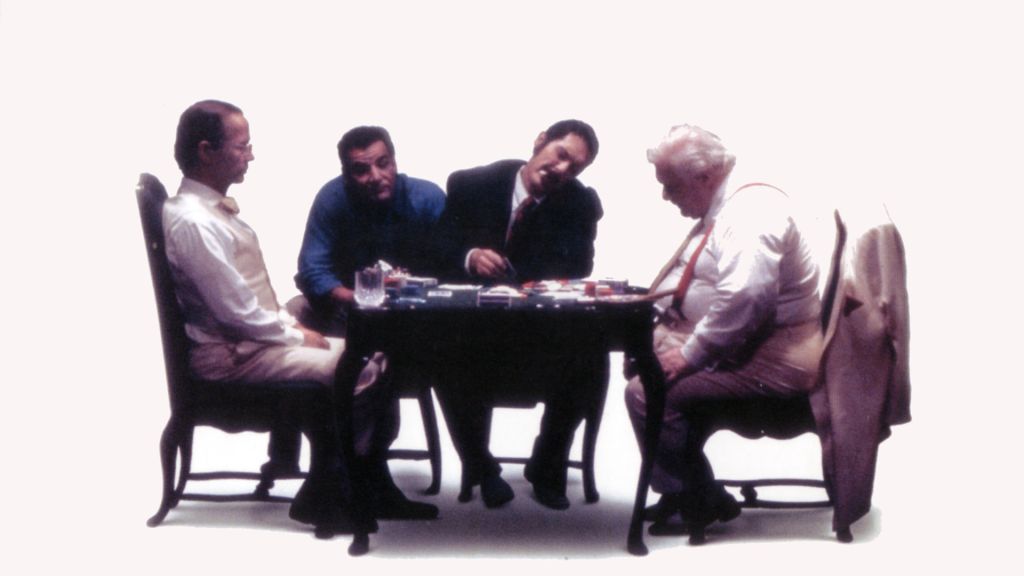
    “The Music of Chance” can, like many films, be seen on many levels. At its most literal, it’s about the consequences of losing a poker game, which leads to the building of a wall. There is another level to analyse which is important as it reveals something about how people think their lives will go or actually are. Life itself However, for those who peel back the straightforward plot to peer at what lies beneath it, more imposing and thought-provoking issues are revealed. The Music of Chance explores how one moment can forever alter — and perhaps destroy — lives. It also reinforces the old saying that luck is too capricious a force to trust.

    “The Music of Chance”  revolves around drifter Jim Nashe (Patinkin), who has just squandered a sizable inheritance, picks up Jack Pozzi (Spader), a battered, bruised, and broke gambler, on the side of a country road, neither can imagine how drastically their lives will change. Jack bemoans his lack of funds and inability to afford the $10,000 buy-in to play poker with Bill Flower (Durning) and Willy Stone (Grey), a couple of eccentric millionaires, at their remote estate. “It’s the chance of a lifetime,” Jack says. Jim agrees to front Jack the cash he needs for what Jack believes will be an easy score, but after starting strong, a string of bad hands cleans Jack out. Jim even sells his car to Flower and Stone in a desperate attempt to get Jack back on track, but Lady Luck abandons them. Now destitute and owing thousands to their gloating, fiendish hosts, Jim and Jack are forced into servitude to settle their debt. They reluctantly sign a contract that requires them to spend 50 days building a massive wall in a barren field from a pile of 10,000 stones supposedly culled from a 15th-century Irish castle. Though the hard-labour sentence bonds Jim and Jack, the back-breaking work breaks both their spirits in different ways over time.

    All of the great actors in this film obviously enjoyed taking part in something quite unique with very individual takes on their own characters which is something they must have relished and it is fun seeing them going down very different roads. Of course when actors are given leeway they sometimes go to broad and it could be said that they all do this except for Mandy Patinkin who, like he does in some of this roles, goes for a minimalism that is may be too small compared to the others. 

    Metaphors abound, from the “wailing wall” to the “City of the World” being built by Willie Stone. In fact, there’s so much symbolism that little in this movie has a single, straightforward meaning. There are times when the screenplay tries too hard to be intellectual, spouting such nonsense as prime numbers having souls, but these isolated instances in no way detract from the deeper meaning of the overall story. Character motivation and interaction are driving forces, and necessary for an understanding of everything that happens during “The Music of Chance”.

    Technical Commentary

    Video

    Mediocre is the best adjective to describe the 1080p/AVC MPEG-4 transfer, which is underwhelming at best and often looks faded and worn. No remastering or clean-up seems to have been performed on the source material, resulting in an image that’s missing the sharp lines and enhanced clarity of typical high-def renderings. The natural grain structure produces a film-like picture, but some shots exhibit more texture than others and a nagging fuzziness sporadically plagues the presentation. If you’re a fan of this 1990s curio, you’ll be disappointed by this lacklustre treatment.

    Audio

    The LPCM 2.0 stereo track supplies clear, well-modulated sound that’s devoid of any age-related hiss, pops, or crackle. All the conversations are clear and easy to comprehend and the myriad pregnant pauses are clean. Effects are limited in this dialogue-driven film, but screeching car wheels, fisticuffs, breaking dishes, and the sounds of stones crunching against each other are distinct.

    Special Features

    • Audio Commentary by film critic A.S. Hamrah
    • “Chance and Destiny,” a video essay by film scholar Adrian Martin and film critic 
    • Cristina Álvarez López
    • “A Character at a Time”: Interview with actor Joel Grey
    • “Defining the Character”: Interview with actor M. Emmet Walsh
    • “Music for Misguided Tasks”: Interview with composer Phillip Johnston
  • Blu-ray/DVD Review: “Memoria” (2021)

    “Memoria” (2021)

    Drama

    Running Time: 136 minutes

    Written and directed by: Apichatpong Weerasethakul

    Featuring: Tilda Swinton, Elkin Díaz, Jeanne Balibar, Juan Pablo Urrego and Daniel Giménez Cacho

    Older Hernán Bedoya: “I remember everything, so I limit what I see.”

    Released on Blu-ray and DVD recently was the latest film from the Thai filmmaker Apichatpong Weerasethakul, “Memoria” (2021), his first real foray into English language cinema. The themes of his work often involve dreams, nature, sexuality and Western perceptions of Thailand and Asia, his films display a preference for unconventional narrative structures and for working with non-actors. However here in “Memoria” he is working with a major actor in Tilda Swinton who is as you would expect excellent in a role that demands, although as she has proved time and again is up to any challenge. If there is one thing “Memoria” will do it is challenge audiences who have not been exposed to foreign film or to anything outside a Western ideal of film.

    “Memoria” is based around one major character in Jessica, a Scottish expatriate to Colombia, she awakens one night to a single loud boom. She appears to be the only one who can hear it. The next day, she goes to visit her sister, Karen, who is ill and in a hospital in Bogotá. Jessica operates a market-flower business in Medellín, and is curious to learn more about an excavation project being carried out in the same hospital where her sister is being treated. Still bothered by the sound, which she hears repeatedly and which prevents her from sleeping, Jessica seeks the help of a young sound engineer named Hernán to recreate the sound. Though unsuccessful at first, the two eventually approximate the sound, and begin a friendly relationship. Right before they are to take a trip together, Jessica looks for Hernán at his sound engineering studio, only to discover that he is not there and no one working there knows who he is. From this point the film becomes a mystery with some sci-fi elements as well, I will not give nay spoilers as this will ruin any outcome. 

    Rarely have a filmmaker and performer been so completely on the same page as Swinton and Apichatpong are here. She is mesmerizing in how she plays unsettled more than panicked. Some actresses would have leaned into the relative insanity of Jessica’s predicament, but Swinton carries it in a concerned look or a tightened posture. In the final act, as the film becomes more symbolic and less linear, she holds it together for the viewer, keeping us connected to the immediacy of what’s happening to her. “Memoria” is a sensory experience, but it takes a performer like Swinton to amplify Joe’s technique. We’re not just hearing the babbling brook and chirping birds on a soundtrack—we’re hearing them through Jessica’s ears. Swinton’s performance is the anchor to everything else happening within the film, but it is both actor and filmmaker who seem to share a connection to what it wanted and what occurs.

  • DVD review: “Good Girls: Season 1 – 4” (2018-2022)

    “Good Girls: Season 1 – 4” (2018-2022)

    Television/Drama

    Fifty Episodes

    Created by: Jenna Bans

    Featuring: Christina Hendricks, Retta, Mae Whitman, Reno Wilson, Manny Montana, Lidya Jewett, Isaiah Stannard and Matthew Lillard

    Jane Boland: [narrating] “Girls today can be anything. CEO, Olympic gold medalist, even a Supreme Court Justice. We’ve finally broken that glass ceiling. And, wow, sure looks good from the top.”

    “Good Girls” (2018-2022) follows three suburban Michigan mothers, two of whom are sisters, who are having a hard time trying to make ends meet. They are tired of having everything taken away from them so they decide to pull off an unlikely heist by robbing a supermarket, only to discover that they’re in for more than they bargained. Their successful robbery attracts the attention of the store manager after he recognizes one of the women, but for a different reason altogether than just the money.

    Generally network television doesn’t get much attention anymore as most of the trending and cool series are streaming, further from the pressures of supposed public decency, where TV is freer to be weird and dangerous. What a nice surprise it is, then, that there’s a show on network television that is daring and full of fun, that often feels as nervy as anything on HBO. That is there are precious few things but this new series is definitely worth a watch and is available now on DVD.

    “Good Girls” definitely borrows from other series, but what it does with those revisited tropes feels fresh and exciting. The series, created by Jenna Bans, has a nice coil to it, tense enough that cliff-hanger endings land with a crack, but loose enough that there’s room for playfulness, for sweetness, for discursive ramble that the show’s three leads maneuver with natural charm.

    Those performers are the major asset of Good Girls. Christina Hendricks takes the first-among-equals lead as Beth, a harried mother of four who realizes she maybe wouldst like to live deliciously as she takes a spin around the room with the devil. She’s the Walter White of the group, I guess, and Hendricks is great at communicating that dawning appetite for dark energy, the sudden conflict between Beth’s settled life and the one that until recently she never dared to imagine. Hendricks also has an irresistible chemistry with Manny Montana as a local gangster who becomes Beth’s main antagonizer and enticer. Their circling of one another, juggling threat and flirtation, is the stuff of perfect TV drama, sophisticated in its soapiness.WATCH NOW: 

    As Ruby, mother to an ailing daughter and the moral compass of the three women, Retta richly expands on her Parks and Recreationappeal, deftly crafting a complicated marital bond with Reno Wilson and managing all of Ruby’s gnawing, mounting worry with sharp humor. It’s a thrill watching an actor prove their range, and Retta would be on Emmy shortlists were there any justice in this world.

    Mae Whitman rounds out the trio as Beth’s scrappy sister, Annie, a single mom with an anarchic streak that is sometimes the teensiest bit cartoony, the show’s most frequent indulgence. Otherwise, though, Whitman is just as dialed-in as the other two; when the three of them are together, bickering and negotiating and consoling, the show hums along. They get able support from Wilson, Montana (swoon), Zach Gilford, David Hornsby, Matthew Lillard (yes!!), and especially this season, Allison Tolman as another exhausted mother hip to the crimes being perpetrated and wanting her cut for staying quiet. It’s a really well-curated group of actors, all reveling in the clever contours of the writing.

    Episodes:

    Season One

    Pilot: A Fine & Frugal grocery store is robbed by three masked women. Flashbacks show Beth Boland is a mother of four and her husband Dean owns a car dealership. Her sister Annie works at the Fine & Frugal and is a single mother. Her ex-husband Gregg plans to sue for custody of their child, Sadie, which she can’t afford. Their friend, Ruby, works as a waitress and is the mother of two children, one of whom is ill and needs expensive medication. Beth finds out Dean is having an affair, took out several mortgages and is about to lose their house.

    Mo Money, Mo Problems: Beth and Annie reveal to Ruby that they are holding Boomer captive in Beth’s backyard in the children’s tree-house. When the ladies meet at the diner to discuss how to pay the gang back, Rio tells them they have until the next day to pay them. Ruby comes up with a plan to ransom Boomer and get his wealthy grandmother Marion to pay. They attempt to break in, but discover that she is home. Pretending to be home helpers, they snoop around the apartment, but Beth refuses to steal. Rio and the gang show up the next day and the ladies try to appeal to him with antique figurines Annie stole from Marion.

    Borderline: Beth explains to the ladies that Rio wants them to travel to Canada and bring a package back for him. In exchange, he will clear them of their debt. In need of a car, the ladies steal one from Dean’s dealership, unaware of Boomer following them. Once they get to Canada, the man who is supposed to give them the package refuses to do so. Ruby decides to scare him with Stan’s gun, but accidentally shoots him in the foot.

    Atom Bomb: Beth discovers one of Rio’s associates wounded in her daughter’s bed. Rio tells the ladies he will pay them if they let his friend hide out there. But upon waking up, the confused man leaves in a frenzy. Beth’s son wants a lavish birthday party and Dean promises him one. Ruby deals with a rude customer and, when he burns his hand on a skillet, is accused of neglect. Refusing to apologize, Ruby is fired.

    Taking Care of Business: FBI Agent Turner asks the Bolands if they have noticed any suspicious activity in the neighborhood and Beth says no. Shortly thereafter, bags of money that need to be cleaned show up in the trunks of the ladies’ cars. They meet with Rio and discuss their concerns about the FBI. He dismisses their worries and tells them they have to find a way to pay him back. The ladies execute their plan to buy a large amount of appliances with the fake cash. Annie meets an employee at the electronics store and has a one-night stand with him.

    A View from the Top: The FBI finds the car that the ladies ditched after their trip to Canada. Ruby thinks the ladies should quit the money laundering business and explain to Rio that they want out. However, at the meeting, Beth instead asks for more money to launder. The ladies bring in help to clean the money faster, using the cover of a secret shopper ring. Agent Turner visits Dean and tells him that Beth was the one who stole the car from his dealership. Dean covers for his wife, but confronts her about it and merely assumes she was taken advantage of by Rio.

    Special Sauce: Dean confronts Beth over her actual work, but she refuses to give him any information. The ladies expand the secret shopper cover so they can clean the money even faster. The FBI picks up the gang member that previously stayed at the Boland’s and coerce him into helping with their case against Rio. Rio and his crew unexpectedly show up at Beth’s and reveal how fake bills were slipped in with the real cash. The ladies confess their secret shopper scam and Rio demands the name of the person who cheated him so he can “handle it”.

    Shutdown: Beth realizes all the fake money she has been storing is missing. She meets with Rio, who tells her that he is temporarily shutting down his operation due to pressure from the FBI. The ladies are forced to return to their “old” lives for income. One month later, the ladies are short of their next payment to Mary Pat. At Sarah’s soccer game, Mary Pat spots Ruby and Stan and hints she will go to the police if she does not get paid. The ladies decide to commit another robbery to get the cash. Ruby finds out Sarah has been shoplifting at school and takes her to the local police station so she can be “scared straight”.

    Summer of the Shark: The ladies discuss telling Rio that his associate, Eddie, flipped on him to the FBI. When Rio asks them to pick up some trucks for him, the ladies are unsure. Ruby decides to get stoned with Stan and inquire if the cops know about the trucks. Assured that the police don’t know anything, the ladies go through with the plan and each drive off in a truck. However, Beth is pulled over and, believing she will be arrested, instructs the ladies to look after her kids. After seeing Mary Pat at the store and Annie paying for her groceries, Boomer gets more information on her. Later, he attends Mary Pat’s church and sparks a conversation with her, leading him back to her house. While alone, he sets up a recording device in her living room.

    Remix: While the ladies ponder ways to turn Rio in without incriminating themselves, Rio meets with Agent Turner and threatens him. With a kidney available for Sara, Ruby and Stan intentionally write a bad check. Later, Annie devises a plan to rob the grocery store again as a means to get the money for Ruby while also leading the FBI to Rio’s illegal business. This time, Annie stays on duty to help Ruby secure the cash. Annie is caught by Tyler, but she tells everyone he heroically saved her in exchange for his silence.

    Season Two

    I’d Rather Be Crafting: Beth must live with the fallout after her plan to get Rio arrested fails. Meanwhile, the women’s crimes finally catch up with them when evidence surfaces that puts them on a collision course with Agent Turner.

    Slow Down, Children at Play: Rio forces Beth, Annie, and Ruby to solve a problem with a possible witness, which challenges the women’s morality. Meanwhile, Annie is in an awkward position with Greg and Nancy.

    You Have Reached the Voicemail of Leslie Peterson: Tensions between the women, Boomer and Mary Pat reach a boiling point. Beth must intervene when Kenny gets in trouble at school.

    Pick Your Poison: Beth’s personal interactions with Rio lead to a fracture with her sister, Annie; the affair between Annie and Greg comes to a head; Ruby seizes an illegal opportunity to pay off a debt.

    Everything Must Go: Beth has to rely on Dean as Turner gets closer to the truth but instead of comfort, she finds a troubling secret about Dean when a past familiar face returns.

    Take Off Your Pants: Beth and Dean experience growing pains settling into their new roles at work and at home. The women realize Rio has flipped his game yet again, as Turner targets Ruby and Stan.

    The Dubby: When Rio gives her an assignment, Beth is forced to take her kids with her. Under pressure from Turner, Ruby crosses a line there’s no coming back from. Annie meets her new manager at Fine and Frugal.

    Thelma and Louise: Beth and Ruby’s friendship fractures just as Dean’s vendetta against Rio compromises the women’s business dealings. Nancy, on the verge of giving birth, needs Annie’s help.

    One Last Time: Stan faces the consequences for his role in Ruby’s criminal dealings; Dean gives Beth an ultimatum. Greg clashes with Annie’s new boyfriend.

    This Land Is Your Land: With Beth determined to lead a new crime-free life, a desperate Ruby and Annie go behind her back to strike a new deal with Rio.

    Hunting Season: Rio uses a series of unnerving tactics to remind Beth that it’s not as easy to walk away from his criminal enterprise as she’d like it to be. Annie learns something new about Noah; Ruby makes a reckless decision to save Stan.

    Jeff: Mary Pat resurfaces in the women’s lives as they try to make sense of a shocking discovery Beth has made. Beth and Dean have an important family talk with the kids. Annie and Noah try to work through their problems.

    King: Turner has Beth in checkmate; the women must contend with a rotten egg from the past. Rio makes a grand gesture for Beth. A new business opportunity presents itself.

    Season Three

    Find Your Beach: A new season of scheming begins as the ladies work to perfect their craft. Beth grapples with guilt and grief – and faces an unexpected visitor.

    Not Just Cards: Beth makes a choice that surprises those around her just as an old foe from the past returns; Annie finds a helpful outlet on her road to self improvement.

    Egg Roll: A desperate Beth does everything she can to stay alive while dealing with the unexpected challenges of being a boss and finds help in the least likely of places.

    The Eye in Survivor: Beth takes a gamble to strike a new business deal, but it has consequences that put the women in an unwelcome position; Ruby worries her lifestyle is rubbing off on her family; Annie realizes that she has a crush on her therapist.

    Au Jus: Sick of working for Rio, the women take drastic measures to strongarm Lucy, their unwitting partner in crime, with gruesome results.

    Frere Jacques: Max’s emotional search for Lucy creates a moral debacle for Beth, Ruby and Annie. Meanwhile, Stan receives an update regarding his suspension.

    Vegas, Baby: The ladies consider their next move – with Max. Stan explores the risks and rewards of a new proposition. Dean stages a professional shake-up.

    Nana: Beth meets the boss and he asks her to do one more assignment which turns out to be collecting Annie’s old boss Leslie “Boomer” but he wants to see his Nana before anything happens.

    Incentive: Beth decides to find a solution to her Rio problem after he backs her into a corner; Ruby enlists Sara as reluctant help to replenish supplies after a key counterfeiting component dries up.

    Opportunity: Beth puts her plan for Rio in motion. The Hills meet the family of Sara’s kidney donor. Annie gets overwhelmed as she studies for her GED test.

    Synergy: Ruby and Stan seem to be at a crossroads; Beth and Dean make Gayle an offer she can’t refuse; FBI agent Finnegan tries to worm her way into the girls’ world.

    Season Four

    One Night in Bangkok: The pressure is on after Lucy’s body is discovered in a graveyard. Beth and Dean do everything they can to get Boland’s Bubbles up and running but encounter red tape. Harry gets in trouble and his teacher encourages Ruby and Stan to get him tested.

    Big Kahuna: A huge client approaches Dean to sell his merchandise at Boland’s Bubbles, but Beth is hesitant. Stan and Ruby’s guilt reaches a breaking point when Sara’s donor family returns. Annie tries to prove to Ben that she can keep up with the rich parents at his school.

    Fall Guy: Beth and Dean deal with the aftermath of his arrest. The ladies must find a fall guy to take Dean’s place. Ruby enlists Stan’s help in getting dollar bills to implicate the new fall guy. Annie feels a growing distance between herself and Ben. 

    Dave: Phoebe inches closer to the trio’s entire operation, which allows the Secret Service to make an interesting deal with Beth. Stan’s boss forces dangerous errands. Ruby imagines a new life for them. Annie struggles with the possibility that her son no longer needs her.

    The Banker: The Secret Service pushes Beth into hot water as the unexpected happens. Ruby catches Stan in a lie and begins to doubt his faithfulness. Annie volunteers to babysit for Nancy and finds help from a surprising source.

    Grandma Loves Grisham: The women take matters into their own hands. Beth meets Rio’s boss, who is not what she expected. Annie secretly retakes the GED. Ruby encourages Stan to step up. Dean works through his trust issues.

    Carolyn with a Y: Ruby and Annie get frustrated with Beth. Things change when Rio asks Beth to recruit a new team member. Stan is wary of involving Beth in new business. Annie is convinced to pull Ben from private school.

    Broken Toys: Flashbacks reveal the road that led Rio to his present life. Beth gets a surprise visit from Nick, who warns her against a relationship with Rio. Dean is roped into a pyramid scheme by his biker gang.

    Chef Boyardee: The Secret Service makes a sudden decision. Tensions begin to rise between Beth and Stan. Annie tackles Ben’s school financial aid problem. Dean is unsatisfied with his new role.

    Strong Hearts Strong Sales: Things become more complicated for the women under Rio’s thumb. Stan offers the ladies an unconventional idea. Annie’s new living arrangement causes more problems than anticipated.

    Put It All on Two: The trio must find a way to smuggle the fake cash, but things are further complicated when Stan gets involved. Annie reluctantly agrees to go to dinner with Kevin. Ruby discovers something horrifying. Beth and Dean reach a breaking point.

    Family First: A frustrated Rio takes matters into his own hands. More complications arise as the strip club undertakes some trouble. Dean forges an unexpected alliance with Stan.

    You: Rio inserts himself in the girls’ new business to Beth’s dismay. Phoebe discovers a bombshell in the case and returns to Detroit.

    Thank You for Your Support: Beth runs for City Council as tensions rise between Nick and Rio. Nancy, down on her luck, offers Annie some unlikely relationship advice. Ruby becomes suspicious of Stan’s new venture.

    We’re Even: The girls are forced into a heist by the Secret Service. Ruby tries to repair Beth and Stan’s relationship. Rio offers an unexpected proposal. Stan and Dean form an alliance.

    Nevada: Beth and Rio form a surprise alliance, but don’t anticipate the shocking consequences. Beth realizes the women’s problems will never go away. Ruby makes a tough decision. Annie is ready to start anew when reality catches up to her.

  • Blu-ray review: “Whore” (1991)

    “Whore” (1991)

    Drama

    Running Time: 85 minutes

    Written by: Ken Russell and Deborah Dalton based on Bondage by David Hines

    Direcetd by: Ken Russell 

    Featuring: Theresa Russell,  Antonio Fargas, Jack Nance, Danny Trejo and Ginger Lynn Allen

    Man in Car: “I wanna fuck you up the ass!”

    Liz: “You can stick it up your own, asshole!”

    Man in Car: “Ha ha ha ha ha, I would if I could, bitch!”

    Critical Commentary

    Released recently on the Imprint label on Blu-ray is the film “Whore” (1991) directed by Ken Russell who at this stage of his career was more as a curio, less as an actual director so by the early 1990s, Russell had become a celebrity: his notoriety and persona attracted more attention than his recent work. He became largely reliant on his own finances to continue making films. Many of his films at this stage on onward into the first ten years of the 21st century are a far cry from his work up to this point, which is our loss as Russell had a keen sense of right and wrong which he would put on display within cinema. For me “Whore” represents one of the last true high points of his career, I also have a soft spot for it as it was the last Ken Russell film I saw upon its initial release. I have also been a fan of Theresa Russell for years and any chance to see her in either a new film or a re-release is one that I take with vigour.

    “Whore” was based on a the stage play/monologue ‘Bondage’, which was written by a London a taxi driver named David Hines based on his conversations with a London hooker. The filmic adaptation, penned by Ken Russell and screenplay Deborah Dalton, modernises the setting and moves the locale to then contemporary early 90’s where a rough and ready prostitute named Liz whom we catch up with as she attempts to evade her violent, controlling pimp Blake. This setting is not really unique but it does mean that we are with Liz for the entire movie, we experience everything through her eyes as she, literally talks us through most situations, we also experience flashbacks of her life and experiences with some meaning to explain at least part of how she arrived at her current situation.  

    It would be easy to say that the movie was some kind of docu-drama or that the techniques that were used were to legitimise it in some way, but in my mind this is not the case, just because the main character breaks the fourth wall does not mean it is aspiring to look or feel like a documentary. In fact in breaking the fourth wall and talking to the audience is more like the reality of Liz’s time with her clients, whilst the artifice would seem to decrease as Liz talks to us in fact if anything it is reinforcing what she does every day. I would think that Liz is so used to lying about herself and her world most of what she tells us is not true. When we see her with her clients or even her supposed friends she is telling them what they want to hear whether it be a fantasy or her situation within the world. If anything the stories Liz tells us get wilder and wilder as the movie continues, she is trying to up the stakes with every encounter.

    I really enjoyed Theresa Russell in this movie, it seems suited for her and to her way of acting, not only that she is in every scene which makes her performance all the more impressive. There are a multitude of other characters that appear with Liz such as a hippie (Tom Villard) who roles up in a VW Beetle, another smiley creep looking for anal, and Liz attempting to stop a streetwalker from bleeding to death after she’s stabbed on the street (Ginger Lynn Allen). There’s also some terrific cameos by way of late Jack Nance, Danny Trejo as a tattoo artist, John Diehl as a derelict, and Antonio Fargas as a Rasta street-urchin whom Liz continually encounters on her street walking adventures. 

    Ken Russell has a reputation for making films that challenge not only conventional storytelling but also taboo subjects, when you couple those two elements together you have some very special movies and their success depends upon how well everything comes together in a complete package. This is the reason Ken Russell’s films can be divisive as well the overall quality being a bit sporadic. Making movies is expensive and when you have an auteur like Russell he requires time and the two do not necessarily compliment each other. In an earlier part of his career “Whore” would have been a very different film, but the director and his cohorts obviously believe in his vision and so this movie is the best it could be with the resources at hand. Whilst this is definitely low budget Russell does not rely on the overuse of graphic imagery to make the movie titillating or anything else a lesser director may use. What Russell does do is incorporate any nudity or sex scenes as part of the plot and narrative and in fact there really is not much sex or nudity considering the name of the movie.

    Apparently there are three known cuts of the film, there was the original full-strength cut, an R-rated cut, and the NC-17 version, and what we get on disc here is the NC-17 cut which is reportedly trimmed by a few seconds compared to the original version, this is what I gather from reading about it as I’ve never seen it, but the uncut version has seemingly only ever been released on VHS and has never had a proper disc release. 

    Whore (1991) is a wonderfully vulgar and uniquely executed slice of voyeuristic cinema that gives a disturbingly intimate fly-on-the-wall portrait of the seedy life of a sex worker. Theresa Russell absolutely dominates the film and gives a strangely charming turn as the jaded non-nonsense prostitute who encounters all manner of violent perverts and scuzzy street urchins while trying to turn a buck. This is the first time that Ken Russell’s film has been available in widescreen HD and Imprint Films do it up right with a proper special edition with a fantastic set of extras and attractive packaging that should make this a highly desirable release. 

    Technical Commentary

    Video

    The NC-17 version of Whore (1992) makes it’s HD debut on region-free Blu-ray in 1080p HD widescreen (1.85:1), looking like an older HD master lacking the refinement, punchier details and tighter visuals a newer scan could offer, but is still quite pleasing with accurate looking colors and modest depth and clarity. The fine grain levels look consistent and fine detail is fairly strong throughout.

    Audio

    Audio comes by way of uncompressed English LPCM 2.0 stereo with optional English subtitles, the dialogue driven film sounds quite nice, as does the score from composer Michael Gibbs (Madame Sin), and there are no issues with hiss or distortion that I ascertained during my viewing. 

    Special Features

    • 1080p High-definition presentation on Blu-ray
    • Audio commentary by film critics Alexandra Heller-Nicholas & Josh Nelson
    • Artist – interview with actress Theresa Russell
    • Dignity – interview with actress Ginger Lynn
    • Raw – interview with writer Deborah Dalton
    • Provocateur – X-rated auteur Bruce La Bruce on Ken Russell’s Whore
    • Legitimate and Illegitimate Women in Ken Russell’s Whore – video essay by author/critic Kat Ellinger
    • Theatrical Trailer
    • Original Aspect Ratio 1.85:1
    • Audio English LPCM 2.0 Stereo
  • Blu-ray review: “Bloody Sunday” (2002)

    “Bloody Sunday” (2002)

    Drama

    Running Time: 111 minutes

    Written & directed by: Paul Greengrass based on Eyewitness Bloody Sunday by Don Mullan

    Featuring: James Nesbitt, Tim Pigott-Smith, Nicholas Farrell, Gerard McSorley and Kathy Kiera Clarke

    Ivan Cooper: “I just want to say this to the British Government… You know what you’ve just done, don’t you? You’ve destroyed the civil rights movement, and you’ve given the IRA the biggest victory it will ever have. All over this city tonight, young men… boys will be joining the IRA, and you will reap a whirlwind.”

    Critical Commentary

    Released recently on Blu-ray on the Imprint label is the Political/Social drama “Bloody Sunday” (2002) which takes the real events of the 1972 civil rights march in Derry, Northern Ireland and shows the events through the eyes of one man. This is a technique that director Paul Greengrass has been using in many of his films in one way or another which is an interesting technique especially in the non-fiction area of his career as it gives a definite point of view, something many filmmakers do not have the courage to do, and is refreshing especially as time has moved on from the event as well as when the film was produced.

    “Bloody Sunday”, the films, shows the events of the day through the eyes of Ivan Cooper, an SDLP Member of the Parliament of Northern Ireland who was a central organiser of the Northern Ireland Civil Rights Association march in Derry on 30 January 1972. The march ended when British Army paratroopers fired on the demonstrators, killing thirteen and wounding another who died four and a half months later. In addition to the deaths, fourteen other people were wounded.

    The film is written and directed by Paul Greengrass, who up to this time had been a notable director of episodic television as well as made for television movies. “Bloody Sunday” as a film became Greengrass’s calling card to a career in Hollywood, he would use the style he illustrated here with his fly on the wall, cinéma vérité style to bring a feeling of authenticity to his films especially those based on real people and events. Not only that but Greengrass would not shy away from the big budget action movies to make sure his name carried weight with the harder to make films he is still tackling. 

    Interestingly the narrative of the film is just as important as the plot, which could arguably be said of all of Greengrass’s non-fiction work. The film covers about 24 hours, starting on Saturday evening, and its central character is Ivan Cooper (James Nesbitt), a civil rights leader in Derry. He was a Protestant MP from the nationalist Social Democratic Labour Party. Most of the 10,000 marchers on that Sunday would be Catholic; that a Protestant led them, and stood beside such firebrands as Bernadette Devlin, indicates the division in the north between those who stood in solidarity with their co-religionists, and those of all faiths who simply wanted the British out of Northern Ireland.

    The main role of Cooper is played by James Nesbitt as a thoroughly admirable man, optimistic, tireless, who walks fearlessly through dangerous streets and has a good word for everyone. Much like Greengrass, Nesbitt is on show here and his performance is as good a calling card as could be seen. Nesbitt up to this point had been a familiar place on television screens so had a wide range of experience and I can’t help but think he was offered a lot of roles because of this singular performance. 

    Much like many of Paul Greengrass’s films they are told out of time so that they stay relevant because many of the themes he analyses are timeless. That is the case with “Bloody Sunday” which is not only a great film but is easily rewatchable. The directors skill can be seen in other true stories most poignantly in “United 93” (2006) which proved that there are no limits when a subject is approached seriously and with respect. Of course in terms of this film we are seeing one side of story, there are good and bad sides which make it easier to apportion blame when a miscarriage of justice can be assumed by all.

    Technical Commentary

    Video

    Presented in an aspect ratio of 1.78:1, encoded with MPEG-4 AVC and granted a 1080p transfer, “Bloody Sunday” arrives on Blu-ray courtesy of Via Vision Entertainment. This release is obviously sourced from an older master, but the film is shot in a way that pretty much invalidates the usual standards we apply to judge the quality of a presentation. Indeed, the film’s pseudo-documentary appearance manipulates delineation, clarity, depth, shadow nuances, highlights, and even colour balance, so it is very difficult to guess what the ideal appearance of the film in 1080p should be like. Image stability is good, but the shaky camera produces plenty of material that is again incredibly difficult to judge. 

    Audio

    There are two audio tracks on this Blu-ray release: English DTS-HD Master Audio 5.1 used for the UK theatrical version of the film and English DTS-HD Master Audio 5.1 used for the U.S. theatrical version of the film. Optional English SDH subtitles are provided for the main feature. 

    Special Features

    • 1080p High-definition presentation on Blu-Ray
    • Audio commentary by writer/director Paul Greengrass and actor James Nesbitt
    • Audio commentary by co-producer Don Mullan
    • Bloody Sunday: Ivan Cooper Remembers – featurette 
    • Bloody Sunday: History Retold – featurette 
    • Forces are Here – featurette 
    • Shooting Bloody Sunday – featurette 
    • Paul Greengrass: Not so British – featurette 
    • Q&A with director Paul Greengrass
    • Cast & Crew interviews
    • Encounter Between Jimmy & Ivan – featurette
    • Theatrical Trailer
  • Blu-ray review: “Into the West” (2005)

    “Into the West” (2005)

    Television Drama

    Running Time: 552 minutes

    Written by: William Mastrosimone, Cyrus Nowrasteh, Craig Storper and Kirk Ellis

    Directed by: Robert Dornhelm, Simon Wincer, Sergio Mimica-Gezzan, Michael W. Watkins, Timothy Van Patten and Jeremy Podeswa

    Featuring: Josh Brolin, Gary Busey, Michael Spears, Tonantzin Carmelo, Skeet Ulrich, Garrett Wang, Steve Reevis, Rachael Leigh Cook, Wes Studi, Irene Bedard, Alan Tudyk, Christian Kane, Russell Means, Jay Tavare, Keri Russell, Graham Greene, Sean Astin, Beau Bridges, Judge Reinhold, Zahn McClarnon, Tom Berenger, Gil Birmingham, David Paymer,  Raoul Trujillo, Eric Schweig, Lance Henriksen, Simon R. Baker, Tyler Christopher, Tatanka Means, Gordon Tootoosis, Sheila Tousey, Annabella Piugattuk and Will Patton

    [Running Fox watches as Dog Star paints the winter count]

    Running Fox: “Your paints always tell the same story. The whites become more plentiful and each year the earth grows a little smaller.”

    Dog Star: “When they have found all the yellow metal they need, they will leave.”

    [Running Fox shakes his head]

    Running Fox: “You can’t even see what your eyes show you.”

    Released recently on Blu-ray is the mid 2000s Western mini-series “Into the West” (2005) which attempted to create a different kind of narrative of the wild West following two families, one a European Family and the other a Native American Family all over almost one hundred years. This was all carried out under the auspices of Steven Spielberg, as producer but like many series in this genre it attempts to cater to a too wide an audience to be anything but a rehash of tropes as well as seemingly being too inoffensive to  a mass audience while making no real comment on Western Expansionism and colonisation. 

    The miniseries begins in the 1820s and is told mainly through the third person narration of Jacob Wheeler (Matthew Settle) and Loved By the Buffalo (Joseph M. Marshall III), although episodes outside the direct observation of both protagonists are also shown. The plot follows the story of two families, one white American and one Native American, as their lives become mingled through the momentous events of American expansion. The story intertwines real and fictional characters and events spanning the period of expansion of the United States in the American frontier from 1825 to 1890.

    “Into the West” is a super ambitious miniseries, with multiple directors including Simon Wincer, who was at the helm of some outstanding movies with the Western genre, some are Quigley Down Under (1990), Crossfire Trail (2001), Monte Walsh (2003), Lonesome Dove (1990) and Comanche Moon (2008).

    The six episodes that make up “Into the West”cover much historical ground: the first expedition from the east to reach California, the Mexican-American War, the California gold rush, the Treaty of Fort Laramie, the Civil War, building the Transcontinental Railroad, the Sand Creek Massacre, the murder of Sitting Bull, the first ‘Indian School’, and the Wounded Knee Massacre, plus frontier hardships like smallpox and cholera. What is always great in modern television an film is the portrayal of First Nation people, not only are they becoming more accurate but as actors they are listened to by the people behind and the camera and of course there is now more inclusion in that area. What I would say about “Into the West” is that they are still being treated one way for narrative’s sake which would change in the coming years, which dates this production.

    Some of the performances contained within “Into the West” especially by the European characters are a little earnest as well as some significant plot points that are a little obvious especially if as a viewer you have seen a genre movie or two. “Into the West” also suffers for being aimed at a general audience and that is because of the budget, it needs to appeal to the widest audience as possible. Not exactly the same but I could not help but think of Tyler Sheridan’s 1883 (2022) which is a Western series, only one season, that covers some of the same ground as “Into the West”, but it feels more realistic as well as appealing to an adult audience with representation not even a question. It tells a little story in terms of the plot and the narrative is still conventional with some actual surprises, also no character is safe from real events. I can’t help but wonder how “Into the West” would have been received if it had concentrated on a smaller cast with some real repercussions that felt more than just a paint by numbers miniseries.

    Episodes

    Wheel to the Stars: Growling Bear (Gordon Tootoosis), an elderly Lakota medicine man, has an apocalyptic vision that the buffalo his people rely upon will soon vanish from the prairie and the Lakota will live in square houses. His vision is controversial and his apprentice, Soaring Eagle (Gerald Auger), convinces most of the people to disregard Growling Bear’s dark vision. A young boy named White Feather (Chevez Ezaneh) overhears and seeks out the now discredited Growling Bear to learn more about his vision. Before he dies, Growling Bear gives White Feather a necklace symbolizing the Lakota medicine wheel. This necklace is passed on to various characters through the miniseries.

    Manifest Destiny: After living among the Lakota people, Jacob decides to take his wife and daughter Margaret Light Shines east to Wheelerton, Virginia. Jacob’s family gives Thunder Heart Woman a much colder reception than her family gave him. After living in Wheelerton for a time, Jacob decides to take his family, now including a young son Abraham High Wolf, back west.

    Dreams and Schemes: Jethro and Thunder Heart Woman remain together in California and a daughter, Corn Flower (Chantelle Webster), is born to them. While working at the Wheeler ranch, now dubbed Rancho Paradiso, Jethro encounters a 49er named Martin Jarrett (Sean Astin) who brings him the first news about the California gold rush. Jethro soon follows him to the nearby American River to prospect for gold, although he returns home each night. Jethro dreams of quick riches but all he finds are a few small grains. Undeterred, he begins to spend more and more time looking for gold. Without Jethro’s labor, the ranch begins to run into difficulties, with essential repairs being left undone. Jethro also takes to drinking heavily to counter the frigid waters of the river and becomes abusive towards Thunder Heart Woman and the children. After one too many arguments turn violent, Abe High Wolf Wheeler (Tyler Posey) decides to leave.

    Hell on Wheels: In December 1863, Clara Wheeler makes her journey to Omaha and finds her cousins, Daniel Wheeler (Lance Henriksen), his wife Esther (Jane E. Goold) and his children Robert (Warren Kole), Jackson (Glen Powell Jr.), Thomas (Kurt Sorenson) and Lilly (Mia Stallard). Daniel is pursuing the family trade as a wheelwright. He is not happy to see Clara (in the previous episode Samson mentioned that he never was on good terms with Daniel, although the reason is never revealed) and intends to send her away to the war-raged East, but he is persuaded by his wife and his son Robert to take Clara in, on the condition that Robert takes the sole responsibility for Clara. The race is on as the Central Pacific and Union Pacific Railroads lay down tracks across the U.S., bringing East and West together. Jacob Wheeler’s son Abe joins the construction crew of the Central Pacific railroad, working east from Sacramento. Working conditions are hard, and many workers leave to prospect for gold in the Californian goldfields. Chinese workers (“Coolies”) are brought in from San Francisco to supplement the work crews. Abe meets and befriends Chow-Ping Yen (Garrett Wang), and they work in difficult conditions into and through the Sierra Nevada. Chow-Ping saves Abe’s life when he almost falls from a bosun’s chair while setting dynamite to construct a shelf along a cliff face.

    Casualties of War: Gold is discovered in the Black Hills in 1874. The Black Hills are considered by the Lakota to be the axis mundi, or center of the world, and the 1868 Treaty of Fort Laramie granted the Indians ownership of the mountain range. Now, settlers trespass on their land to prospect for gold, and the U.S. Army moves in to take possession. Conflict over control of the region sparks the Black Hills War, the last major Indian War on the Great Plains. Red Cloud (Raoul Trujillo) continues to talk of peace with the whites at Pine Ridge Indian Reservation, but many young men leave to join Sitting Bull (Eric Schweig), including cousins White Bird (Kalani Queypo)—son of Sleeping Bear and grandson of Dog Star (Gil Birmingham)—and Red Lance (Eddie Spears)—grandson of Running Fox (Russell Means) and son of White Crow (David Midthunder). Red Lance’s younger brother, Voices That Carry (Nakotah Larance), wants to go with his brother, but is required to stay behind with his grand-uncle Dog Star because of his youth. Red Cloud thinks that the “peace talkers” from Washington will honor the Treaty of Fort Laramie and keep other whites out of the Black Hills.

    Ghost Dance: Ten years have passed Robert (Craig Sheffer) and Clara Wheeler (Joanna Going) return home, disillusioned by the school they have been hired to run, and Clara begins to teach Native American children on the reservation. Loved by the Buffalo (Joseph M. Marshall III) believes he has found the foretold prophet when a mysterious Indian named Wovoka(Jonathan Joss) inspires his people with the Ghost Dance and a vision of their restored land at a Paiute reservation, the Yerington Indian Colony near Yerington, Nevada. But the ritual stirs up more fear among those who wish to contain the Native Americans. Voices That Carry (Chaske Spencer) is reunited with his brother Red Lance (Eddie Spears). Within weeks, the Ghost Dance becomes a phenomenon in the reservation. Local white governors and suppliers, who are tasked with the job of providing clothing and food for the Natives, become fearful of an Indian uprising. Local newspaper reporters overly exaggerate the dance as being sadistic and rebellious in nature. Margaret Light Shines is living in the reservation to help tend to the local children and sick. One of the newspaper reporters, not realizing she speaks English and knows how to use a camera, confronts her and trades his camera for a Ghost Shirt. Margaret Light Shines then uses the camera to record her version of the history.

  • 4K Review: “The War of the Worlds” (1953)

    “The War of the Worlds” (1953)

    Sci-fi

    Running Time: 85 minutes

    Written by: Barré Lyndon based on The War of the Worlds by H. G. Wells

    Directed by: Byron Haskin

    Featuring: Gene Barry and Ann Robinson

    Radio Reporter: [voiceover] “In the First World War, and for the first time in the history of man, nations combined to fight against nations using the crude weapons of those days. The Second World War involved every continent on the globe, and men turned to science for new devices of warfare, which reached an unparalleled peak in their capacity for destruction. And now, fought with the terrible weapons of super-science, menacing all mankind and every creature on the Earth comes the War of the Worlds.”

    Critical Commentary

    Released this month on 4K Blu-ray is the now classic science fiction movie “The War of the Worlds” (1953) based on the novel of the same name, which sees an alien invasion of Earth with a narrative that sees mankind almost wiped out but saved in the end by something that is unseen but important meaning that this story can be reinterpreted as a story about keeping the natural world intact free from mutation in any forms by humanity. The novel and later the movie when produced were ahead of their time and even though there was little appetite for the film in the 1950s it was only made through the determination of the producer, George Pal and Ray Harryhausen who was not part of the movie at all in the end. After all these decades the movie is still a stunning work, it precedes all the blockbusters that were to come with the human characters taking a backseat to the spectacle of the action as well as the mass destruction.

    To be honest there has been so much written and talked about “The War of the Worlds” that I doubt I could very much at all but I will endeavour to offer some small insights into what this movie means to me anyway.

    Firstly the movie is set in Southern California, Dr. Clayton Forrester (Gene Barry), a well-known atomic scientist, is fishing with colleagues when a large object crashes near the town of Linda Rosa. At the impact site, he meets USC library science instructor Sylvia Van Buren (Ann Robinson) and her uncle, Pastor Matthew Collins (Lewis Martin). Later that night, a round hatch on the object unscrews and opens; a Martian weapon disintegrates the three men standing guard at the site. The United States Marine Corps surround the crash site, as reports pour in of identical cylinders landing all over the world and destroying cities. Martian war machines emerge from the cylinder. Pastor Collins attempts to make contact with the Martians, but is disintegrated. Seeing this, the Army attacks, but bullets, bombs, and missiles are unable to penetrate force fields protecting the machines. The machines counterattack and effortlessly defeat the military, with their Heat-Ray and skeleton-beam weapons burning, melting, and vaporizing weapons and soldiers.

    Whilst “The War of the Worlds” was produced by George Pal it was directed by Byron Haskin, although Pal’s fingerprints are all over this movie especially in terms of harnessing the plot and narrative together while keeping a balance that at threatens to come undone but ends up being a milestone in the sci-fi genre. Of course none of this would be possible without the source material written by H. G. Wells who still remains a giant of the sci-fi world having penned some of the greatest stories ever made, that have been and still remain a deep source for film-makers world-wide. One of the most amazing elements of Well’s own career is that the novels he is most well known for including The Time Machine (1895), The Island of Doctor Moreau (1896), The Invisible Man (1897), The War of the Worlds (1898), The First Men in the Moon (1901) were all produced within a six year period which defies almost every modern author. What a time it must have been for Wells who wrote about the present and the future as well as themes that still haunt us to this day such as the fear of the other, how external forces can shape us, what it means to be a minority in any form and a host of others. Within his work it is easy to see the timeless wonder that so enraptures fans to this day and way with simple changes of time they are easily retold, just last year there were two more adaptations of War of the Worlds.

    When George Pal was setting a cast he did not want to employ actors who were stars to overshadow not only the story but the special effects as well, which he did by casting Gene Barry, Ann Robinson as well as a host of other character actors who would be able to grapple with the script as well as the huge amount of special effects in the form of miniatures, models, costuming and a host of other elements that are now common place. To be fair all of the actors quit themselves well especially for a movie made in the 1950s, however in terms of those same performances they are dated so the idea that they take a backseat was a wise one in hindsight.

    Of course as this is very much a special effects based movie the question is how does it look in 2021 with a new transfer to blu-ray? The answer is the effects still look amazing especially with the use of miniatures that were ahead of their time then but still hold the attention of audience. Not only that but the decision to use a three colour process meant that the image quality was superior to many movies that followed when the process was discarded for cheaper quicker methods. This is a movie that needs to be seen on blu-ray it looks incredible with all the colours popping even with some negative aspects that may be noticeable.

    If there was any movie to purchase from the Imprint range that has become the go to range of Blu-rays over the past year it is this one, not only is the movie one of the best, it also has great effects, the transfer has been done very well and there are some truly great special features.I recommend this highly as it is a must have for any real film viewer.

    Technical Commentary

    Video

    Dolby Vision HDR offers up some wonderful nuances to the screen with deep black levels and lovely Technicolor. 

    There is one issue here and it’s significant: For some inexplicable reason, in the process of color grading the film, the opening image of Mars was left with too strong a bluish cast—it should be red with just a touch of blue. And frankly, that’s astonishing. Mars is known as the “Red Planet” after all. The whole point of having Bonestell paint Mars for the film was that he was known for his astronomical accuracy, having worked regularly with NASA.

    Audio

    Audio-wise, the 4K release includes the film’s English soundtrack in remixed DTS-HD Master Audio 5.1. Note that while the film’s sound was originally recorded using Western Electric’s then-new Multi-track Magnetic Stereophonic Sound System in “three-track stereo,” only a small handful of theaters were able to exhibit the film that way at the time. What’s more, it’s believed that those original audio elements no longer survive. But the new 5.1 mix is absolutely fantastic. It was created in 2018 at Skywalker Sound by Star Wars sound designer Ben Burtt specifically for the restoration. The 5.1 mix retains much of the original mono’s sonic flavor, while widening the front soundstage a bit and adding a fuller and more robust tone (with a bit more bass as well). The rear channels are used for a nifty bit of atmosphere and some light panning and directional effects (blowing wind, the sound of the fireball passing overhead, the war machine’s “lid” unscrewing, heat ray and weapons fire, etc). It’s quite a fun mix—I actually almost prefer it to the mono. (Heresy, I know.) Dolby Digital mono mixes are included in German and French only, and there are optional subtitles available in English, English for the Deaf and Hard of Hearing, German, Spanish, Latin Spanish, French, Italian, Japanese, and Dutch.

    Special Features

    DISC ONE (4K UHD)

    • Audio Commentary with Gene Barry and Ann Robinson
    • Audio Commentary with Joe Dante, Bob Burns, and Bill Warren
    • The Sky Is Falling: Making The War of the Worlds (SD – 29:59)
    • H.G. Wells: The Father of Science Fiction (SD – 10:29)
    • The Mercury Theater on the Air Presents: The War of the Worlds Radio Broadcast from 1938(HD – 59:30)
    • Original Theatrical Trailer (HD – 2:20)

    DISC TWO (BD)

    • Audio Commentary with Barry Forshaw and Kim Newman
    • Audio Commentary with Gene Barry and Ann Robinson
    • Audio Commentary with Joe Dante, Bob Burns, and Bill Warren
    • The Sky Is Falling: Making The War of the Worlds (SD – 30:00)
    • H.G. Wells: The Father of Science Fiction (SD – 10:26)
    • The Mercury Theater on the Air Presents: The War of the Worlds Radio Broadcast from 1938(HD – 59:10)
    • Original Theatrical Trailer (HD – 2:19)
    • Photo Gallery (HD – 4:55)
    • Imprint Trailer (HD – :26)
  • Blu-ray review: “Julius Caesar” (1970)

    “Julius Caesar” (1970)

    Drama

    Running Time: 116 minutes

    Written by: Robert Furnival based on Julius Caesar by William Shakespeare

    Directed by: Stuart Burge

    Featuring: Charlton Heston, Jason Robards, John Gielgud, Richard Johnson, Robert Vaughn, Richard Chamberlain, Diana Rigg, Christopher Lee and Jill Bennett

    Julius Caesar: “Let me have men about me that are fat; Sleek-headed men, and such as sleep o’ nights. Yond Cassius has a lean and hungry look; He thinks too much: such men are dangerous.”

    Critical Commentary

    Released recently on Blu-ray on the Imprint Label is an adaptation of William Shakespeare’s “Julius Caesar” (1970) featuring a British and American cast with very different styles and accents. In fact this version of the Shakespeare play is the last major film that has been produced based on it, however there have been television versions as well as series based on the actual person. This version of the play is not really successful especially when compared to the Marlon Brando starring “Julius Caesar” (1953). 

    What almost everyone agrees on, including some of the actors in this version is that it is not a great adaptation with slot of the blame going to the miscasting of Jason Robards as Brutus once one of the key roles. Robards was a quintessentially American actor, gruff, unaffected and unvarnished. As such, he might seem to be a near perfect choice to play Brutus, a character whose name has become synonymous with violence and passionate behaviour. But Robards’ flat, nasal quality is distinctly at odds with the rest of the cast—including, it might be pointed out, other Americans like Robert Vaughn and Richard Chamberlain—and when combined with a really peculiarly somnambulistic performance style, Robards is a very weak link in an otherwise at least marginally commendable (and at times, much more than that) cast.  

    It’s difficult to believe that the director of “Julius Caesar”, Stuart Burge, could have a more negative experience than his previous Shakespearean adaptation “Othello” (1965) where Laurence Olivier played Othello in blackface. He also adopted an exotic accent of his own invention, developed a special walk, and learned how to speak in a voice considerably deeper than his normal one. However his performance was and the movie is very good, although possibly not as great as the Welles version. In “Julius Caesar”, Burge does a passable enough job recreating Imperial Rome with a minimum of effort, as well as opening the film up with some good location work in the second act especially which helps to establish a sense of scope. And one simply can’t do better than John Gielgud as Caesar, although as with many of his performances, especially his later ones he acts like he is elderly and apart from every other character, in opposition to the way he is actually written or performed by others as extremely ruthless.

    In terms of Charlton Heston his actual performance is more pleasing especially if you were expecting the Heston of old, he brings some seriousness to the role of Mark Antony and in his way anchors the performances as well the film itself. Heston always had his own particular acting gravitas, which frankly sometimes worked against him in roles not well suited to that sort of overt seriousness, but here it serves him very well, establishing a nicely nuanced tug of war between his character and Gielgud’s. The supporting cast, save for Robards, is quite good, especially Richard Johnson as Cassius. Diana Rigg is also quite lovely if not especially tragic Portia. 

    But nothing can really overcome Robards in this film, not only because of Robards’ failures in terms of performance and flat speaking style, but for the very reason that so much of the drama in Shakespeare’s version of historical events hinges on Brutus’ crisis of conscience. This role needs an actor who viscerally presents the inner struggle of Brutus as he attempts to come to terms with exactly how he feels about Caesar and the “new world order” that the erstwhile “dictator for all time” seeks to impose on Rome. Unfortunately in Robards’ hands, it often looks like Brutus simply couldn’t care less what happens, and that means the audience never really does, either.

    Technical Commentary

    Video

    “Julius Caesar” is presented on Blu-ray with an AVC encoded 1080p transfer in 2.35:1. This is generally a fine looking release, one with relatively few damage issues in the source elements, but with some anomalies that videophiles will want to be aware of. As with virtually all Imprint releases, no digital tweaking of any kind seems to have been done, and this is in fact a fairly grainy looking presentation all around.

    Audio

    “Julius Caesar” features a lossless DTS-HD Master Audio Mono mix that suffices surprisingly well for this film, offering Shakespeare’s immortal text in a clear and precise fashion. Fidelity is excellent, but dynamic range is relatively limited.

    Special Features

    • 1080p High-definition presentation on Blu-Ray
    • Audio commentary by Cinema Retro’s Lee Pfeiffer and film historians Paul Scrabo and Tony Latino
    • Film critic Matthew Sweet on Julius Caesar
    • Author Neil Sinyard on Julius Caesar
    • Et tu, Burge? – interview featurette with the original Production Crew including production manager Denis Johnson, Jr., make-up artist Christopher Tucker, grip David Cadwallader, production accountant Maurice Landsberger and assistant director Nicholas Granby
    • Original Aspect Ratio 2.35:1
    • Audio English LPCM 2.0 Mono
  • Blu-ray review: “The Long Ships” (1964)

    “The Long Ships” (1964)

    Drama

    Running Time: 126 minutes

    Written by: Beverley Cross and Berkely Mather based on The Long Ships by Frans G. Bengtsson

    Directed by: Jack Cardiff

    Featuring: Richard Widmark, Sidney Poitier, Russ Tamblyn and Rosanna Schiaffino

    Aly Mansuh: “We sail tomorrow and may Allah send us a fair wind and a calm sea.”

    Rolfe: “And may Thor do the same, my lord.”

    Critical Commentary

    Released recently onto Blu-ray through the Imprint label is the Viking themed “The Long Ships” (1964), a movie that was designed to cash in on other big box office hits of the time, like Richard Fleischer’s and Kirk Douglas’ The Vikings (1958) leading the pack, other producers and filmmakers jumped on board, including producer Irving Allen and cinematographer turned director Jack Cardiff. 

    “The Long Ships” largely revolves around the possible existence of a massive golden bell nicknamed “The Mother of Voices”; Moorish king Aly Mansuh (Sidney Poitier) is its most ambitious seeker and he’s not above kidnapping a shipwrecked Norseman named Rolfe (Richard Widmark), who apparently knows its location. After insisting golden bell is most likely a myth, Rolfe escapes captivity… but as revealed to several family members later, the Norseman knows more about its existence that he initially claimed. Soon enough, Rolfe and his brother Orm (Russ Tamblyn) are able to hijack a ship built by their father for the Danish king Harald (Clifford Evans), getting a two-for-one when they persuade drunken Vikings to serve as their unwitting crew. But Rolfe’s earlier escape won’t be his last run-in with the Moors, who still stand in they way of a glorious treasure that may or may not exist.

    “The Long Ships” really is an old-fashioned, epic with an attempt at large scale filmmaking with massive sets, costumes, as well as a huge amount of extras for background scenes. However the tone is a little off, this should be an adventure for the audience as well as the characters but there are too many meandering scenes to make it truly enjoyable, it takes away too much from its two dynamic leads. It’s worth at least one viewing for genre fans, but “The Long Ships” can’t compete with more well-known and enduring epics from this era because it doesn’t really succeed on anything deeper than occasional surface-level thrills and the connect-the-dots appearance of its higher-profile cast members. 

    Written by Beverley Cross and Berkely Mather who were both extremely good writers of action as well as having some experience with fantasy which of course some of “The Long Ships” definitely was based on. It is a real shame that both writers did not lean into their strengths, that is a simple plot with a classic narrative and action to punctuate scenes. Of course with the experienced and talented cinematographer Jack Cardiff as the director it is a great looking movie which is its true strength along with the score by Dusan Radic and an opening animated sequence by James Bond veteran Maurice Binder.

    In terms of performances it is Sidney Poitier who shines among a large cast, it is difficult to think of a bad performance by the actor, it is unfortunate that the rest of the cart seem a little lost. Richard Widmark looks and sounds like he’s another film altogether, never inhabiting the role but merely acting it out. The story doesn’t really begin to right itself until the final half hour or so when the crew tries to reach the bell under threat from Mansuh, but after that, the film closes with a haphazard battle and a hook for a sequel, neither of which are engaging.

    “The Long Ships” is far from a perfect movie, but it does give some insight into the type of movie being made and some of the actors that were at their peak as those that were on the rise. In a way this movie represents what was wrong in Hollywood and in less than six years these types of movies would be non existent for another decade and a half. However because of other issues like the picture and sound this movie really is only a curio.

    Technical Commentary

    Video

    The Long Ships was shot by Christopher Challis on 35 mm film using the Super Technirama 70 process, finished photochemically, and presented in the aspect ratio of 2.35:1 for non-70 mm presentations and 2.20:1 for its intended presentation. Imprint brings the film to Blu-ray from a master provided by Sony Pictures. The text before the film begins states that “Due to the original source materials, viewers may notice some imperfections in the presentation of this film. The best available master from the copyright owner has been used.”

    It’s unclear what elements were used to create this ancient master, but judging by the frequent shifts in quality, likely different sources. Multiple reels exhibit contrast and exposure issues with oversaturated hues and crushed blacks that appear gray and blue. The bottom edge of the frame is often discolored and the animated opticals at the front of the film are a little rough. However, the second hour sees some improvement with more balanced saturation and contrast. The overall presentation is soft with a crosshatched appearance and unstable grain, which is sometimes pixellated in the shadows. Mild scratches and speckling also appear throughout, but the frame is otherwise stable. Unfortunately, this is not the mark of quality that one associates with Sony high definition masters. 

    Audio

    Audio is included in English 2.0 mono LPCM with optional subtitles in English SDH. Sound effects and Dusan Radic’s score offer the most heft, but the majority of the track is flat. The dialogue, while filled with sibilance issues, is always intelligible. The PCM 2.0 audio mix doesn’t fare much better, although the modest expectations of this era’s sonic source material makes certain elements a little easier to digest. Of course, the raw soundtrack has likewise not been subjected to any sort of restoration and this means that decades worth of damage can be heard such as occasional hiss, pops, crackle, and even sibilance issues during a number of conversations.

    Special Features

    Audio Commentary with Phillipa Berry

    The Long Shoot (HD – 16:44)

    The Long Wigs (HD – 3:53)

    Kim Newman on The Long Ships (HD – 20:18)

    Sheldon Hall on The Long Ships (HD – 16:26)

    Theatrical Trailer (Upscaled SD – 3:23)

  • Blu-ray review: “Damn the Defiant” (1962)

    “Damn the Defiant” (1962)

    Drama

    Running Time: 101 minutes

    Written by: Nigel Kneale and Edmund H. North based on the novel Mutiny by Frank Tilsley

    Directed by: Lewis Gilbert

    Featuring: Alec Guinness, Dirk Bogarde, Anthony Quayle, Maurice Denham and Nigel Stock

    Lieut. Scott-Padget: “What is your name?”

    Wagstaffe: “Wagstaffe. Percival Pallister Wagstaffe.”

    Lieut. Scott-Padget: “Wagstaffe? Are you by any chance related to Admiral Wagstaffe?”

    Wagstaffe: “Remotely, yes. He’s a distant cousin.”

    Lieut. Scott-Padget: “But he would speak for you?”

    Wagstaffe: “Well, I’m quite sure that he…”

    Lieut. Scott-Padget: “Admiral Wagstaffe – how well do you know him?”

    Wagstaffe: “Intimately.”

    Lieut. Scott-Padget: “You visit his house?”

    Wagstaffe: “Oh, yes, often.”

    Lieut. Scott-Padget: “You claim that, do you? Do you also claim to be a mad-man? For to have constantly visited someone who does not exist?”

    Wagstaffe: “Not exist! Would I not know my own cousin?”

    Lieut. Scott-Padget: “I invented him a moment ago.”

    Critical Commentary

    Released recently on the Imprint label on Blu-ray is the drama “Damn the Defiant” (1962) a sea based drama about war and mutiny. This film represents a way of making and casting a movie in an older style that by the late 1960s had all but disappeared because of the American New Wave.

    The plot of “Damn the Defiant” is a little complex in that it almost involves a war on two fronts, it is set in1797, the humane Captain Crawford (Alec Guinness) is in command of the frigate HMS Defiant during the French Revolutionary Wars. He soon finds himself in a battle of wills with his first officer, the sadistic and supercilious first lieutenant, Mr. Scott-Padget (Dirk Bogarde). The lieutenant believes that Crawford is too soft on his crew, and also disagrees with the captain’s decision to follow his orders to sail to Corsica despite word that Napoleon’s army has overrun much of Italy. Scott-Padget has powerful family connections, which he has used in the past to “beach” two previous commanding officers with whom he disagreed. Knowing that Crawford is helpless to intervene, Scott-Padget subjects the Captain’s son, Midshipman Harvey Crawford (David Robinson), to excessive daily punishments so as to gain leverage over the captain. Meanwhile, some of the crew, led by seaman Vizard (Anthony Quayle), are preparing to petition for better conditions, in conjunction with similar efforts throughout the British fleet. They eventually pledge virtually the entire crew.

    “Damn the Defiant” didn’t make much of an impression with US audiences when it was released in 1962, however it did do extremely well internationally, particularly in the United Kingdom. Written by Nigel Kneale, who most people will know from his genre defining work “Quatermass” as well ashes other horror and science fiction work and Edmund H. North who is arguably best known as the co-writer of “Patton” (1970) for which he won an Oscar. Interestingly North also had some serious bonafides in genre movies as well, one prime example is “The Day the Earth Stood Still” (1951). Directed by Lewis Gilbert who directed “Damn the Defiant” was about to come into his own with the now classic “Alfie” (1966) as well as being behind four James Bond movies would become a very well known, bankable and dependable director. It is odd then that with such a pedigree this movie is not more well known, especially as this was a twist on the mutiny narrative which had been explored on-screen successfully before.

    Interestingly as complicated as the plot on show is there are no true villains since the common enemy is the French. A single incident reveals two characters’ true colors, but even so, they’re intertwined and don’t really reflect everyone else. Because of this, the film is more interesting because it deals with shades of gray instead of black and white, which it isn’t totally successful at, but it’s more intriguing than most. There are also aspects of the story that aren’t perfectly clear and require an additional watch to get absolutely everything, but regardless, the biggest draw are the sets, the cinematography, the battle scenes, and the performances.

    Technical Commentary

    Video

    “Damn the Defiant” was shot by cinematographer Christopher Challis on 35 mm film with CinemaScope (anamorphic) lenses, finished photochemically, and presented in the 2.35:1 aspect ratio. The film comes to Region-Free Blu-ray from Imprint Films with a presentation that’s solid, if a bit imperfect. It is clearly an older master, but saturation is good and grain is distributed evenly enough, being heavier in some scenes more than others. Contrast is lacking at times and blacks aren’t very deep, but everything appears bright with decent clarity. Speckling is prevalent, but the image is mostly stable and detail is generally pleasant. It could look better, yet it’s in good enough shape to be enjoyed.

    Audio

    Audio is included in English 2.0 LPCM with optional subtitles in English SDH. The volume is a bit uneven, but the majority of the track is clean with good support for the score. Although this is listed on the case and menu as a dual mono track, it’s definitely stereo.

    Special Features

    • 1080p High-definition presentation on Blu-Ray
    • Special Features TBC
    • Theatrical Trailer
    • Original Aspect Ratio 2.35:1
    • Audio English LPCM 2.0 Mono
  • Blu-ray review: “A Night to Remember” (1958)

    “A Night to Remember” (1958)

    Drama

    Running Time: 123 minutes

    Written by: Eric Ambler based on the book A Night to Remember by Walter Lord

    Directed by: Roy Ward Baker

    Featuring: Kenneth More, Laurence Naismith, Kenneth Griffith, David McCallum, Tucker McGuire, Frank Lawton, Richard Leech and John Cairney

    Steerage steward: [going through the steerage corridors, rousing the passengers] “Everybody up, get dressed, get your lifebelts on, at once. Everybody up, get dressed, get your lifebelts on, at once.”

    Critical Commentary

    Released recently by the Imprint label on Blu-ray, “A Night to Remember” (1958), is a film about the sinking of the luxury cruise ship Titanic, until the James Cameron version was released in 1997, it was arguably the best know movie about the disaster. Not only that but this is also the most accurate in terms of what happened on board the ship itself even though there are some dramatic leaps. One major difference between this movie and the later movies and miniseries that would follow would be that in this narrative the ship sinks whole, but it is now known that the ship broke in half.

    “A Night to Remember” was based on a book written by Walter Lord in 1955, when he wrote it there was not much public interest in what happened to the Titanic, in fact he was the first writer in four decades to attempt a grand-scale history of the disaster, by marrying written sources and survivors’ firsthand accounts. Interestingly he book had previously been adapted as a live American TV production, screened by NBC on 28 March 1956. George Roy Hill directed and Claude Rains narrated, a practice borrowed from radio dramas, which provided a template for many television dramas of the time. It took a similar approach to the book, lacking dominant characters and switching between a multiplicity of scenes.

    However when the production of the film began there were a number of alterations to the narrative to increase the drama and appeal. Some examples of this are the limited involvement of American passengers, and several characters based on Americans are depicted as being British. Also, the film diverges from both the book and the TV adaptation in focusing on a central character, Second Officer Charles Lightoller, who does and says some things that other crewmembers are reported to have done and said during the actual disaster. Its conclusion reflects Lord’s world-historical theme of a “world changed for ever” with a fictional conversation between Lightoller and Colonel Archibald Gracie, sitting on a lifeboat.

    The general plot and narrative are as you would expect of “A Night to Remember”, in 1912, the Titanic is the largest vessel afloat and is widely believed to be unsinkable. Among the passengers boarding for her maiden voyage to New York are First Class passengers Sir Richard and Lady Richard, Second Class passengers Mr. and Mrs. Clarke, a young newlywed couple, and steerage passengers Pat Murphy, Martin Gallagher and James Farrel. On 10 April, Titanic sails from Southampton. On 14 April, in the Atlantic, the ship receives a number of ice warnings from other steamers. Later that night, the SS Californian spots float ice in the distance, and tries to send a message to Titanic. Meanwhile, steerage passengers on Titanic enjoy a party in Third Class where Murphy becomes attracted to a young Polish girl and dances with her. In the wireless room, operators Jack Phillips and Harold Bride are changing shifts. Phillips receives an ice warning, but when more messages arrive for him to send out, the warning is lost under them. On the Californian, field ice is spotted. Later, the vessel collides with an iceberg. Captain Smith sends for Thomas Andrews, the ship’s builder, to inspect the damage. Andrews determines that Titanic will sink within two hours, and quickly realizes it lacks sufficient lifeboat capacity. Distress signals are sent out, but the Californian’s radio operator is off duty. 58 miles away, the RMS Carpathia radio operator receives the distress call and alerts Captain Arthur Rostron, who orders the ship to turn around.

    “A Night to Remember” is regarded as the most historically accurate Titanic disaster film, with the exception of not featuring the ship breaking in half. (There was still doubt about the fact she split in two when the book and film were produced. The accepted view at the time and the result of the inquiries was that she sank intact; it was only confirmed that she split after the wreck was found in 1985. While some events are based on true history, some of the characters and their storylines are fictional or dramatised. Interestingly, the movie seems to have spawned a sub-genre, that is the disaster movie, that still exists today, some that directly followed were “The Poseidon Adventure” (1972) and “The Towering Inferno” (1974).

    Technical Commentary

    Video

    “A Night to Remember” is presented in an aspect ratio of 1.67:1, encoded with MPEG-4 AVC and granted a 1080p transfer. The release introduces ITV Studios’ 2K restoration of “A Night to Remember” which first appeared on Blu-ray in 2012. A decade later, this 2K restoration still looks excellent.

    Audio

    There is only one standard audio track on this Blu-ray release: English LPCM 2.0. Optional English SDH subtitles are provided for the main feature. The restored Mono track is very good. Obviously, this should not be surprising since it is the same audio that was restored at ITV Studios. Clarity and sharpness are particularly impressive.

    Special Features

    • 1080p High-definition presentation on Blu-Ray by ITV Studios
    • Audio commentary by film historian / author Bruce Hallenbeck
    • The Making of ‘A Night to Remember’ – documentary
    • A Shoot to Remember – interview with camera assistant Mike Fox
    • Film historian Jo Botting on A Night to Remember
    • Film critic Matthew Sweet on A Night to Remember
    • Film critic Kim Newman on A Night to Remember
    • Theatrical Trailers
    • Original Costume Notes
    • Press and Publicity Gallery
    • Behind the Scenes Gallery
    • Production Gallery
    • Original Aspect Ratio 1.66:1
    • Audio English LPCM 2.0 Mono
  • DVD review: “Elizabeth A Portrait In Parts” (2022)

    “Elizabeth A Portrait In Parts” (2022)

    Documentary

    Running Time: 108 minutes

    Produced by: Kevin Loader

    Directed by: Roger Michell

    Featuring: Queen Elizabeth II

    Queen Elizabeth II: “Like all the best families, we have our share of eccentricities, of impetuous and wayward youngsters and of family disagreements.”

    Released recently on DVD is the documentary “Elizabeth A Portrait In Parts” (2022) a film that was originally released to coincide with her Platinum Jubilee, of course it also ended up marking her death as well as being director Roger Michell last movie before his death. There is no doubt that there are many options to choose from in any medium to learn or see about the Queen and the Royal Family, but this film stands out just because it was directed by Roger Michell who was a very good and successful film director and who also understood his subjects and was able to build a narrative around them. One need only view his “Nothing Like a Dame” (2018) which is proof he knew how to harness a subject as well as knowing what to include and what to remove from the narrative.

    Michell’s final film tells and retells a well-worn story that many at least know of wither because they have lived through at least some of it or from the many television series that have been produced as well as the endless documentaries that have been aired The director has edited a variety of archival clips spanning the Queen’s entire life, many of them audiences have possibly seen before, which is fine as the Queen has to be one of the most famous people in history. So, we see segments of the 1953 coronation, the first to be broadcast on television. There is the footage of the Queen receiving flowers from the crowd after Diana’s death. There are endless shots of waving-at-crowds, something almost everyone as seen at some point in their own life. Of course there are also other clips that have not been seen such as an enjoyable and funny encounter with David Attenborough where he notes a sundial at Buckingham Palace is sat in the shade. There is B-roll taken from before an interview, where she seems relaxed and witty, a proper peek-behind-the-curtains.

    Of course with the fun and lightness of these other clips there has to be something to counteract that, nothing is a secret but viewing these clips does make for a somber affair, we witness everything from Diana’s death to her children’s divorces to Prince Andrew claiming he can’t sweat, and some extraordinary 1992 news footage which saw the Queen jeered and booed by hostile crowds during a historic visit to Dresden, a city destroyed by British bombers. None of this is pleasant and of course with a long life as well as a long reign there are going to be ups and downs, of course with the modern media all of these downs have been witnessed by millions.

    I am sure over the coming decades and centuries much will be made of Queen Elizabeth II’s life, reign and family but “Elizabeth A Portrait In Parts” is a nice relatively short trip through her life and fits well within what is available already, it does seem a nice fullstops to two lives, they should both be pleased.

  • Blu-ray review: “The Nelson Affair” (1973)

    “The Nelson Affair” (1973)

    Drama

    Running Time: 118 minutes

    Written by: Terence Rattigan

    Directed by: James Cellan Jones

    Featuring: Glenda Jackson, Peter Finch, Michael Jayston and Anthony Quayle

    Adm. Lord Horatio Nelson: “Captain!”

    Capt. Blackwood: “Yes, my lord?”

    Adm. Lord Horatio Nelson: “Five hours I’ve watched you trying to pass me in your damned Temeraire. When we come to battle, I’ll thank you to keep to your proper station.”

    Capt. Blackwood: “Yes, my lord, and what is that?”

    Adm. Lord Horatio Nelson: “Behind me!”

    Recently released on Blu-ray within the Imprint label is the drama “The Nelson Affair” (1973) featuring the great Glenda Jackson and Peter Finch in the lead roles as Lady Hamilton and Lord Nelson respectively who after almost fifty years are still fascinating too see even if the material is a little stiff and without a lot of action. “The Nelson Affair” is the very definition of a costume drama and something the English had been doing for decades within film up to this point.

    “The Nelson Affair” is the film of Terence Rattigan’s play about their long-time romance as his death at the Battle of Trafalgar brings together the mistress and wife, Lady Frances Nelson (Margaret Leighton), and reconciles their differences. Jackson starts at the top and gets gradually more raucous, while Finch underplays riskily but more appealingly. What is missing or lacking is a sense of dignity, a parade of pageantry, a command of history, maybe a bit of pomp and circumstance; some real quality that is.

    This film was based on a play as mentioned by Terence Rattigan it was made at a time when the playwright could adapt their own work which brings with it some very real strengths was well as some negatives. The positives are quite obvious in that the writer knows the material extremely well and he or she has already done the hard work in carrying out the research and honing the material down to within an inch of its life. However, these can also be weaknesses and the first negative is that the writer finds it difficult to see outside their own frame, that is the play that he has seen many times onstage. That leads into the rigidity of a play versus a film, one is something that is rehearsed to death whereas sometimes the magic in movies can be found outside the frame as well as in the community of a group of people making the movie.

    Directed by James Cellan Jones who was as prolific as any director that has ever worked, he switched between television and the big screen with what seems like a specialty in drama as well as very serious works. Interestingly like the writer he seems to be interested in transplanting the play straight to the big screen with little in the way of style which a director needs. In fact much of his work seems to be deferential to the material through the writer which may explain his work on television which is a writers medium. Nevertheless he did work with some talented actors as well as writers. To look at the work he could have done one need only compare him to the producer and director team of Ivory and Merchant who were able to tell English stories with some inventiveness while staying true to the material. This is something that Jones may have had success with, another collaborator who could offer some protection in terms of decision making.

    “The Nelson Affair” is a very good film with some interesting performances that liven up the screen, it is lead by the great Glenda Jackson who made some challenging movies in this time and you can see why she is fearless. I do recommend this movie and it is fantastic that Imprint has chosen some very different movies to release alongside ore contemporary movies.

    Special Features:

    • 1080P High definition presentation
    • Video Interview by critic Matthew Sweet
    • Video Interview by critic and author Neil Sinyard
    • Video Interview with Actor Michael Jayston
    • Theatrical Trailer