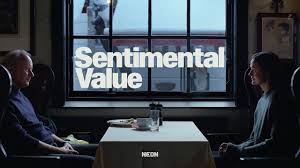
“Sentimental Value” (2025)
Drama

Running Time: 133 minutes
Written by: Eskil Vogt & Joachim Trier
Directed by: Joachim Trier
Starring: Renate Reinsve, Stellan Skarsgård, Inga Ibsdotter Lilleaas and Elle Fanning
Press: “Your movie is a Netflix production. Will it be released in theatres?”
Gustav Borg: “Well… how else would you watch it?”
The DVD release of Sentimental Value arrives with the weight of expectation already attached to it. Directed by Joachim Trier and co-written with longtime collaborator Eskil Vogt, the film follows in the remarkable artistic lineage established by Reprise, Oslo, August 31st and especially The Worst Person in the World. Yet Sentimental Value feels less like a continuation of those works and more like a deepening of Trier’s central obsessions: memory, regret, performance, family inheritance, and the strange emotional architecture that binds people together long after affection has curdled into disappointment.
Watching the film on DVD gives it an unexpectedly intimate quality. This is not a gigantic spectacle demanding the overwhelming force of a cinema screen. Instead, it is a chamber piece built around faces, pauses, uncomfortable silences, and the emotional debris that accumulates inside families over decades. Seen at home, the film almost feels invasive, as though the viewer has stumbled into a private argument and stayed long enough to understand the history underneath every cutting remark.
At the centre of the story is a father-daughter relationship that refuses easy reconciliation. Trier avoids melodramatic confrontations in favour of something far more recognisable and painful: conversations that circle old wounds without ever fully addressing them. The film’s title proves perfect because every object, every room, every remembered slight carries emotional residue. A house is never just a house in this film; it is an archive of unresolved feelings. A piece of furniture becomes an accusation. A photograph becomes evidence. Even absence acquires texture.
The performances are extraordinary across the board. Trier has always been gifted at directing actors toward emotional naturalism, but here he reaches another level entirely. The cast never appears to be “performing” in the conventional awards-season sense. Instead, they inhabit emotional rhythms so authentic that scenes often feel discovered rather than scripted. Small hesitations become devastating. A glance across a dinner table conveys years of resentment more effectively than pages of exposition ever could.
The lead performance in particular is astonishing because of its restraint. Modern cinema often mistakes emotional intensity for loudness, but Sentimental Value understands that the most painful emotions are frequently suppressed rather than expressed. The protagonist moves through scenes carrying emotional exhaustion like physical weight. Trier’s camera lingers just long enough for viewers to register the thoughts that never become dialogue.
Visually, the film continues Trier’s movement toward elegant simplicity. There are none of the hyperactive stylistic flourishes common to prestige dramas attempting to appear “important.” Instead, the cinematography quietly observes spaces and faces with extraordinary patience. Interiors are especially memorable. Apartments, hallways, kitchens, and living rooms are framed not merely as environments but as emotional battlegrounds. The muted colour palette reinforces the sense of lives suspended between nostalgia and stagnation.
The DVD presentation handles this subtle visual style surprisingly well. While the format obviously cannot compete with 4K for sheer sharpness or HDR depth, the transfer retains strong detail and stable contrast throughout. Grain appears natural rather than over-processed, and darker scenes avoid the compression problems that often plague dialogue-heavy dramas on DVD. The film’s muted Scandinavian palette remains intact, preserving the melancholic atmosphere that defines so much of Trier’s work.
Sound design is equally impressive, even within the limitations of standard DVD audio formats. Trier has always understood the dramatic power of silence, and Sentimental Value uses ambient sound beautifully. Rooms hum with distant traffic, floorboards creak under emotional tension, and ordinary domestic noises become psychologically charged. The score is used sparingly but effectively, drifting into scenes almost imperceptibly before disappearing again. Nothing feels manipulative. The music never instructs the audience how to feel; it merely deepens emotional undercurrents already present in the performances.
One of the film’s greatest strengths is its refusal to divide characters neatly into heroes and villains. Parents wound children while believing they acted lovingly. Children weaponise old pain while insisting they merely seek honesty. Everyone carries legitimate grievances, yet everyone also contributes to the cycle of emotional damage. Trier and Vogt write with remarkable compassion toward human frailty. Even the most selfish behaviour emerges from loneliness, insecurity, or fear.
This complexity elevates the film beyond conventional family drama. Lesser films simplify emotional conflict into solvable misunderstandings. Sentimental Value recognises that some wounds never entirely heal because they become part of personal identity. People grow attached to their grievances because those grievances help define who they are. That insight gives the film extraordinary emotional maturity.
There is also a fascinating undercurrent concerning art itself. Trier repeatedly explores how artists transform lived experience into narrative, often at the expense of those around them. Characters struggle with the ethics of memory: who owns family history, and who has the right to reinterpret it? The film quietly interrogates whether artistic honesty can itself become a form of emotional exploitation. These ideas never overwhelm the drama, but they add substantial thematic richness.
What makes Sentimental Value especially powerful is how recognisable its emotional terrain feels. Even viewers without similarly fractured family histories will recognise the awkward negotiations, defensive humour, strategic silences, and tiny acts of reconciliation that define intimate relationships. Trier captures the exhausting familiarity of family dynamics with almost documentary precision.
The pacing may frustrate viewers expecting dramatic revelations or major plot twists. This is a deliberately patient film that accumulates emotional force gradually. Scenes breathe. Conversations drift sideways. Meaning emerges through repetition and behavioural detail rather than narrative shocks. Yet for viewers willing to engage with its rhythm, the payoff is immense. By the final act, the film achieves a devastating emotional clarity without ever resorting to sentimentality.
As a DVD package, the release is solid if not extravagant. The menus are clean and unobtrusive, and the transfer respects the film’s subdued aesthetic. Depending on the edition, supplementary materials may include interviews or behind-the-scenes features that illuminate Trier’s collaborative process, which has become one of contemporary cinema’s most fruitful creative partnerships. Even without extensive extras, however, the film itself more than justifies the purchase.
What ultimately distinguishes Sentimental Value is its emotional intelligence. Contemporary prestige cinema often confuses misery with depth, but Trier understands that genuine emotional complexity includes humour, absurdity, tenderness, and contradiction. The film contains moments of uncomfortable comedy that feel painfully true to life. Family interactions frequently oscillate between affection and cruelty within seconds. People attempt sincerity, fail, retreat into irony, and try again. That emotional instability feels profoundly human.
In many ways, the film resembles the work of great literary realists more than traditional modern cinema. Like a finely observed novel, it accumulates psychological detail until characters feel less like fictional constructs and more like people the viewer has genuinely known. Long after the credits finish, scenes continue echoing in the mind because Trier understands the small humiliations and fragile hopes that shape ordinary emotional life.
The DVD release of Sentimental Value therefore becomes more than a convenient home-video edition. It is an opportunity to revisit a film that rewards close attention and repeated viewing. Trier has crafted a work of remarkable sensitivity and precision, one that trusts audiences to recognise emotional truth without excessive explanation. Few contemporary filmmakers capture the texture of memory and regret with such grace.
This is a quietly devastating film — restrained, humane, intelligent, and deeply affecting. On DVD, viewed in the intimacy of one’s own living room, its emotional power becomes even more immediate. For admirers of thoughtful character-driven cinema, Sentimental Value stands as one of the finest and most emotionally perceptive dramas of recent years.



 spryfilm.com