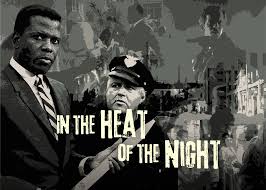
“In the Heat of the Night” (1967)
Drama

Running Time: 110 minutes
Written by: Stirling Silliphant
Directed by: Norman Jewison
Featuring: Sidney Poitier, Rod Steiger, Warren Oates and Lee Grant
Chief Gillespie: “Just once in my life, I’m gonna own my temper. I’m telling you that you’re gonna stay here. You’re gonna stay here if I have to go inside and call your chief of police and have him remind you of what he told you to do. But I don’t think I have to do that, you see? No, because you’re so damn smart. You’re smarter than any white man. You’re just gonna stay here and show us all. You’ve got such a big head that you could never live with yourself unless you could put us all to shame. You wanna know something, Virgil? I don’t think that you could let an opportunity like that pass by.”
Norman Jewison’s In the Heat of the Night has long stood as one of the most defining American films of the late 1960s—a tense, socially charged mystery that captures the racial divides of its era with both urgency and nuance. Over half a century later, the film has lost none of its power, and the new 4K Ultra HD release does it proud, offering a stunning restoration that breathes new life into Haskell Wexler’s evocative cinematography while preserving the film’s raw, Southern atmosphere.
Released in 1967, In the Heat of the Night tells the story of Virgil Tibbs (Sidney Poitier), a Black Philadelphia detective who becomes entangled in a murder investigation while passing through a small Mississippi town. Arrested on suspicion simply for being Black, Tibbs soon finds himself reluctantly assisting the town’s police chief, Bill Gillespie (Rod Steiger), in solving the case. What follows is both a gripping procedural and a deeply human story about prejudice, professionalism, and mutual respect.
Poitier’s performance remains one of the most dignified and quietly forceful in cinema history. His delivery of the now-iconic line—“They call me Mister Tibbs!”—still lands with the full weight of moral outrage and self-assertion. Rod Steiger, meanwhile, gives what might be his finest performance as the blustery, weary, and conflicted Gillespie, a man struggling to reconcile his small-town biases with the reality of Tibbs’ competence and decency.
Norman Jewison directs with sharp attention to atmosphere, alternating between the oppressive heat of the Deep South and the claustrophobic interiors of police stations and small-town homes. Quincy Jones’ score, driven by Ray Charles’ unforgettable title song, adds a sultry, soulful edge that perfectly matches the tone of simmering tension. The film went on to win five Academy Awards, including Best Picture, and its impact on American cinema—particularly in representing Black characters as intelligent, commanding professionals—cannot be overstated.
The 4K UHD release, sourced from a new 4K scan of the original camera negative, represents a remarkable upgrade over all previous home video editions. Criterion and MGM have both handled In the Heat of the Night in the past, but this latest restoration is easily the definitive presentation.
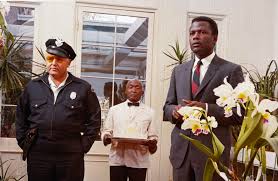
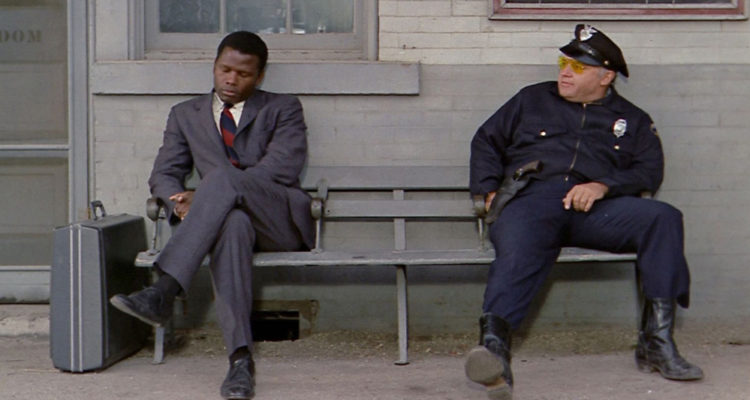
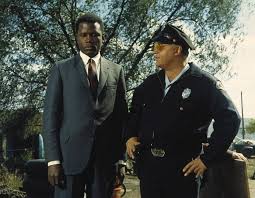
The transfer retains the film’s natural grain structure, giving it a pleasingly organic texture. Wexler’s use of color—muted but rich, emphasizing the sticky warmth of the South—is rendered with impressive accuracy. Flesh tones, always tricky in older transfers, now look lifelike and consistent. Shadows are deeper and more stable, yet the increased dynamic range means that nighttime scenes are no longer crushed into murk; we can finally appreciate the subtleties of Wexler’s lighting, particularly in the tense nighttime sequences between Tibbs and Gillespie.
The HDR10 (and Dolby Vision, depending on the edition) grading brings a newfound depth to the image. The dusty streets, sweat-streaked faces, and hazy small-town neon lights feel tangible in a way they never have before. Grain lovers will be relieved to find that the transfer hasn’t been scrubbed clean with digital noise reduction—this is a filmic presentation through and through, with fine detail that respects the texture of 35mm film.
The audio comes in a DTS-HD Master Audio 2.0 track that faithfully recreates the film’s original monaural sound. Dialogue is crisp and well-balanced, while Jones’ score sounds warmer and more resonant than ever. The mix doesn’t attempt to artificially expand into surround sound—which would have been inappropriate—but instead focuses on clarity and fidelity. There’s no distortion or hiss to distract from the film’s moments of silence and confrontation, which are just as powerful as its music cues.
Revisiting In the Heat of the Night today, it’s remarkable how well it holds up—not only as a mystery but as a film of ideas. Its social commentary remains potent, especially in its refusal to provide easy catharsis. The uneasy alliance between Tibbs and Gillespie feels as authentic as ever, their mutual respect forged through exhaustion and necessity rather than sentimentality.
Jewison’s restraint keeps the film grounded; every shot and exchange feels lived-in. The 4K restoration enhances that sense of realism by making the environments—sweaty, humid, and tense—almost tactile. Watching it in this format feels like seeing it anew, a rediscovery of a masterpiece that was always about the power of seeing clearly.
In the Heat of the Night in 4K is a must-own for serious film collectors and cinephiles. The restoration honors the film’s artistry while revealing textures and details that earlier home releases could only hint at. It’s not just a better way to watchthe film—it’s a way to feel it, to experience the physical and emotional heat that pulses through every frame.
A stunning 4K release of one of America’s essential films. Norman Jewison’s classic has never looked or sounded better—an indispensable upgrade that cements In the Heat of the Night’s place as both a cinematic triumph and a vital historical document.



 spryfilm.com