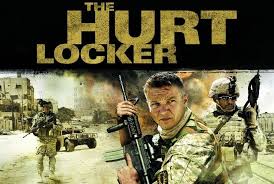
“The Hurt Locker” (2008)
Drama

Running Time: 131 minutes
Written by: Mark Boal
Directed by: Kathryn Bigelow
Featuring: Jeremy Renner, Anthony Mackie, Brian Geraghty, Evangeline Lilly, Ralph Fiennes, David Morse and Guy Pearce
Opening Quote by Chris Hedges: “The rush of battle is often a potent and lethal addiction, for war is a drug.”
Kathryn Bigelow’s The Hurt Locker (2008) remains one of the defining films of the 21st century—a tense, nerve-shredding exploration of modern warfare that eschews politics and grand statements for something far more visceral: the psychological addiction to danger. Fifteen years after its release, Lionsgate’s new 4K Ultra HD Blu-ray offers the definitive way to experience Bigelow’s Oscar-winning masterpiece, both visually and sonically. This is more than a simple format upgrade—it’s a rediscovery of a film whose textures, rhythms, and precision are more striking now than ever.
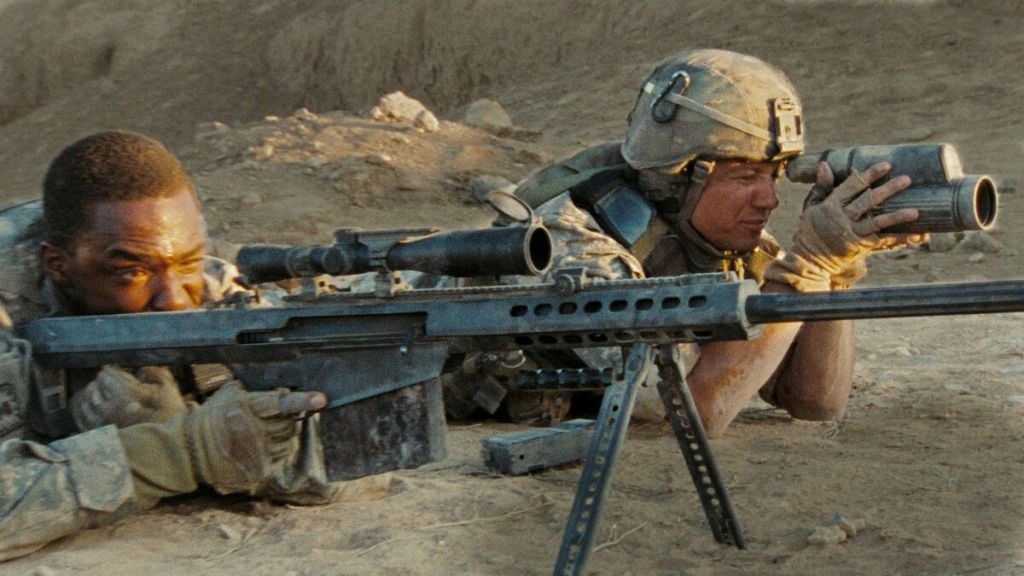
At its heart, The Hurt Locker is a study in obsession. Staff Sergeant William James (Jeremy Renner, in a career-defining role) leads a U.S. Army Explosive Ordnance Disposal (EOD) unit in Iraq, where each day brings a new life-or-death encounter with improvised explosive devices. Alongside his teammates—Sanborn (Anthony Mackie) and Eldridge (Brian Geraghty)—James operates in an atmosphere of relentless uncertainty. Every mission is a potential death sentence, yet James approaches his work with a reckless intensity that borders on compulsion.
Bigelow’s direction is taut and immersive, capturing the heat, noise, and sensory overload of Baghdad street patrols with documentary-like realism. Shot by Barry Ackroyd (United 93, Captain Phillips) using handheld Super 16mm cameras, the film achieves a raw, kinetic energy that feels authentic and immediate. The sand-choked air, the blinding sunlight, the subtle movements of civilians that may—or may not—signal an impending explosion: all are woven into a tapestry of sustained tension.
Mark Boal’s screenplay (based on his own journalistic experiences embedded with EOD teams) avoids easy moralizing. It’s not a film about whether the war is just, but about the cost of living on a perpetual adrenaline high. When James returns home to domestic safety, he finds the cereal aisle more terrifying than any war zone. The film’s closing moments—quiet, ambiguous, and devastating—cement its status as one of modern cinema’s great character studies.
Lionsgate’s 4K transfer, sourced from the original Super 16mm elements and scanned at 4K resolution, is a revelation. This film has always had a gritty, textured look by design, and the Ultra HD presentation fully honors that aesthetic. The grain structure is intact and beautifully resolved—never smeared or noisy—and it gives the image an almost tactile authenticity.
The upgrade to HDR10 (and Dolby Vision on some displays) subtly enhances contrast and brightness without compromising the film’s documentary feel. Highlights—particularly the sun glaring off desert vehicles or the blinding flash of a detonation—are more intense, while shadow detail gains depth and clarity. The dusty yellows and washed-out browns of the Iraqi landscape look more natural, and skin tones are more lifelike than ever before.
This isn’t a glossy blockbuster transfer—it’s faithful, nuanced, and filmic. Every bead of sweat, every puff of dust kicked up in a tense street standoff feels real. In motion, the 4K presentation has a fluidity and sharpness that surpasses the 1080p Blu-ray by a wide margin.
The Dolby Atmos (and backward-compatible TrueHD 7.1) soundtrack is equally impressive. The Hurt Locker has always been a film about the sound of silence punctuated by chaos, and this mix captures that contrast beautifully. The Atmos track opens up the soundstage, with discrete effects placed throughout the overhead and surround channels—explosions ripple outward with thunderous power, debris rains down realistically, and even the faint hum of Baghdad’s streets carries spatial dimension.
Dialogue remains crisp and centered even in the most chaotic moments. Marco Beltrami and Buck Sanders’ minimalist score gains subtle weight in Atmos, but the real star is the environmental sound design: the distant crack of gunfire, the crunch of boots on gravel, the faint rustle of wind through desolate streets. The result is total immersion, creating a battlefield experience that is as intimate as it is overwhelming.



 spryfilm.com