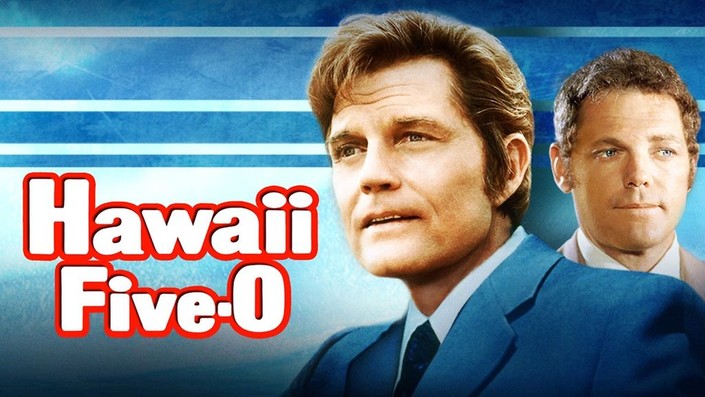
“Hawaii Five-O” (1968 – 1980)
Television Drama

Two hundred and eighty one Episodes
Created by: Leonard Freeman
Featuring: Jack Lord, James MacArthur, Kam Fong, Zulu, Al Harrington, Doug Mossman, Herman Wedemeyer, William Smith, Sharon Farrell and Moe Keale
Det. Steve McGarrett: “Book him, Danno. Murder one.”
The 1980s era of Hawaii Five-O captures the essence of a classic police procedural with a distinct tropical flair. Though the show originally premiered in 1968 and ran until 1980, its influence carried over into subsequent decades, cementing it as a cultural touchstone of crime television.
The most notable feature of Hawaii Five-O is its iconic setting. Filmed in Hawaii, the show made excellent use of the lush landscapes, pristine beaches, and urban Honolulu backdrops to create a unique atmosphere. The sunny aesthetic juxtaposed the often gritty and intense crime plots, making it visually engaging.
Jack Lord’s portrayal of Steve McGarrett remains one of the highlights. His commanding presence and sharp delivery of the catchphrase “Book ’em, Danno!” made him one of TV’s most memorable law enforcement figures. The chemistry between the team members was strong, with characters like Danny “Danno” Williams and Chin Ho Kelly providing reliable and likable support.
The storytelling often reflected the era’s issues, from organized crime to political corruption, giving it a sense of realism. The show maintained a balance between serialized plots and self-contained episodes, allowing viewers to jump in at any point without feeling lost.
While groundbreaking in many ways, the show occasionally falls into the pitfalls of its time. Its portrayal of certain cultural elements could be seen as dated or overly simplified by today’s standards. Additionally, the dialogue, though charmingly retro, can come across as melodramatic to modern viewers.
The pacing may feel slow compared to contemporary police dramas, as episodes often focus heavily on exposition rather than action. This, however, was a product of the era’s storytelling style rather than a flaw per se.
The original Hawaii Five-O, which ran from 1968 to 1980, was a cornerstone of American television, offering viewers a window into crime-solving set against the exotic backdrop of Hawaii. By the time the show entered the 1980s, it had become a well-oiled machine, with established characters, a devoted fan base, and a reputation for thrilling stories. While its final seasons showed signs of wear, the show still managed to uphold much of what made it groundbreaking during its earlier years.
One of Hawaii Five-O‘s enduring strengths was its ability to blend conventional police procedural elements with the uniqueness of its location. The show often tackled cases involving international intrigue, organized crime, political corruption, and local Hawaiian culture. Themes of loyalty, justice, and morality were recurring, with the writers making efforts to include topical issues of the time, such as drug trafficking, espionage, and even ecological concerns.
Episodes often followed a tried-and-true format: a crime occurs, the Five-O team investigates, and McGarrett leads a dramatic takedown or confrontation. This formula was straightforward but highly effective, especially when paired with tension-filled action scenes and clever detective work.
However, by the 1980s, the stories occasionally veered into more formulaic territory. As the series aged, some plots began to feel repetitive, with fewer groundbreaking episodes to match earlier classics like “Hookman” or “The Singapore File.” The 12th and final season saw a notable decline in quality, with Jack Lord’s McGarrett often carrying the show alone due to cast turnover and less engaging narratives.
Jack Lord as Steve McGarrett was undoubtedly the heart and soul of Hawaii Five-O. Lord’s steely demeanor, sharp intellect, and unwavering commitment to justice made McGarrett one of TV’s quintessential detectives. His leadership was balanced by his moments of humanity, which added depth to the character.
James MacArthur as Danny “Danno” Williams provided a grounded foil to McGarrett’s intensity, often injecting humor and a more relatable perspective into the team dynamic. Kam Fong Chun as Chin Ho Kelly and other key team members like Zulu (Kono Kalakaua) and Al Harrington (Ben Kokua) brought their own unique personalities to the table, making the ensemble feel cohesive.
In the later seasons, cast changes weakened the group’s chemistry. The departure of James MacArthur before Season 12, for instance, left a noticeable gap, and the introduction of new characters like Truck Kealoha and Lori Wilson never quite captured the same magic. Still, Lord’s commanding presence ensured that the show retained its central appeal.
Perhaps the most defining feature of Hawaii Five-O was its setting. The show made Hawaii itself a character, capturing the islands’ natural beauty, urban life, and cultural richness. From sweeping shots of Oahu’s mountains and beaches to bustling scenes in Honolulu, the series showcased Hawaii in a way no other show had done before.
The inclusion of local actors and cultural references, while imperfect by today’s standards, was a bold move for its time. It helped bring Hawaiian culture into the homes of millions of viewers, albeit sometimes through the lens of mainland perspectives. Despite occasional missteps, Hawaii Five-O deserves credit for attempting to give Hawaii a voice in an era when diverse representation was rare.
The action sequences in Hawaii Five-O were another highlight. Car chases, shootouts, and undercover operations were staples, and while they might feel tame compared to today’s high-octane standards, they were exciting and well-staged for their time. The show’s cinematography, particularly its outdoor shots, elevated the viewing experience, blending crime drama with the natural beauty of its setting.
The production values remained consistent throughout most of the series, though by the 1980s, some aspects began to feel dated. The reliance on stock footage and occasional budget constraints were more noticeable in the final seasons, but the iconic opening credits and Morton Stevens’ unforgettable theme music kept the show feeling larger than life.
Hawaii Five-O was more than just a crime drama—it was a pop culture phenomenon. The phrase “Book ’em, Danno!” entered the lexicon, and the show’s theme song became instantly recognizable. It also paved the way for future crime dramas that emphasized location, such as Miami Vice and Magnum, P.I. (another Hawaiian-set series).
The series’ legacy endures, both through its influence on television and the successful 2010 reboot. The original remains a time capsule of a specific era in TV history, blending procedural storytelling with a uniquely Hawaiian twist. While the final seasons may not represent the show at its peak, Hawaii Five-O as a whole is a testament to the enduring appeal of good storytelling, compelling characters, and the allure of paradise.
Despite its dated aspects, Hawaii Five-O has left a lasting impression on the genre. Its influence is evident in later procedural dramas, and the 2010 reboot paid homage to the original’s legacy while updating the formula for modern audiences.
For fans of classic TV or those intrigued by vintage crime dramas, the original Hawaii Five-O offers a fascinating glimpse into the evolution of the genre. It remains a symbol of its time—bold, stylish, and unafraid to dive into the complexities of crime in paradise.
Special Features
– Emme’s Island Moments: Memories of Hawaii Five-O
– Hawaii Five-O Syndication Sales Reel
– Jack Lord on “The Mike Douglas Show”
– Clip from “The Winners’ Circle – 1968 CBS Fall Preview Show
– Inside Edition and Entertainment Tonight Segments
– Series Promo and Select Episode Promos



 spryfilm.com