
“The Boys in the Boat” (2023)
Drama

Running Time: 124 minutes
Written by: Mark L. Smith
Directed by: George Clooney
Featuring: Joel Edgerton and Callum Turner
Daniel James Brown: “Harmony, balance, and rhythm. They’re the three things that stay with you your whole life. Without them civilization is out of whack. And that’s why an oarsman, when he goes out in life, he can fight it, he can handle life. That’s what he gets from rowing.”
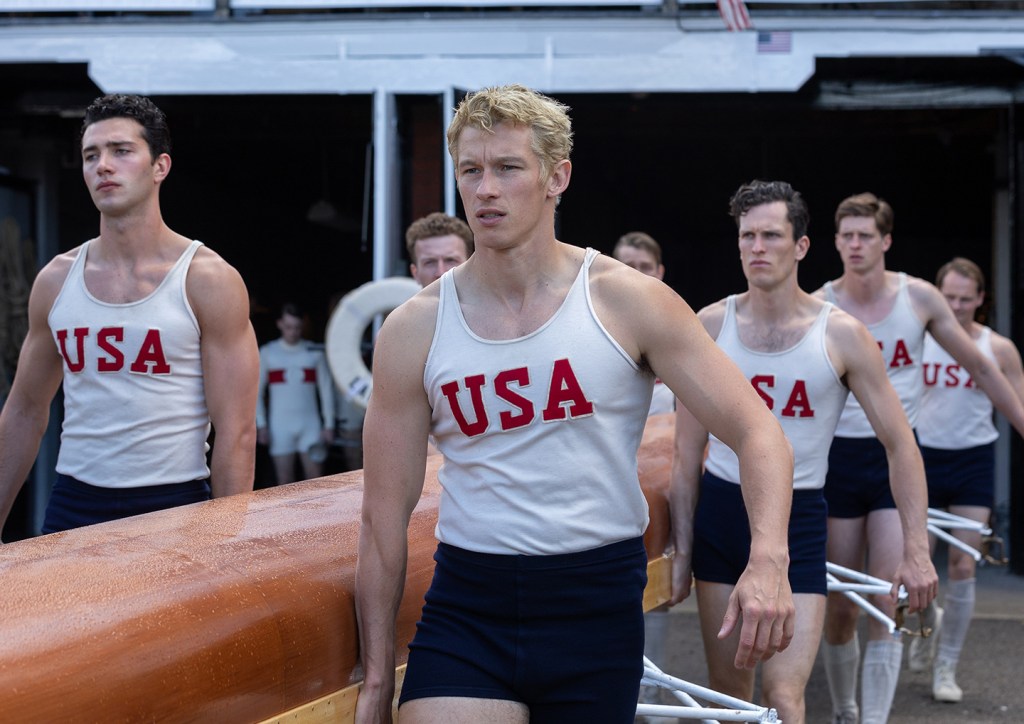
George Clooney’s directorial outing, “The Boys in the Boat,” glides onto the screen with the smooth rhythm of oars slicing through water. Based on Daniel James Brown’s bestselling book, it tells the true story of the University of Washington Huskies rowing team and their improbable victory at the 1936 Berlin Olympics. It’s a tale of grit, teamwork, and triumph against the odds, all set against the backdrop of the Great Depression and Nazi Germany.
The film’s greatest strength lies in its cast, spearheaded by Callum Turner as Joe Rantz, the team’s unlikely coxswain. Turner embodies Joe’s vulnerability and tenacity with understated nuance, making him a truly relatable protagonist. Joel Edgerton plays Coach Al Ulbrickson, the gruff but dedicated mentor who pushes the boys to their limits. Edgerton’s performance is a masterclass in balancing tough love with genuine care, while the rest of the ensemble cast delivers admirable portrayals of the diverse group of young men who form the heart of the crew.
Clooney, as director, excels in capturing the beauty and intensity of rowing. The training sequences are thrilling, as the camera moves in sync with the oars, immersing us in the synchronized struggle and exhilarating release of each stroke. He also paints a vivid picture of the Depression-era Seattle, where the boy’s face poverty, hunger, and prejudice. These scenes, though brief, add depth and context to their motivations, reminding us that their Olympic journey is about more than just winning a race.
However, “The Boys in the Boat” stumbles when it leans too heavily on familiar underdog tropes. The narrative follows a predictable arc, from initial setbacks to triumphant victory, with each obstacle meticulously overcome in classic Hollywood fashion. While this formula undeniably evokes a sense of satisfaction, it also leaves a lingering feeling of déjà vu. Additionally, the film occasionally employs melodramatic dialogue and sentimentality, which, while aiming to tug at the heartstrings, sometimes feels saccharine.
Furthermore, the historical context of the 1936 Olympics, particularly the looming shadow of Nazi Germany, remains largely unexplored. While the film hints at the political backdrop, it doesn’t fully delve into the implications of competing on Hitler’s stage. This missed opportunity leaves viewers with a sense of incompleteness, especially considering the potential for a deeper exploration of themes like resilience in the face of oppression.
There is social disparity and triumph in “The Boys in the Boat.” This aspect adds a crucial layer to the film’s underdog narrative, revealing how their victory transcends athletic achievement and becomes a symbol of overcoming societal inequalities.
The juxtaposition of Joe’s impoverished background and Roger’s privileged upbringing is a powerful tool. Analyze how the film depicts their initial interactions, the friction caused by their differing experiences, and ultimately, how rowing becomes a common ground. We can explore how Coach Ulbrickson recognizes this potential and shapes the team to value each member’s unique strengths, regardless of their social standing.
Look at how the team’s victory resonates beyond the Olympic arena. Highlight how their success becomes a beacon of hope for working-class communities in Depression-era America. Analyse how the film portrays the public’s reaction to their triumph, emphasizing how it transcends personal glory and speaks to a collective yearning for social justice.
While Joe takes centre stage, we can examine how the film weaves in the struggles of other team members with contrasting backgrounds. Consider exploring how the triumphs of boys like Joe, Shorty, and even Al Ulbrickson, represent victories for their respective communities, each overcoming distinct obstacles and prejudices.
Analyse how the film uses visual cues and metaphorical language to emphasize the theme of social disparity and triumph. Look for scenes where camera angles, set design, or even costuming highlight the differences between the team members’ backgrounds. Explore how rowing itself becomes a symbol of bridging these gaps, as the rhythmic strokes and synchronized effort showcase the power of unity against inequality.
While “The Boys in the Boat” undeniably falls into the classic underdog sports film category, its true power lies in its nuanced exploration of social disparity and how the crew’s victory becomes a symbol of triumph against deeply ingrained societal inequalities. The film expertly weaves together the personal journeys of these young men from diverse backgrounds, showcasing how rowing offers a platform for not just athletic achievement, but also social leveling and collective empowerment.
One aspect that shines particularly bright is the stark contrast between Joe Rantz’s working-class upbringing and the affluent backgrounds of teammates like Roger Morris. The initial friction between them feels authentic, revealing the unspoken class tensions simmering beneath the surface. However, the film beautifully avoids the trap of simplistic solutions. Instead, it allows rowing to act as a bridge, slowly breaking down these barriers and fostering a sense of shared purpose. As the camera lingers on their synchronized strokes, we witness a visual metaphor for unity and equality, where each pull transcends individual circumstances to contribute to a collective goal.
This triumph against disparity extends beyond the personal. The film subtly but effectively connects the crew’s victory to the wider struggles of Depression-era America. We see the joy and hope that erupt in working-class communities as news of their success spreads. Their achievement becomes a beacon of inspiration, proving that even in the face of economic hardship and social marginalization, collective effort and perseverance can rewrite the script.
The film doesn’t shy away from individual struggles either. Characters like Shorty Hunt, plagued by self-doubt and anxiety, and Joe himself, battling his own insecurities, represent the emotional toll of navigating both athletic pressure and societal biases. By showcasing how their teammates rally around them, offering support and encouragement, the film highlights the transformative power of community in overcoming personal demons.
Furthermore, “The Boys in the Boat” utilizes symbolism and imagery to subtly reinforce the theme of social disparity and triumph. The camera often lingers on Joe’s calloused hands contrasted with Roger’s manicured fingernails, reminding us of their divergent starting points. The cramped, dilapidated boathouse juxtaposed with the grandeur of the Olympic stadium visually underscores the distance they have traversed. These subtle cues add depth and resonance to the narrative, urging viewers to see their victory not just as a sporting feat, but as a collective act of defiance against social barriers.
“The Boys in the Boat” is a well-made, heart-warming film with undeniable crowd-pleasing appeal. Its stellar cast, stunning visuals, and inspiring story offer a satisfying cinematic experience. However, its adherence to formulaic storytelling and a somewhat superficial treatment of the historical context prevent it from achieving true greatness. It’s a film that ultimately leaves you smiling and cheering, but also wishing it had dared to dig deeper into the complexities of its subject matter.





 spryfilm.com
Callum Turner portrays Joe Rantz but is not the coxswain. Luke Slattery portrays the coxswain, Robert Mohr.
LikeLiked by 1 person