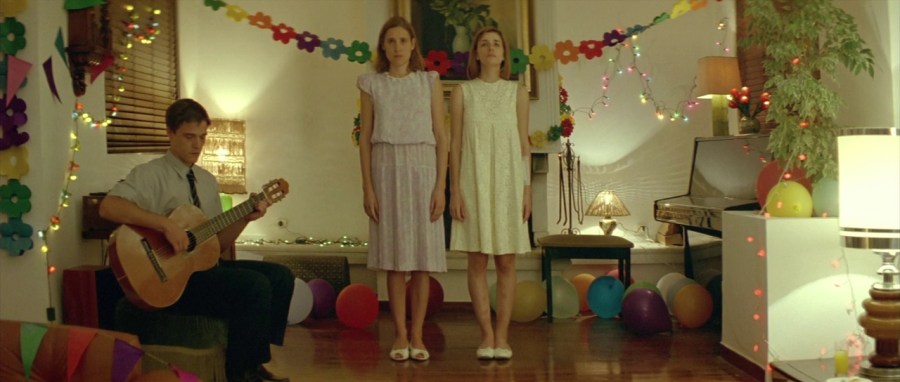
“3:10 to Yuma” (2007)
Drama

Running Time: 97 minutes
Written by: Yorgos Lanthimos and Efthymis Filippou
Directed by: Yorgos Lanthimos
Starring: Christos Stergioglou, Michelle Valley, Angeliki Papoulia, Christos Passalis, Mary Tsoni and Anna Kalaitzidou
Father: [subtitled version] “Soon your mother will give birth to two children and a dog.”
Yorgos Lanthimos’s Dogtooth remains one of the most unsettling, darkly funny, and formally precise films of the 21st century, and its arrival on 4K UHD only reinforces just how rigorously constructed and emotionally corrosive the film truly is. More than a simple visual upgrade, this release offers a renewed confrontation with a work that feels as confrontational and disturbing now as it did upon its original release—perhaps even more so, given how Lanthimos’s later international success has reframed Dogtooth as the raw blueprint of his cinematic worldview.
Dogtooth tells the story of a family living in near-total isolation, governed by a tyrannical father who controls every aspect of his children’s lives, from their vocabulary to their understanding of the outside world. The premise alone is chilling, but what makes the film extraordinary is Lanthimos’s refusal to sensationalize the material. Instead, the horror emerges from the banality of control, repetition, and ritual.
Viewed again in high resolution, the film’s emotional violence feels even sharper. The children’s affectless line readings, stiff physicality, and ritualized games register with renewed intensity. The film’s infamous moments—castration anxiety, sexual bargaining, self-mutilation—remain shocking, but what lingers is the atmosphere of enforced normalcy. Everything is framed as routine. Everything is “correct.”
This remains one of Lanthimos’s most punishing works, lacking the overt stylization or ironic cushioning of later films like The Favourite or Poor Things. Dogtooth is colder, harsher, and more clinical, and the 4K presentation highlights just how deliberate that aesthetic choice is.
The 4K transfer is a revelation precisely because Dogtooth is not a traditionally “beautiful” film. Shot in flat, natural light with restrained color and minimal camera movement, the film relies on stark compositions and sterile environments. The UHD presentation sharpens these qualities without betraying the original intent.
Detail is significantly improved, particularly in facial close-ups. Skin textures, sweat, and subtle muscle tension are now more visible, making the performances feel even more exposed and uncomfortable. The sterile white interiors of the family home reveal fine gradations in paint, fabric, and shadow that were previously flattened in lower-resolution presentations.
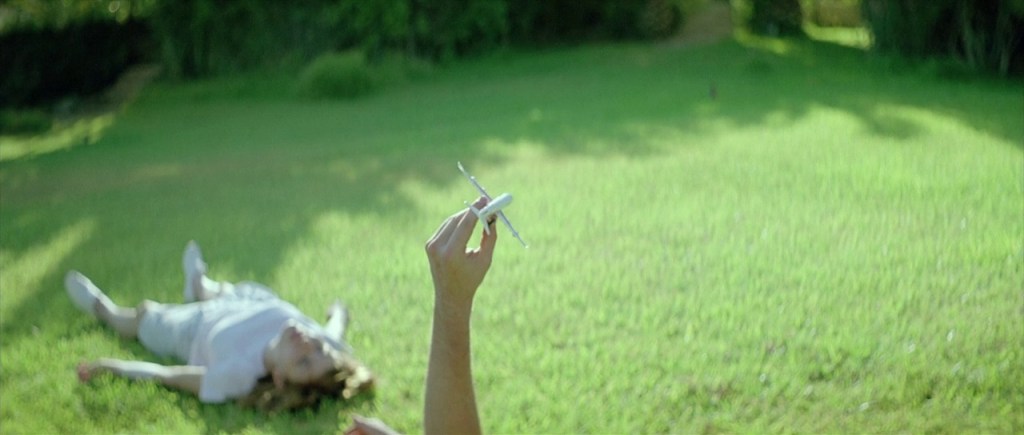
The color grading remains muted and naturalistic. The greens of the garden, the pale blues of the swimming pool, and the washed-out interiors are rendered with remarkable stability and accuracy. HDR is used conservatively, but effectively: highlights are controlled, never flashy, allowing daylight scenes to feel oppressively bright rather than aesthetically pleasing. Shadows maintain depth without crushing, reinforcing the sense that nothing in this world offers refuge.
Grain appears intact and organic, giving the image a tactile, filmic quality that suits the material. Importantly, there is no sense of over-processing or digital smoothing. The image feels honest, almost austere—perfectly aligned with Lanthimos’s vision.
The audio track, while modest, is faithful and precise. Dogtooth is not a film driven by sound design or music, and the mix reflects that restraint. Dialogue is clean and centered, capturing the strange rhythms and deliberate pauses that define the film’s tone.
Ambient sounds—footsteps on tile, splashing water, distant dogs barking—are crisp and quietly unsettling. These mundane noises take on heightened significance, especially in the absence of a traditional score. When music does intrude, it lands with greater impact precisely because of its rarity.
The lossless presentation ensures clarity without embellishment. This is not a film that benefits from sonic grandeur, and the UHD release wisely resists any attempt to inflate the soundscape.
While Dogtooth has been widely discussed over the years, its inclusion in a 4K format invites renewed critical engagement. Any accompanying extras—commentaries, interviews, or essays—are especially valuable here, given how often the film is misunderstood as merely provocative rather than structurally rigorous.
Revisiting the film in this format underscores how carefully every element is controlled: framing, blocking, performance, and language itself. It becomes clearer than ever that Dogtooth is less about shock and more about systems—how power is taught, normalized, and internalized.
The 4K UHD release of Dogtooth is not an easy watch, nor is it meant to be. What it offers is the most precise, unforgiving presentation yet of a film designed to disturb through clarity rather than excess. The improved image quality intensifies the discomfort, bringing the viewer closer to the performances and the oppressive environment than ever before.
For fans of Yorgos Lanthimos—especially those familiar with his later, more accessible works—this release serves as a stark reminder of his origins: a filmmaker unafraid of emotional brutality, formal rigidity, and moral ambiguity. Dogtoothin 4K does not soften the experience; it sharpens it.
This is an essential release for serious collectors, cinephiles, and admirers of Lanthimos’s work—but it is also a reminder that some films, no matter how beautifully presented, are meant to leave you shaken rather than satisfied.




 spryfilm.com