
“Workaholics: Series 1 – 7” (2011-2017)
TV Comedy

Eighty Six Episodes
Created by: Blake Anderson, Adam DeVine, Anders Holm, Kyle Newacheck, Connor Pritchard and Dominic Russo
Featuring: Blake Anderson, Adam DeVine, Anders Holm, Jillian Bell, Maribeth Monroe and Erik Griffin
Adam Demamp: “I’m like one of those dragons from Avatar!”
When Workaholics premiered, it arrived disguised as a workplace sitcom but quickly revealed itself as something far stranger, louder, and more aggressively stupid—in the most deliberate way possible. Over the course of seven seasons, the series carved out a singular niche in modern television comedy: a show that glorifies laziness while requiring immense comic discipline, that celebrates immaturity while showing a surprisingly sharp understanding of adulthood’s quiet despair. At its best, Workaholics is not just a parade of outrageous jokes, but a sustained character study of three men utterly committed to never growing up—and the consequences of that commitment.
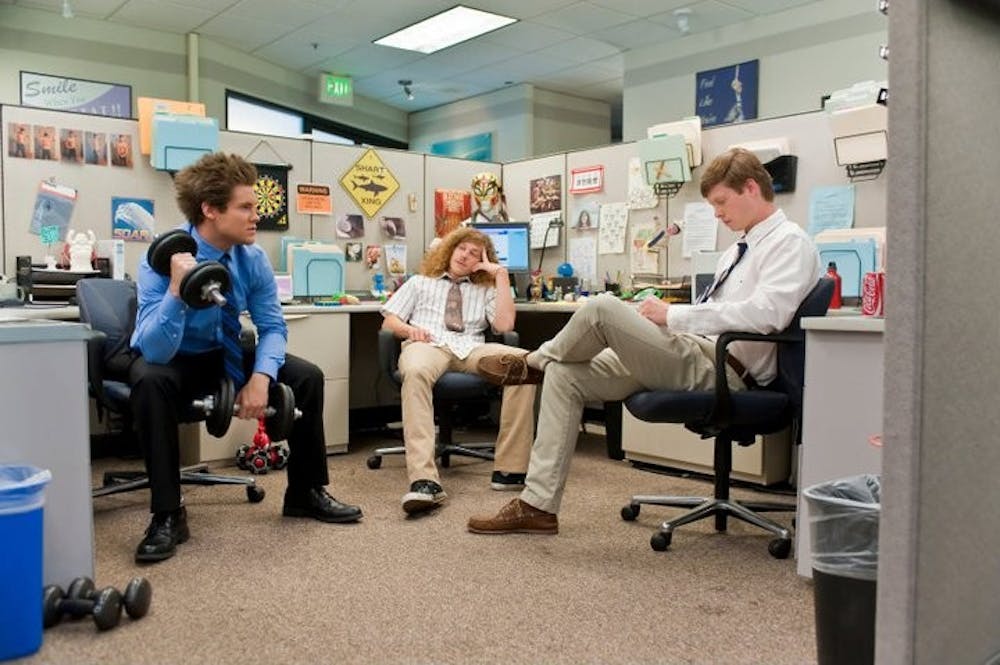
Set largely within the bland purgatory of a telemarketing office, Workaholics follows Adam DeMamp, Blake Henderson, and Anders Holmvik—roommates, coworkers, and self-appointed philosophers of slacker culture. Their jobs are nominal; work is something to be avoided, gamed, or subverted. The office exists less as a setting for professional ambition than as a playground for chaos, a backdrop against which the trio’s warped priorities are continually exposed.
What immediately distinguishes Workaholics from other workplace comedies is its utter lack of aspiration. These characters do not secretly dream of promotions or respect. They dream of getting high before noon, winning petty victories over authority figures, and maintaining their codependent friendship indefinitely. In a genre often built around upward mobility or emotional growth, Workaholics stands proudly still, planting its flag in arrested development.
The show’s success rests almost entirely on the chemistry and sharply defined personalities of its three leads.
Adam DeMamp is the engine of chaos. Loud, impulsive, and deeply insecure, Adam is the embodiment of unfiltered id—he wants what he wants immediately and loudly announces it. His behavior is often repellent, yet the show commits so fully to his lack of self-awareness that he becomes perversely endearing. Adam is the purest expression of the show’s ethos: consequences are annoying interruptions to fun.
Blake Henderson is the faux-smooth talker, a man who believes himself far cooler, sexier, and more competent than he actually is. Blake’s humor comes from delusion—his confidence is entirely unearned, but he wields it with absolute certainty. He is the most likely to posture, to exaggerate, and to construct elaborate lies, only for reality to puncture them instantly.
Anders Holmvik is the self-styled intellectual and “responsible” one, though this distinction is relative at best. Anders believes he is destined for something greater, which makes his stagnation all the more painful—and funny. He is the character most aware of the passage of time, and that awareness curdles into bitterness, entitlement, and occasional cruelty. Anders is where Workaholics flirts with genuine pathos, using comedy to mask anxiety about wasted potential.
Together, the trio functions like a dysfunctional id-ego-superego system, each amplifying the others’ worst instincts. Their friendship is genuine but toxic, loving but suffocating—a portrait of male bonding that is both affectionate and deeply unhealthy.
Surrounding the trio is a gallery of memorable supporting characters who serve primarily as obstacles, foils, or cautionary tales.
The office managers—especially the gloriously unhinged supervisors—are caricatures of corporate authority, stripped of competence and dignity. Rather than representing adulthood or responsibility, they are simply older versions of the same failures, suggesting that growing up does not guarantee wisdom.
The roommates, love interests, and recurring weirdos who drift through the series often feel like exaggerated reflections of the main characters’ possible futures. Each interaction reinforces the show’s central fear: that time will pass, opportunities will vanish, and nothing meaningful will change.
Workaholics is frequently described as crude, and that description is accurate—but incomplete. Yes, the show revels in bodily humor, drug jokes, and shocking language. It pushes boundaries with gleeful recklessness. However, what elevates it above mere gross-out comedy is its structure and timing. The jokes land because they are meticulously set up, often escalating to absurd extremes before collapsing in on themselves.
Episodes tend to follow a pattern of overconfidence leading to disaster. The trio’s schemes—whether designed to avoid work, impress someone, or exploit a loophole—are always flawed from inception. The comedy lies not in whether things will go wrong, but in how spectacularly and humiliatingly they will fail.
Importantly, the show rarely lets its characters “win” in any meaningful sense. Even when they achieve their immediate goal, it is hollow, fleeting, or actively damaging. This refusal to reward bad behavior gives the series a moral backbone, even as it wallows in immorality.
For all its outrageousness, Workaholics taps into genuine generational anxieties. It is, at heart, a show about young adults trapped between adolescence and responsibility, paralyzed by too many choices and too few consequences. The telemarketing job symbolizes a broader fear of meaningless labor, of selling one’s time without receiving purpose in return.
The series also interrogates masculinity, albeit indirectly. Adam, Blake, and Anders perform exaggerated versions of male bravado, constantly competing, posturing, and seeking validation. Yet they are deeply dependent on one another, emotionally fragile, and terrified of rejection. The show exposes the hollowness of macho posturing by pushing it to absurd extremes.
Friendship, too, is both celebrated and critiqued. The trio’s bond is unbreakable, but it is also the very thing preventing growth. They enable one another’s worst habits, creating a closed system where self-improvement is impossible. It’s a brutally honest depiction of how comfort can become a trap.
Across seven seasons, Workaholics largely resists evolution, which is both its strength and its limitation. The refusal to let characters grow is thematically consistent, reinforcing the show’s worldview. However, it also leads to repetition. Later seasons sometimes feel like remixes of earlier, sharper episodes, with chaos dialed up but insight dialed down.
That said, even at its weakest, the show retains a manic energy and commitment to its characters that keeps it watchable. The creators clearly understand their comedic voice and rarely betray it for sentimentality or false maturity.
Workaholics occupies a specific cultural moment, reflecting the frustrations of a generation navigating economic precarity, extended adolescence, and the erosion of traditional career paths. Its humor speaks to viewers who recognize themselves—uncomfortably—in the trio’s refusal to engage with adulthood.
The series also helped pave the way for other comedies centered on deeply flawed, unapologetically immature protagonists. Its influence can be felt in later shows that embrace chaos, moral ambiguity, and abrasive humor without apology.
Workaholics is not for everyone. Its humor is confrontational, its characters intentionally aggravating, and its worldview nihilistic in bursts. But for those attuned to its frequency, it is a bracingly honest, consistently hilarious portrait of stagnation disguised as freedom.
It is a show that understands that comedy often comes from failure, that friendship can be both salvation and prison, and that sometimes the funniest response to a broken system is to laugh, smoke, and absolutely refuse to take it seriously. In embracing its own stupidity with intelligence and craft, Workaholics earns its place as one of the most distinctive and enduring comedies of its era.



 spryfilm.com