“Sinbad and the Eye of the Tiger ” (1977)
Fantasy

Running Time: 113 minutes
Written by: Beverley Cross
Directed by: Sam Wanamaker
Starring: Patrick Wayne, Taryn Power, Margaret Whiting, Jane Seymour and Patrick Troughton
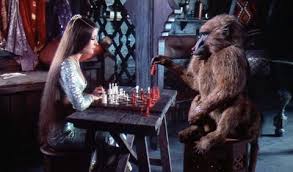
Melanthius: “Extraordinary, a normal babboon wouldn’t have reconised its reflection and attacked it thinking it was another babboon.”
Ray Harryhausen’s final Sinbad adventure, Sinbad and the Eye of the Tiger (1977), arrives on Blu-ray with the usual mixture of wonder, nostalgia, and a touch of disappointment that has accompanied the film since its theatrical release. Often regarded as the weakest of Harryhausen’s Sinbad trilogy, it nonetheless remains a vivid showcase of his visual imagination, full of animated creatures, mythic adventure, and a tone that bridges the Saturday-matinee sensibility of the 1950s with the post-Star Wars blockbuster era it arrived on the cusp of.
What makes this Blu-ray noteworthy is not only the film’s technical presentation but the contextual framing it provides—an opportunity to reassess what has long been considered an underachieving entry in a legendary visual-effects career.
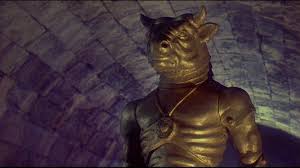
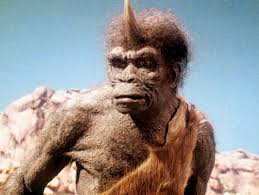
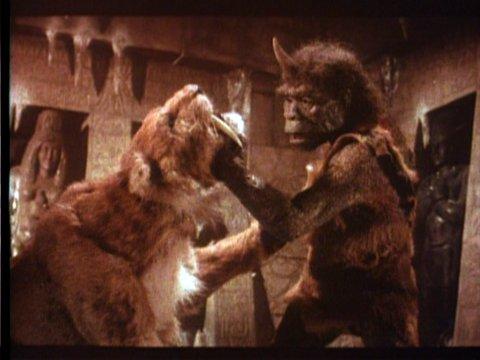
Narratively, Eye of the Tiger follows Sinbad (Patrick Wayne), joined by the usual assortment of loyal crew and generated love interests, as he attempts to break a magical curse placed on Prince Kassim, who has been transformed into a baboon by an evil sorceress (Margaret Whiting, in one of the film’s few spirited performances). The journey takes the crew across fantastical landscapes populated by sabre-toothed tigers, troglodytes, towering insects, and undead skeletons—classic Harryhausen beasts rendered with his trademark stop-motion animation.
Critically, the film suffers from a lack of charisma in its leads. Patrick Wayne is handsome but wooden, and Jane Seymour, radiant though she is, is given little to do beyond gazing admiringly and feigning distress. The script is simplistic even by late-’70s adventure standards, and the direction by Sam Wanamaker occasionally feels rushed—an odd mismatch with the laborious, handcrafted animation that defines the movie’s appeal.
Yet it’s precisely that handcrafted quality that keeps the film alive. The baboon—one of Harryhausen’s most expressive creations—is arguably the emotional core of the story, and the stop-motion set pieces are still charming and distinct, especially when viewed in high-definition. Where the film falters in pacing and performance, it succeeds almost entirely on the basis of visual imagination.
Visually, the Blu-ray reveals an unexpectedly strong transfer from often inconsistent original elements. Grain is present and mostly natural, befitting the film stock of the period. The colour palette is surprisingly rich, with vivid blues, golden sands, and deep reds that have often looked washed-out in television and VHS broadcasts restored to something like their intended vibrancy.
Detail is improved considerably, particularly in close-ups and in Harryhausen’s models, where you can now fully appreciate the texture of fur, scales, and costumes. Matte shots and optical effects inevitably show their seams under HD scrutiny, but that is part of the charm rather than a flaw—these films are made of visible artistry, not digital perfection.
The biggest technical issue is occasional softness and inconsistency from scene to scene, a by-product of the film’s extensive photographic compositing. While the transfer doesn’t attempt to over-correct or scrub these characteristics away, viewers accustomed to modern 4K restorations may find it less striking overall.
The lossless audio track is clean, nicely balanced, and gives a welcome showcase to Roy Budd’s enthusiastic, muscular score. Dialogue is generally clear, though occasionally thin in the original recording, and the mix does its best to balance lively sound effects with orchestration.
There are no aggressive surround tricks here, but the track preserves the spirit of the original mix without distortion or hiss.
Sinbad and the Eye of the Tiger is flawed, fun, old-fashioned fantasy. The Blu-ray does not disguise its shortcomings—awkward acting, sluggish pacing, and dated narrative—but it amplifies its strengths: Harryhausen’s extraordinary technique, the sense of mythic wonder, and the tangible magic that only physical effects can conjure.
The high-definition transfer honours the film’s textures without over-polishing, the audio does justice to the heroic score, and the supplements provide a rich layer of context that makes revisiting this “lesser” Sinbad much more rewarding.
Not essential for casual viewers, but a surprisingly handsome Blu-ray that enhances appreciation of a film whose creative ambition exceeded its resources—yet still produced moments of genuine cinematic charm.a restoration of memory—the humble, resilient spirit of the “happy breed” it celebrates.estoration triumph but as a rediscovery of a film that glimmers with wit, irony, and supernatural elegance.


 spryfilm.com