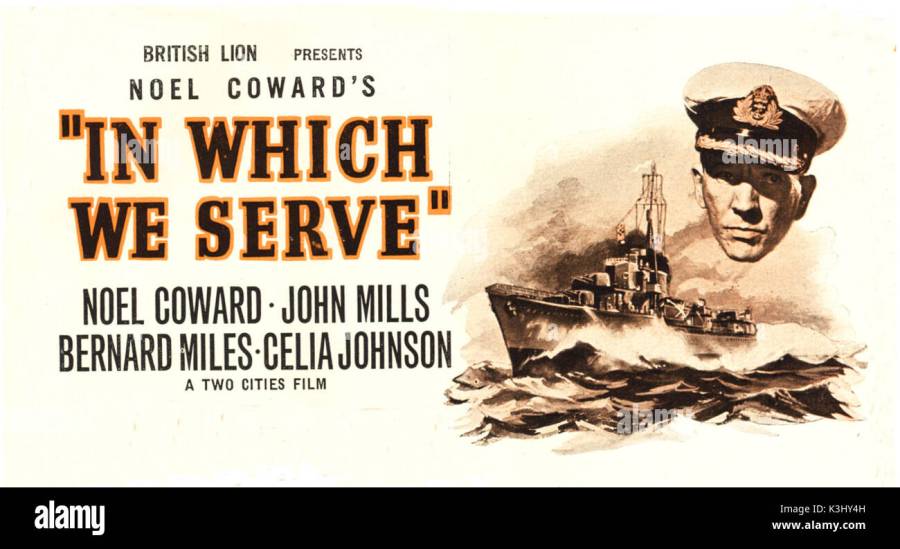
“In Which We Serve” (1942)
Drama

Running Time: 115 minutes
Written by: Noël Coward
Directed by: David Lean
Starring: Noël Coward, John Mills, Bernard Miles and Celia Johnson
Mrs. Alix Kinross: [Christmas dinner toast] “Ladies and gentlemen. I’ll begin by taking my husband’s advice and wishing you all a very happy Christmas. I’m sure Elizabeth and June will back me up when I say I’d like to deliver, on behalf of all wretched naval wives, a word of warning to Maureen who’s been unwise enough to decide to join our ranks. Dear Maureen: we all wish you every possible happiness, but I think it only fair to tell you in advance exactly what you are in for. Speaking from bitter experience I can only say that the wife of a sailor is most profoundly to be pitied. To begin with, her home life, what there is of it, hath no stability whatever. She can never really settle down. She moves through a succession of other people’s houses, flats, and furnished rooms. She finds herself having to grapple with domestic problems in Bermuda, Malta, or Weymouth. We will not deal with the question of pay as that is altogether too painful. But we will deal with is the most important disillusionment of all, and that is that wherever she goes there is always in her life a permanently undefeated rival: her husband’s ship. Whether it be a battleship or a sloop, a submarine or a destroyer, it holds first place in his heart. It comes before wife, home, children, everything. Some of us try to fight this and get badly mauled in the process. Others, like myself, resolve themselves to the inevitable. That is what you will have to do, my poor Maureen. That is what we all have to do if we want any peace of mind at all. Ladies and gentlemen I give you my rival. It is extraordinary that anyone could be so fond and so proud of their most implacable enemy – this ship. God bless this ship and all who sail in her.”
David Lean’s directorial debut, In Which We Serve (1942), remains one of the most resonant British films of the Second World War — a patriotic yet profoundly humane portrait of courage, duty, and endurance under fire. Co-written, co-directed, and starring Noël Coward, the film was conceived as a morale-boosting tribute to the Royal Navy and to the British spirit during the darkest days of the conflict. This new Blu-ray edition (typically sourced from the BFI or StudioCanal restoration, depending on region) offers a thoughtful presentation of a wartime classic that holds both historical and cinematic value, balancing emotional storytelling with a documentarian’s sense of duty.
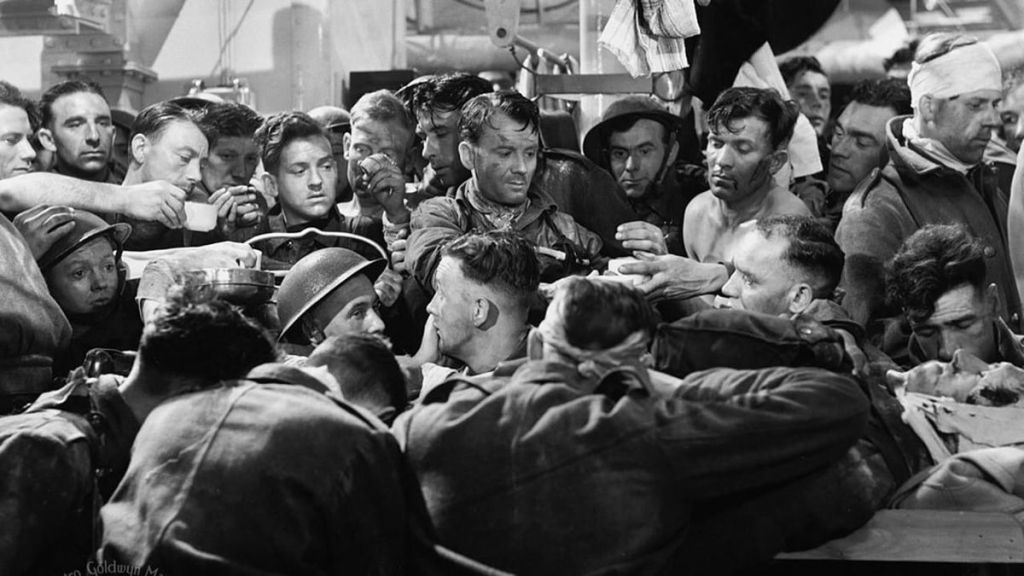
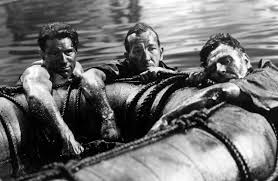
In Which We Serve opens amid chaos: the British destroyer HMS Torrin is struck and sunk by German bombers during the Battle of Crete. As the survivors cling to a raft in the churning sea, flashbacks chart the ship’s life and the intertwined stories of its crew — from construction to commissioning, from camaraderie to catastrophe. At the film’s emotional core is Captain Kinross (Coward), whose stoic leadership and moral fortitude embody the film’s message of sacrifice and unity. Yet Lean and Coward expand the narrative beyond the captain’s experience, weaving in the lives of ordinary sailors and their families on the home front, creating a mosaic of wartime Britain.
While Coward’s influence is evident in the film’s dialogue and patriotic tenor, Lean’s cinematic instincts give the film its lasting vitality. His visual precision — the careful framing of confined spaces aboard ship, the documentary-like montage of naval operations, and the striking use of smoke, water, and debris — gives the film an immediacy uncommon in British cinema of the period. There’s a remarkable fluidity to the editing and structure, alternating between the present-tense survival drama and memory sequences that emphasize community and endurance. The film’s emotional power rests not in sentimentality but in its quiet, unwavering respect for ordinary lives lived with dignity amid crisis.
Coward, an actor often associated with urbane wit and theatricality, delivers one of his most restrained and heartfelt performances. As Captain Kinross, he embodies duty without arrogance, authority without bluster. His clipped delivery, so often used for comedy, here becomes a voice of steady resolve. Opposite him are John Mills, Bernard Miles, Celia Johnson, and Kay Walsh, each lending warmth and authenticity to their portrayals. Johnson, as Kinross’s wife, gives one of her most moving early performances, prefiguring her later work with Lean in Brief Encounter.
The film’s tone is unmistakably propagandistic — a wartime necessity — but it achieves a rare emotional honesty. Where other British wartime films leaned on stiff-upper-lip rhetoric, In Which We Serve humanizes its patriotism through domestic scenes of longing, humor, and loss. The recurring image of ordinary people working together — in dockyards, kitchens, or lifeboats — encapsulates the collective ethos of wartime Britain.
The Blu-ray presentation benefits enormously from a meticulous restoration of the original 35mm elements. Shot by Ronald Neame in black and white, the film is characterized by a rich chiaroscuro aesthetic that the Blu-ray captures in impressive detail. Grain is well-managed, preserving the texture of the period cinematography without artificial smoothing. The contrast levels are deep and stable, and the sea battle sequences, with their smoke and explosions, exhibit a newfound clarity.
Some of the wartime stock footage remains slightly softer, as expected, but transitions between staged and archival material are seamless. Damage, scratches, and flicker that plagued earlier DVD editions have been almost entirely removed. The overall result is a presentation that feels faithful to Lean and Neame’s original visual design — crisp but not clinical, atmospheric but not overly processed.
The LPCM mono track is a solid representation of the original sound design. Dialogue remains clear and well-balanced, even during the most chaotic action scenes. Coward’s own score — understated but stirring — sounds fuller than in previous releases, with the orchestral highs given some welcome depth. There’s still an inherent thinness to some of the wartime recordings, but any remaining hiss or distortion is minimal and authentic to the film’s period origins. English subtitles are included and helpful given the occasional overlap of dialogue and ambient noise.
The supplements, though modest in number, are thoughtfully curated. Most editions include:
- Audio commentary featuring film historians or Coward scholars discussing the collaboration between Lean and Coward, the film’s production during the Blitz, and its importance in shaping Lean’s later career.
- Documentary featurette on the making of the film, tracing its dual function as art and propaganda.
- Interview segments with surviving crew members or family descendants, discussing Coward’s meticulous working methods.
- Archival newsreels or wartime publicity materials, offering fascinating context for how the film was received in 1942.
The absence of a full-length Coward retrospective might disappoint completists, but the included material complements the film well, especially in illustrating Lean’s apprenticeship under Coward and Ronald Neame — a collaboration that would later blossom into some of British cinema’s greatest works.
Viewed today, In Which We Serve stands as more than a relic of wartime propaganda. It is an essential bridge between the classical theatricality of prewar British film and the more fluid, psychologically rich cinema Lean would later perfect in Brief Encounter and Great Expectations. Coward’s prose and Lean’s cinematic intelligence make for an ideal pairing: one grounding the film in national identity, the other elevating it to visual poetry.
This Blu-ray release does the film proud. The restoration honors its historical significance without stripping away its texture or intimacy. For fans of Lean, Coward, or British wartime cinema, this is not just a technical upgrade but a rediscovery of a landmark work that shaped the postwar narrative of endurance and moral strength.
A beautifully restored presentation of a cornerstone of British cinema — stirring, intimate, and impeccably crafted. In Which We Serve has never looked or sounded better on home video.ving artistry, or of mid-century Technicolor domestic drama, this disc is essential. It’s not only a restoration of a film but a restoration of memory—the humble, resilient spirit of the “happy breed” it celebrates.estoration triumph but as a rediscovery of a film that glimmers with wit, irony, and supernatural elegance.


 spryfilm.com