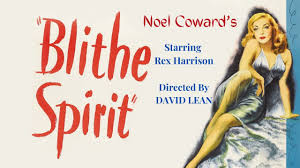
“Blithe Spirit” (1945)
Drama

Running Time: 96 minutes
Written by: David Lean and Ronald Neame
Directed by: David Lean
Starring: Rex Harrison, Constance Cummings, Kay Hammond and Margaret Rutherford
Charles Condomine: “It’s discouraging to think how many people are shocked by honesty and how few by deceit.”
David Lean’s Blithe Spirit remains one of the most curious entries in the director’s early career — a supernatural farce filmed with sumptuous Technicolor style and a distinctly English mix of sophistication and silliness. Adapted from Noël Coward’s celebrated stage play, the film occupies a unique place in Lean’s evolution from editor to master filmmaker: poised between the domestic comedies he made with Coward (In Which We Serve, This Happy Breed) and the grand, emotionally charged epics that would define his later career. Now restored and released on Blu-ray, Blithe Spirit receives the kind of visual and archival treatment that allows modern audiences to appreciate its wit, craftsmanship, and eccentric charm anew.
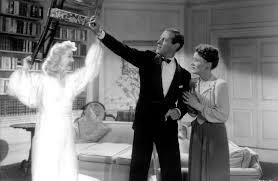
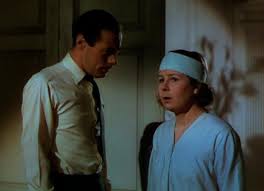
The premise — a mild-mannered novelist, Charles Condomine (Rex Harrison), invites a medium to conduct a séance, only to accidentally summon the mischievous ghost of his late wife Elvira (Kay Hammond) — remains a deliciously dry exploration of marital discord and the supernatural. Charles’ new wife, Ruth (Constance Cummings), is less amused by the spectral intrusions, and what follows is a battle of wits and wills that veers between the comic and the macabre.
What makes Lean’s interpretation so striking is its visual imagination. Though the original play thrived on Coward’s brittle dialogue and stage-bound repartee, Lean opens the material up cinematically. He fills the screen with the lush glow of Technicolor, using the supernatural premise to experiment with visual textures and lighting. Elvira’s ghostly presence, filmed in shimmering pastel greens and blues, contrasts vividly with the warm, earthbound tones of the living. The effect is both eerie and elegant — a ghost story rendered with the same painterly precision Lean would later bring to the deserts of Lawrence of Arabia or the icy platforms of Brief Encounter.
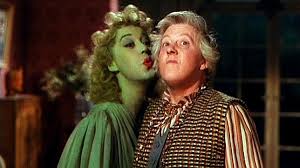
The performances strike a balance between Coward’s verbal wit and Lean’s cinematic sensibility. Harrison’s dry, clipped delivery perfectly suits the exasperated Charles, while Hammond, reprising her stage role as Elvira, exudes a feline playfulness that makes her haunting both delightful and disruptive. Margaret Rutherford steals every scene as the eccentric medium Madame Arcati — a whirlwind of unselfconscious energy, she’s the antithesis of the film’s drawing-room restraint and gives Blithe Spirit much of its comic vitality.
While critics of the time found the film’s tone uneven and too subdued compared to Coward’s stage production, modern viewers can appreciate the tension between irony and melancholy that Lean introduces. Beneath the polished banter lies a streak of darkness — a recognition of love’s transience and the absurd persistence of jealousy beyond the grave.
The new Blu-ray presentation — derived from a meticulous 4K restoration — is a revelation. The Technicolor photography, originally captured by Ronald Neame, has never looked better on home video. The rich palette of emeralds, creams, and soft reds gleams with renewed vibrancy, while skin tones and fabric textures show an impressive naturalism for a 1940s production. The film’s spectral effects, achieved through layered exposures and optical work, benefit enormously from the crisp detail and stable contrast of the transfer.
The restoration also eliminates many of the scratches, flickers, and fading that plagued earlier home video editions. Grain is finely preserved, maintaining a filmic quality without succumbing to overzealous digital cleaning. This is especially important for a Technicolor film of the period, where too much smoothing can erase the subtleties of the dye-transfer process.
The monaural soundtrack, presented in LPCM or DTS-HD Master Audio (depending on the edition), offers a clear and balanced rendering of Coward’s dialogue-heavy script. Dialogue sits comfortably in the mix, and the score — by Richard Addinsell — retains its period charm without distortion. Some minor hiss remains in a few quieter scenes, but it’s never intrusive. For a film nearly 80 years old, the audio fidelity is remarkably strong.
The Blu-ray release comes well stocked with extras that contextualize both the film and Lean’s broader career. Highlights include:
- Audio Commentary by film historians who delve into the Coward-Lean collaboration, offering insight into how Lean’s visual approach complemented (and sometimes contradicted) Coward’s theatrical sensibilities.
- Featurette: David Lean and Noël Coward: A Creative Partnership – an illuminating retrospective on how their four films together shaped British postwar cinema.
- Interview with Ronald Neame (archival) – the cinematographer discusses the technical challenges of capturing the ghost effects in Technicolor.
- Restoration comparison – a short but fascinating look at the before-and-after states of the film.
- Trailer and stills gallery, rounding out the package.
Some editions (notably the Criterion or StudioCanal releases) also include a printed essay exploring Blithe Spirit as a bridge between Lean’s “small” films and his later epics.
As a film, Blithe Spirit may not possess the emotional depth of Brief Encounter or the visual grandeur of Great Expectations, but its sophisticated craftsmanship, sparkling dialogue, and vivid color photography make it one of Lean’s most distinctive early works. The Blu-ray presentation restores its visual splendor and offers valuable supplements that situate it within the context of both Coward’s stage legacy and British cinema’s postwar transformation.
For fans of Lean, Coward, or classic British comedy, this Blu-ray is essential — not only as a restoration triumph but as a rediscovery of a film that glimmers with wit, irony, and supernatural elegance.



 spryfilm.com