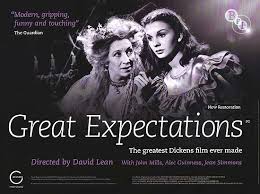
“Great Expectations” (1946)
Drama

Running Time: 118 minutes
Written by: David Lean, Anthony Havelock-Allan and Ronald Neame
Directed by: David Lean
Starring: John Mills, Valerie Hobson, Bernard Miles, Francis L. Sullivan, Anthony Wager and Jean Simmons
Mr. Jaggers: “Now, Pip: put the case that this legal advisor has often seen children tried at the criminal bar. Put the case that he has known them to be habitually imprisoned, whipped, neglected, cast out, neglected, cast out, qualified in all ways for the hangman, and growing up to be hanged. Put the case that here was one pretty little child out of the heap that could be saved. Put that last case to yourself very carefully, Pip.”
David Lean’s Great Expectations is one of the most distinguished literary adaptations in British cinema history — a film that not only captures the spirit of Charles Dickens’ 1861 novel but refines it into something visually poetic, emotionally potent, and cinematically timeless. Released in 1946, this was Lean’s second adaptation of Dickens (following Oliver Twist two years later) and remains one of the greatest translations of 19th-century literature to the screen.
Dickens’ sprawling narratives have often proved difficult to adapt, filled as they are with digressions, large casts, and social commentary. Lean’s genius lay in his ability to condense the material without losing its heart. Working with co-writers Ronald Neame, Anthony Havelock-Allan, and Kay Walsh, Lean distilled the 600-page novel into a tightly paced two-hour film that retains the novel’s essence: a story of moral awakening, disillusionment, and redemption.
What makes Lean’s Great Expectations so remarkable is its cinematic economy. From the first moments — a young boy in a windswept graveyard, accosted by an escaped convict — the story grips the viewer. There’s no wasted motion, no indulgence. Every image, every edit advances the story or deepens its atmosphere.
The opening graveyard scene remains one of the most iconic in British film. Shot by cinematographer Guy Green, the sequence feels almost gothic in its bleak beauty. The camera glides through the fog-drenched marshes, the gravestones silhouetted against the grey sky, and young Pip (Anthony Wager) trembling as Magwitch (Finlay Currie) bursts out of the mist. The use of shadows and perspective evokes German Expressionism — particularly Murnau’s Nosferatu and Lang’s M — but Lean grounds the stylization in raw emotion. It’s a moment of fear and pity, setting the moral tone for Pip’s lifelong struggle between compassion and ambition.
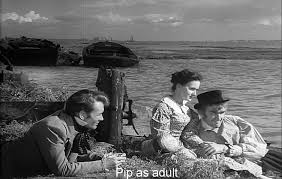
The casting throughout is nearly flawless. John Mills, though arguably too old to play the young adult Pip, brings quiet sensitivity and decency to the role. His performance anchors the film’s emotional development — Pip’s shame, confusion, and eventual humility are all finely rendered.
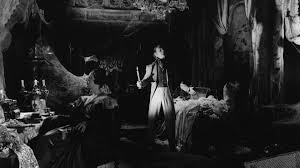
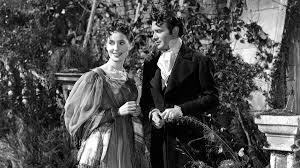
Valerie Hobson, as the adult Estella, captures the character’s cold beauty and tragic conditioning, while Jean Simmons (as the young Estella) steals the early scenes with her composed cruelty and flickering vulnerability. Martita Hunt’s Miss Havisham is one of the film’s triumphs — a living ghost surrounded by cobwebs, dust, and the decaying remnants of her wedding feast. Hunt’s portrayal is equal parts pitiful and terrifying, her bitterness transformed into ritualized madness.
Finlay Currie’s Magwitch, too, deserves special praise. His performance transcends caricature, showing the convict as both frightening and deeply human. When he reenters Pip’s life years later, the tenderness in Currie’s eyes gives the revelation of his identity an almost biblical force.
The visual world of Great Expectations is unforgettable. Lean and his production team — including art director John Bryan — constructed environments that look lived-in yet dreamlike. Miss Havisham’s mansion, Satis House, is a masterpiece of design: cobwebbed draperies, rotting cake, and frozen clocks all illuminated by ghostly shafts of light. The film’s black-and-white photography transforms the setting into a metaphor for emotional decay and moral paralysis.
Every shot in the film feels meticulously composed. Guy Green’s cinematography (which won an Academy Award) makes brilliant use of light and shadow to convey mood and meaning. The candlelit interiors glow with a Rembrandt-like richness, while the foggy exteriors evoke a sense of entrapment and destiny. Lean’s direction here prefigures his later mastery in epics like The Bridge on the River Kwai and Lawrence of Arabia: even in intimate moments, his visual storytelling feels grand, operatic.
Lean began his career as an editor, and his command of pacing is one of the film’s great strengths. The transitions between Pip’s childhood and adulthood are seamless, enhanced by Lean’s ability to suggest the passage of time through imagery rather than dialogue. The editing of the climactic river chase — as Magwitch faces capture — demonstrates Lean’s growing skill in building tension, something that would become a hallmark of his later work.
At its heart, Great Expectations is about the corruption of innocence and the painful education of the soul. Lean handles these themes with restraint and empathy. Pip’s yearning to become a “gentleman” and his subsequent disillusionment feel universal. The film avoids heavy-handed moralizing; instead, it shows the quiet consequences of pride and ingratitude.
The ending — altered slightly from Dickens’ original — offers redemption and reconciliation, fitting Lean’s more romantic sensibility. Where Dickens left some ambiguity, Lean allows a glimmer of hope: Pip and Estella reunited, the windows of Satis House opened to the light. It’s sentimental, yes, but deeply earned.
David Lean’s Great Expectations remains one of the crown jewels of postwar British cinema. It won two Academy Awards (for cinematography and art direction) and was nominated for three others, including Best Picture and Best Director. Critics and audiences alike recognized its achievement — not merely as a faithful adaptation, but as a standalone work of art.
More than seventy years later, it still feels modern in its storytelling precision and visual power. Its influence can be traced through countless later Dickens adaptations, from Lean’s own Oliver Twist to the BBC’s many versions. But none have matched its balance of poetry and realism, darkness and grace.
Lean’s Great Expectations is a triumph of craft and emotion — a film that bridges literature and cinema with rare intelligence and beauty. It captures the soul of Dickens while speaking the language of film fluently, elegantly, and indelibly.
Whether one approaches it as a Dickens enthusiast, a cinephile, or simply a lover of great storytelling, this version remains definitive. The marshes, the mists, the tattered wedding dress — they linger in the mind long after the final frame fades, a testament to Lean’s genius for turning literary imagination into cinematic legend.



 spryfilm.com