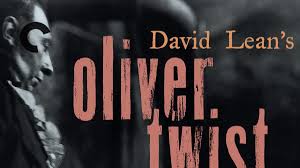
“Oliver Twist” (1948)
Drama

Running Time: 116 minutes
Written by: David Lean and Stanley Haynes
Directed by: Stanley Haynes
Starring: Alec Guinness, Robert Newton, Kay Walsh, John Howard Davies, Anthony Newley and Diana Dors
Mr. Bumble: “Cry your hardest now, it opens the lungs, washes the countenance, exercises the eyes and softens down the temper. So cry away.”
David Lean’s 1948 adaptation of Oliver Twist is widely regarded as one of the most visually striking and dramatically powerful renderings of Charles Dickens’ classic novel. Following the triumph of Lean’s Great Expectations (1946), he returned once again to Dickens with a greater confidence in how to translate the author’s richly atmospheric prose into visual storytelling. The result is a dark, compelling, and at times unsettling film that remains one of the finest Dickens adaptations ever put to screen.
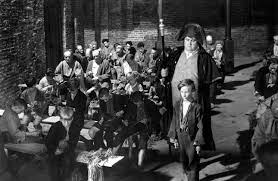
The film follows the familiar arc of Dickens’ novel: Oliver, an orphan born in a workhouse, dares to ask for more food, is punished, and eventually ends up on the streets of London, where he falls in with Fagin and his band of young pickpockets. Through twists of fate, Oliver is taken in by kind benefactors but is continually pursued by the criminal world that seeks to drag him back into the shadows.
Lean’s adaptation is fairly faithful to the novel, though, as with Great Expectations, he condenses subplots and characters for narrative flow. Some storylines are trimmed to keep the film within just under two hours, but the essence of Oliver’s innocence clashing with a corrupt and cruel world is preserved. The film’s darker tone matches Dickens’ own anger at social injustice and the plight of the poor, making it a more serious, adult interpretation compared to later, more sentimental versions.
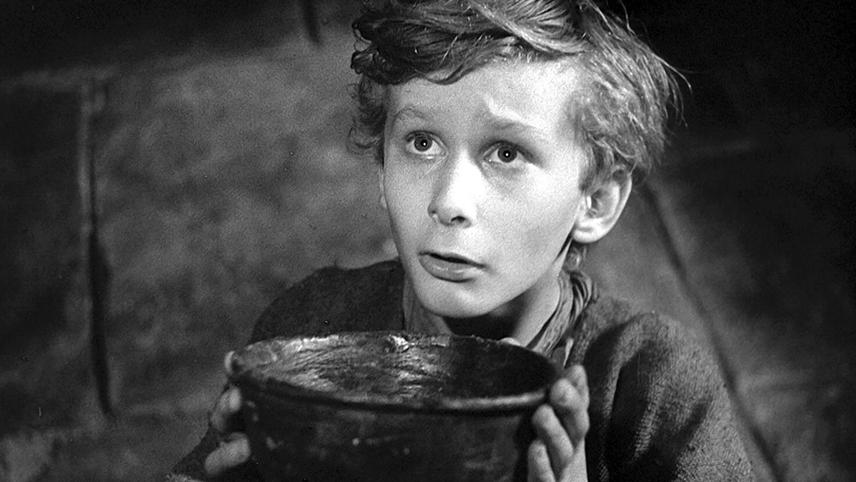
At the heart of the film is John Howard Davies as Oliver. Only eight years old at the time, Davies brings a fragile, almost ethereal quality to the role. His performance is understated, leaning on his natural innocence rather than theatrical delivery, which makes Oliver’s suffering all the more poignant.
But it is the supporting cast that truly dominates the screen. Alec Guinness delivers a notorious and unforgettable performance as Fagin. Lean and Guinness lean heavily into grotesquerie, with Guinness buried under heavy makeup that exaggerated Dickens’ controversial descriptions. His Fagin is sly, sinister, and almost rodent-like, a figure who embodies both menace and theatricality. While brilliantly performed, the depiction has been the subject of much criticism for perpetuating antisemitic stereotypes—so much so that the film was initially banned in the United States and in several European countries. This controversy continues to shape discussions of the film today.
Robert Newton gives a brutal turn as Bill Sikes, one of the most terrifying presences in any Dickens adaptation. His violent outbursts and simmering rage culminate in moments of shocking intensity, particularly in the scenes involving Nancy. Kay Walsh, as Nancy, provides the film’s most human and tragic performance. She captures the warmth, desperation, and doomed loyalty of Dickens’ heroine, ensuring that her death resonates as the emotional core of the story.
What sets Lean’s Oliver Twist apart is its style. Shot in black and white by cinematographer Guy Green, the film uses harsh lighting, deep shadows, and striking compositions to create a near-expressionistic atmosphere. London becomes a place of looming buildings, fog-shrouded alleys, and oppressive interiors, all reflecting the crushing social realities Oliver faces. The sequences in Fagin’s den are particularly memorable, dripping with menace and claustrophobia.
Lean, who had already demonstrated his gift for blending literary adaptation with cinematic flair, constructs set pieces with remarkable precision. The robbery attempts, the chase scenes, and the climactic pursuit of Sikes across the rooftops are thrilling and technically superb, combining spectacle with raw emotional weight.
Unlike some adaptations that soften Dickens’ story for family audiences, Lean emphasizes its brutality. The workhouse scenes are grim, the violence of Sikes is horrifying, and the overall tone is bleak. This was both a strength and a liability: critics praised the film’s artistry and power but questioned its suitability for younger audiences. In Britain, it was lauded for its faithfulness to Dickens’ anger at social injustice, but in America it faced cuts and censorship due to its disturbing imagery and the depiction of Fagin.
Despite the controversy, the film has endured as one of the greatest Dickens adaptations. Its combination of stylized visual design, powerful performances, and unflinching tone captures something essential about the darker undercurrents of Oliver Twist.
Today, Lean’s Oliver Twist is remembered both for its cinematic brilliance and the debate around its handling of Fagin. It set a high bar for literary adaptations, showing that Dickens could be translated into a medium that preserved both his social criticism and his sense of gothic grandeur. While some later versions opted for a more sanitized or musical approach, Lean’s remains uncompromising—a stark reminder of the cruelty at the heart of the story.
The 1948 Oliver Twist is not an easy watch, nor was it ever meant to be. It is a visually stunning, emotionally intense, and morally troubling work of cinema that dares to present Dickens without gloss. John Howard Davies’ innocent Oliver, Alec Guinness’ sinister Fagin, Robert Newton’s terrifying Bill Sikes, and Kay Walsh’s heartbreaking Nancy all contribute to a film that lingers long after viewing.
It is both a masterpiece of British cinema and a product of its time—brilliant, haunting, but also controversial. For those interested in Dickens, Lean, or the evolution of postwar British film, it remains essential viewing.




 spryfilm.com