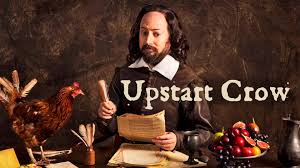
“Upstart Crow Series 1 – 3” (2016 – 2020)
Television Series / Comedy

Twenty One Episodes
Created by: Ben Elton
Featuring: David Mitchell, Liza Tarbuck, Rob Rouse, Gemma Whelan and Mark Heap
Will: [Repeated line on having a good idea] “Hang on. Hang the futtock on!”
Upstart Crow (2016–2020), written by Ben Elton, is a clever, affectionate, and consistently witty sitcom that reimagines the life of William Shakespeare with equal measures of reverence and ridicule. Starring David Mitchell as the Bard, the series blends historical detail with modern satire, managing to both parody the Elizabethan world and skewer contemporary social issues. Across its three seasons (and special episodes), the show has carved out a distinctive place in the canon of British television comedy.
The premise is deceptively simple: Shakespeare, still establishing himself as a playwright, struggles with the daily realities of Elizabethan England while juggling the demands of his family, his acting troupe, and the cultural climate of the time. What elevates the series beyond a mere historical parody is Ben Elton’s sharp writing. Elton uses Shakespeare’s world as a mirror for modern-day debates: class prejudice, gender inequality, xenophobia, celebrity culture, and even the futility of commuting.
The dialogue is a highlight. Elton peppers the scripts with wordplay and faux-Elizabethan flourishes, but always with a wink to the audience. Shakespeare’s lines are frequently juxtaposed with blunt, modern phrasing, creating a comic friction that becomes the show’s signature style. For example, an Elizabethan character might solemnly discuss the plague, only for another to dismiss it as “just another London transport issue.” These anachronisms are deliberate, not sloppy, and they give the show its satirical edge.
Mitchell’s casting is perfect. He embodies Shakespeare as a pompous, self-important, yet oddly sympathetic figure. His Will is forever convinced of his genius but constantly undermined by others—actors, family, even his rivals—who see him as pretentious or absurd. Mitchell’s deadpan delivery enhances the humor, and he plays the Bard less as a mythic literary figure and more as a beleaguered, middle-class professional trying to “make it” in a cutthroat industry.
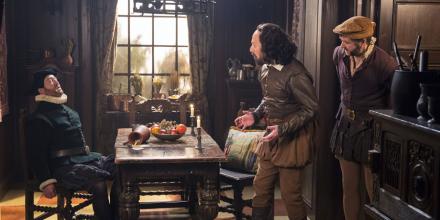
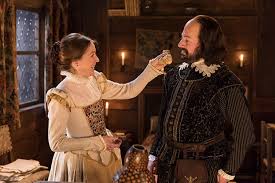
The ensemble is rich with comic talent. Paula Wilcox and Liza Tarbuck shine as Shakespeare’s mother and wife, respectively, both offering no-nonsense counterpoints to Will’s lofty self-regard. Gemma Whelan is delightful as Kate, the aspiring actress whose intelligence and ambition constantly highlight the absurd gender restrictions of the era. Rob Rouse, as Shakespeare’s servant Bottom, provides a reliable stream of earthy humor. Spencer Jones as Kempe, the clownish actor, and Mark Heap as the brooding Robert Greene (forever sneering “Upstart Crow!”) bring additional layers of absurdity.
The chemistry among the cast is one of the show’s strongest assets. Each character plays off Shakespeare’s vanity in different ways, ensuring that he is always being punctured by reality, whether it comes from a servant’s blunt honesty, a rival’s cruelty, or his wife’s dry pragmatism.
The comedy operates on multiple levels. On the surface, it’s a traditional sitcom, complete with running gags (such as Shakespeare’s disastrous attempts at travel, or his family’s indifference to his “genius”). But beneath that, it is a witty commentary on Shakespearean scholarship, a parody of the challenges artists face, and even a meta-commentary on sitcom structures themselves.
Elton, who previously co-wrote Blackadder II (another historical comedy with an Elizabethan setting), often draws comparisons between the two shows. While Blackadder was sharper in its cynicism, Upstart Crow leans more toward affectionate satire. It is gentler, less biting, but it compensates with clever anachronisms and topical parallels.
The show frequently uses Shakespeare’s works-in-progress as fodder for comedy. Episodes will often end with Will inadvertently stumbling upon the idea for a famous line or plot twist, only to have it dismissed by others as ridiculous. This running gag both celebrates and undercuts the myth of Shakespeare’s genius, reminding viewers that even the greatest writers had to wrestle with doubt, criticism, and failure.
If the show has a flaw, it is that its rhythms can sometimes feel predictable. Many episodes follow a familiar formula: Shakespeare struggles with a problem, his peers mock him, he lectures pompously, and then he accidentally discovers a great literary idea. For some, this repetitiveness can lessen the impact of the humor. Additionally, the heavy reliance on modern parallels (Brexit references, celebrity culture jokes, etc.) may date the show more quickly than Elton’s earlier work.
However, these are minor quibbles when weighed against the sheer charm and intelligence of the series.
Upstart Crow stands out as one of the most successful attempts to blend historical comedy with contemporary satire. It manages to poke fun at Shakespeare without belittling his importance, instead humanizing him as a flawed but determined artist. The show works both for casual viewers, who can enjoy the slapstick and anachronisms, and for Shakespeare enthusiasts, who will delight in spotting references and allusions.
The final Christmas special, Lockdown Christmas 1603, and the subsequent stage play adaptation show the durability of the concept and characters. While it may not reach the legendary status of Blackadder, Upstart Crow is a warm, clever, and consistently funny sitcom that demonstrates Ben Elton’s enduring talent for mixing wit with cultural critique.



 spryfilm.com