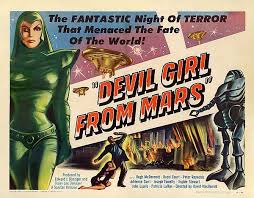
“Devil Girl from Mars” (1954)
Science Fiction

Running Time: 77 minutes
Written by: James Eastwood and John C. Mather
Directed by: David MacDonald
Starring: Patricia Laffan, Hugh McDermott, Hazel Court, Peter Reynolds and Adrienne Corri
Michael Carter: “Mrs. Jamieson, may I introduce your latest guest. Miss Nyah. She comes from Mars.”
Mrs. Jamieson: “Oh, well, that’ll mean another bed.”
To review “Devil Girl from Mars” (1954) is not merely to dissect a film; it is to engage with a relic, a fascinatingly flawed artifact from the golden age of drive-in cinema and the burgeoning anxieties of the Cold War. Often lumped into the “so bad it’s good” category, this British sci-fi offering, directed by David MacDonald, is less a masterpiece and more a cultural touchstone – a curious blend of ambition, limited resources, and an almost endearing commitment to its ludicrous premise.
The film opens with a premise as blunt as a flying saucer landing in rural Scotland: Nyah (Patricia Laffan), a striking, imperious, and undeniably glamorous alien woman, crash-lands her spaceship near a remote inn. Her mission? To abduct suitable males from Earth to repopulate her dying Martian race, who, through some unspecified societal evolution, have eliminated their own male population. This immediate declaration of intent sets the tone for the entire film: no subtle mystery, no gradual reveal, just a direct, almost business-like assertion of alien intent that would make even the most hardened sci-fi fan crack a smile.
The majority of the film unfolds within the confines of the inn, a decision clearly dictated by budget but one that, surprisingly, works to its advantage. This single setting creates a claustrophobic, almost theatrical atmosphere, forcing the human characters – a disparate collection of tropes including a cynical journalist, a troubled scientist, a kindly innkeeper, and a runaway model – to confront Nyah directly. The interactions within this confined space are where the film’s peculiar charm truly lies.
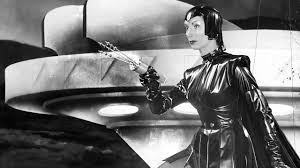
Patricia Laffan’s performance as Nyah is, without a doubt, the film’s undeniable star. Clad in a truly iconic, form-fitting black leather outfit, complete with a helmet that screams “futuristic dominatrix,” Laffan embodies the role with an icy, aristocratic bearing that transcends the limitations of the script. Her voice, a clipped, almost robotic monotone, delivers lines of cosmic pronouncements and threats with a chilling conviction. She is both alluring and terrifying, an alien femme fatale who, despite the low-budget effects, genuinely feels like a superior being. Her presence alone elevates the film from mere schlock to something genuinely memorable. When she glares and declares, “We are the superior race!”, you almost believe her.
The supporting cast, while not as captivating as Laffan, admirably fulfills their roles. Hugh McDermott as Michael Carter, the journalist, provides a cynical, sometimes sarcastic counterpoint to Nyah’s pronouncements. Hazel Court, as the runaway model Doris, injects a touch of vulnerability and human frailty. The interactions between these characters, as they grapple with the unfathomable situation, often lead to moments of unintentional comedy, particularly when they try to reason with or resist Nyah’s unyielding logic.
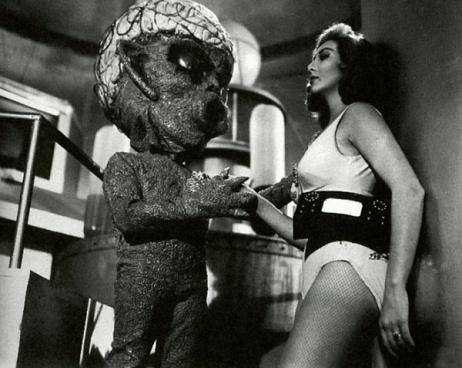
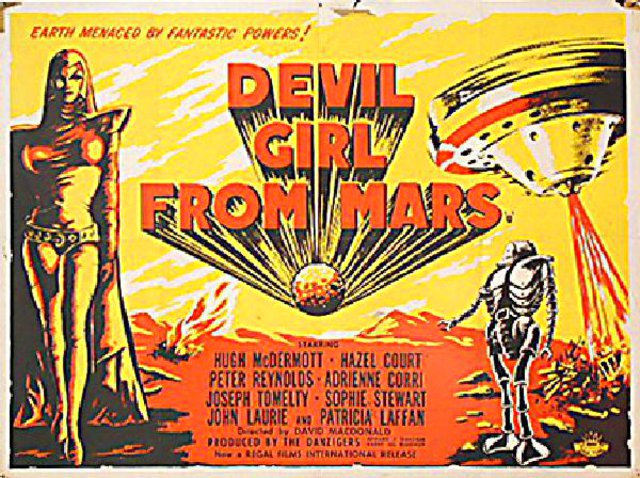
Of course, no review of “Devil Girl from Mars” would be complete without acknowledging its technical limitations. The special effects are, by modern standards, rudimentary at best. The flying saucer is clearly a miniature on wires, and the infamous “robot,” Chani, is a hilariously clunky, almost child-like creation that shuffles rather than strides. Yet, these very imperfections are part of the film’s enduring appeal. They are a testament to the ingenuity and resourcefulness of a bygone era of filmmaking, where imagination often had to compensate for budget. Rather than detracting, these charmingly primitive effects contribute to the film’s unique aesthetic and cement its status as a quintessential B-movie.
Thematically, “Devil Girl from Mars” touches upon classic sci-fi anxieties of the 1950s: invasion, the fear of the unknown, and the fragility of human civilization in the face of a superior alien intellect. However, it also veers into more peculiar territory with its focus on gender dynamics and the supposed “perfection” of a single-sex society. While undoubtedly a product of its time, this unusual subplot adds another layer of intriguing absurdity to the narrative.
Ultimately, “Devil Girl from Mars” is not a film that demands deep critical analysis or boasts profound cinematic achievements. It is, instead, a delightful romp, a testament to the power of a strong central performance and the enduring appeal of low-budget, high-concept sci-fi. It’s a film best enjoyed with a sense of humor and an appreciation for its historical context. It’s a movie that doesn’t take itself too seriously, and in turn, invites its audience to do the same.
For fans of classic B-movies, vintage sci-fi, or anyone looking for an entertaining, if slightly goofy, escape, “Devil Girl from Mars” offers an abundance of unintentional laughs, a surprisingly compelling villainess, and a nostalgic trip back to a simpler, more imaginative era of filmmaking. It may not be “good” in the conventional sense, but it is undeniably, and wonderfully, something. And sometimes, that’s more than enough.



 spryfilm.com