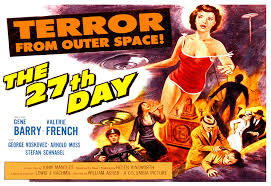
“The 27th Day” (1957)
Science Fiction

Running Time: 75 minutes
Written by: Robert M. Fresco
Directed by: William Asher
Starring: Gene Barry, Valerie French, George Voskovec and Arnold Moss
Jonathan Clark: “People hate because they fear, and they fear anything they don’t understand, which is almost everything.”
“The 27th Day” (1957), directed by William Asher and based on John Mantley’s novel, is a fascinating, if sometimes flawed, product of 1950s Cold War paranoia and science fiction. Far from a monster-driven B-movie, it’s an “idea film” that grapples with weighty themes of human nature, the perils of absolute power, and the potential for self-destruction, all set against the backdrop of nuclear anxiety.
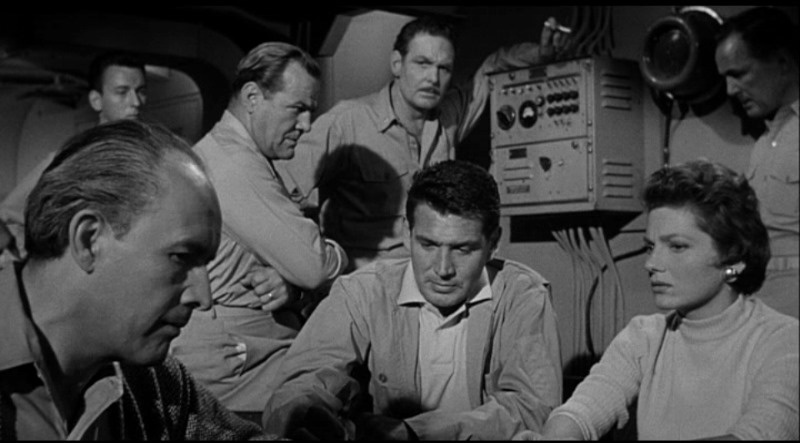
The premise is immediately compelling: an alien, seeking a new home for his dying race, is prohibited by his moral code from directly harming intelligent life. His solution? To give humanity the means to annihilate itself. Five individuals, seemingly chosen at random from the world’s major powers – American reporter Jonathan Clark (Gene Barry), Englishwoman Eve Wingate (Valerie French), German physicist Klaus Bechner (George Voskovec), Soviet soldier Ivan Godofsky (Azemat Janti), and Chinese peasant Su Tan (Maria Tsien) – are abducted and each given a set of three capsules. These capsules, activated by the owner’s thought, can wipe out all human life within a 3,000-mile radius. The catch: they become inert after 27 days. If humanity destroys itself, the aliens can move in. If not, they are doomed.
The film excels in its initial setup, creating a palpable sense of tension and dread. The alien’s broadcast to the world, revealing the existence of the capsules and the identities of their holders, plunges the globe into chaos. We witness the immediate reactions: Eve throws her capsules into the English Channel, Su Tan commits suicide (her capsules self-destructing), while Godofsky is captured and tortured by Soviet authorities determined to harness this terrifying new weapon. Clark and Eve go into hiding, and Bechner, the thoughtful scientist, begins to analyze the implications of the power he now wields.
It’s in the exploration of these reactions and the escalating global crisis that “The 27th Day” truly shines. The film shrewdly reflects the Cold War anxieties of its era. The US and Soviet Union, perpetually at loggerheads, see the capsules as ultimate leverage. The torture of Godofsky by the Soviets, and their subsequent ultimatum to the U.S., is a stark portrayal of the era’s deep-seated distrust and the terrifying prospect of mutually assured destruction. The film doesn’t shy away from depicting mob hysteria and the quick descent into violence when fear takes hold.
However, the film’s execution of its ambitious themes isn’t always seamless. The dialogue, at times, can feel stilted and overly expositional, hindering the natural flow of the narrative. The characters, while representing diverse backgrounds, are somewhat underdeveloped, making it difficult to fully invest in their personal struggles, despite the immense weight of their burden. Maria Tsien’s character, Su Tan, is particularly underserved, given no lines and a somewhat stereotypical portrayal.
The “low-budget” nature of the production is evident in its minimalist sets and restrained special effects, which often rely on stock footage (notably from “Earth vs. The Flying Saucers”). However, director William Asher and cinematographer Henry Freulich utilize these limitations effectively, employing noir-inspired lighting and a functional visual style that prioritizes atmosphere and narrative over spectacle. The score, while sparse, punctuates key moments without overwhelming the dialogue.
The film’s ending, while offering a resolution, has been a point of contention for many viewers. Without giving too much away, the ultimate twist, which hinges on a “moral” rather than purely scientific solution, can feel a bit too convenient and even problematic in its implications. While it attempts to deliver a message of unity and humanity’s capacity for good, some might argue it takes a too simplistic approach to complex issues, particularly in its depiction of “enemies of freedom.”
Despite its shortcomings, “The 27th Day” remains a thought-provoking and historically significant piece of 1950s science fiction. It’s a film that asks profound questions about humanity’s fitness to wield destructive power and whether, when pushed to the brink, we are inherently destructive or capable of redemption. Its engagement with Cold War themes and its unique take on the alien visitation trope set it apart from many of its contemporaries. For aficionados of classic sci-fi and those interested in the cultural anxieties of the mid-20th century, “The 27th Day” is certainly worth a watch, offering a fascinating glimpse into a bygone era’s hopes and fears for the future.



 spryfilm.com