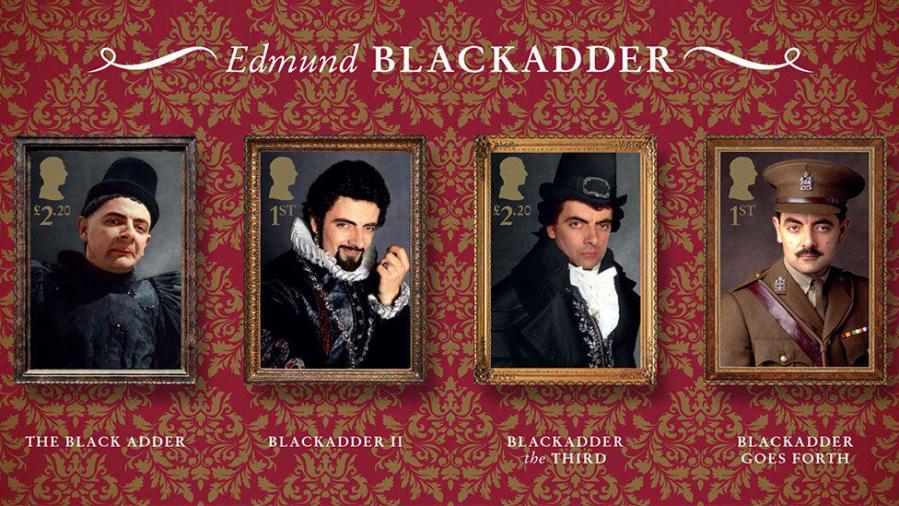
“Blackadder” (1983 – 1989)
Television Series / Comedy

Twenty eight Episodes
Created by: Richard Curtis and Rowan Atkinson
Featuring: Rowan Atkinson, Tony Robinson, Hugh Laurie, Stephen Fry, Tim McInnerny and Miranda Richardson
Opening tune singer: “The sound of hoof beats ‘cross the glade / Good folk, lock up your son and daughter / Beware the deadly flashing blade / Unless you want to end up shorter / Black Adder, Black Adder, he rides a pitch black steed / Black Adder, Black Adder, he’s very bad indeed / Black: his gloves of finest mole / Black: his codpiece made of metal / His horse is blacker than a vole / His pot is blacker than his kettle / Black Adder, Black Adder, with many a cunning plan / Black Adder, Black Adder, you horrid little man.”
Where does one even begin with a show that has, for four distinct incarnations (plus a few specials), redefined British historical comedy, witty put-downs, and the very art of the cynical anti-hero? To review the entire series is to embark on a journey through a thousand years of British (and European) history, guided by the perpetually scheming, increasingly contemptible, yet utterly captivating Edmund Blackadder, and his long-suffering (or often, enthusiastically enabling) sidekick, Baldrick.
The genius of Blackadder lies in its radical reinvention with each series. Gone were the days of sitcoms sticking to one formula until it withered. Instead, writers Richard Curtis and Rowan Atkinson (and later, Ben Elton) shrewdly recognized the potential for a historical anthology, allowing them to explore different comedic dynamics, social absurdities, and character archetypes, all while retaining the core Blackadder-Baldrick relationship.
Blackadder (The First – 1983): “The Black Adder”
The inaugural series stands somewhat apart from its successors. Set in a fictional 1485, immediately following the Battle of Bosworth Field, this Blackadder is a far cry from the sophisticated cynic we’d come to know. Prince Edmund, Duke of Edinburgh (Rowan Atkinson), is a snivelling, cowardly, and rather dim-witted second son of King Richard IV (Brian Blessed), constantly overshadowed by his elder, more chivalrous brother, Harry (Robert East). He’s often the butt of the jokes, frequently outsmarted, and decidedly un-Blackadder-like in his general ineptitude.
While visually impressive for its time (filmed largely on location, giving it a grand, almost cinematic feel), “The Black Adder” is perhaps the least polished. The humor is broader, more reliant on slapstick and Atkinson’s physical comedy, and the dialogue, while good, lacks the surgical precision of later iterations. Baldrick (Tony Robinson) is a simple, if slightly more competent, peasant, and Percy (Tim McInnerny) a similarly daft noble. Yet, even here, the seeds of greatness are sown. The central dynamic is established, the historical backdrop provides fertile ground for anachronistic humour, and the sheer ambition of the production is commendable. It’s an interesting curio, a rough diamond that, while not as brilliant as what followed, was essential in paving the way.
Blackadder II (1986): “Ink and Incapability”
Three years later, “Blackadder II” arrived, and with it, a comedic renaissance. Set in the court of Queen Elizabeth I (a brilliantly petulant Miranda Richardson), this series is where Blackadder truly finds its voice. Lord Edmund Blackadder is no longer a fool, but a quick-witted, scheming, and magnificently sarcastic courtier, constantly vying for the Queen’s favour and the advancement of his own meagre fortune. He’s cruel, arrogant, and utterly charming in his villainy.
The dialogue here is a revelation. Ben Elton, joining Curtis and Atkinson as a writer, brought a sharp, anachronistic wit that crackled with energy. The insults are legendary, the wordplay sublime. Baldrick, while still dim, becomes the perfect foil for Blackadder’s verbal dexterity, offering absurdly simple solutions and enduring endless abuse with a stoic, often cheerful, idiocy. Percy, now a foppish and utterly useless Lord, completes the core trio. Supporting characters like Lord Melchett (Stephen Fry) and Nursie (Patsy Byrne) are comedic masterpieces in their own right. “Blackadder II” is a masterclass in ensemble comedy, with every performance perfectly pitched, and remains arguably the most popular and quotable series.
Blackadder the Third (1987): “Dish and Dishonesty”
Leaping forward to the Regency era, “Blackadder the Third” presents us with Edmund Blackadder as the long-suffering butler to the foppish, idiotic Prince Regent (Hugh Laurie, in a career-defining performance of upper-class buffoonery). This shift in social standing provides a rich new vein of humour. Blackadder, though still scheming, is now perpetually frustrated by his imbecilic employer and the absurdity of the upper classes.
This series is often considered the most perfectly structured of the four, with tighter plots and a relentless parade of historical figures being lampooned. The dynamic between Blackadder and the Prince Regent is pure gold – a clash of intellect and utter vacuity that provides endless comedic mileage. Baldrick, though still a purveyor of “cunning plans,” often finds himself inadvertently thwarting Blackadder’s schemes or getting them into even deeper trouble. The humour is still sharp and verbal, but with an added layer of exasperated realism as Blackadder navigates the ludicrous world of the early 19th century.
Blackadder Goes Forth (1989): “Goodbyeee”
The final full series takes us to the grim trenches of World War I, and it’s here that Blackadder achieves its most poignant and powerful form. Captain Edmund Blackadder is now a weary, disillusioned officer, desperately trying to escape the front lines and the almost certainly fatal “big push.” Baldrick is his even more unhygienic and equally dim-witted private, while Hugh Laurie returns as the utterly clueless and aristocratic Lieutenant George. Stephen Fry also returns as the blustering and incompetent General Melchett.
“Blackadder Goes Forth” manages the impossible: it’s incredibly funny while never shying away from the tragic absurdity and futility of war. The gallows humour is prevalent, the jokes are as sharp as ever, but there’s a growing sense of dread that culminates in one of the most iconic and heartbreaking finales in television history. The final scene, where the four main characters go over the top into a field of poppies, is a masterful blend of historical accuracy and emotional impact, proving that comedy can be both hilarious and deeply moving. It cemented the series’ legacy as more than just a historical sitcom, but as a significant cultural commentary.
Beyond the four main series, several specials further cemented Blackadder’s place in comedic history. “Blackadder: The Cavalier Years” offered a brief, biting look at the English Civil War. “Blackadder’s Christmas Carol” twisted the Dickens classic with a delightfully cynical Blackadder, and “Blackadder: Back and Forth” saw the characters time-travel through British history. These, particularly the Christmas special, showcase the adaptability of the characters and the enduring strength of the writing.
The entire Blackadder series is a towering achievement in British comedy. It’s a masterclass in character development (even if it’s reinvention rather than linear progression), razor-sharp dialogue, and historical satire. What truly sets it apart is its willingness to evolve, to shed its skin and reinvent itself, always finding new ways to explore the core dynamic of the cunning Blackadder and the idiotic Baldrick against the backdrop of an absurd world.
From the broad medieval farce to the biting Elizabethan wit, the exasperated Regency antics to the poignant wartime commentary, Blackadder consistently delivers. It’s a show that rewards re-watching, revealing new layers of comedic brilliance with each viewing. The performances are uniformly superb, and the writing is unparalleled in its intelligence and comedic timing.
In a television landscape often dominated by formulaic sitcoms, Blackadder stands as a testament to creative ambition and uncompromising wit. It’s not just funny; it’s clever, it’s insightful, and in its final moments, it’s profoundly moving. It’s a series that has left an indelible mark on British culture, and its influence can still be seen in countless comedies today. For its sheer brilliance, its consistent quality (after a slightly shaky start), and its daring evolution, the entire Blackadder series remains an absolute masterpiece. Go forth and watch it, by heavens! You won’t regret it.



 spryfilm.com