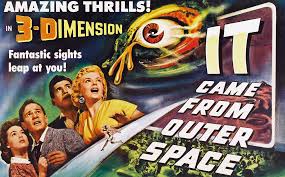
“It Came from Outer Space” (1953)
Science Fiction

Running Time: 80 minutes
Written by: Harry Essex
Directed by: Jack Arnold
Featuring: Richard Carlson and Barbara Rush
Sheriff Matt Warren: “Did you know, Putnam, more murders are committed at ninety-two degrees Fahrenheit than any other temperature? I read an article once – lower temperatures, people are easy-going. Over ninety two, it’s too hot to move. But just ninety-two, people get irritable.”
Released in 1953, Jack Arnold’s It Came from Outer Space stands as a remarkably intelligent and atmospheric entry in the canon of 1950s science fiction cinema. While often overshadowed by more bombastic alien invasion tales of the era, this film, based on a screen treatment by none other than Ray Bradbury, offers a nuanced and surprisingly empathetic portrayal of extraterrestrial contact, defying many of the conventions of its time.
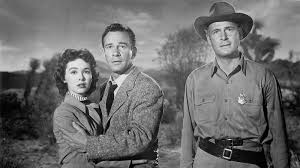
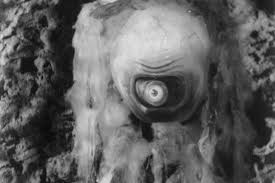
The film opens with amateur astronomer John Putnam (Richard Carlson) and his schoolteacher fiancée, Ellen Fields (Barbara Rush), enjoying a quiet evening of stargazing in the Arizona desert. Their peaceful night is violently interrupted by the fiery crash of what appears to be a meteor. Investigating the impact site, John discovers not a space rock, but a genuine alien spacecraft. Before a landslide buries the ship, he catches a glimpse of the monstrous, one-eyed, tentacled creatures within.
John’s attempts to report his discovery are met with skepticism and ridicule from the insular residents of the nearby town of Sand Rock, particularly the pragmatic Sheriff Matt Warren (Charles Drake). As a newcomer and an intellectual, John is already viewed with suspicion, and his extraordinary claims only reinforce the town’s distrust. However, things take a sinister turn when townsfolk begin to disappear, only to reappear acting strangely – their movements stilted, their emotions muted. It quickly becomes clear that the aliens are not only present but are taking on human forms, walking among them.
What sets It Came from Outer Space apart from its contemporaries is its profound departure from the typical “aliens as invading menace” trope. While the duplicates are undeniably eerie, and their motives initially unclear, the film, thanks to Bradbury’s original vision, presents a more complex picture. The aliens, when finally understood, are not here to conquer or destroy; they are simply stranded, their ship damaged, and they are using human forms as a means to repair their craft and leave Earth. Their actions, while unsettling, stem from a desperate need for survival, rather than malevolence.
This nuanced portrayal allows It Came from Outer Space to subtly comment on human xenophobia and the inherent fear of the unknown. John Putnam, the lone voice of reason, finds himself caught between the desperate aliens and the increasingly panicked and armed townspeople, who are quick to assume the worst and resort to violence. The film posits that humanity’s own fear and aggression might be a greater threat than any extraterrestrial visitor. This theme resonates strongly with the Cold War anxieties of the 1950s, where “the other” – whether alien or political enemy – was often demonized.
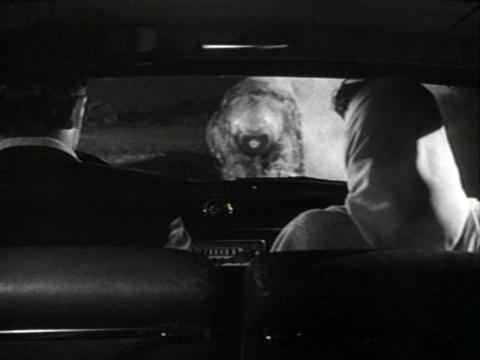
Director Jack Arnold, who would go on to helm other sci-fi classics like Creature from the Black Lagoon and The Incredible Shrinking Man, demonstrates a masterful understanding of atmosphere and suspense. The desolate desert landscapes, shot in stark black and white, create an unsettling sense of isolation and vulnerability. Arnold’s use of the then-novel 3-D process (though often viewed in 2-D today) was particularly innovative, not just for cheap jump scares, but to create a palpable sense of depth and immersion. The alien’s subjective point-of-view shots, with a distorted, looming lens, are particularly effective in conveying their unsettling presence without fully revealing their grotesque forms until much later. The minimalist yet effective score, particularly the use of the theremin, further enhances the film’s eerie mood.
While some performances might feel a bit “of their time” by modern standards, Richard Carlson delivers a compelling performance as the intellectual outsider striving for understanding, and Barbara Rush, who won a Golden Globe for her role, brings a quiet strength to Ellen. The supporting cast effectively portrays the escalating fear and mob mentality of the town.
It Came from Outer Space remains a significant film in the history of science fiction, not only for its technical achievements (especially its pioneering use of 3-D) but, more importantly, for its thoughtful and subversive narrative. It challenges audiences to look beyond superficial fears and consider the motivations of “the other,” advocating for understanding and empathy in the face of the unknown. It’s a film that proves sci-fi can be both thrilling entertainment and a vehicle for deeper social commentary, and it holds up remarkably well as a classic that continues to resonate today.
Special Features & Technical Specs:
Disc One: 4K UHD
- 2160p ultra-high-definition presentation of the 2D version in HDR10
- Audio Commentary by film historian Tom Weaver
- The Universe According to Universal – documentary (2000)
- Theatrical Trailer
- Aspect Ratio 1.33:1
- Audio: English DTS-HD Master Audio 3.0
- Optional English HOH Subtitles
Disc Two: Blu-ray
- 1080p High-definition presentation on Blu-ray of the 2D version (4K remaster)
- It Came from Outer Space II (1996) (standard-definition)
- Audio Commentary by film historian Tom Weaver
- The Universe According to Universal – documentary (2000)
- NEW Jack Arnold Remembers ‘It Came from Outer Space’ – interview with director Jack Arnold (1983) (previously unreleased)
- NEW The 3-D Girl – interview with actress Katherine Hughes (2004) (previously unreleased)
- Theatrical Trailer (2D)
- Aspect Ratio 1.33:1
- Audio: English DTS-HD Master Audio 3.0 / LPCM 2.0 Stereo
- Optional English HOH Subtitles
Disc Three: 3D Blu-ray
- 1080p High-definition presentation on Blu-ray of the 3D version
- Theatrical Trailer (3D)
- Aspect Ratio 1.33:1
- Audio: English DTS-HD Master Audio 3.0 / LPCM 2.0 Stereo
- Optional English HOH Subtitles



 spryfilm.com