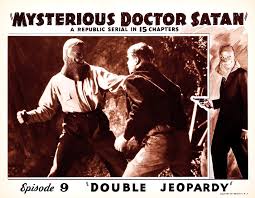
“Mysterious Doctor Satan” (1952)
Science Fiction

Running Time: 100 minutes
Written by: Franklin Adreon, Ronald Davidson, Norman S. Hall, Joseph F. Poland and Sol Shor
Directed by: William Witney and John English
Featuring: Edward Ciannelli, Robert Wilcox, William Newell, C. Montague Shaw, Ella Neal and Dorothy Herbert
Bob Wayne: “Then some of the rumors about this mysterious Dr. Satan are true!”
Gov. Bronson: “All of them are probably true! Dr. Satan’s spies have penetrated even the police department. The situation is so serious that I’m going to call four companies of the National Guard!”
Mysterious Doctor Satan, directed by William Witney and John English, is one of the crown jewels of Republic Pictures’ famous serial output—a thrilling, kinetic, and slightly loopy 15-chapter adventure packed with mad science, masked heroes, robot menaces, and pure pulp spirit. It’s widely regarded among film historians as one of the very best movie serials ever made, and for good reason.
At its heart, the story is classic early superhero fare. The serial follows Bob Wayne (Robert Wilcox), a man who, after witnessing the murder of his guardian by the criminal mastermind Doctor Satan (Edward Ciannelli), dons a masked identity as “The Copperhead” to seek justice. Doctor Satan himself is a wonderfully theatrical villain, complete with a shadowy lair, an army of henchmen, and a fiendish plan to conquer the world by creating an army of robots. Opposing him are Bob, plucky journalist Lois Scott (Ella Neal), and a few sturdy law enforcement allies.
The plot is a colorful mélange of kidnapping attempts, narrow escapes, car chases, fistfights, and cliffhangers—essentially, everything audiences loved about serials distilled into one dense, headlong rush. While many chapter plays of the 1930s and 1940s feel repetitive or padded, Mysterious Doctor Satan keeps its momentum unusually high. It thrives on sharp, tight editing, brisk pacing, and a sense that something new or dangerous could happen at any moment.
The performances are, understandably, broad, but some shine in surprising ways. Edward Ciannelli’s Doctor Satan is a standout. Rather than overplaying his villainy with cackling or campiness, Ciannelli imbues the character with a genuinely sinister presence. He’s oddly understated for a pulp villain, and that restraint makes him more believable—and more frightening. Robert Wilcox brings a clean-cut likability to Bob Wayne, even if he lacks the larger-than-life charisma of some other serial stars. Ella Neal is serviceable as the intrepid reporter, although she’s given less to do than one might hope.
The production values deserve particular praise. Republic Pictures was the master of serial action, and here they put that expertise to stunning use. The stunts, orchestrated by the legendary Yakima Canutt and others, are spectacular. Car chases skid dangerously close to realism, fistfights are brutal and convincing, and explosions have genuine heft. Scenes are rarely static; even dialogue moments are directed with dynamic camera movement or a ticking clock of tension.
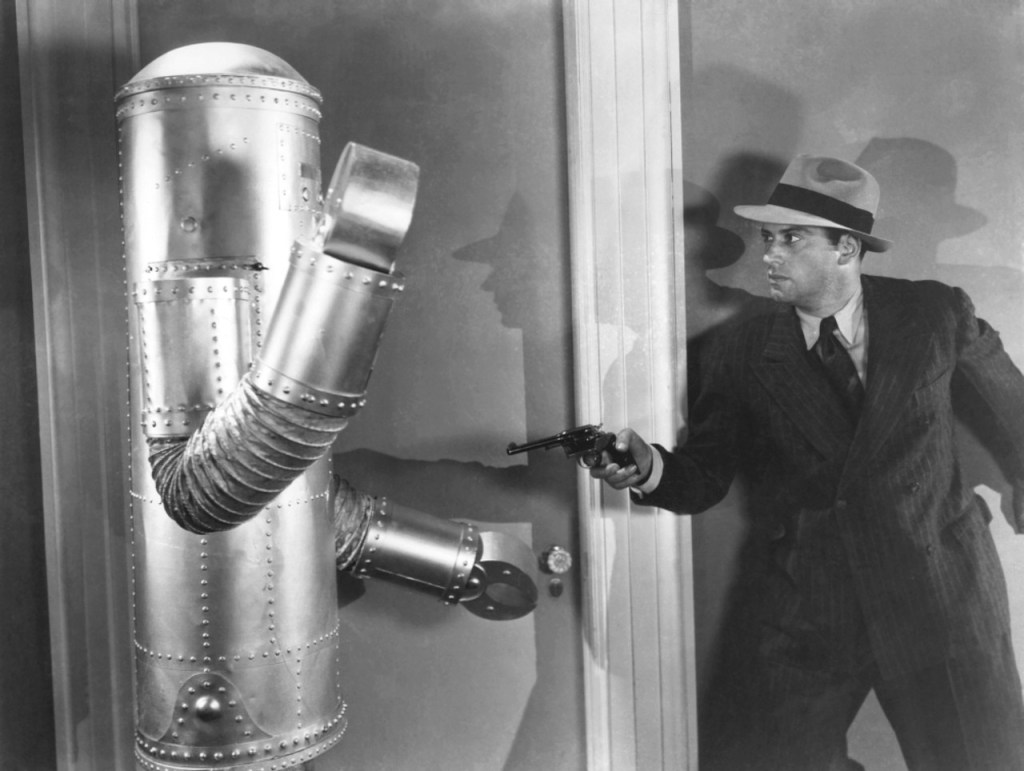
Special attention must be given to the “robot”—a hulking, helmeted, metallic figure that has become iconic in serial lore. From a modern perspective, the robot looks delightfully clunky, more like a man in a tin can than a fearsome automaton. But at the time, it must have seemed thrilling and uncanny. Its sheer size and mechanical strangeness still carry an eerie charm today, perfectly embodying the serial’s pulp science-fantasy tone.
Mysterious Doctor Satan is also notable for its unusual development history. It was originally intended to be a Superman serial, but licensing negotiations with DC Comics fell through. Rather than abandon the project, Republic retooled the story, changing the protagonist into the Copperhead—a vigilante in a simple mask and fedora. Knowing this adds a certain fascination: you can see traces of the original Superman DNA throughout, particularly in the way Bob Wayne switches between his civilian identity and his masked alter ego, and in the way Lois resembles an early, no-nonsense version of Lois Lane.
Despite its many strengths, the serial isn’t flawless. Like almost all Republic serials, it reflects some dated attitudes and occasional narrative clumsiness. Female characters, while brave, are still largely relegated to roles of being kidnapped or imperiled. There’s also a formulaic rhythm to the chapters: Bob Wayne gets into danger, a cliffhanger looms, and a clever escape follows. But these are features, not bugs, for genre fans.
Stylistically, Witney and English direct with impressive economy and flair. Their understanding of kinetic action, use of vertical movement (characters climbing, falling, jumping), and emphasis on physicality make each chapter a model of propulsive storytelling. Even today, many modern action directors could learn from their clean, comprehensible way of staging fights and chases.
One of the joys of Mysterious Doctor Satan is how many of its individual chapters deliver strong, self-contained thrills. Some highlights include:
Chapter 1: “Doctor Satan’s Man of Steel”
The opening chapter sets a perfect tone. We’re immediately thrust into the action: the murder of Bob Wayne’s guardian, the introduction of the sinister Doctor Satan, and the Copperhead’s origin. The quick pacing and the sense of “no time to waste” hooks the audience fast—essential for a serial.
Chapter 4: “Doctor Satan’s Trial”
This chapter features one of the more inventive cliffhangers: Bob Wayne is trapped in a courtroom rigged with a deadly device. The set-piece suspense is heightened by clever editing and a genuine sense of danger. It also shows how Doctor Satan manipulates people in power, adding an extra layer of menace to his character.
Chapter 7: “The Monster Strikes”
This is where the robot comes into full view, causing havoc. Watching the mechanical giant plod through scenes, smashing and grabbing, is pure pulp joy. It’s one of the serial’s most iconic images, and the effects (though quaint today) are extremely charming.
Chapter 13: “The Flaming Coffin”
The later chapters pile on the danger, and this one stands out for a particularly brutal cliffhanger: Bob trapped inside a coffin that’s about to be set on fire. It’s a grim and memorable image that really ups the stakes late in the story.
Chapter 15: “Doctor Satan’s Ultimate Fate”
The final confrontation between the Copperhead and Doctor Satan is satisfying without feeling rushed. Many serials stumble at the end, but here, the showdown is staged with energy and a real sense of payoff. Doctor Satan gets a fate worthy of his chilling persona.
Deeper Analysis: Why Mysterious Doctor Satan Endures
Beyond the stunts and cliffhangers, Mysterious Doctor Satan has endured because it taps into something primal about serialized storytelling: the endless battle of good vs. evil, dramatized in a vivid, heightened way. Each chapter escalates the tension, layering betrayals, deathtraps, robot attacks, and double-crosses, creating a serial that feels alive and constantly in motion.
The aesthetic also matters. Republic’s serials had a distinct “house style”—gritty yet clean, shadowy yet dynamic. The sets (especially Doctor Satan’s various hideouts) have a wonderful atmosphere, part industrial wasteland, part gothic horror. You can feel the fingerprints of 1930s horror films here, mixed with the rising tide of superhero adventure that would dominate the next two decades.
Then there’s the thematic resonance. The very idea of a masked hero fighting against a technologically empowered villain taps into the fears and hopes of the era. 1940 was a time of escalating global conflict and uncertainty. A villain like Doctor Satan, using science for evil, embodied cultural anxieties about unchecked technological progress. Meanwhile, the Copperhead offered a fantasy of a lone individual, with courage and ingenuity, standing against seemingly unstoppable evil—a very American dream at the time.
Mysterious Doctor Satan is a deliriously entertaining time capsule of golden-age serial storytelling. It’s earnest, breathless, and bursting with imagination. For aficionados of classic adventure stories, pulp fiction, superhero origins, or vintage sci-fi oddities, it’s a must-see. Even casual viewers, if they can surrender to its old-fashioned rhythms and enjoy the ride, will find it a surprisingly exhilarating experience.
Not just a relic of a bygone era, Mysterious Doctor Satan remains, in its charming, robot-stomping way, a little bit timeless.


 spryfilm.com