
“Zombies of the Stratosphere” (1952)
Science Fiction

Running Time: 70 minutes
Written by: Ronald Davidson
Directed by: Fred C. Brannon
Featuring: Judd Holdren, Aline Towne, Wilson Wood, Lane Bradford, Stanley Waxman, John Crawford, Craig Kelly, Ray Boyle and Leonard Nimoy
Zombies of the Stratosphere is one of those wonderfully pulpy, endearingly earnest science-fiction serials that could only have come from the early 1950s. Directed by Fred C. Brannon and produced by Republic Pictures, the 12-part serial follows heroic Larry Martin (played by Judd Holdren) — a government agent equipped with a rocket-powered flight suit — as he tries to thwart an invasion plot cooked up by Martians and their human allies. Their goal? Detonate a nuclear device to dislodge Earth from its orbit, making way for Mars to take Earth’s place closer to the sun.
Yes, the plot is as insane as it sounds — and it’s all part of the charm.
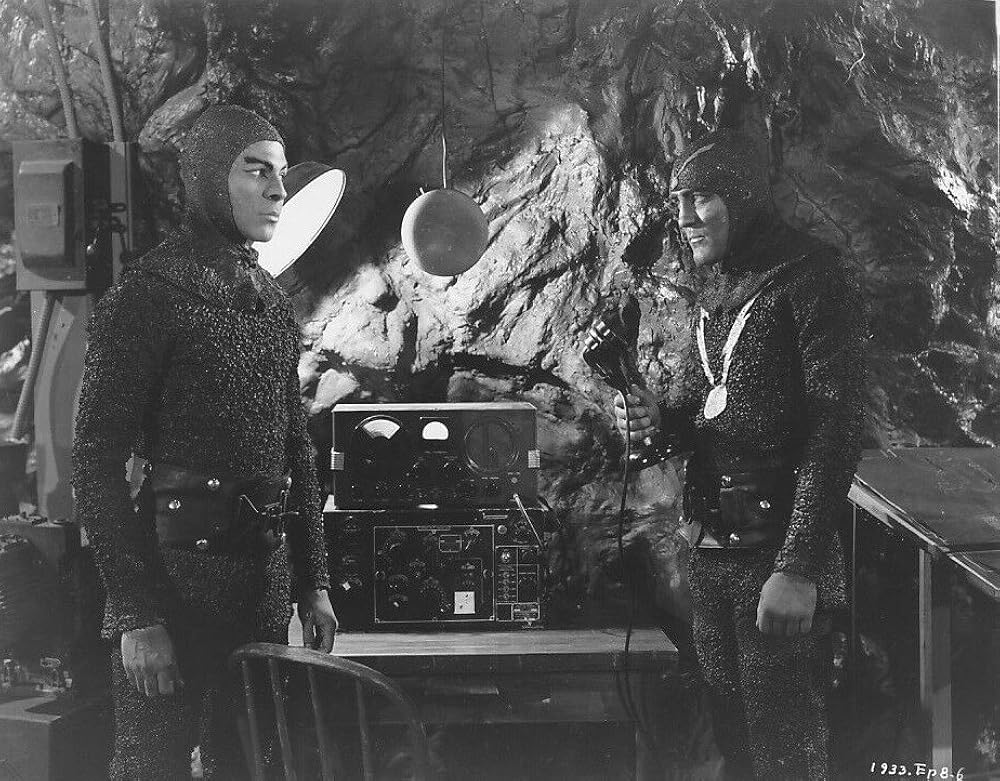
First, let’s address the obvious: despite the title, the movie contains no actual zombies. The “Zombies” in question are Martian invaders who, aside from their blank expressions and single-mindedness, have little in common with the undead. Leonard Nimoy, decades before Star Trek, appears in a small role as one of the Martians — a fascinating piece of trivia for fans, even though his screen time is brief and dialogue minimal.
The serial’s structure is pure cliffhanger: each short chapter ends with Larry Martin or his allies (Aline Towne as Sue Davis, Wilson Wood as Bob Wilson) in mortal peril, only to miraculously survive through often hilariously contrived means. This rhythm gives the story a breathless, manic energy, even if it means you can only ever engage with it on a surface level.
From a production standpoint, Zombies of the Stratosphere is a classic Republic affair: quick, cheap, and scrappy. Special effects consist largely of visible wires, miniature models, stock footage, and repurposed sets from previous serials like King of the Rocket Men and Radar Men from the Moon. The rocket flight scenes — with Larry Martin zipping through the air — are simultaneously charming and ridiculous, thanks to the unmistakable dummies used in wide shots.
But even with these limitations, there’s a real earnestness in the filmmaking. Fred C. Brannon and his team understood the power of straightforward, action-packed storytelling. The dialogue is purely functional, the performances are flat but serviceable, and the costumes — particularly the Martian outfits — are delightfully campy. Everything is engineered not to explore ideas but to move the story forward, scene after scene, fight after fight.
What really gives Zombies of the Stratosphere its staying power today is its snapshot of early Cold War anxieties. The Martian plan to swap orbits with Earth by detonating atomic bombs is pure science-fiction nonsense, but it taps into the real, palpable fear of nuclear annihilation that hung over 1950s America. Even in such an absurd setting, the destructive power of the bomb is treated with gravity, and the villainous use of atomic energy would have resonated with contemporary audiences on a deeper level than perhaps the filmmakers realized.
Viewed today, the serial’s flaws — its wooden acting, repetitive plotting, and primitive effects — are part of its charm. Zombies of the Stratosphere is a time capsule of an era when “space invaders” weren’t just fictional villains but thinly veiled metaphors for Communists or existential threats from “outside.” Its goofy earnestness is refreshing, especially compared to the ironic, self-aware tone of much later science fiction.
Zombies of the Stratosphere is an emblem of early American science fiction serials: earnest, imaginative, and clunky all at once. It stands as the third and final entry in Republic Pictures’ “rocket man” saga (following King of the Rocket Men and Radar Men from the Moon), reusing many props, costumes, and even whole sequences from its predecessors. To modern viewers, it often plays like a patchwork quilt of mid-century sci-fi clichés — but that’s also exactly what gives it its retro charm.
The story is a straightforward one: Martians, realizing their planet is dying, hatch a desperate plan to relocate to Earth’s orbit. This would require the total destruction of Earth as we know it. They team up with Earth-based criminals to steal the necessary atomic technology, and only rocket-powered government agent Larry Martin and his small team stand in their way.
Despite the ludicrous premise, the plot hits many notes that mirror real-world fears of the era. Postwar America lived in the shadow of nuclear annihilation and space-race anxieties. Here, extraterrestrial invaders — “zombies” in name only — symbolize an external, existential threat, while the emphasis on atomic bombs reflects deep-seated worries about mankind’s own destructive potential.
Even though the serial never lingers on these anxieties intellectually (this is a children’s matinee serial, after all), it’s fascinating how they slip in through the back door of the story. Underneath the ray guns and rocket packs, Zombies of the Stratosphere quietly mirrors a nation’s insecurity about science, technology, and survival.
Directed by Fred C. Brannon, the serial was shot quickly and cheaply, relying on the Republic Pictures formula: action first, plot second, character third. Brannon, a veteran of dozens of serials, directs competently but without much flair. The real “stars” are the gadgets — most notably Larry Martin’s jetpack, a holdover from earlier serials that became iconic for mid-century sci-fi fans.
The effects are primitive even by 1950s standards. Rocket flights are accomplished with visibly dangled models or stiff dummies, and most “special effects” involve a lot of stock footage explosions. Set design is extremely minimalist — caves, warehouses, and bare rooms stand in for everything from Martian headquarters to atomic labs. Yet there’s a kind of rugged charm in the way the film simply pushes forward, refusing to let a small budget slow down its high-stakes story.
The acting is largely perfunctory. Judd Holdren as Larry Martin plays the square-jawed hero with all the personality of a cardboard cutout. His dialogue is delivered with the clipped, earnest cadence typical of low-budget serial heroes. Aline Towne, one of Republic’s go-to serial actresses, gives a solid turn as Sue Davis, though her role is mostly confined to being the supportive (and occasionally endangered) assistant.
One of the most fascinating elements in hindsight is the small role played by Leonard Nimoy. Barely recognizable under his Martian makeup and delivering only a few lines, Nimoy nonetheless brings an odd intensity to the part — a brief glimpse of the screen presence that would later make him iconic as Spock in Star Trek.
As was standard for serials, each chapter ends with a cliffhanger: explosions, crashes, or characters trapped under falling debris. These endings are often resolved by slight rewrites in the next chapter, leading to continuity errors that are charming rather than frustrating. The repetition of plot devices — kidnappings, rocket chases, and last-minute rescues — gives the serial a rhythmic, almost hypnotic quality.
The entire 12-chapter run clocks in at about three and a half hours, but no one section ever feels particularly long. If anything, the serial’s biggest flaw is its sameness: after a few chapters, you can predict almost exactly how each encounter will unfold.
When it was released in 1952, Zombies of the Stratosphere was considered fairly routine — another entry in a long line of cheap Saturday morning thrills. But today it holds a special place in science fiction history. Not only because of its early connection to Leonard Nimoy, but also because it captures an era when America was simultaneously looking to the stars and fearing what it might find there.
In many ways, it’s a precursor to the more sophisticated science fiction stories that would emerge later in the decade and into the 1960s. Without the stiff earnestness of these early serials, the genre might never have evolved into the thoughtful explorations we see in films like The Day the Earth Stood Still (1951) or even 2001: A Space Odyssey (1968).
For fans of old-school science fiction, retro-futurism, and low-budget ingenuity, Zombies of the Stratosphere is a genuine delight — a relic from a time when imagination was often more important than plausibility, and when even the cheapest production could ignite a young viewer’s sense of wonder.
Zombies of the Stratosphere is by no means “good” in the conventional sense — it’s hokey, rushed, and largely disposable. But it’s also a genuine artifact of 1950s popular culture: a low-budget spectacle made with ambition, optimism, and just enough imagination to make up for its technical shortcomings. If you love retro science fiction, model spaceships on wires, or the early roots of pop culture legends like Leonard Nimoy, it’s well worth your time.



 spryfilm.com