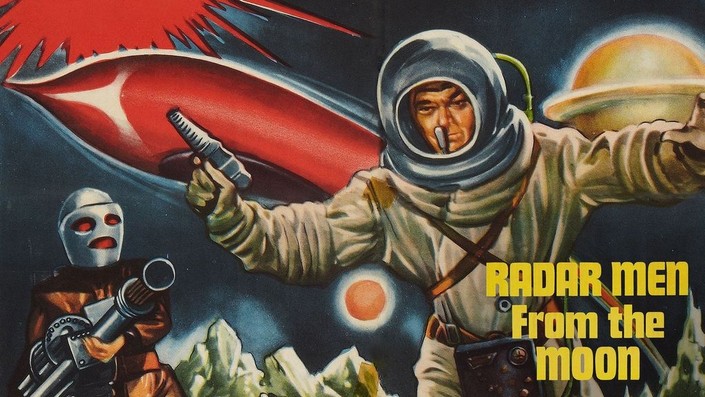
“Radar Men from the Moon” (1952)
Science Fiction

Running Time: 100 minutes
Written by: Ronald Davidson
Directed by: Fred C. Brannon
Featuring: George Wallace, Aline Towne and Roy Barcroft
Graber: “How ’bout a ride to town, mister?”
Motorist: “Sure. Hop in.”
Graber: “There’s a man in a flying suit chasing us. Step on it.”
Motorist: “Huh?”
“Radar Men from the Moon” is a fascinating piece of mid-century science fiction—a 12-chapter Republic serial that embodies both the charm and the clumsiness of early 1950s American genre filmmaking. Directed by Fred C. Brannon and starring George Wallace as the heroic Commando Cody, the serial is a breezy, low-budget adventure that manages to capture the spirit of its time, even as it stumbles under the weight of its limited resources and paper-thin script.
At its core, Radar Men from the Moon is a story of invasion and resistance. Earth is facing devastating attacks, traced back to a militaristic society on the Moon led by the ruthless Retik (portrayed with an oddly aloof menace by Roy Barcroft). Commando Cody, a scientist-adventurer equipped with a jetpack and a helmet that looks suspiciously like a modified motorcycle accessory, is tasked with stopping the lunar threat before humanity is conquered.
The serial format dictates a structure of constant cliffhangers—explosions, fisticuffs, daring escapes—which gives the story a relentless energy. However, viewed today as a single experience (many fans have watched condensed movie versions), the repetitive beats of Radar Men become very apparent. Car chases, shootouts, and fistfights are recycled with minor variations across chapters, which can be both endearing and numbing depending on the viewer’s patience.
Visually, Radar Men from the Moon is delightfully scrappy. The special effects, though primitive by today’s standards, are impressive given the tiny budget. The flying sequences—Cody soaring across rocky terrain with the help of wires and models—are charmingly inventive. Republic Pictures, for all its penny-pinching, had a way of squeezing every ounce of excitement out of their sets and props. The lunar landscape is essentially an earth desert with a few painted backdrops, but the filmmakers push forward with a kind of blissful confidence that almost makes you believe in it.
The performances are earnest if not especially nuanced. George Wallace plays Cody as a straight-laced man of action, and while his delivery is sometimes stiff, he conveys a certain everyman likability. Aline Towne, as Joan Gilbert, is one of the few female characters, and she is refreshingly portrayed as a capable assistant rather than a typical 1950s damsel in distress. Roy Barcroft’s Retik is less a vivid villain and more a gruff bureaucrat of evil; he’s not quite the colorful megalomaniac one might expect from a space opera, but he fits the serial’s no-frills tone.
One of the most interesting things about Radar Men today is how it reflects the anxieties of its era. In 1952, America was deep into the Cold War, and the fear of technological inferiority and sudden destruction loomed large. The serial’s Moon men plot can easily be read as an allegory for communist infiltration and nuclear attack paranoia, albeit in the goofiest possible packaging. There’s also an implicit belief in the redemptive power of American ingenuity—Cody isn’t a soldier; he’s a scientist-adventurer, using his inventions (like the jetpack and a “radar ray”) to outwit the lunar threat.
Of course, the serial is not without its major flaws. The dialogue is often laughably stiff, the action scenes blend together after a while, and the villains’ grand plan—shooting Earth with radar rays—isn’t exactly chillingly believable. The film’s Moon Men are indistinguishable from ordinary humans, save for the occasional futuristic jumpsuit or gun, betraying the production’s bare-bones approach to science fiction world-building.
Still, for all its limitations, Radar Men from the Moon has a scrappy charm that’s hard to resist. It’s a sincere attempt to bring pulpy adventure to the screen with whatever means were available. It helped cement the visual language of rocket-powered heroes—laying groundwork for later characters like The Rocketeer—and remains a crucial artifact of 1950s sci-fi cinema.
If you’re a fan of old serials, vintage sci-fi, or simply curious about the roots of pop culture’s love affair with rocketmen and alien invasions, Radar Men from the Moon is an essential, if occasionally tedious, viewing experience. Watch it with a sense of humor, a sense of history, and an appreciation for the boundless optimism of early science fiction storytelling.
“Adventure! Suspense! Rocket Men battling Moon Men in a desperate struggle for Earth’s survival!”
This could easily have been the tagline for Radar Men from the Moon, a quintessential early 1950s serial that now feels like a charming time capsule of America’s postwar imagination. It’s rough, earnest, and entirely unpretentious — and because of that, it’s surprisingly rewarding to revisit.
The story is simple to the point of being skeletal: mysterious attacks are devastating Earth’s infrastructure. Enter Commando Cody, a government scientist who deduces that the attacks originate from the Moon. Naturally, he straps on his jet-powered rocket suit, dons his iconic crash helmet, and blasts off in a spaceship to confront the extraterrestrial threat.
Cody’s confrontations with the Moon’s would-be conquerors, led by the coldly methodical Retik, form the backbone of the serial’s twelve episodes. Each chapter ends in a cliffhanger, a strategy designed to lure audiences back into theaters week after week. Viewed consecutively today, these cliffhangers (car plunges, explosions, fistfights on cliff edges) can seem formulaic, but at the time they were genuinely thrilling.
There’s a primitive kind of narrative propulsion here — a straightforward, earnest momentum that carries you from one brawl to the next. Plot depth and character development are practically nonexistent, but that wasn’t the goal. This was about sensation, about keeping you on the edge of your seat for 15 minutes, then leaving you desperate for the next installment.
Commando Cody himself is a fascinating figure — not a superhero in the comic book sense, but a sort of government-sponsored adventurer. In many ways, he reflects an idealized American postwar archetype: practical, inventive, brave, and utterly dependable. Cody is a man of science, not magic; his rocket suit is a product of human ingenuity, not alien technology.
George Wallace’s portrayal is earnest, if not exactly dynamic. Cody is less a character than a function — a clean-cut man in a leather jacket and tie who happens to also own a rocket ship. There’s no internal conflict, no character arc; Cody is simply good, and that’s all that matters.
By today’s standards, the effects are laughably crude — but to dismiss them would be to miss the spirit of the thing. The rocket flying sequences, accomplished through clever wirework and miniature models, are pure early Hollywood ingenuity. You can see the strings, you can spot the reused shots from previous Republic serials like King of the Rocket Men (1949), but that just adds to the handmade charm.
The Moon sets are just California hills with slightly weirder rock formations and painted matte backgrounds, but when you watch it with a childlike imagination, they feel otherworldly. The costumes, especially the Moon soldiers’ quilted uniforms and goofy-looking “ray guns,” are the stuff of classic pulp illustration.
Retik and his moon men represent the classic “other” — cold, calculating, and driven by expansionist ideology. There’s a subtle whiff of Cold War propaganda here. The Moon Men are militaristic, secretive, and intent on subjugating Earth through superior technology — clear stand-ins for American anxieties about Soviet technological advancement.
Yet Radar Men doesn’t dive deeply into political metaphor; it prefers the simple, black-and-white world of good guys and bad guys. That simplicity gives it an almost mythic quality. There’s something comforting about the absolute certainty that good will triumph, no matter how many explosions, laser battles, or attempted kidnappings occur along the way.
Despite its many shortcomings, Radar Men from the Moon has had a lasting impact on pop culture. It helped popularize the visual archetype of the flying rocket man, influencing everything from The Rocketeer (both the comics and the 1991 Disney film) to countless sci-fi serial parodies.
It also became a frequent target for affectionate ridicule. Mystery Science Theater 3000 famously featured Radar Men from the Moon in its first season, lovingly mocking its cheap effects, stilted dialogue, and endless fight scenes — helping introduce a new generation to its charming absurdities.
More seriously, Radar Men represents an era when science fiction was still close to pulp adventure — before the more complex, cerebral science fiction of the later 1950s and ’60s. It’s a bridge between Buck Rogers and Forbidden Planet, a relic of a time when “the future” meant jetpacks, ray guns, and manly men punching their way across the galaxy.
Radar Men from the Moon is not a “good” movie in the traditional sense. Its acting is stiff, its story paper-thin, and its budgetary limitations painfully obvious. But it’s a joyful movie — a relic from a more innocent time when filmmakers chased big dreams with small resources. Watching it today is less about plot or polish and more about tapping into a spirit of wide-eyed optimism.
If you love cheesy sci-fi, vintage adventure serials, or simply want to experience a formative chapter in the evolution of science fiction on screen, Radar Men from the Moon is a delightful watch. Imperfect, yes — but also imaginative, earnest, and weirdly inspiring.


 spryfilm.com