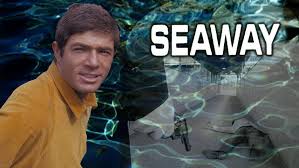
“Seaway” (1965-1966)
Television Series

Thirty Episodes
Created by: Abraham Polonsky
Featuring: Stephen Young, Austin Willis and Cec Linder
“Seaway” is a Canadian drama series that aired during the 1965–1966 television season. Set against the backdrop of the newly constructed Saint Lawrence Seaway, the series offers a compelling blend of adventure, drama, and crime-solving narratives. Despite its brief run of 30 episodes, “Seaway” has left an indelible mark on Canadian television history.
The series was created by Abraham Polonsky, a notable figure in the film industry. Produced by Seaway Films in collaboration with the UK’s Associated Television (ATV), the show received funding from the Canadian Broadcasting Corporation (CBC). This partnership aimed to produce a series that would appeal to both Canadian and international audiences. Notably, “Seaway” was one of the most expensive Canadian television productions of its time, with a total cost of $3 million.
“Seaway” follows the adventures of Nick King, portrayed by Stephen Young, a ship owners’ agent tasked with investigating crimes related to shipping along the Saint Lawrence Seaway. He is assisted by retired Admiral Leslie Fox, played by Austin Willis, who represents the Department of Transport. Together, they tackle issues ranging from smuggling and espionage to mutiny and murder, reflecting the complexities and challenges of maintaining order in this vital waterway. The series was primarily filmed in various locations along the seaway, notably Toronto and Montreal, adding authenticity to its setting.
Stephen Young’s portrayal of Nick King brings a blend of determination and charisma to the role, effectively embodying the character’s commitment to justice. Austin Willis, as Admiral Fox, provides a seasoned and authoritative presence, offering a counterbalance to King’s youthful vigor. The chemistry between the two leads is a cornerstone of the series, driving much of the narrative forward. The show also features Cec Linder as Inspector Provist, adding depth to the investigative team. Notable guest stars include Gordon Pinsent, Barry Morse, Sally Kellerman, and Faye Dunaway, whose appearances contribute to the series’ dynamic storytelling.
The series comprises 30 episodes, each delving into different facets of maritime law enforcement and the challenges faced by those policing the seaway. Episodes such as “Shipment from Marseilles” and “Last Voyage” explore smuggling operations, while “Mutiny” and “Ghost Ship” delve into internal conflicts aboard vessels. The two-part episodes “Don’t Forget to Wipe the Blood Off” and “Gunpowder and Paint” were notably filmed in color, a rarity for the series, which was predominantly shot in black-and-white.
Upon its release, “Seaway” received positive reviews for its engaging storytelling and high production values. User reviews on IMDb highlight the show’s well-crafted scripts and compelling performances. One reviewer notes, “Good scripts, well directed and well played by all concerned,” emphasizing the quality of the series. Another reviewer praises Austin Willis’s performance, stating, “The late Austin Willis, one of my all-time favorite actors, was brilliant in this one.”
Despite its acclaim, “Seaway” faced challenges in securing a broader audience, particularly in the United States. The decision to film primarily in black-and-white limited its appeal during a time when color television was becoming the standard. Nevertheless, the series found a lasting presence in international markets. In Australia, for instance, “Seaway” has enjoyed numerous reruns over the decades, often occupying late-night and early-morning time slots.
“Seaway” stands as a testament to the ambition and creativity of Canadian television production in the mid-20th century.Its blend of maritime adventure and crime drama, bolstered by strong performances and authentic settings, offers a unique viewing experience. While it may not have achieved enduring mainstream success, “Seaway” remains a noteworthy chapter in television history, reflecting the complexities of law enforcement along one of North America’s most crucial waterways.



 spryfilm.com