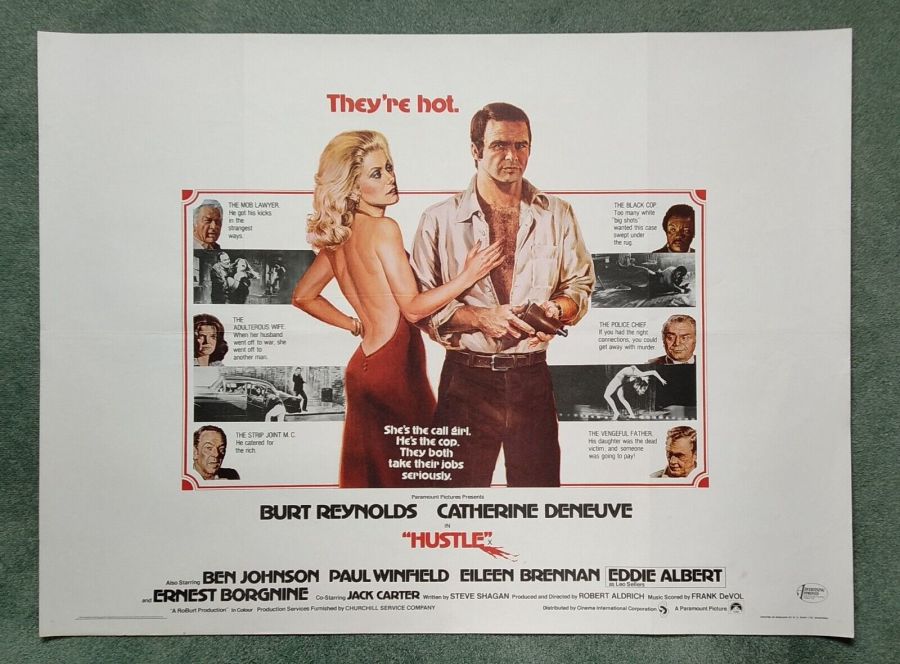
“Hustle” (1975)
Action

Running Time: 120 minutes
Written by: Steve Shagan
Featuring: Burt Reynolds, Catherine Deneuve, Ben Johnson, Paul Winfield, Eileen Brennan, Eddie Albert, Ernest Borgnine and Jack Carter
Lt. Phil Gaines: “Don’t you know where you live, Marty? Can’t you smell the bananas? You know what country you live in? You live in Guatamala with color television.”
Hustle (1975), directed by Robert Aldrich and starring Burt Reynolds, Catherine Deneuve, and Paul Winfield, is a moody crime drama that attempts to blend elements of film noir with the character-driven cynicism of 1970s Hollywood. Released at the height of Reynolds’ popularity, Hustle presents a different side of the actor, stepping away from his signature wisecracking persona to deliver a more subdued, introspective performance. While the film struggles at times with its pacing and uneven tone, it remains a compelling snapshot of an era in transition, both in film and in society.
The film follows Phil Gaines (Burt Reynolds), a weary, disillusioned Los Angeles police detective, and his partner Louis Belgrave (Paul Winfield) as they investigate the apparent suicide of a young woman named Gloria Hollinger. However, her father, Marty (Ben Johnson), refuses to accept the ruling, believing his daughter was murdered. As Gaines delves into the case, he finds himself entangled in a corrupt and indifferent justice system, while also navigating his strained romance with Nicole (Catherine Deneuve), a high-class call girl seeking a way out of her profession.
As the investigation unfolds, Gaines discovers unsettling truths about the city’s underbelly, crime, and power structures. His increasing frustration with the futility of justice reflects a broader existential crisis, one that mirrors the moral ambiguity permeating 1970s American cinema. The case ultimately forces him to confront his own ethical compromises and the possibility that, despite his best efforts, the world is beyond redemption.
Burt Reynolds, known for his charismatic and often comedic roles, delivers a restrained and nuanced performance in Hustle. As Phil Gaines, he embodies a man torn between duty and apathy, balancing toughness with moments of vulnerability. Reynolds’ performance is effective, though at times his usual magnetism feels intentionally dampened to fit the film’s somber tone.
Catherine Deneuve, in one of her few American roles, brings an ethereal presence to Nicole. While her character is underwritten, Deneuve manages to convey a quiet desperation that adds depth to the film. Paul Winfield provides strong support as Gaines’ more pragmatic partner, and Ben Johnson delivers a heartbreaking turn as a grieving father seeking justice in a world that doesn’t care.
Robert Aldrich, best known for Kiss Me Deadly (1955) and The Dirty Dozen (1967), brings a world-weary sensibility to Hustle. His direction is steady, but at times the film struggles to maintain momentum. The pacing is deliberately slow, emphasizing mood and character over plot, which may frustrate viewers expecting a more conventional crime thriller.
The film’s visual style leans into noir aesthetics, with shadowy cinematography by Joseph Biroc that captures the bleakness of 1970s Los Angeles. The city feels oppressive and indifferent, mirroring the characters’ struggles. Hustle also benefits from a moody score by Frank De Vol, which complements the film’s melancholic tone.
At its core, Hustle is a meditation on moral decay and disillusionment. The film critiques institutional corruption, the commodification of women, and the inescapability of fate. Phil Gaines represents the archetypal noir protagonist: a man who knows the system is broken but lacks the power to change it. His relationship with Nicole underscores themes of escapism and the impossibility of redemption.
The film also reflects the broader cultural anxieties of the mid-1970s, a period marked by post-Watergate distrust in institutions and a growing cynicism in American cinema. Unlike traditional detective films where the protagonist finds justice, Hustle offers no such comfort. Its ending is downbeat and unresolved, reinforcing the film’s overarching sense of fatalism.
While Hustle has its strengths, it is not without flaws. The film’s pacing can feel sluggish, and some of its subplots—particularly those involving Nicole—are underdeveloped. The script, penned by Steve Shagan, occasionally leans too heavily on existential brooding at the expense of narrative tension. Additionally, while Reynolds delivers a strong performance, some critics have argued that his subdued portrayal lacks the depth needed to fully carry the film’s weightier themes.
Despite these shortcomings, Hustle remains an intriguing entry in the neo-noir genre. Though it lacks the punch of classics like Chinatown (1974) or Night Moves (1975), it is a worthwhile watch for fans of 1970s crime dramas and those interested in seeing a different side of Burt Reynolds. While it never reaches the heights of Aldrich’s best work, it is an admirable effort that captures the moral ambiguity and disillusionment of its time.
Hustle is a slow-burning, melancholic crime drama that trades action for introspection. While it may not be among the most memorable films of the era, it is a fascinating piece of 1970s cinema that showcases a more restrained Burt Reynolds and a haunting vision of a world where justice is elusive. If you appreciate moody, character-driven crime films with a noir edge, Hustle is worth seeking out.


 spryfilm.com