
“White Lightning” (1973)
Action

Running Time: 101 minutes
Written by: William W. Norton
Featuring: Burt Reynolds, Jennifer Billingsley, Ned Beatty, Bo Hopkins and Matt Clark
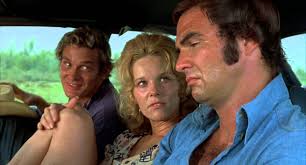
Vinnie Carruthers: “What happened to you?”
Gator McKlusky: “I was tryin’ to save these two buddies of mine from getting knocked up by a homosexual.”
Vinnie Carruthers: “Oh, praise God!”
White Lightning, directed by Joseph Sargent and starring Burt Reynolds, is a quintessential 1970s action film that blends Southern grit, moonshine-running thrills, and a touch of revenge drama. This film, often credited as one of the defining entries in the “hicksploitation” subgenre, paved the way for a slew of similar films throughout the decade. It also cemented Reynolds’ status as a leading man, showcasing his charisma, physicality, and a newfound depth that set him apart from many of his contemporaries.
The story follows Gator McKlusky (Burt Reynolds), a former moonshine runner who finds himself in prison for his illicit activities. While serving time, he learns that his younger brother was murdered by corrupt Sheriff J.C. Connors (Ned Beatty), a ruthless lawman who has been cracking down on bootlegging with an iron fist. Seeking vengeance but unable to do so legally, Gator strikes a deal with federal agents: if he agrees to go undercover and help expose Connors’ operations, he will earn his freedom.
Posing once again as a moonshiner, Gator returns to his old stomping grounds in rural Arkansas and rekindles relationships with old associates, including the charming but cautious Roy Boone (Bo Hopkins) and his girlfriend Lou (Jennifer Billingsley). As he delves deeper into the operation, Gator navigates high-speed chases, violent confrontations, and the growing threat posed by Connors’ men, all while struggling with his personal demons.
Burt Reynolds delivers a compelling performance as Gator McKlusky. While his later roles often leaned into comedy, this film highlights a more serious and determined side of Reynolds. Gator is a man on a mission, but he’s not just a two-dimensional action hero—his pain and anger over his brother’s death add an emotional weight to the character that makes his quest for justice feel more personal. Reynolds’ natural charm and rugged appeal make Gator easy to root for, and his presence alone elevates the material.
Ned Beatty’s portrayal of Sheriff J.C. Connors is chilling. Unlike some over-the-top villains of the era, Connors is more subdued in his menace, which makes him all the more terrifying. He exudes authority and corruption in equal measure, making it easy to see why the locals are too afraid to challenge him. His interactions with Gator are tense and layered with unspoken threats, making their eventual showdown all the more satisfying.
The supporting cast, including Bo Hopkins as Roy Boone, adds depth to the film. Boone is a complex character—a man who, while involved in the bootlegging trade, isn’t as ruthless as others in the game. His moral ambiguity and growing friendship with Gator create an engaging dynamic. Jennifer Billingsley, though given less to work with, delivers a solid performance as Lou, a love interest who provides a softer contrast to the film’s rough-and-tumble world.
One of White Lightning’s greatest strengths is its action sequences. The film is packed with thrilling car chases that showcase the raw power and danger of backroad moonshine running. The stunt work is impressive, with practical effects and real, high-speed driving that adds an authentic edge. Unlike modern action films reliant on CGI, every crash, skid, and pursuit in White Lightning feels visceral and real, making the stakes feel genuinely high.
Joseph Sargent’s direction gives the film a grounded, almost documentary-like feel in places. He captures the gritty, sweaty reality of the Deep South, from its lush swamps and dusty backroads to the rundown bars and dingy police stations. The cinematography by Edward Rosson complements this aesthetic, using natural lighting and long tracking shots to immerse the viewer in Gator’s world. The choice to film on location adds to the authenticity, making the setting feel as much a character as any of the actors.
Beneath its high-octane action, White Lightning touches on deeper themes of corruption, justice, and rebellion. Sheriff Connors represents an oppressive force—an unchecked authority figure who operates above the law, using fear and violence to maintain his grip. Gator, though far from a traditional hero, embodies the idea of fighting back against corruption, even if his methods are unconventional.
The film also reflects a changing America in the 1970s. The South was still grappling with the aftermath of the Civil Rights Movement, and distrust of government and law enforcement was at an all-time high following events like Watergate and the Vietnam War. White Lightning taps into these anxieties, portraying Gator as an anti-establishment figure who seeks justice on his own terms. His refusal to back down in the face of corruption resonated with audiences at the time and continues to do so today.
White Lightning was a box office success and led to a sequel, Gator (1976), which Reynolds himself directed. While the sequel leaned more into comedy, the original remains a standout for its blend of action, drama, and social commentary. The film also influenced later Southern action films, from Smokey and the Bandit (1977) to The Dukes of Hazzard TV series, which borrowed heavily from White Lightning’s themes and aesthetic.
Reynolds’ performance as Gator McKlusky helped solidify his on-screen persona as a lovable rogue—a template he would return to throughout his career. The film’s gritty, no-nonsense approach to action storytelling remains a blueprint for many modern filmmakers seeking to recapture that raw, unpolished style of 1970s cinema.
White Lightning is more than just a fast-paced action film—it’s a time capsule of 1970s filmmaking, blending thrilling car chases with a compelling revenge story and subtle but effective social commentary. Burt Reynolds gives one of his most engaging performances, and Ned Beatty’s turn as the villainous sheriff adds real dramatic weight. The direction, setting, and raw action make this a must-watch for fans of classic action cinema.
For those looking for a movie that combines Southern charm with edge-of-your-seat excitement, White Lightning delivers in spades. Whether you’re a Burt Reynolds aficionado, a fan of car chase films, or just someone who appreciates a well-crafted revenge thriller, this film remains a standout of its era and a testament to the enduring appeal of gritty, character-driven action movies.



 spryfilm.com