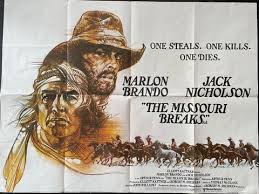
“The Missouri Breaks” (1976)
Western

Running Time: 126 minutes
Written by: Thomas McGuane
Featuring: Marlon Brando, Jack Nicholson, Randy Quaid, Kathleen Lloyd, Frederic Forrest and Harry Dean Stanton
Tittle Tod: “Damn, I don’t know why they had to put Canada all the way up here.”
Arthur Penn’s The Missouri Breaks (1976) is a film that resists easy categorization. A revisionist Western featuring two of the greatest actors of the era, Marlon Brando and Jack Nicholson, it presents a unique and often confounding vision of the West, one that’s both beautiful and brutal, comedic and violent. Upon its release, the film was met with mixed reviews, and even today, it remains a polarizing entry in the Western genre. However, looking back at it decades later, The Missouri Breaks stands as an ambitious and fascinating film—flawed, certainly, but compelling in its unpredictability.
The film is set in 1880s Montana and follows Tom Logan (Jack Nicholson), the leader of a band of horse thieves, who decides to purchase a small farm as a front for their operations. He and his gang set their sights on rustling from a powerful land baron, David Braxton (John McLiam), a ruthless cattleman who has spent his life protecting his empire from rustlers. Braxton, eager to rid himself of Logan’s gang, hires the eccentric “regulator” Robert E. Lee Clayton (Marlon Brando), an Irish bounty hunter with a flair for the theatrical and a love for sadistic executions.
As Logan grows closer to Braxton’s daughter, Jane (Kathleen Lloyd), a romance develops, complicating the outlaw’s relationship with the man trying to destroy him. Meanwhile, Clayton begins his slow and methodical hunt, picking off members of Logan’s gang in strange and unsettling ways.
The main draw of The Missouri Breaks is, without a doubt, the performances of its two leads. Jack Nicholson is in his prime here, delivering a grounded and charismatic performance as Tom Logan. Unlike the wild-eyed, unhinged roles he would become famous for (The Shining, One Flew Over the Cuckoo’s Nest), his Logan is subdued and pragmatic. He’s an outlaw, but he’s not heartless—just a man trying to carve out a piece of the world for himself. His romance with Jane adds an interesting dimension to the film, though it is underdeveloped compared to the central conflict with Brando’s character.
Then there’s Marlon Brando as Robert E. Lee Clayton, a performance that can only be described as bizarre. Brando, ever the eccentric, reportedly refused to learn his lines and improvised much of his dialogue. The result is one of the strangest performances in Western history. Clayton is a dandyish assassin, clad in absurd outfits, slipping into an exaggerated Irish brogue at times, and killing with a psychotic sense of humor. One moment, he’s casually talking about literature; the next, he’s dressed in a woman’s bonnet, preparing to murder a man in cold blood. His unpredictability makes him one of the most unsettling characters in any Western.
Brando’s performance is divisive—some find it brilliant, others see it as self-indulgent nonsense. But there’s no denying that it makes The Missouri Breaks unique. If Brando had played Clayton straight, the film would likely be much more conventional. Instead, his presence turns it into something strange, at times surreal.
Direction and Cinematography: A Slow, Bleak Beauty
Arthur Penn, best known for Bonnie and Clyde (1967), was no stranger to films about outlaws. But unlike that film’s kinetic energy, The Missouri Breaks is slow and meandering. The pacing is deliberate, almost too much so, as it lingers on the mundane aspects of Logan’s life while punctuating the narrative with bursts of sudden, brutal violence.
Cinematographer Michael Butler captures the vast beauty of Montana’s landscapes, making the film visually stunning. The rolling plains, the expansive skies, and the rustic farmhouses create a backdrop that feels both romantic and harsh—mirroring the film’s tone. But while the film looks great, it doesn’t follow the traditional Western structure. There are no grand shootouts, no clear heroes and villains. Instead, Penn focuses on mood and character, which may leave some viewers frustrated.
Like many revisionist Westerns of the 1970s, The Missouri Breaks explores the moral ambiguity of the Old West. There are no true good guys here—Logan is a criminal, but Braxton is no better. Clayton, supposedly the “law,” is the most monstrous of them all, a man who enjoys the act of killing. The film suggests that the West wasn’t built on noble ideals but on power, violence, and opportunism.
It also comments on the death of the outlaw era. Logan and his gang represent a way of life that is fading. Braxton’s hiring of Clayton signals the shift from lawless individualism to corporate control—where men like Logan are no longer welcome. The West is changing, and the film is filled with a melancholic sense of inevitability.
Though it is often meditative, The Missouri Breaks is punctuated by moments of shocking violence. Clayton’s methods of execution are particularly unsettling—hanging men in their sleep, killing without warning, toying with his victims before finishing them off. The film’s violence is sudden and brutal, reinforcing the harshness of the world it depicts.
At the same time, the film has a strange sense of humor, largely due to Brando’s antics. Whether he’s prancing around in an absurd costume or delivering cryptic monologues, Clayton often feels like he belongs in a dark comedy rather than a Western. This tonal imbalance is one of the reasons the film has remained so divisive.
Upon its release, The Missouri Breaks was a commercial disappointment. Critics were baffled by Brando’s performance, and audiences found the film too slow and meandering. However, in the years since, it has gained a cult following. Modern audiences, more accustomed to revisionist Westerns, have come to appreciate its oddball nature, its subversion of genre tropes, and its meditative storytelling.
Films like Unforgiven (1992) and The Assassination of Jesse James by the Coward Robert Ford (2007) owe something to The Missouri Breaks—they continue its tradition of deconstructing the Western myth. It may not have been fully appreciated in its time, but today, it stands as an interesting and worthwhile entry in the genre.
The Missouri Breaks is not a film for everyone. It’s slow, unconventional, and at times frustrating. But it’s also compelling, visually stunning, and utterly unique. Nicholson gives a solid, grounded performance, while Brando delivers one of the most bizarre turns in Western history. Arthur Penn’s direction is thoughtful, if a bit meandering, and the film’s thematic depth makes it worth revisiting.
Arthur Penn’s The Missouri Breaks (1976) is a fascinating and frustrating film, a Western that both embraces and deconstructs the genre. With its breathtaking cinematography, odd tonal shifts, and the volatile pairing of Jack Nicholson and Marlon Brando, it stands as one of the most unconventional Westerns ever made. Upon release, it was met with confusion and disappointment. Even today, it remains divisive. Some see it as a muddled failure, while others recognize it as an ambitious, if flawed, meditation on the end of the outlaw era.
By the mid-1970s, the Western genre was undergoing a radical transformation. The golden age of John Ford and Howard Hawks had given way to grittier, more morally ambiguous takes on the Old West. Films like McCabe & Mrs. Miller(1971) and Pat Garrett and Billy the Kid (1973) abandoned the black-and-white morality of classic Westerns, instead portraying the West as a place of corruption, decay, and existential dread. The Missouri Breaks fits squarely in this revisionist tradition, though its odd pacing and tonal inconsistencies make it stand out even within that movement.
The film centers on Tom Logan (Jack Nicholson), the leader of a gang of horse thieves who has grown tired of the constant danger of outlaw life. Seeking a more stable operation, Logan and his men purchase a small plot of land in Montana, using it as a front for their ongoing rustling activities. Their primary target is the wealthy rancher David Braxton (John McLiam), who has spent years protecting his property from bandits like Logan. Braxton, unwilling to tolerate further losses, hires Robert E. Lee Clayton (Marlon Brando), a bounty hunter with a penchant for elaborate disguises, sadistic mind games, and disturbingly creative methods of execution.
What follows is not a typical Western cat-and-mouse game but something stranger and more psychological. While Logan tries to maintain his gang and develop a romance with Braxton’s daughter, Jane (Kathleen Lloyd), Clayton methodically hunts down his men, dispatching them in bizarre and unsettling ways. The film moves at a slow, deliberate pace, building tension less through action than through the sheer unpredictability of Clayton’s character.
Jack Nicholson, fresh off his Oscar-winning performance in One Flew Over the Cuckoo’s Nest (1975), delivers a surprisingly restrained performance as Tom Logan. While he was known for playing wild, unhinged characters, Logan is quiet and pragmatic. He’s a criminal, but he’s not especially ruthless—he’s simply trying to survive in a changing world. Unlike many classic Western outlaws, Logan isn’t a larger-than-life figure. He’s a man caught between the old ways of the West and the creeping forces of modernity.
One of the most interesting aspects of his character is his relationship with Jane Braxton. Though their romance is somewhat underdeveloped, it adds a new layer to Logan. He’s clearly drawn to her, not just for her beauty but for the idea that she represents—a life away from crime, a future he knows is unlikely but still longs for. Nicholson plays this with a quiet sadness, making Logan a more complex figure than the traditional Western antihero.
If Nicholson is subdued, Brando is the exact opposite. His performance as Robert E. Lee Clayton is the most divisive element of The Missouri Breaks and the reason the film is remembered today. Brando, by the 1970s, was already infamous for his erratic behavior on set, and this film is no exception. Reportedly, he refused to learn his lines, improvised much of his dialogue, and constantly changed his character’s wardrobe and accent. The result is one of the strangest villains in Western history.
Clayton is an enigma. At times, he seems almost comical, dressing in absurd costumes (including a woman’s bonnet) and speaking in an exaggerated Irish brogue. But underneath his theatrics is a genuinely terrifying presence. Unlike Logan, who is just trying to survive, Clayton enjoys his work. He delights in killing, treating each murder as a kind of performance. His methods are cruel and unpredictable—sometimes he shoots his victims without warning, other times he toys with them, psychologically tormenting them before striking.
Brando’s performance can be seen as either brilliant or self-indulgent, depending on the viewer. Some argue that he brings an eerie unpredictability to the film, making Clayton one of the most unsettling bounty hunters in cinema. Others see it as a case of an actor going completely off the rails, sabotaging the film’s coherence. Regardless, Clayton is unforgettable. In a genre full of hardened gunmen and stoic bounty hunters, he is something else entirely—a grotesque, flamboyant psychopath who operates on his own twisted logic.
One of the reasons The Missouri Breaks struggled upon release is its pacing. Unlike the action-packed Westerns of the past, this film unfolds at a deliberate, often glacial speed. Penn is less interested in shootouts than in mood and atmosphere. The film lingers on the vast, desolate landscapes of Montana, emphasizing the loneliness of its characters.
For some, this slow pace is a strength. It allows the film to build an eerie tension, making Clayton’s sudden bursts of violence all the more shocking. For others, it makes the film feel aimless. There are long stretches where very little happens, and when the action does arrive, it’s often abrupt and strange rather than cathartic.
Like many revisionist Westerns, The Missouri Breaks is ultimately about the end of the outlaw era. Tom Logan and his gang represent a way of life that is dying out. The frontier is no longer a place for free-spirited outlaws to roam; it is becoming a world of rules, regulations, and hired killers like Clayton who enforce the new order.
David Braxton, though not as flamboyant as Clayton, represents the real power in this world. He is not a man of action but a businessman, using money and influence to control his domain. When his wealth is threatened, he doesn’t fight back himself—he hires someone else to do his dirty work. In this sense, The Missouri Breaks can be seen as a metaphor for the death of the rugged individualist, replaced by corporate and institutional control.
Upon its release, The Missouri Breaks was a box office failure. Critics were baffled by Brando’s performance, and audiences found the film too slow and meandering. However, in the decades since, it has developed a cult following. Some appreciate it as a bold, experimental take on the Western. Others still see it as a misfire, an example of a film with too many competing ideas and an unhinged performance that derails its narrative.
Regardless of where one falls on it, The Missouri Breaks remains one of the most unique Westerns ever made. It is neither a masterpiece nor a total disaster—it exists in a strange limbo, fascinating and frustrating in equal measure.
If you’re looking for a straightforward Western, this isn’t it. But if you’re willing to embrace its weirdness, The Missouri Breaks offers an experience unlike any other. It’s a flawed, fascinating oddity—a film that, for better or worse, refuses to be forgotten.


 spryfilm.com