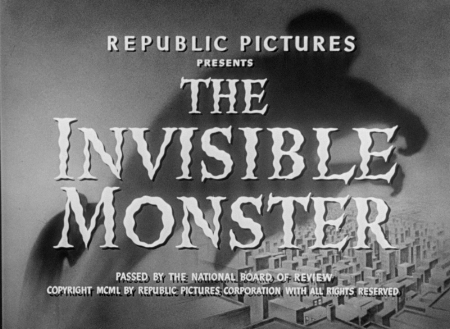
“The Invisible Monster” (1950)
Science Fiction

Running Time: 100 minutes
Written by: Ronald Davison
Featuring: Richard Webb, Aline Towne, Lane Bradford, Stanley Price, John Crawford and George Meeker
CHAPTER TITLES: 1. Slaves of the Phantom; 2. The Acid Clue; 3. The Death Car; 4. Highway Holocaust; 5. Bridge to Eternity; 6. Ordeal by Fire; 7. Murder Train; 8. Window of Peril; 9. Trail to Destruction; 10. High-Voltage Danger; 11. Death’s Highway; 12. The Phantom Meets Justice.
Republic Pictures was a powerhouse of action-packed serials in the golden age of movie serials, and The Invisible Monster (1950) is one of its lesser-known but intriguing entries. Clocking in at 12 chapters, this science-fiction/crime hybrid delivers on the studio’s trademark mix of thrills, stunts, and outlandish plots. Though not one of Republic’s finest serials, it offers enough charm, absurdity, and cliffhangers to keep serial enthusiasts entertained.
The story follows the exploits of an evil mastermind known only as “The Phantom Ruler” (played by Stanley Price), who has developed a unique chemical that, when applied to clothing, renders the wearer invisible. He uses this power to orchestrate a campaign of terror, recruiting criminals to help him execute a series of heists and eliminate those who stand in his way. His ultimate goal? To amass enough wealth to create an army of invisible soldiers and take control of the country.
Standing in his way is federal agent Lane Carson (Richard Webb), who, along with intrepid reporter Carol Richards (Aline Towne), works tirelessly to thwart the Phantom Ruler’s schemes. Through a series of chases, fights, and close calls, Carson and Richards attempt to unravel the mystery behind the invisible criminal and put an end to his reign of terror.
Classic Republic Action: Republic serials were known for their dynamic stuntwork, and The Invisible Monsterdelivers in that regard. Fistfights, car chases, and rooftop pursuits punctuate the action, with the usual high-energy editing and pacing that keep the story moving.
Entertaining Absurdity: The central premise of an invisible villain trying to take over the country is wonderfully ludicrous, which is part of the charm. The budgetary limitations force Republic to use creative techniques, such as floating guns and objects being manipulated by wires, to suggest the presence of an invisible character.
Effective Cliffhangers: Like any good serial, each chapter ends with an over-the-top perilous situation, ensuring that audiences of the time would return to see the resolution. While some cliffhangers are predictable, others are genuinely creative.
The Weaknesses:
Budget Limitations: The invisibility effect is achieved through simple means, such as cutting away from the action, using wires, and inserting reaction shots. While this was a practical necessity, it makes the central gimmick feel less convincing.
Repetitive Plot Structure: As with many serials, The Invisible Monster suffers from a repetitive cycle: Carson investigates, fights henchmen, nearly gets killed, and escapes—only for the Phantom Ruler to hatch yet another variation of the same plan. While this was expected of serials, modern audiences may find the repetition tiresome.
Weak Characterization: The characters are fairly one-dimensional. Richard Webb is serviceable as the square-jawed hero, but Lane Carson lacks much personality beyond being a dutiful federal agent. Aline Towne’s Carol Richards is more proactive than some serial heroines, but she still spends much of the time either reporting on events or getting captured.
The Invisible Monster is not one of Republic’s standout serials, but it’s a fun example of the studio’s formulaic but entertaining approach to filmmaking. While the special effects are primitive and the plot is highly predictable, the serial retains a certain charm for fans of classic B-movie thrills. It represents the dying days of the serial format, which would soon be eclipsed by television’s rise in the 1950s.
For those interested in vintage cliffhangers, The Invisible Monster is worth a watch. It might not reach the heights of The Adventures of Captain Marvel or Spy Smasher, but its mix of invisible villainy, over-the-top action, and Republic’s signature energy make it an enjoyable, if flawed, relic of its era.




 spryfilm.com