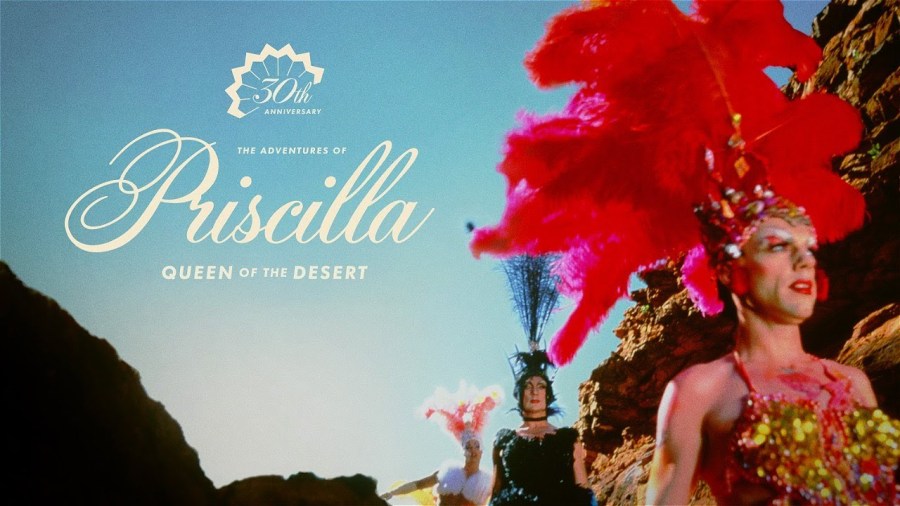
“The Adventures of Priscilla, Queen of the Desert” (1994)
Comedy

Running Time: 103 minutes
Written and directed by: Stephan Elliott
Featuring: Terence Stamp, Hugo Weaving, Guy Pearce and Bill Hunter
Bernadette: [to Shirley] “Now listen here, you mullet. Why don’t you just light your tampon, and blow your box apart? Because it’s the only bang you’re ever gonna get, sweetheart!”
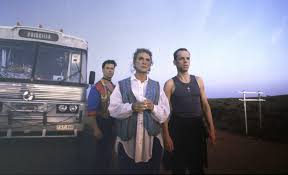
Few films capture the spirit of flamboyance, resilience, and self-acceptance as beautifully as The Adventures of Priscilla, Queen of the Desert. Released in 1994 and directed by Stephan Elliott, this Australian road movie remains a cultural landmark, blending humor, heart, and groundbreaking LGBTQ+ representation with dazzling visuals and unforgettable performances. Starring Terence Stamp, Hugo Weaving, and Guy Pearce, the film follows the journey of three drag performers as they traverse the Australian Outback in their lavender-hued bus, Priscilla. Along the way, they encounter prejudice, camaraderie, and personal revelations, making for an unforgettable cinematic experience.
The film’s premise is deceptively simple: two drag queens, Tick/Mitzi (Hugo Weaving) and Adam/Felicia (Guy Pearce), and a transgender woman, Bernadette (Terence Stamp), travel from Sydney to Alice Springs to perform a drag show. Tick, the unofficial leader of the trio, secretly accepts the gig as a means of reconnecting with his estranged wife and son. What follows is a journey filled with both joyous and challenging moments, as the three characters confront their pasts, navigate an often-hostile landscape, and celebrate their identities with unshakable pride.
The film thrives on its road trip structure, using the vast, desolate beauty of the Australian Outback to create a striking contrast with the extravagant costumes and personalities of its protagonists. The cinematography by Brian J. Breheny captures both the grandeur of the landscape and the intimate struggles of the characters, making for a film that is visually arresting and emotionally resonant.
One of Priscilla’s greatest strengths is its cast. Terence Stamp delivers a career-defining performance as Bernadette, a transgender woman who is both poised and world-weary. Her character exudes dignity, wisdom, and vulnerability, and Stamp plays her with a quiet grace that was groundbreaking at the time. Unlike many portrayals of transgender characters in earlier films, Bernadette is never reduced to a stereotype; she is complex, fiercely independent, and deeply human.
Hugo Weaving, best known for later roles in The Matrix and The Lord of the Rings, brings warmth and nuance to Tick/Mitzi, a drag queen struggling with his responsibilities as a father. Tick’s arc is perhaps the most emotionally rewarding, as he transitions from self-doubt to self-acceptance over the course of the film. His relationship with his young son, Benji, is a highlight, showcasing a rare and positive depiction of LGBTQ+ parenthood.
Guy Pearce, in one of his earliest major roles, is a revelation as Adam/Felicia, the brash, unapologetic, and mischievous young queen. Adam’s reckless confidence and sharp wit provide much of the film’s humor, but he also experiences moments of vulnerability, particularly in a harrowing scene involving homophobic violence. Pearce’s performance is electric, embodying both the exuberance and the dangers of being openly queer in a hostile world.
In the early 1990s, mainstream films rarely featured LGBTQ+ protagonists, let alone as the central focus of a major motion picture. Priscilla not only placed drag culture and transgender identity front and center but did so in a way that was both celebratory and unflinching. The film acknowledges the discrimination and violence faced by its characters, but it never loses its sense of joy and empowerment.
One of the most powerful aspects of Priscilla is how it normalizes its characters’ identities without reducing them to their struggles. Bernadette, Tick, and Adam are not defined by their queerness; they are individuals with dreams, flaws, and strengths. The film doesn’t shy away from depicting homophobia, but it also balances these moments with scenes of acceptance, such as when Tick’s son welcomes him with open arms, showing that love and understanding can transcend societal prejudice.
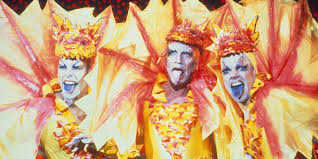
Of course, no review of The Adventures of Priscilla, Queen of the Desert would be complete without discussing its legendary costumes. Designed by Lizzy Gardiner and Tim Chappel, the film’s wardrobe is nothing short of spectacular. From the iconic silver flip-flop dress to the extravagant feathered headdresses, the costumes are a dazzling explosion of creativity and self-expression. Their work was so impressive that it won the Academy Award for Best Costume Design, solidifying Priscilla’s place in the pantheon of great cinematic fashion moments.
The film’s soundtrack is another highlight, featuring anthems from disco legends like ABBA, Gloria Gaynor, and The Village People. These songs serve as both a celebration of queer culture and a reflection of the characters’ emotional journeys. Whether it’s the euphoric energy of “I Will Survive” or the poignant melancholy of “Save the Best for Last,” the music elevates the film’s already rich emotional tapestry.
Since its release, The Adventures of Priscilla, Queen of the Desert has achieved cult classic status and remains one of the most beloved LGBTQ+ films of all time. It paved the way for greater representation in cinema, inspiring later works like To Wong Foo, Thanks for Everything! Julie Newmar (1995) and the stage adaptation Priscilla, Queen of the Desert – The Musical.
The film also played a crucial role in shifting perceptions of drag and transgender identity in popular culture. While some aspects of its portrayal might be considered dated today, particularly in the way Bernadette’s gender identity is discussed, Priscilla was undeniably ahead of its time in portraying LGBTQ+ characters with depth, dignity, and humanity.
The Adventures of Priscilla, Queen of the Desert is more than just a road trip comedy; it is a heartfelt, visually stunning, and culturally significant masterpiece. With its unforgettable characters, stunning costumes, and uplifting message of self-acceptance, it continues to resonate with audiences decades after its release.
Whether you’re drawn to its outrageous humor, its emotional depth, or its trailblazing LGBTQ+ representation, Priscillais a film that deserves to be celebrated and revisited. In a world that still struggles with acceptance, its message of resilience, love, and unapologetic self-expression remains as vital as ever.
Special Features and Technical Specs:
Disc One: 4K UHD
- Dolby Vision presentation on 4K UHD, restored from the original 35mm negative by Imprint Films
- Audio Commentary by director Stephan Elliott
- Original Aspect Ratio 2.35:1
- Audio English DTS-HD 5.1 Surround + LPCM 2.0 Stereo
- Optional English Subtitles
Disc Two: Blu-ray
- 1080p High-definition presentation on Blu-ray of the 4K restoration
- Audio Commentary by director Stephan Elliott
- Theatrical Trailer
- Original Aspect Ratio 2.35:1
- Audio English DTS-HD 5.1 Surround + LPCM 2.0 Stereo
- Optional English Subtitles
Disc Three: Blu-ray – Documentary + Special Features
- Between a Frock and a Hard Place – Feature Documentary (2015)
- Priscilla: A Celebration For Everybody – interview with writer/director Stephan Elliott (2024)
- The Average Little Boy – interview with actor Mark Holmes (2024)
- Birth of a Queen – featurette
- Behind The Bus: Priscilla With Her Pants Down – featurette
- Tidbits From The Set – featurette
- Ladies Please – featurette
- Backstage – extended featurette
- Deleted Scenes
- The Bus From Blooperville – outtakes
- Original Australian Theatrical Trailer
- US Teaser Trailers
- Photo Gallery




 spryfilm.com