“Eureka” (2006 – 2012)
Television Series

Seventy Seven Episodes
Created by: Andrew Cosby and Jaime Paglia
Featuring: Colin Ferguson, Salli Richardson-Whitfield, Joe Morton, Debrah Farentino, Jordan Danger, Ed Quinn, Erica Cerra, Neil Grayston, Niall Matter, Matt Frewer, Tembi Locke and James Callis
Marshall Jack Carter: [about heat signatures in the morgue] “I swear if this turns into a zombie attack, I am quitting!”
Eureka is a captivating blend of science fiction, drama, and comedy that aired from 2006 to 2012. Created by Andrew Cosby and Jaime Paglia, the show unfolds in the fictional town of Eureka, Oregon—a hidden hub of scientific innovation populated by brilliant but eccentric minds. It’s a delightful mix of episodic storytelling and overarching narratives, balancing humor, heart, and high-stakes drama in a way that keeps audiences engaged.
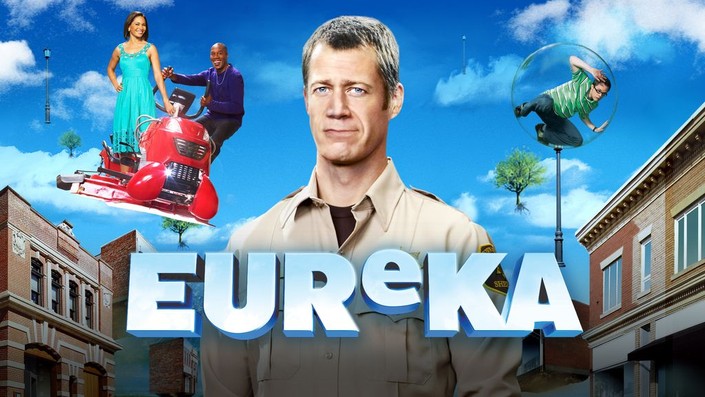
The show’s protagonist, U.S. Marshal Jack Carter (Colin Ferguson), stumbles upon Eureka after a car accident while escorting a fugitive. When circumstances force him to remain in the town, he is appointed as its sheriff. Jack’s straightforward, pragmatic approach contrasts sharply with the quirky genius of Eureka’s residents, leading to humorous misunderstandings and creative problem-solving.
The central conceit of Eureka is its setting—a town where cutting-edge technology and experimental science are a part of daily life. This premise allows the series to explore a wide array of science fiction concepts, from time travel to artificial intelligence, often with unexpected and entertaining consequences.
The characters are the heart of Eureka, and the show excels at making them relatable despite their extraordinary intellects. Jack Carter is the quintessential “everyman” whose common sense and grounded nature make him the ideal counterbalance to the town’s high-tech chaos. Colin Ferguson’s performance is charismatic and endearing, making Jack a compelling protagonist.
Dr. Allison Blake (Salli Richardson-Whitfield), the town’s liaison to the Department of Defense, serves as both a romantic interest and a voice of reason. Her relationship with Jack evolves naturally, adding depth to their characters. Meanwhile, Dr. Henry Deacon (Joe Morton), the town’s moral compass and mechanical genius, brings wisdom and heart to the series. Supporting characters like Deputy Jo Lupo (Erica Cerra), Fargo (Neil Gordon), and various guest scientists provide comic relief and help flesh out the rich tapestry of Eureka’s community.
While Eureka is often lighthearted, it doesn’t shy away from exploring serious themes. The series examines the ethical implications of scientific advancements, the responsibilities that come with genius, and the unintended consequences of tampering with nature. However, it balances these weightier elements with a playful, whimsical tone. The humor often arises from Jack’s fish-out-of-water status or the unintended chaos of failed experiments, making even dire situations entertaining.
One of Eureka’s greatest strengths is its imaginative storytelling. Each episode introduces a new scientific dilemma or experiment gone awry, keeping the narrative fresh and engaging. The show’s writers cleverly integrate real-world scientific theories with speculative fiction, creating scenarios that feel both plausible and fantastical.
The production design and special effects, while occasionally limited by budget, are creative and effective. The town of Eureka itself is a character, with its picturesque streets and hidden laboratories contributing to the show’s charm.
Another standout feature is the show’s character development. Over its five-season run, the characters grow and change in meaningful ways. Relationships deepen, past mistakes are confronted, and personal triumphs are celebrated. This emotional resonance elevates Eureka beyond a standard sci-fi series.
While Eureka is consistently enjoyable, it does have its flaws. Some story arcs feel rushed or underdeveloped, particularly in later seasons. Additionally, the show occasionally leans too heavily on romantic subplots, which can feel forced or repetitive.
The episodic nature of the series sometimes leads to a lack of continuity. Certain plot points or character developments are introduced and then seemingly forgotten, which can be frustrating for viewers invested in the overarching narrative.
Eureka remains a beloved series in the science fiction genre. Its mix of humor, heart, and inventive storytelling has earned it a dedicated fanbase. The show’s optimistic view of science and its focus on community make it a refreshing alternative to darker, more dystopian sci-fi narratives.
The fictional town of Eureka itself deserves special recognition as one of the most inventive settings in modern television. A secret government project birthed this idyllic enclave to house the most brilliant scientists in the world, all working for Global Dynamics (GD), a sprawling high-tech research facility that sits at the heart of the town. The dynamic nature of GD gives Eureka its episodic versatility: any scientific mishap, grand experiment, or groundbreaking discovery can originate here.
The town blends quintessential small-town Americana with high-tech innovation. The cozy café doubles as a meeting ground for quantum physicists, and quirky homes may hide state-of-the-art laboratories. This juxtaposition creates a world that feels simultaneously grounded and fantastical, inviting viewers to dream of a place where science can be both exhilarating and disastrous.
Beyond Jack Carter’s down-to-earth charm and Allison Blake’s driven intellect, Eureka shines for the sheer diversity and depth of its ensemble cast.
Dr. Henry Deacon (Joe Morton): A jack-of-all-trades genius with a moral compass as sharp as his intellect. Henry’s expertise in almost every scientific field often makes him Jack’s go-to for solving problems. The evolution of his character—from a wise mentor figure to someone grappling with his own ethical dilemmas—offers some of the show’s most poignant moments.
Douglas Fargo (Neil Gordon): As GD’s bumbling yet lovable assistant, Fargo frequently finds himself in over his head, but his growth over the seasons—from comic relief to capable leader—is genuinely rewarding. Fargo symbolizes the humanity behind even the most brilliant minds, showing that genius and fallibility often go hand in hand.
Deputy Jo Lupo (Erica Cerra): A no-nonsense former Army Ranger who brings a different kind of expertise to the show. While others handle the science, Jo often takes charge of tactical situations with grit and heart. Her evolving relationships, particularly with Zane Donovan (Niall Matter), add layers of depth to her character.
The show is especially adept at portraying women in science, with Allison, Jo, and other female characters frequently in pivotal, trailblazing roles. This approach felt refreshing for a mid-2000s television series and added to the show’s appeal.
Eureka uses its science fiction framework to explore broader philosophical questions and social commentary. Some recurring themes include:
Ethics in Science: Global Dynamics routinely pushes the boundaries of scientific progress, raising questions about the unintended consequences of ambition. Whether it’s an experiment destabilizing time or creating artificial life, the show examines the moral implications of wielding such immense power.
Humanizing Genius: The series takes a refreshing approach to genius, showing that even the brightest minds are prone to emotional struggles, insecurities, and mistakes. The residents of Eureka aren’t depicted as cold, detached intellectuals but as fully realized individuals balancing brilliance with fallibility.
Family and Community: At its core, Eureka is a show about relationships. Jack Carter’s bond with his daughter Zoe (Jordan Hinson) is a beautiful throughline that grounds the series emotionally. The townspeople form a family of their own, showing how even the quirkiest individuals can come together as a community.
Humor as a Coping Mechanism: While the stakes in Eureka can be high, the show consistently uses humor to diffuse tension. Whether it’s Carter’s exasperation at yet another crisis or Fargo’s accidental chaos, the comedy makes the series accessible to viewers who might be intimidated by hard sci-fi.
Some standout episodes and arcs deserve special mention for their creativity and storytelling prowess:
“Once in a Lifetime” (Season 1 Finale): This game-changing episode introduces a parallel reality where life in Eureka looks vastly different, forcing characters to confront “what might have been.”
Time Travel Arc (Season 4): One of the show’s most ambitious arcs involves a group of characters traveling back to the 1940s and altering the course of history. The ramifications of this storyline add layers of complexity to the relationships and showcase the series’ commitment to evolving its narrative.
The Artifact Mystery: A central storyline spanning multiple seasons revolves around an alien artifact that impacts key characters in unexpected ways. The tension and intrigue surrounding the artifact provide some of the show’s most suspenseful moments.
Eureka is noteworthy for its relatively accurate integration of scientific concepts. While the show takes creative liberties, its use of theoretical physics, artificial intelligence, nanotechnology, and more remains rooted in plausible (albeit speculative) ideas. This dedication to blending real science with fiction elevates the series above many of its contemporaries.
The show’s visual effects are another highlight. While it operates on a cable TV budget, Eureka effectively uses practical effects and CGI to bring its high-tech gadgets and futuristic disasters to life. The aesthetic balance between the quaint town and sleek technology amplifies its unique charm.
Eureka’s final season offers a bittersweet farewell, wrapping up character arcs and revisiting the show’s central themes. While some fans felt the ending was a bit rushed, it remained satisfying overall, delivering closure while leaving room for imagination about the future of the town and its quirky inhabitants.
More than a decade after its conclusion, Eureka maintains a strong fanbase and continues to find new audiences through streaming platforms. Its optimistic vision of science and the creativity it celebrates make it a timeless piece of entertainment.
Eureka is a charming and imaginative series that strikes a perfect balance between humor, drama, and science fiction. Its well-drawn characters, inventive plots, and heartfelt moments make it a standout in the genre. While it’s not without its flaws, the show’s unique blend of elements ensures it remains an engaging and entertaining ride from start to finish. Whether you’re a sci-fi aficionado or just looking for a fun, feel-good series, Eureka is well worth a visit.





 spryfilm.com