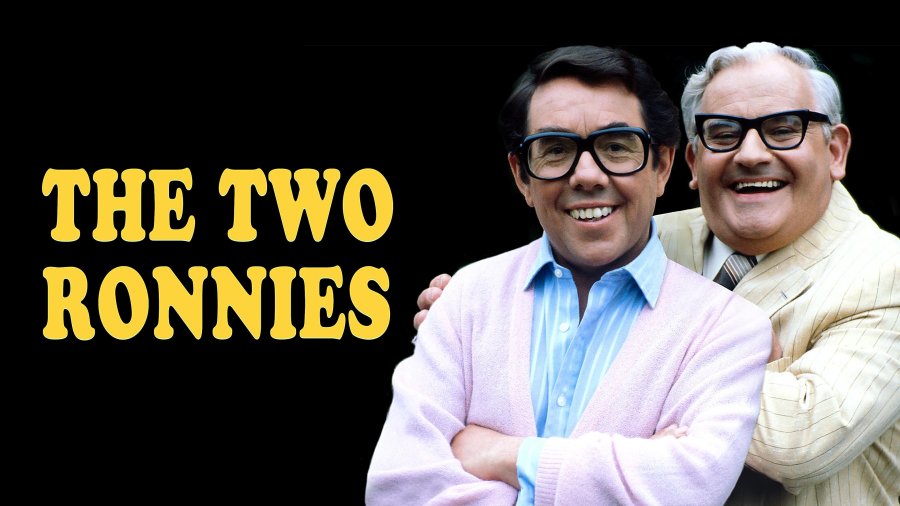
“The Two Ronnies” (1971 – 1987)
Television Comedy
Ninety three Episodes
Created by: Bill Cotton
Featuring: Ronnie Barker and Ronnie Corbett
Ronnie Corbett: “And now, it’s goodnight from me…”
Ronnie Barker: “…and it’s goodnight from him.”
Few comedy duos have left as indelible a mark on British television as Ronnie Barker and Ronnie Corbett, collectively known as The Two Ronnies. Running from 1971 to 1987, the series remains a seminal work in the landscape of British humor, revered for its clever wordplay, diverse sketches, and undeniable charm. Its enduring legacy is a testament to the duo’s comic genius and their ability to blend timeless humor with an eclectic range of skits, songs, and parody.
One of the hallmarks of The Two Ronnies was its episodic structure, which lent a rhythmic quality to each installment. The show often began with the signature news desk segment, where Barker and Corbett exchanged satirical “news” reports. This recurring skit set the tone for the show—witty, unpredictable, and sharp. The comedic news delivered clever puns and observational humor, often poking fun at social norms, politics, and the absurdities of daily life.
Interspersed within the episodes were a variety of sketches, from bite-sized comedic vignettes to more elaborate serialized spoofs that spanned several episodes. Notable examples include the faux-soap opera The Phantom Raspberry Blower of Old London Town and the hilariously over-the-top murder mystery The Worm That Turned. These storylines allowed Barker and Corbett to adopt different roles, demonstrating their versatility as performers.
Music and songs also played a pivotal role in the show, often presented as parodies of popular genres. Barker’s and Corbett’s sharp lyricism, combined with their endearing musical performances, brought yet another layer to their humor. No review of The Two Ronnies would be complete without mention of Ronnie Corbett’s armchair monologues. These moments offered Corbett a chance to connect with the audience directly, weaving meandering anecdotes filled with self-deprecating wit and surprise punchlines.
Ronnie Barker was a master of wordplay, and his influence on The Two Ronnies cannot be overstated. Whether it was through tongue-twisting dialogue or ingenious double entendres, Barker’s scripts often turned language itself into a comedic playground. His talent shone through sketches such as Fork Handles (or “Four Candles”) and Mastermind, where a contestant’s specialist subject involved answering the question before last. These sketches are not only pillars of British comedy but also highlight Barker’s unmatched knack for twisting the mundane into the absurd.
While Barker often took on the role of the more expansive and bombastic character, Corbett’s humor relied on subtlety and charm. His monologues, often delivered while seated in an oversized chair, had a deceptive simplicity. What started as an innocuous story would build layer upon layer of comedic misdirection, culminating in a hilariously unexpected twist. Corbett’s affable demeanor made these segments feel intimate, as though he were sharing a private joke with each viewer.
Certain sketches from The Two Ronnies have attained legendary status, transcending generations. The aforementioned Four Candles sketch is perhaps the most iconic, perfectly encapsulating the duo’s comedic dynamic. Another highlight is the “Class Sketch,” featuring Barker, Corbett, and guest star John Cleese, which incisively pokes fun at Britain’s class system through brilliantly simple dialogue.
The show’s appeal lay in its ability to balance sophistication with silliness. Barker and Corbett’s humor often leaned on wordplay and clever constructions, but it never veered into pretension. They had an uncanny ability to unite audiences across class and age divides, crafting comedy that felt both intelligent and accessible.
While The Two Ronnies enjoys widespread acclaim, it is not immune to criticism. Some sketches, especially those reliant on cultural or social norms of the 1970s and 1980s, may feel dated to modern audiences. Occasionally, humor rooted in stereotypes can come across as out of sync with contemporary sensibilities. However, such instances are relatively sparse compared to the show’s broader catalog of evergreen comedy.
The Two Ronnies remains a masterpiece of British television, celebrated for its unique blend of sharp wit, absurdist humor, and timeless sketches. Ronnie Barker and Ronnie Corbett’s chemistry was the cornerstone of the show, with their contrasting styles complementing one another in perfect harmony. The series not only entertained millions during its original run but also laid the groundwork for future comedy duos and sketch shows.
In revisiting the series, one is reminded of the power of great writing and charismatic performance. Whether through an ingenious pun, a heartfelt monologue, or a cheeky parody, The Two Ronnies continues to bring joy and laughter, securing its place as an enduring treasure in the world of comedy.




 spryfilm.com